Monthly Archives: September 2014

R is for reflections

IMG_0650

I don’t think I’ve ever lived somewhere before where a simple walk into town takes me past so much beauty. You can take the high road, past the multicoloured cottages which look down over the harbour, but more often than not I choose the steps which wind their way down to Breakwater beach.

The pebbles are not easy to traverse, but it’s worth it for the sound of the waves pulling at the shore, the smell of the seaweed and the breeze which whips its way around the cliffs. From there it’s only a little further to the marina.

I love to look at boats – have often wandered down to unprotected jetties in foreign ports just to peek at the vessels that float there, full of so much potential. It’s more than a little bit surreal having them on my doorstep here, and whilst the security in place means I rarely get up close I always pause at that point in the harbour wall, listen to the wind in the halliards and breathe in the heady mix of saltwater and diesel that lingers deliciously in the air.

My last sailing trip was from this marina. Having been a keen but not entirely competent crew member on many yachts over the years I finally decided that doing a day skipper course would be a good idea. I was four months pregnant at the time, and haven’t managed to fit in any sailing since.

When Arthur’s a bit bigger though I cannot wait to introduce him to the unadulterated pleasure of travelling along powered only by the wind.

But in the meantime we will continue to enjoy these boats vicariously as they bob gently at their moorings, masts pointing proudly up into the sky which is in turn reflected beneath them on the mirrored surface of the depths below.

R is for reflections.


Joining in with The Alphabet Photography Project over at PODcast. 

The edit begins…

IMG_0314

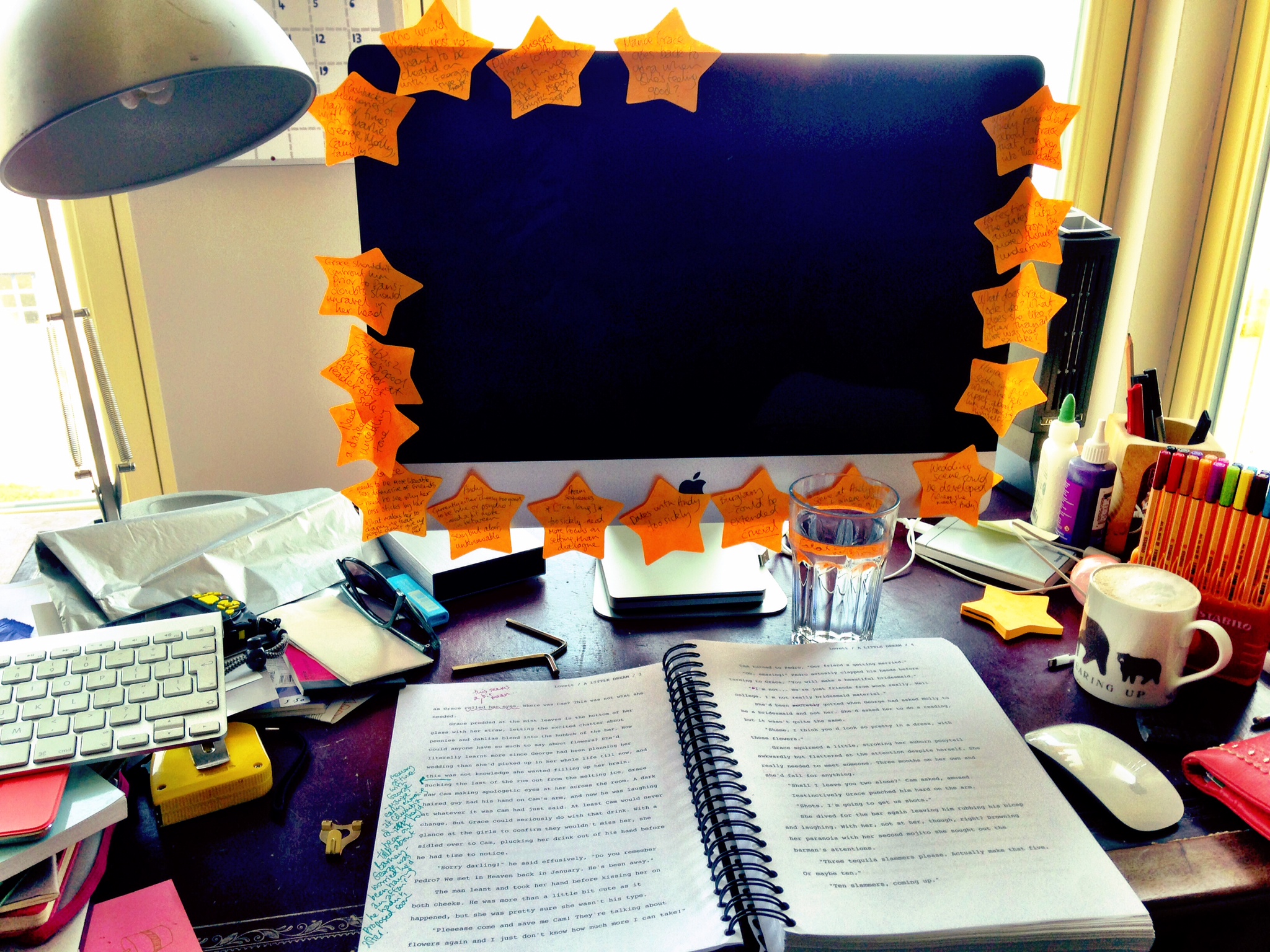
At the moment my desk looks something like this. Having let the first draft of my second novel sit and mature over a long and glorious summer, it is time to get down to the serious business of editing.

I’m trying to be quite methodical about it so far. My first step was to read the manuscript in its printed form – an altogether different experience from reading it on the screen – annotating it with things that struck me: questions, problems, things I might need to change.

I’ve quite enjoyed getting back into the story, but to be honest I’m finding it pretty tricky to keep an objective eye on it. Fortunately I’m not doing this alone: I’ve had several people read the first draft and give me feedback, including my agent who handily vocalised some of the things that were niggling me about the characters in particular.

That’s where the post-it notes come in. There are a few amendments to specific scenes I’m working on, but mostly they’re threads that run through the whole book, things that need to be tweaked to achieve the effect I’m aiming for and keep the reader on side. So as I read through the draft again, a different coloured pen in hand this time, my eyes are flicking to those orange stars as my mind shifts and changes and adds the details that I think will make a difference.

I’m about a third of the way through this second critical reading now, and am quietly satisfied by the things that are starting to fall into place. I’m hoping that by the middle of next week I should be able to get back into Scrivener and start the actual rewrite – and that as I switch from paper to screen again more ideas will seep in to give my story the depth and authenticity it needs.

It’s an exciting process, and definitely a challenging one. I think the biggest challenge is not being able to completely immerse myself in it – having to keep a toddler entertained and trying to keep this blog going too. So the edit is happening in very distinct chunks, and invariably I have to tear myself away just as things are getting interesting.

But I’m working on it every day, and hopefully my brain will keep ticking over during the enforced breaks, searching out new inspiration and solving the problems that remain outside my grasp whilst I’m staring at the page. I’m not very good at being patient – once I set my mind to something I generally just like to get it done. But in this case I think the slower pace might just work to my advantage… We shall see.


Writing Bubble


Our Shoalstone summer

IMG_0305

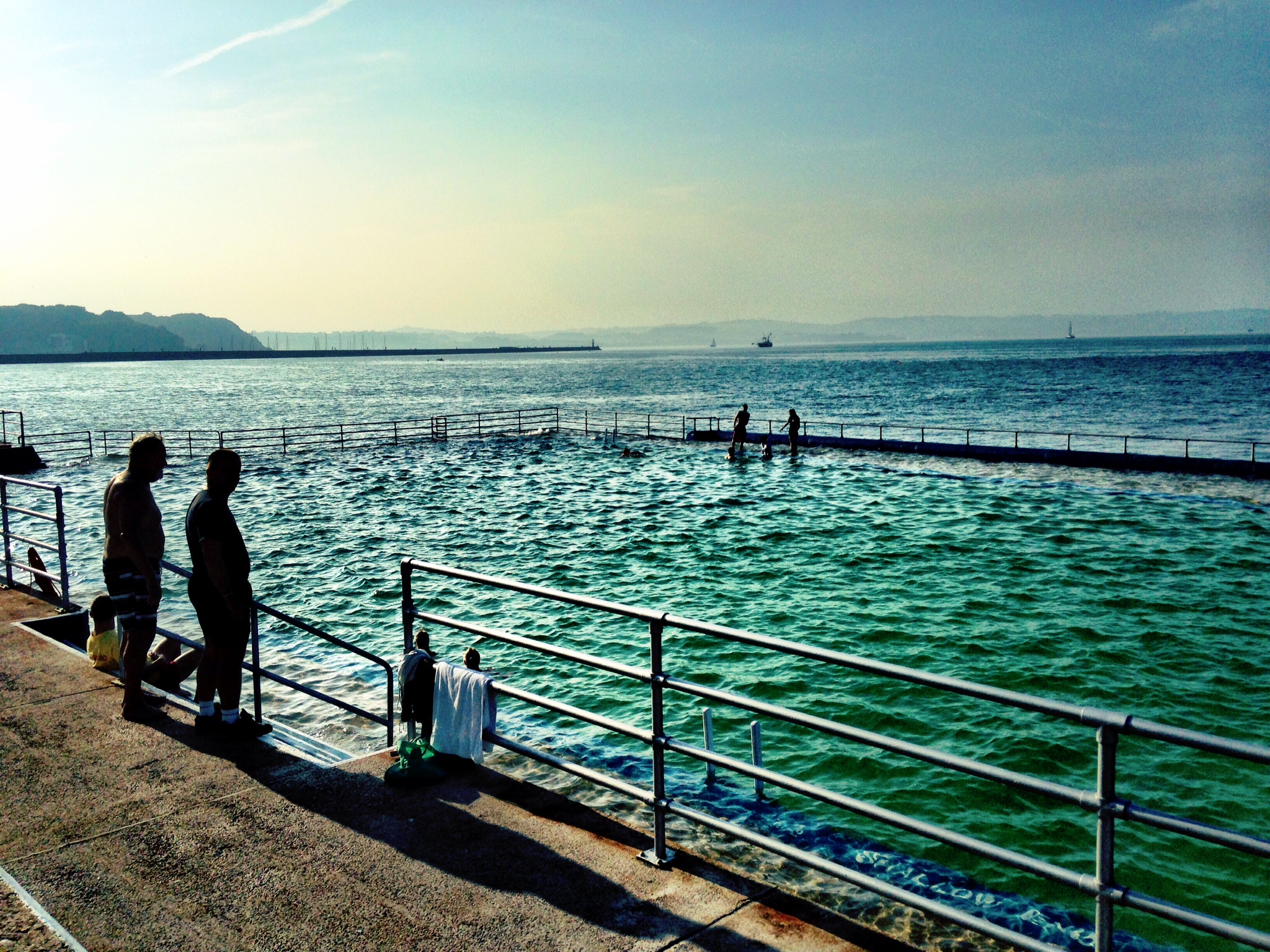
Yesterday marked the end of the season at Shoalstone Pool. It seems to have come round far too quickly, especially with this gloriously warm September. But it has been a fabulous few months, and I think we can safely say we made the most of the incredible facility we have on our doorstep.

It feels like a very long time ago that we were doubting whether the pool would even open this year at all: when there were still wranglings with Torbay council over funding and the fallout from their ill-omened deal with a local dive company.

Luckily Brixham town council came to its rescue and it opened for the season at the end of May: we took our first dip of the summer a couple of weeks later.

Since then we’ve been there as often as we can. Arthur’s swimming has come on in leaps and bounds: back in June he was still holding on to us as we took those first dips in the then icy water.

IMG_0300

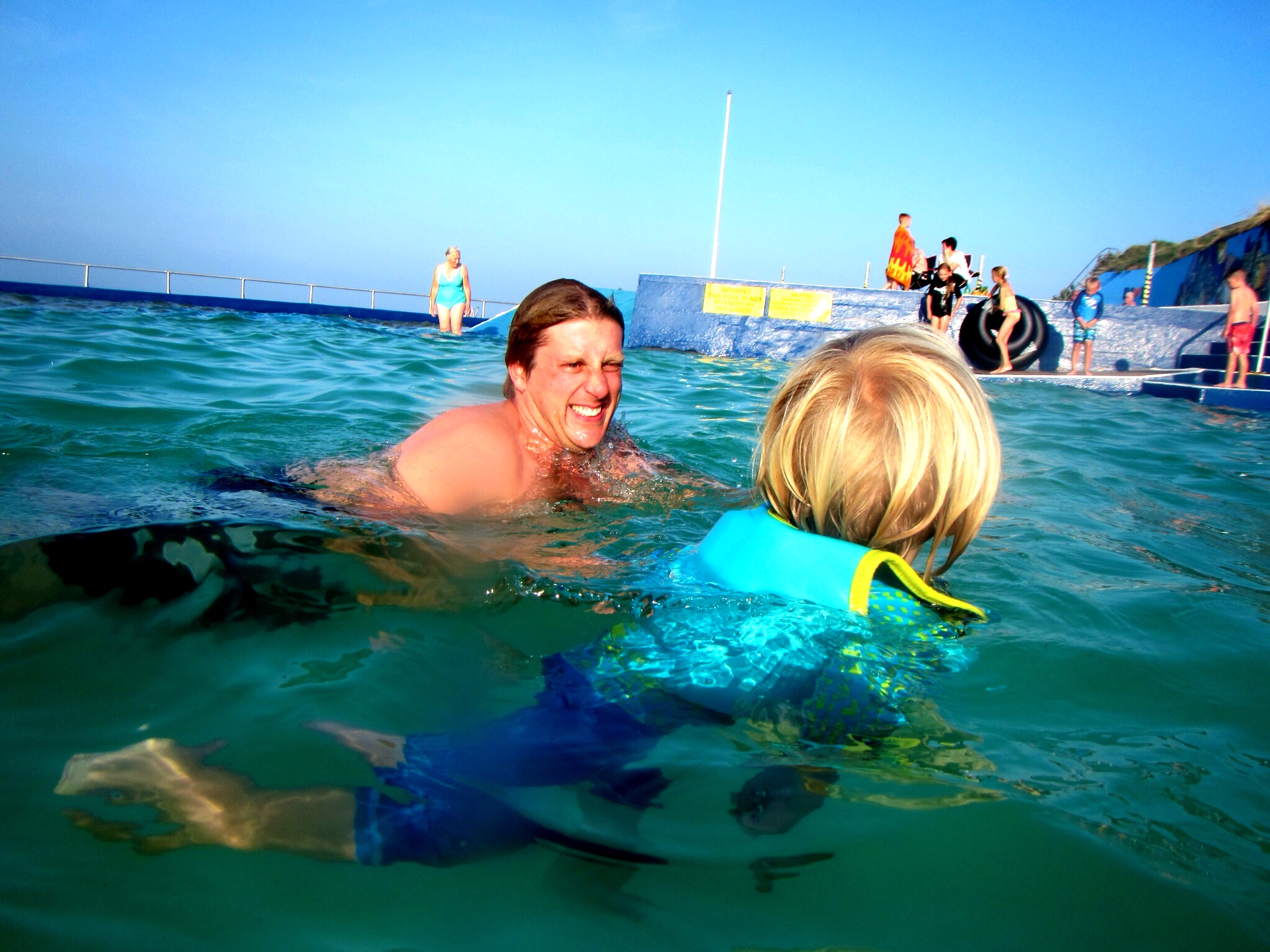
But then came his float suit, and with it a whole new lease of life. He loves the independence it has given him, and confidently navigates himself around the pool as we hover nearby.

IMG_0302

IMG_0312

It’s been fantastic to see the pool so busy over the summer holidays – kids learning to swim or splashing about under the watchful eyes of the lifeguards, adults doing lengths with a look of bliss on their faces, locals and tourists alike enjoying the safety of the enclosed pool whilst still getting the invigorating benefits of the seawater.

I reckon we’ve toughened up quite a lot over the summer. The water has actually been pretty warm at points – well, for the UK anyway – but even recently, when our miserable August weather cooled it back down, it’s actually started to feel quite amazing. I certainly don’t flinch so much when I’m walking in with Arthur…

And of course the location is all but impossible to beat. When he’s not in the pool itself Arthur has loved gazing over the wall to the sea, watching boats or fishermen and even catching the odd glimpse of our local friendly seal.

IMG_0306

With a summer like this, it was apt that our final swim of the year should be particularly special. We were determined to get down there yesterday but as so often the day ran away with us and it was almost five o’clock by the time we were walking out of the door. As we approached the pool it became clear that it was an especially high tide: the sea was lapping over the wall by the deep end, and even the shallow end was not particularly shallow.

IMG_0300 2

IMG_0307

Although it was a gorgeous afternoon the water was rougher than usual, and we did wonder the wisdom for a moment of taking a toddler in for a dip. We needn’t have worried though: Arthur of course took it in his stride, loving the novelty and the sense of occasion and happily swimming along beside his daddy.

IMG_0309

IMG_0303

He ventured out on to the ‘poolside’ too, splashing through the water to take a peek over the sea wall.

IMG_0310

As the sun began to set and the tide continued to rise, it was almost as if the sea was reclaiming the pool for another year. As the summer fades and autumn turns into winter those sea walls will be battered by storms, and we will marvel that we ever swam in sunshine there. Shoalstone Pool is such a very precious place, and I cannot wait for it to be reborn again next year.

IMG_0304

 To find out more about the pool and how you can help support it go to www.shoalstoneseawaterpool.co.uk

 photo 93142f35-6d39-479f-b3de-d94dbca68162_zps58499252.jpg

Country Kids from Coombe Mill Family Farm Holidays Cornwall

Why setting children by ability does more harm than good

Yesterday afternoon I was rudely awakened from my post-Gove reverie by the announcement that Nicky Morgan plans to effectively force schools into setting pupils by ability. Twitter was aflame with indignation, tempered only by those who were sure the papers were over-reacting. Morgan herself was quick to refute the claims soon after, but I cannot help but wonder whether that was prompted more by the backlash the news received than the lack of truth at its core. And exaggeration or not, I’m not prepared to leave this one alone – particularly when Cameron is so clear on his own views about the issue: “I want to see setting in every single school. Parents know it works. Teachers know it works… But it still hasn’t happened. We will keep up the pressure till it does.”

When you put it like that it appears there’s not much to argue against. If everyone knows setting works so well, then why indeed are all our children not taught in ability groupings? The thing is of course that, like most things in education, it’s not actually that simple. It may seem obvious – separate the brighter kids from the ones who are struggling so that teachers can pitch their lessons more effectively – but in reality it doesn’t quite work that that. I’ve got plenty of anecdotal evidence to draw on here, but first let’s look at the research.

The Educational Endowment Foundation, in its analysis of setting or streaming as a potential intervention to raise achievement, concludes that overall it has a slightly detrimental effect. On average pupils taught in ability groups will be one month behind similar pupils elsewhere at the end of a year, with the only positive impact (equivalent to one or two additional months progress) being seen in higher attaining pupils. Significantly negative impact on achievement is seen in pupils who are mid-range or lower attainers, summer born or from ethnic minorities.

And it’s not just the detrimental impact on achievement that we should be concerned about. This might fly directly in the face of Cameron’s claims, but even more worrying are the myriad of other impacts setting by ability has on our children.

In her 2002 book ‘Ability Grouping in Schools’, Susan Hallam delves deeper into this, analysing research carried out over almost a century to conclude that:

‘concerns about underachievement, lack of pro-school attitudes and exclusion have tended to be approached by calls for more differentiation by ability or attainment. Such moves are not supported in the research literature. Indeed differentiation by ability/ attainment has been associated with limited access to knowledge by some pupils, domination of pedagogic practices by teachers, preferred teachers for ‘elite’ pupils and enforcement of social divisions among pupils’

Students put in lower ability groups struggle with their self-esteem, which then impacts on their motivation and performance – a situation only made worse by the allocation of less experienced or less effective teachers to their classes. Every teacher I know has tales of bottom sets made up of mostly boys, with a disproportionate number of pupils of lower socio-economic status and a high incidence or special educational needs and challenging behaviour – and these experiences are fully supported by the research that has been carried out.

But what of the higher attainers? The ones who would otherwise be held back by those badly behaving boys, have their thirst for knowledge hampered by the need for teachers to attend to all those individual needs? Well I would argue that they, too, are ill done by to be grouped with others of supposedly similar ability. My experience of teaching top sets has shown me that pupils can become arrogant, ultimately underachieving against their individual potential because they feel that the label they have been given shows they don’t need to work as hard as everyone else. At the other end of the scale it has also shown me bright students lacking in confidence who feel that they don’t belong in the top set, who will happily take their place at the bottom of that particular ladder when if they were taught in a system which valued the individual they may have been more keen to play to their strengths.

The thing with mixed ability teaching is that you can’t do it unless you recognise that all the students in front of you are individuals. Of course that is true in any classroom, but teachers can be lulled into a false sense of security if they are told that the students in their charge fall into a set – that there is parity in how they will perform as learners.

One of my favourite ever classes was a mixed ability group who were studying for GCSEs in English and Media. The target grades in that class ranged from G to B, and the personalities ranged from introverted high achievers to poor attenders with challenging behaviour. I had to design my lessons around each of their needs – to pitch each different task at the level that was going to best help each individual in that class achieve their potential. That process was illuminating in itself, because there was not one child in that room who was universally high or low ability. Some were better at analysing literature, others at creative writing; some excelled in creative thinking, others in their artistic ability; some listened perceptively, others spoke engagingly and eruditely on a range of topics.

I am confident that each pupil in that class left with a strong sense of what they were good at, and also the areas in which they needed to improve. They learnt not to judge others on face value, that they had much to gain from listening to their peers as well as much to offer in supporting them. And the actual grades they achieved ranged from E to A*, with a good proportion going on to study English or Media in sixth form.

In a literature review carried out in 2005, Kutnick et al express their concern about the narrow scope of the educational outcomes that are considered, saying that ‘in general a narrow range of learning outcomes has been researched with little concern for critical thinking, creativity and meta-cognitive and transferable skills’. 

I would add to this concerns about equality, about social mobility, and about mental health. Ultimately I believe in the importance of each pupil being able to genuinely discover their potential through learning, not through a label imposed on them at the start of their educational journey.

But even if we put all this to one side, even if we focus purely on academic achievement, then the fact remains that setting children by ability does more harm than good.

In contrast, research shows that mixed ability teaching can:

  • provide a means of offering equal opportunities
  • address the negative social consequences of structured ability grouping by encouraging co-operative behaviour and social integration
  • provide positive role-models for less able pupils
  • promote good relations between pupils
  • enhance pupil/ teacher interactions
  • reduce some of the competition engendered by structured grouping
  • enable pupils to work at their own pace
  • provide a sense of continuity and security for primary pupils when they transfer to secondary school
  • encourage teachers to acknowledge that the pupils in their class are not a homogenous group
  • encourage teachers to identify pupil needs and match learning tasks to them 

(S.Hallam, 2002)

Or to put it another way:

‘I love group discussions and I admit I get really excited and a surge of energy to participate. In GCSE English we had mixed ability students in class and I enjoyed it. Helping and telling others what I know about the task or stimulus helped me to remember as I was going over it out loud. I learn the best in discussions or debates as I hear what other people are thinking and it gives me a different or an altered view and the ideas just seem to flow one after another in my head.’

(A* GCSE English student, 2009)

For me this sums up the key benefits of mixed ability classrooms – where students become collaborators in each others’ learning and teachers adapt their pedagogy to include, challenge and engage all learners.

Of course not all schools or classrooms or situations are the same, and where mixed ability works for one teacher and one group of pupils another may thrive on setting by ability. But to claim that setting should be happening across the board? I am afraid, Mr Cameron, that I do not see the logic in that.

Q is for queue

queue

As I was mulling over words to inspire my contribution for the letter ‘q’ I kept being transported back to a very particular place. To a queue I stood in for hours and hours on end on many, many Saturday nights. Well, afternoons really: we were waiting for Whirl-Y-Gig to open, a club I frequented in my teenage years which at the time was held in Shoreditch Town Hall. It kept the rather unusual hours of eight until midnight – handy for sneaking out as a sixteen year old, and a party which people were keen to extend by whichever means they could.

The queue started to form in the middle of the afternoon. Often when we made it there by four or five it would already be snaking down Old Street – people chatting, banging drums, excited about what the night would bring. On the night this photo was taken I’m pretty sure we’d arrived early and made it to the steps of the town hall itself. This was the most coveted spot, the place you’d find the most hardened regulars, where you could look down over the pavement as the queue and the anticipation began to build. I vaguely remember dancing to The Prodigy’s ‘Out Of Space’ as it blasted out of someone’s battered ghetto blaster.

Once we were inside it really was as if we’d been taken to another dimension. Colours and music and lights and rhythm, dancing at the front of the stage as if our lives depended on it. Everyone was so friendly, their hugs and smiles quickly replacing the grey hostility of the London streets we’d left behind.

The streets around Shoreditch Town Hall were very different then. There was The Blue Note in Hoxton Square, the Comedy Cafe and a couple of pubs on Curtain Road, but nothing like the teeming mass of bars and restaurants and wannabe hipsters you find there now. There are even hotdog stalls on Old Street on the weekends, peddling their questionable wares to drunken tourists. A long, long way from how it used to be.

We took less photos then of course. It took me ages to dig this one out, trawling through boxes of old prints, and even then the picture I found was clearer in my imagination than in reality. Not that it wasn’t fun: there’s something quite different about holding physical photographs in your hands rather than just scrolling through images on a screen. I’m still friends with the core group of people I hung out with twenty (!) years ago, and it was pretty awesome to see us as we were then – at parties and festivals, in gardens and parks, cooking and laughing and getting up to no good.

We’re scattered across the globe now, from London to LA to Osaka, but there’s a bond that was formed by adventures like standing in line for hours on a grimy street in East London that I don’t think will ever be broken.

Q is for queue.


Joining in with The Alphabet Photography Project over at PODcast.