Category Archives: Sophie is pondering

Crocodile tears?

So there is something that’s been bugging me, and I haven’t said anything because it’s all a bit contentious. I can hear the arguments already: about how I’m cold-hearted, or blinkered to the concerns of others, or so biased that I just can’t see the hurt some people are feeling. But do you know what? I’m going to say it anyway.

So here it is: what on earth is going on with all these female MPs being reduced to tears lately?

IMG_1553.jpg

It started with Labour leadership challenger Angela Eagle, bemoaning her ‘agonising decision’ to resign by insisting that ‘it’s just not working’. A couple of days later we had Margaret Beckett, again pleading for Jeremy Corbyn to resign by comparing him unfavourably to the eight previous Labour leaders she has felt able to be ‘loyal to’. And then of course there was Ruth Smeeth, who left an antisemitism event in tears after being accused by a supporter of Corbyn of ‘being part of a media conspiracy’.

As a woman, I am embarrassed.

This is an incredibly stressful time for our politicians, I get that. The disastrous EU referendum project brought out the worst in everybody, breeding hatred and animosity that has been felt at every level of our society. My social media timelines have been filled with anger and with grief, and I have no doubt that many tears have been shed behind closed doors over what is happening to our country.

But to do it in public, when what is happening to our country is actually your job, your responsibility? No, that does not sit comfortably with me at all.

I know what it feels like to be pushed to the edge, to be beaten down by the system and by the task that lies before you. As a teacher and a leader in secondary schools I felt that biting pain of tears behind the eyes both in the classroom and in meetings, but I did not let my smile drop until I was alone – or at least alone amongst the most trusted of my colleagues. It takes strength, but keeping those emotions at bay is vital not only to maintain a semblance of professionalism but also to be able to continue to act professionally.

These women who have let down their guard have not been overlooked in some private place: they have let their emotions rise to the surface in front of politicians and journalists. And I do not believe they have done it because they are weak. If I did then I would not be writing this. These are strong, powerful, empowered women – they are choosing to let themselves cry.

The reasons why are to me pretty clear. There is a narrative at work here, a narrative which is placing Jeremy Corbyn and his supporters in role as bullies. There are undoubtedly within the people who have flocked around Momentum (as with any political cause) those that give the whole movement a bad name. But to blame it on the movement itself is laughable. Jeremy Corbyn is a peacemaker, a champion of kindness and equality, a speaker of truth. He is not a bully. He is being bullied, that much is certain, by the PLP and the media. But I have yet to see his emotions show in public beyond a flicker of resentment and a determination to continue with the job he was elected to do.

And this steely resolve is being used against him. Women are crying as they say his name, and he is being aligned with the bullies. And I do not think that is fair.

It is not fair on him, and it is not fair on us.

Just over a year ago, Tim Hunt and Boris Johnson were at the centre of a furore over gender discrimination: Hunt said, and Johnson agreed, that ‘when you criticise [girls], they cry’ – that ‘it is a scientific fact that women cry more readily than men’. They were despicable comments to have made, and revealed a truth about the underlying misogyny in our society that women have to battle against every single day in order to be taken seriously.

I cannot help but feel that, with their tears, Eagle, Beckett and Smeeth have taken us back even further.


Writing Bubble


Beyond Brexit

It has come to something when, five days since I woke up to discover that the people of the UK had voted to leave the EU, this news has now been relegated to third in my list of things that are keeping me awake at night.

IMG_1518.jpg

Firmly at the top is my incredulity at what is happening within the Parliamentary Labour Party. As a fully paid up Labour member, I am incensed that they have chosen now to mount their nefarious coup on Jeremy Corbyn. It has little to do with the referendum result – Corbyn after all succeeded in bringing two thirds of Labour voters with him into the remain camp – and everything to do with the fact that, for a range of reasons, a huge number of Labour MPs just don’t like him or what he stands for. Their numbers have swelled now, of course, with others making a frenzied guess as to the most likely winning side and plumping their allegiance there, and the leader of the Opposition, elected by an overwhelming mandate less than a year ago, is left clinging on by his fingertips. The PLP has yet to present a single alternative candidate for the leadership role, and polls suggest that even if they did Corbyn would still win the support of the members – and rightly so, from where I stand.

Then over in the Tory camp, we have had the resignation of Cameron (even though he said he wouldn’t) leaving us with the terrifying prospect of Boris Johnson for PM. He might not win, but our other options don’t exactly fill me with optimism: Theresa May, who wants to repeal the Human Rights Act, Michael Gove (or his successor Nicky Morgan) who have ripped apart our education system, or maybe perhaps Jeremy Hunt, who is still in the process of dismantling our NHS. I quite genuinely want rid of the lot of them, but given the state of the Labour party I can’t see that happening in a general election which could be called as early as October this year. In fact the only people who are likely to benefit significantly from all of this are UKIP, who despite the continuing odious behaviour of their leader are currently celebrating the validation of everything they stand for.

Which brings me to the fallout from that Brexit vote itself. Naturally, pretty much every major claim the Leave camp made is proving to be false – from that £350 million a week for the NHS, to the reduction of immigration, to improved fortunes for our fishermen, with more revelations coming out each day. Our economy is in dire straits, Osbourne is promising tax rises and spending cuts, and the EU seems intent on making an example of us despite the government’s continuing assertions that they can use this as leverage to cut a better deal.

More important than any of this though is that seemingly the vote to leave the EU has opened the floodgates to a torrent of racist and xenophobic abuse up and down the country. My own work recently on the resettlement of Syrian refugee families in Torbay has shown me how close to the surface these racist views have been hiding, waiting for validation that a hatred of ‘the other’ is not only ok, but a justified move in the name of self defence. That validation has been growing in the rhetoric of the Leave campaigners over the past few months, most notably that of course of Nigel Farage, and now that the Leave campaign has ‘won’ there are many who seem incapable of extricating that ‘victory’ from supposed proof that the rhetoric was actually fact, and that those who would never before have voiced their racist views in public can now do so with impunity.

As someone who generally has a pretty strong sense of self-efficacy, I have been almost completely floored by this barrage of contradictions to my conception of the world we live in. When I haven’t been frantically cross-referencing media sources to try to discern some sort of truth in the midst of it all, I have been scouring property websites for somewhere to hide on a distant Scottish loch, and eagerly encouraging my husband to renew his lapsed Canadian passport.

But actually, I quite like where I live. I am quite fond, despite all of its efforts to put me off, of the UK. And so, through stubbornness or denial or a combination of the two I will not, for now, be going anywhere.

There are, however, some things I need to do for myself if I am going to survive in this post-Brexit world:

1) See the result of the referendum for what it is

Despite the glee of many factions of the Leave camp over the narrowly won referendum, I do not believe that there is anything to celebrate here. That is not just because I staunchly believe that remaining in the EU was the best thing for our country, but because I believe that the vote to leave was a symptom more than anything of a broken society.

I wholeheartedly appreciate the motivations behind those calling for a second referendum – it is becoming increasingly clear after all that the Leave campaign was won on lies, and that no-one actually has a plan for what to do next. However I also believe that a second referendum would only succeed in disenfranchising further the millions of people who have voted for change, and whose trust for the political system hangs from a fast-fraying thread.

For what it’s worth, I’m not entirely convinced that we will actually be leaving the EU at all given the various barriers that still lie between our government and that decisive action, but we cannot simply ignore the seventeen million people who voted for that, however unfounded or misguided we might believe their reasons to have been.

Rather we need to look at those reasons, and look at how we address them moving forward. We also need to seriously shake up our politicians and our press, who have wilfully moved from barely acceptable propaganda to outright lies in order to deceive and manipulate the population. Those are not the foundations on which a democracy survives, and all of us deserve better.

2) Re-evaluate my political engagement

Since I was elected to my town council last May, I have been directly involved in politics in a way I haven’t been before. As a teacher, I was always politically engaged – keen to work with the unions, and to recognise that being a public servant was not just about the very important business of teaching itself. I worry, though, that in local politics my view has become narrowed.

You would not believe the amount of things a town council has to do in the wake of government funding cuts, and the upshot of that is that a group of volunteers who care passionately about their community are being kept extremely busy just making sure no vital services fall through the gaps, with very little time or energy to engage in the bigger picture of the real forces that are making everyday life so very difficult for so many people.

I don’t think I’m ready to step down from being a town councillor quite yet, but I do want to become more involved with my local Labour party – perhaps even actually switching my allegiance to them as a councillor rather than continuing as an Independent. More and more I believe that it is Labour’s vision, on a local and a national level, that will really make a difference to communities like mine. Though of course that vision at the moment is under threat, and unless Labour can maintain the commitment to progressive politics rather than returning to a dance around the centre line with the Tories I may have to have a serious rethink.

3) Join those standing up against racists and bigots in pursuit of a tolerant, inclusive society

It drives me to distraction that this even has to be a ‘thing’, but there is no doubt that our society is currently experiencing something of a free-fall into the past as far as equality is concerned. The myriad of incidents that have been reported in just the past few days are no doubt only the tip of the iceberg, and whilst I have yet to witness anything myself there is no way I will be ignoring it if I do.

In the meantime I have a safety pin firmly attached to my lapel, and I will continue to support and promote the groups who are working tirelessly to ensure that the bigots do not win.

4) Take a step back from social media

There is a difficult balance to be found, here, between making sure I am as informed as I can reasonably expect to be and not getting completely suckered in to the internet at the expense of the real world. There are so many incredibly complex, multi-layered issues to grapple with, and there will be for some considerable time to come as all of this crazy takes its course. I need to somehow accept that there is no panacea for my aching brain to be found amidst the conflicting words flying around the world wide web, and that if I am going to maintain some semblance of sanity I need to take a step back and trust that somehow good will prevail. If it doesn’t there’s always that loch.

5) Make time for the things that are important in my life

Friends and family, and my writing. When all is said and done it comes back to these.

I have lots of events to look forward to over the next few weeks where thrashing out the truth in all the chaos can be done over a cold drink rather than through a keyboard: who knows, we might even be able to talk about something else!

And then there’s Arthur of course, who is most definitely getting frustrated with the political monolith that has inserted itself so ungraciously into our lives. Whilst it is his future I am most afeared of in the middle of the night, I clearly have a responsibility not to let it impact unnecessarily on his present – and to be present, both physically and emotionally, as much as I possibly can.

And finally there is writing, and the plans I made for summer before this cataclysm hit. Those poor novels are still languishing on my hard drive, and I can’t let political turmoil be just another excuse for not showing them the light of day.

For better or for worse, we are living in interesting times. It is up to us – as it has always been – to make the most of them.

 

Writing Bubble

26/52

IMG_1517.jpg

“A portrait of my child, once a week, every week, in 2016.”

It has been a strange few days. The EU referendum result has ignited such shock, grief and anger – not just amongst me and my friends, but amongst many millions of people in the UK and beyond.

I have spent hours dwelling on the impact that impending Brexit will have on the life of this little one – the identity shifted, the opportunities missed, the unity unknown.

We had to escape on Saturday morning, taking our van to a campsite not far away but far enough to immerse ourselves in nature for a while. It didn’t entirely drag me away from social media and its outpouring of emotion, analysis and dismay, but it stopped me from going completely mad.

There was something strangely comforting about the fact that most of the weekend was mired in cloud and slow drizzle, belying the forecast of sunshine we had been looking forward to all week. It was as if the universe was grieving with us for all that we have lost.

And then this morning the sun came up, and bathed our campsite in warmth and beauty. We went for a swim in the sea, cool and invigorating, and I began to see things with fresh eyes.

I still believe that something terrible has happened to our country, but I am beginning to see the referendum result as a symptom rather than a cause – and as a call to act, for all of our futures.

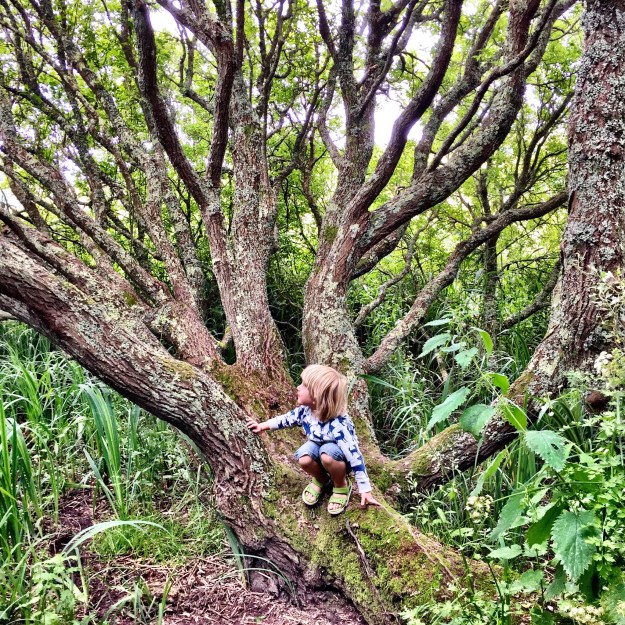
Looking at this boy, poised and full of wonder at the heart of an ancient tree budding with new life, gives me hope that we, too, can find a way to bring ourselves back from the winter that has befallen us.

Linking up with Jodi at Practising Simplicity for The 52 Project. 

On words, and truth

This past week, for me as for many others, has been almost entirely consumed by the EU referendum.

I have been pretty certain of how I would vote since the idea of a referendum was even mooted – I feel more European than I do British, and the thought of walking away from an institution that has successfully secured peace on our volatile continent, and has always been there as a buffer to protect us from the increasingly right-wing leanings of our government, just does not sit easily with me.

IMG_1512.jpg

Still, though, I have wanted to put my conviction to the test – both as an individual and as a town councillor I have wanted to ensure that I am not missing a trick: that I am not so blindly caught up in an emotional response to this seminal issue that I skirt over the facts, and promote a stance that is, in fact, not in the best interests of me or my community.

I expected to discover, as I delved deeper into the realities behind the propaganda, that things were not as clear cut as my gut was telling me. That whilst there were good reasons to Remain, the Leave camp would also have compelling evidence to support their point of view. After all, there are many people just as passionate about getting rid of the EU as there are about staying within it – almost exactly as many, if the polls are to be believed.

But the more I dug, and read, and reflected, the more I became convinced that not only is remaining in the EU the right thing do, but that a huge number of people who are planning to vote to leave are doing so not because they believe that it will lead to a better future, but because they are fed up with the status quo.

They are fed up of there not being enough money to go round, of our resources not being enough to sustain us, of other people deciding their destinies. With this referendum, they have been offered a scapegoat: and bolstered by the lies of the Leave campaigners they have been fuelled to protest against this (to them) faceless organisation that (they believe) has done far more harm than good.

Except they are participating in a ‘revolution’ led by the very people who have the most to gain by reducing their voice even further, and they are protesting against a reality which doesn’t actually exist.

Take fishing, for example.

This is probably the key issue for voters here in Brixham, and the reason why even breathing in the direction of the Remain campaign gets you labelled a traitor and an enemy of our community. When I started looking into what it was that had prompted the fishermen to bedeck their boats with the livery of the Leave campaign, I was almost certain that this was one area where I would be proven wrong: everybody knows that our fishing industry has suffered at the hands of the EU, right? Meaning that, surely, leaving the EU would solve all their woes.

Except the reality isn’t quite that simple.

There is little doubt that, over its lifetime, the fishing policies introduced by the EU have had a negative effect on our fishermen. However, the policies were introduced in response to very real concerns about over-fishing – the impact of which has a potentially devastating effect on both the environment and fish stocks, and therefore on fishermen themselves.

Since Hugh Fearnley-Whittingstall’s Fish Fight campaign the Common Fisheries Policy has actually been subject to considerable reform – and is one of the best examples of how we as a member state of the EU can affect change from within. The figures now actually point to a real growth within our fishing industry, which is heavily reliant on the EU as a market for its exports.

There is still a problem with quotas, but the allocation of these is within the hands of the U.K. Government – it is them that have chosen to favour the huge commercial players at the expense of smaller-scale fishermen.

I completely understand why people in the fishing industry might want to use their referendum vote to retaliate against past injustices, but I do not believe that their position reflects the current realities. Given how many other areas – the NHS, the arts, scientific research (to name but a few) – will suffer if the UK votes to leave the EU, a Leave vote as a protest seems a very, very risky move to make indeed.

This whole issue of risk seems to be the thing that the referendum is hinging on right now. The Leave camp have somehow manipulated themselves into the position where to support them is the maverick move, the thing to do if you are fed up with any aspect of your life within the current system. Nigel Farage, with his hate-fuelled political career, is on the verge of precipitating the biggest shift in our government in my lifetime: he has made people believe that this is the only real opportunity to effect change that we will ever be offered.

But let’s just leap forward thirty-six hours to Friday morning. Let’s imagine what that vote to leave would really mean. We would have not only rejected the views of our current Prime Minister – someone who, on the vast majority of issues, I am utterly polarised from – but we would also have rejected the views of the vast majority of our academics, our business leaders, our artists, our scientists, our health practitioners, our trade unionists. The only group who would be united in celebration of this outcome would be UKIP, and in a blur of fear and propaganda they would have leapt from being a minor political force to the key drivers of our future as a country.

I really hope that is not going to be the case.

There is no doubt that Europe is not perfect, but no aspect of our political system really is. If we vote Leave, we are decisively saying to all of the European countries who want to be our friends, that we have no regard for them – and we have no regard either for the myriad of experts and professionals who have been warning us that this is a very bad idea. And that vote to leave would be conclusive: whatever the consequences there will be no going back, not without convincing the rest of Europe that despite us shunning them so hugely we deserve to be welcomed back into the fold.

If we vote Remain, we are putting our faith in unity. We are recognising that, in the words of the late Jo Cox, “we are far more united and have far more in common with each other than things that divide us”.

There is still a long way to go before this European Union that we are a part of is the perfect fit for all of its members, but those are words that I would like to strive for, and a truth that I believe is the key to the future of our world.


Writing Bubble

How to grow a writer

It is easy to be negative at the moment when thinking about education. In fact it’s easy to be negative about most things to be honest – I’ve spent most of this week dwelling on the seemingly inevitable fate of the NHS, while intermittently wondering whether there is anything we can do to bring our schools back from the brink.

But of course there is.

Beneath all the doomsaying around the utterly depressing state of assessment – the unbelievably detrimental SATs exams, and ill-thought-out reforms to GCSEs – there are teachers just getting on with doing their jobs. Jobs which, incidentally, align the vast majority of them much more closely with the interests of the young people in their care than with the government and its dictats.

Much of what we have shared through the #THISislearning campaign so far has been rooted in the Early Years. And it is a relief to know that here the notion of play as a vehicle of learning still predominates; that our children, at least when they are very young, can follow their own path to creativity and fun.

But of course play does not become defunct as children grow older. In fact I would argue that its magic becomes all the more important.

IMG_1412.jpg

It was always one of my key goals as a secondary school teacher, to harness the power of play.

There is a tightrope of engagement when you are working with teenagers, hung tentatively between the towers of curriculum and assessment. My job, the way I saw it, was to enable my students to balance on that high wire – to give them the skills they needed to succeed whilst simultaneously not losing sight of the love of learning that motivated them all, once upon a time.

Of course inherent in this is the notion of success, and this is where my views diverge most from those of our our current government. For me, success (from an English teacher’s perspective) is a young person who can think, read, write and speak with confidence. I imagine what that looks like for me is very different to Nicky Morgan’s idea of a perfectly educated child. To be honest I seriously doubt whether confidence, and all of the dangerous individuality that goes with it, factors anywhere at all in this government’s vision for our children. But that’s a story for another post.

So back to my job, as a teacher.

I established very early on in my career that I was not a ‘filling empty pails’ kind of educator, but rather one more interested in kindling fires. I have never had much time for bare facts – knowledge without context leaves me cold, and I admit to finding myself so completely disengaged with the approach to learning about grammar intrinsic to the new KS2 SATs papers that I can hardly read to the end of a sample question without switching off.

That’s not to say grammar is not important, or fascinating – of course it is, given the right situation. It’s just that there are so many more interesting ways to understand it than by methodical categorisation and endless rules – especially given that our language is often not very interested in following the rules itself.

My goal in the classroom was to get my students interested in things. To get them asking questions, being genuinely curious – to get them to a place where the answers (where they existed) might just stick.

I remember sitting down with a colleague (and friend) to plan a scheme of learning for Year Eight which needed to get down to the nitty gritty of word and sentence level analysis, as well as improving students’ use of grammar and punctuation in their own writing. We wanted to use a multimodal approach to engage students in a dialogue about how texts were constructed, the similarities and differences in the way meaning is conveyed through images, film and the written word. It ended up being based around a range of texts including ‘Where the Wild Things Are’, ‘Persepolis’ and ‘Stand By Me’, weaving back and forward through the narratives in their different forms and inviting an intelligent discussion which did – inevitably – lead us to the technicalities of how language was being used, and how the students could manipulate it to their own ends. I can tell you now that at the end of it none of those kids would have been any closer to passing the exams that, according to our current government, they should have been sitting two years earlier. But they were more confident readers and writers, and could explain why they (and others) used words the way they did.

All of that aside, it was fun. Not easy – in fact arguably harder than going through the motions of learning by rote because of the degree of thinking involved. But it was interesting: informed by the personalities of myself and my friend, and inviting our students to engage with it on a personal level.

There are a couple of other schemes of learning that stand out to me from Year Nine – a notoriously tricky year where the emotions of puberty are in danger of taking over completely, but an exciting one too when the new level of maturity students are beginning to exhibit can take everything up to another level. One was inspired by a brilliant set of resources from BT, using an exploration of all forms of spoken language as the hook into learning more about how words work. Another took its starting point from an excellent study guide produced by the English and Media Centre to explore the Sherlock Holmes stories, and detective fiction in general. We encouraged students to go into role as detectives as they read and studied the texts, to look out for clues in the language to the meaning that was being created and then be able to apply the techniques themselves as they grew into more confident writers. My kids produced some fantastic stories as a result of what they learnt, with some exhibiting incredibly sophisticated and effective manipulation of language. Could they have told me exactly what grammatical devices they were using and why? I doubt it. Did they need to? No! Not back then anyway…

I could go on, but I imagine you get my point. The nurturing of a writer has very little to do with teaching them to identify fronted adverbials and subordinate clauses, to carefully construct expanded noun phrases and employ the correct balance of semi-colons and exclamation marks. It has everything to do with introducing them to a wide range of texts, with letting them discover for themselves the thrill that comes from reading words that truly speak to you, with giving them the tools and the confidence to be able to construct their own sentences and paragraphs and weave them into whole texts that they are proud of and that mean something.

I know that, in English classrooms up and down the country, that is exactly what is happening. But I fear that it is happening less and less. Because, in our overloaded education system, this sort of learning seems to no longer be valued. And I don’t mean by the teachers – they know what learning looks like, and how to inspire.

But they also have an obligation to get the children in their charge to pass the tests. And if this government remains insistent on testing the wrong things (and testing them way too often) then there will be no space for real learning left at all.


Writing Bubble


This is what learning looks like

On Tuesday 3rd May, thousands of parents are planning to take a stand against a school system which is more interested in testing our children than it is in nurturing in them a love of learning. They will be adding their voices to the growing unrest that already permeates the teaching profession, and joining the call from the National Union of Teachers to cancel the SATs for 2016. By keeping their children home from school on that day, they want to send a clear message to the government that enough is enough, and that their children – all children – deserve more.

We want to take things one step further.

THISislearning badge final

As well as fully supporting the kids’ strike on 3rd May, we want to use that day and the run up to it to flood the internet with inspirational learning moments: images, stories and activities that show just how much more there is to learning than the narrow focus of the SATs allows. Whatever the age of your child, whether they are at school or nursery or educated at home, we would like you to help us show the government what learning really looks like using the hashtag #THISislearning.

If you’re a teacher, we would love to hear your thoughts too: this government has marginalised the expertise of education professionals for far too long.

If you have a blog, you can link up your posts below to create a hub of inspiration in the run up to 3rd May and share what you and your child(ren) get up to on the day itself. If you are not a blogger then don’t worry – you can share your ideas and activities on your social media accounts, using the hashtag #THISislearning on Facebook, Twitter and Instagram.

You can find out more about why we’re taking this action by reading Maddy’s post No, Mr Cameron, No, which inspired us with the fantastic response it received from parents and teachers alike, and the follow up, This is learning, Mr Cameron, as well as my post Why SATs are Bad for our Children, reflecting on the current situation from the perspective of ten years of teaching as well as life with a three year old.

You can also join our Facebook group to keep up to date with latest developments, and please comment below or contact either of us directly if there is anything else you want to know.

Sophie: Sophie is…

Maddy: Writing Bubble

#THISislearning


We would love as many bloggers as possible to join in! Here are just a few suggestions for taking part:

  • Link up any post (old or new) about inspiring children to learn, including fun activities people might like to try on May 3rd.
  • Please grab the #THISislearning badge for your post to spread awareness of the campaign (copy and paste the HTML code to add it to your site). We will share your posts on Twitter in return.
  • If you share your post on social media, please the hashtag #THISislearning. If you tweet us a link to your post @writingbubble and @sophieblovett then we will RT.
  • Link up your post below – just click on the blue button that says ‘add your link’ and follow the instructions. We look forward to reading your posts!


grab button for Sophie is

<div class=”sophie-is-button” style=”width: 200px; margin: 0 auto;”>
<a href=”http://www.sophieis.com&#8221; rel=”nofollow”>
<img src=”https://sophieis.com/wp-content/uploads/2016/04/thisislearning-little-badge.jpg&#8221; alt=”Sophie is” width=”200″ height=”200″ />
</a>
</div>


Why SATs are bad for our children

There are many moments that have stayed with me from my ten years of teaching. The overwhelming majority of them are positive, but there is one in particular that has been circling around my head the past few days that makes me feel so sad about what current government policy is doing to our children’s experience of learning.

Early on in the first term of Year Seven, I often broached the question to my English class “What makes good writing?”. It’s a big question, and not one I ever expected to hear answered in its entirety, but still the responses that I got were pretty telling. The particular set of responses I remember was from Autumn 2012, just before I disappeared on maternity leave. Fresh from SATs preparation, hands shot up as I wrote the question on the board, and the answers spilled out proudly into the classroom: “varied sentence starters”, “correct use of conjunctions”, “fronted adverbial clauses”, “using semi-colons”.

Now none of this is strictly wrong, of course – and I dutifully noted each response on the whiteboard before mooting my own ideas. But it was still incredibly deflating to hear it from a room full of eleven year olds. Where was the talk of imagination? Of storytelling? Of creativity? Where was the space for them to fly?

IMG_1384

It is this reduction of learning to rote mechanics that worries me most about the SATs, because the world doesn’t work like that – and yet in order for children to be able to succeed in these exams they have to be trained as if it does. When Key Stage 3 SATs were still around, I remember as an English department poring over questions trying to work out what it was they were actually getting at, and then teaching our students which right answers to put down for which type of question to make sure they got the marks they deserved. It was a preposterous waste of time and energy at a delicate stage in young people’s lives when the cocktail of hormones they were dealing with made the conventions of school pretty challenging anyway.

Still, I can get the argument that (at least within the limitations of our current system) being able to ‘do’ exams is kind of necessary. And I can just about stomach the concept of putting thirteen year olds through that process – at least we could explain to them the whole idea of the hoops they had to jump through, and begin to separate out different types of learning so that the experience didn’t completely extinguish the fire within.

I find it harder to justify for ten year olds, and I think it is such a crushing shame that children’s final year in primary school, a period in education which for many has been characterised by creativity and imagination, is reduced to drills and mock exams and learning ‘right’ answers to the most complex of questions making reopening the door to the potential for real learning a dauntingly challenging task in the years that follow.

Except of course primary school isn’t really like that any more. Not since the reintroduction of KS1 SATs, where children as young as six are now expected to sit formal tests in spelling, punctuation, grammar, reading, arithmetic and reasoning. SIX! The notion of what constitutes correct answers is, from what I have seen, just as convoluted as it was in KS3 – and so drilling is, if teachers are not going to sacrifice the children in their charge (and themselves) on the pyre of government assessment, inevitable.

And then of course there is the question of what all of this drilling occurs at the expense of. Play, for example, and creativity. Various other government initiatives are squeezing out the arts as children move up through the school system, but it is beyond belief that they should be marginalised at this crucial early stage. It goes against all of the research, the experience and the professional instinct that should guide our education system. When I admit that as a result of the regressive nature of government reforms I am reluctant to enrol my child in nursery, friends are quick to defend the relative freedoms that are still enjoyed in the early years. They go quiet when we get on to what starts to happen in year one.

All of this is part of why I am no longer teaching, and is a major driver in my decision to home-educate my son – for the first few years at least. My approach as a teacher always meant that there was a degree of rallying against the system – I wanted to see my students grow as individuals, to try to find creative ways of managing assessment that did not compromise their own personal development. During the bulk of my career, it felt at least as if I was moving with the tide – that what I innovated with one year I could integrate the next as Labour education policy responded to the needs of teachers and schools. And then the Tories came to power.

I could still be fighting the battle from the inside – I have untold respect and admiration for my former colleagues that are – but it is just so exhausting to have to make your classroom a fortress against the outside world, and I have a family to think about now.

My son is three: he is curious, brave, funny, unique and creative. He has many subjects he is passionate about, and is developing his own clear preferences for how he likes to learn about them. I want to nurture those in him, to enable him to find his way through the world in a way that it keeps its wonder, and where he gets to cherish his uniqueness, not play it down to fit in within the system and win validation for himself, his teachers and his school.

These KS1 SATs don’t give children levels; they don’t take a formative approach to identifying their strengths and areas for development; they don’t recognise that each and every child will progress in different areas at a different pace: they just indicate whether they have reached the required standard, whether they have passed or failed, whether or not they are ‘good enough’ at this stage in their lives.

I cannot imagine putting my little boy through that in three years time.

And it looks like I am not alone.

A campaign is gathering pace to undermine the KS1 SATs with a children’s strike on the 3rd of May. Yet more parents are calling for a boycott of the KS2 SATs, where the expected standards have risen so sharply that children are being set up to fail more than ever before. Parents up and down the country are uniting to say that this dismantling of their children’s childhood is simply not OK, that to stop their kid’s learning in its tracks by subjecting it to meaningless assessment is not something they want to be a part of.

My son is too young for me to be able to make a stand in this way, but I will be taking the opportunity on that day to demonstrate just what learning can look like when we set it free: to tell the story of our learning journey on this blog and on social media, to show how much fits into a day when it is not constrained by the need to learn to jump through hoops.

If you too are angry about what current government policy is doing to our schools, teachers and most importantly our children, then I hope that you will join me.


Edited 16th April 2016:

In response to our general disbelief at the way the government are decimating our education system, myself and Maddy from Writing Bubble have started a campaign to show them what learning really looks like. 

To find out more, check out our launch post and join our Facebook group. It would be awesome to have you on board.


Writing Bubble

On women and writing

My son has not been 100% the past few days, which has meant much more time sitting on the sofa having cuddles than usual. During one of these moments yesterday afternoon, whilst savouring the calmness of the three year old nestled at my chest, I had a bit of a revelation.

I found myself looking at my bookshelves, idly imagining my own published work sitting up there one day, and then it struck me: the overwhelming majority of the books in my life were written by men.

I couldn’t in that moment put my finger on why that was, but I knew it was significant for me – as a woman and as a writer. So today, what with it being International Women’s Day, I decided to do a little investigation.

As I am so often wont to do, I turned my gaze inwards first: tried to work out what it was about me that had led to such a literary gender imbalance. These books I have around me chart my reading history back to my teens. I have never got around to organising them in any particular way, and the resulting cacophony of titles is not easy to analyse, but however many times I went back again to look the facts remained the same: I have, over the past twenty years of my life as an avid adult reader, amassed a library which is almost entirely male-generated.

McEwan, Banks, Rushdie, Murakami, Self: all literary idols of my teens and twenties, all fantastic authors in their own right, but peculiar role models for a young woman trying to find her way in the world.

I didn’t think so at the time of course. I remember having a strong desire to be taken seriously as a reader and as an intellectual in my very male-dominated social and family circle. I remember arrogantly dismissing Austen – the only female author I remember studying at school – for what I saw as her obsession with vacuous romance. I remember being switched off by chick-lit as frivolous and a waste of reading energy (though I never looked beyond the covers to find out if that was actually true).

Of course as time went on I read – and loved – books by female authors too. Just not enough.

As my mind shifted to the context of all this I began to wonder whether it was merely a phenomenon isolated to my own book collection. I suspected probably not – certainly my sense of the world of the professionally respected writer is of one that is very male dominated. But I had already established that my lifetime’s research in this field was somewhat skewed, so I figured it was worth investigating.

Turns out it wasn’t just me. A quick google search threw up a woman whose novel proved eight times more attractive to agents when submitted under a male pseudonym; a study which revealed that 75% of the books reviewed in the London Review of Books and the Times Literary Supplement were written by men. I’m sure further research would have given me plenty more reassurance, but I’m pretty confident that it’s not just my bookshelves that are biased.

The reason why is somewhat more elusive. Are there actually less female authors than male ones – or good ones anyway? This question was explored at length in a fascinating essay written by Francine Prose in 1998, resurfacing when V.S.Naipaul expressed a similar disparagement towards Jane Austen as my teenage self in comments he made in 2011. The answer is of course complex and multilayered, with a multitude of reasons why women write, or don’t, and why people want to read what women write, or don’t (or at least what the publishers think in this regard).

A hypothesis that has recurred over the years is that is has something to do with motherhood: that ‘there is no more sombre enemy of good art than the pram in the hall’. Or if you are going to succumb to kids, just make sure you only have the one.

For me, the opposite is true. Or at least I thought it was. I found becoming a mother extremely motivating – liberating, even – and the birth of my son will always be intrinsically linked with my reasons for finally putting virtual pen to paper and writing my first novel. However as time goes on it has all started to feel a little self-indulgent, a waste of my ‘potential’, of my ‘education’  – both the desire to plunge myself headfirst into parenthood, and the equally strong desire to use all my spare moments to write. The voices from my past are surfacing and telling me that just writing and looking after a kid are hardly valuable uses of my time. So those precious minutes are being eaten away because I feel like I should be earning money (though I am lucky enough at the moment not to strictly need to) and because I feel that I should be doing something ‘worthwhile’ (though I have already dedicated ten years of my life to teaching).

I am wondering now, as I work all this through, whether I shouldn’t be seriously rethinking my priorities. But that would mean a commitment to this role of Writer, an assertion to myself and to others that I am good enough, and it is worthwhile.

I’m not sure that I’m there yet. Though coming across another article about how what separates unsuccessful female writers from successful male ones is the very reticence that I recognise wholeheartedly in myself has given me even more pause for thought.

And I am glad to say that my explorations did not throw up only negatives. I found this article about ten women authors who published after age forty particularly encouraging – there is still time, and hopefully plenty of it.

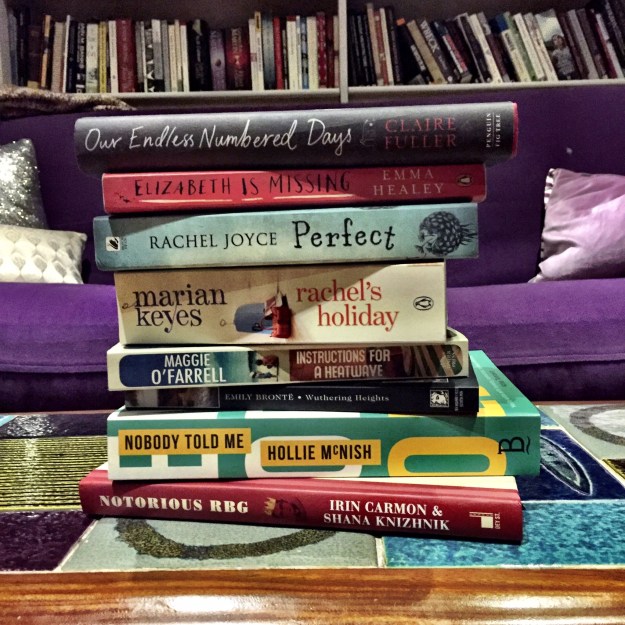
Also encouraging is the fact that one of these authors is currently sitting on top of my reading pile: a reading pile which for perhaps the first time ever is made up of books entirely written by women.

IMG_1334.jpg

None of this is by design. I never consciously set out to not read books by women, or indeed to seek them out as I grew older. But the shift in my literary gender balance is not entirely accidental either. I think it speaks to where I am right now with myself, as a woman and as a writer.

I’m still figuring out exactly where that is, but once I do? You’d better watch out, world.


Writing Bubble

Happy New Year!

IMG_8695

I am wandering around in a bit of a haze today.

It’s always a bit of a blurry day, the first Monday after the festive season, and this one is made no easier by our journey home this weekend from our adventures in Iceland and the USA. It took approximately twenty seven hours to get from the house we were staying in to our front door: fun and games at the best of times and made that little bit more challenging with the addition of a three year old.

It’s the longest journey by far we’ve attempted with him, and actually he was pretty amazing – he slept for almost all of the two flights and a fair portion of the car journeys. Though of course that meant that at 2am this morning I was left negotiating with a temporally confused toddler who wanted nothing more than to play.

So today is a little more blurry than usual. But in between the essential sorting I am trying to get my focus on and think about the shape I want this year to take.

And part of that has been pondering about the place of this blog.

I feel like I’ve been prevaricating for a while now – not entirely sure what I’m blogging for, but not wanting to give it up entirely. But after taking a complete break for the past couple of weeks I’m getting closer to understanding why I’m still here.

It comes back to the initial intentions of this blog really: a place to carve out my new, post-motherhood identity – for myself, and anyone else who wants to listen. After a mostly enjoyable but emotionally turbulent couple of weeks over Christmas and New Year with my family that is feeling more important than ever.

For reasons I may or may not elaborate on in the future I’ve come back feeling the opposite of invigorated – my self-esteem has taken a bit of a beating, and that sense of identity I thought I was getting closer to having all worked out is suddenly seeming more than a little elusive.

But I know it’s in there somewhere, and this is the place, I reckon, to work it all out.

That’s not to say I have entirely worked out the shape these ponderings will take, but I have the beginnings of ideas – and certainly more than enough to get me started.

I want to continue to document Arthur’s childhood, and I’m going to do that a bit more explicitly with a shift over to The 52 Project as the drive behind my weekly photo. I’ve been sort of doing it for a while, but I want to use the project now to focus my lens a little more closely on Arthur as he grows – and maybe even to inspire a shift to ‘proper’ photography rather than a total reliance on my phone.

I also want to look more closely at Arthur’s learning and development through a journal about the beginning of our explorations into homeschooling. Whilst I don’t know for sure whether this is the direction we will take when it is actually time for him to start school, I don’t see the damage the government are doing to our education system easing any time soon. Besides, I’ve already started down this road to an extent by dint of the fact that I have chosen not to send him to nursery or preschool – a decision that rightly or wrongly it is feeling increasingly important to defend.

In fact there is much of my approach to parenting which is coming under increasing scrutiny as it continues to diverge from mainstream expectations, and this is something I’m keen to explore further in the coming weeks and months. I’m intending to start with a ‘parenting manifesto’ – a summary of the principles driving my approach and what I am hoping to achieve – and as I begin to thrash out the contents of this in my mind it’s spawning lots of ideas for further posts about the choices I have made when it comes to parenting.

Finally there is of course my writing. I am still waiting on feedback on the latest draft of my second novel from my agent, but I am hoping in the next few weeks to not only have an idea about the next steps with that but also to start work properly on drafting novel number three. And as part of this whole process I’m looking forward to continuing to link up with the lovely What I’m Writing community – without whom, if I’m honest, I might not have made it through my rather sketchy year of blogging in 2015 at all…

So there you go. A little bit of focus to the haze, a few ideas to get me started, and hopefully the beginning of a bit more blogging this year. Because whilst I have a million other things going on to take up my time I have come to realise that this one is pretty damned important to my sense of self – and I owe it to myself to get that sorted.


Writing Bubble

Words of hope

Tonight I set myself one of the hardest writing tasks I’ve ever faced. And even just writing that makes me wince at my misconception of hardship.

I like to think I’m pretty good with words. I’d go so far as to say they’re my ‘thing’. But there are times when they are so woefully inadequate that they may as well not even exist.

IMG_1229

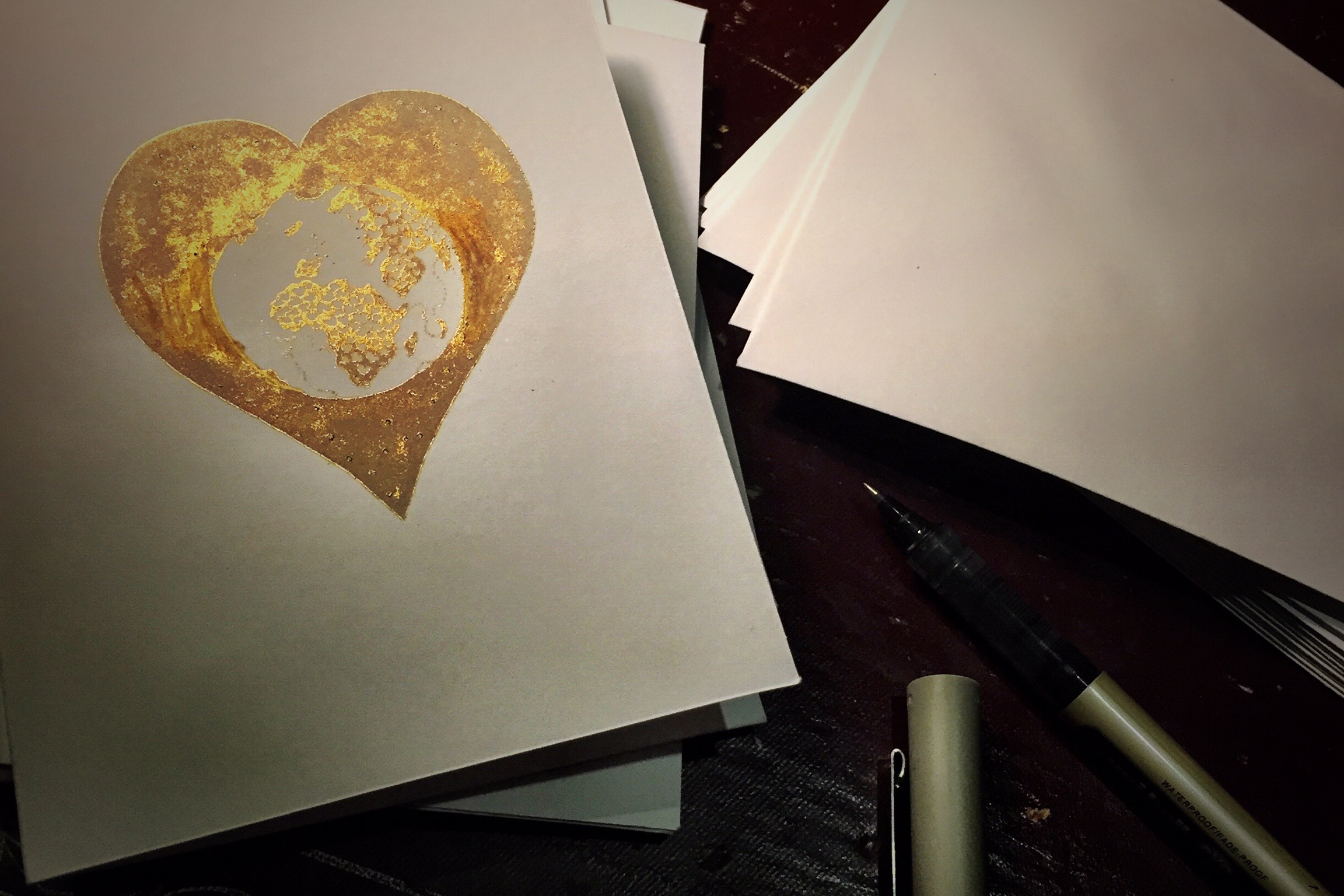
Tonight I have been writing letters to refugees. Cards, actually. I thought that if I could maybe encapsulate my words in a whole package of hope and solidarity then maybe their inherent flimsiness would be less noticeable.

Because, honestly, what do you say?

What do you say to someone whose roof has been ripped from over them whilst you sit in the warmth and the comfort of your own four walls?

What do you say to someone whose children are struggling to survive when you have spent the evening delighting in filling an advent calendar for your own precious one?

What do you say to give someone hope when you cringe at the state of the world every time you look at the news?

In the end it was only hope that made any sense. Despite the odds stacked against humanity by fear and greed and mistrust, hope is the only thing we have to hang on to.

I fumbled through my words, and then – as I so often do – borrowed those of someone else to say what I really wanted to.

Emily Dickinson always stops me in my tracks, and this stanza is one of my very favourites.

“Hope” is the thing with feathers –

That perches in the soul –

And sings the tune without the words –

And never stops – at all – “

Tomorrow I will take my cards, and my words, down to the sorting centre in Brixham where volunteers are making sense of the bags and bags of donations ready to send them to Lesvos, where hopefully they might provide some respite for refugees. The plan is that each box on the palette we send will contain a message from someone here, someone who is living in safety and in disbelief that our world can treat other humans as badly as we do.

Each palette, each box, each card, will hardly make a dent in the ocean of need: I wrote ten messages tonight; approximately 400,000 asylum seekers have arrived in Lesvos so far this year.

But they might just bring some hope. And whilst we’re busy working out what else to do, there are worse things to leave in our stead.


I’ve put together some resources to help teachers tackle the refugee crisis in the classroom. Please help yourself if you think you can use them!

If you would like to find out more about how you can help, please visit the Humanity Has No Borders website. Thank you. 


Writing Bubble