Category Archives: Uncategorized

Lili Badger hits the town

On Tuesday night, I got to take Lili Badger for her first public outing. It’s not that no-one’s met her yet: she’s been introduced to my Dad, my Grampa, a few select friends. And of course my agent, who in turn has introduced her to some lucky YA editors. But it’s the first time I was introducing her directly to a literary audience of (mainly) strangers, with a reading at Speakeasy at Drink Shop Do.

As someone who trained as an actor and taught for ten years you’d have thought that eight minutes of reading aloud wouldn’t phase me. But I was surprisingly nervous. Choosing an extract to read was the first challenge: the opening chapters seemed to have too much exposition, some of the later ones too little. I was also keen to avoid having to recreate some of the dialogue as whilst it sounds suitably street when spoken by the voices in my head I doubted I’d be able to make it convincing enough when I opened my mouth. Even at drama school accents were never my strong point. In the end I chose an extract which almost stands alone as an event in the story. It was actually one of the first scenes I visualised when I was planning the novel, and made it into the final cut more to enrich the fabric of the world I was creating than to drive the plot forward. It’s a bit dark though, and I spent the tube journey to King’s Cross panicking that it was going to set completely the wrong tone.

My mind was put at rest by one of the lovely friends who’d come to support me – she also handily was one of my initial readers and I definitely trust her judgement above my own on such matters. Once that was sorted, beer in hand and catching up with mates, I was finally able to chill a little. Until of course the comperes announced the beginning of the readings and my heart was once more in my throat.

Nicci Cloke and Ian Ellard were actually completely wonderful, putting me at ease and warming up an already very friendly audience. Listening to Tom Easton’s seriously chuckle-worthy extracts from Boys Don’t Knit chilled me out still further, though as the room was collapsing in hysterics I was wondering how they were going to react to my very different and somewhat depressing choice. I really needn’t have worried though.

Stood at the bar, microphone in one hand and iPad in the other, suddenly it felt like I was absolutely supposed to be there. A hush came over the room, and for perhaps the first time I really felt like an author. Not just someone who writes, which obviously is a role I step into most days, but someone whose words get listened to. I had really enjoyed revisiting the novel I wrote this time last year in preparation for the evening, and stepping into Lili’s shoes to release her into the world as I told a part of her story was a real thrill.

I have to admit Tom Pollock’s super dramatic reading from The City’s Son passed in a bit of a blur – I was buzzing, and grinning from ear to ear.

There was still one more challenge to come, one which I’d been dreading even more than the reading itself: creating a piece of flash fiction on the spot to be read at the end of the evening. Again my worries were completely unfounded. We worked collaboratively during the interval, me and the two Toms led by Ian, writing a story on the theme of ‘a dustbin knocked over in the backstreets of Whitechapel’. With perhaps a little scientology thrown in. Armed with a celebratory glass of cava the writing itself was a blast: as authors our styles are very different, but the story we produced with those styles meshed irreverently together was, even if I do say so myself, a work of genius. I’d forgotten how much fun it is to write collaboratively. I always used to love improvisation as an actor, and it’s basically the same thing just with added speedy handwriting.

I was able to relax into the second half a bit more. I was captivated by Tanya Byrne’s reading from Heart-Shaped Bruise, loved the unexpected tenderness of Non Pratt’s Trouble, and soaked up the spookiness of James Dawson’s Say Her Name. Once the author readings were over, Nicci and Ian took it in turns to share the stories we’d concocted earlier. And ours of course won – who could resist Tiny Tom Cruise being humiliated by a Thetan? You can read both stories here: I very much recommend you do.

All in all it was a fantastic evening. I left feeling a little bit more like an author, and Lili Badger left feeling a little more real. It was a privilege to begin to get her story out there, even if only a part of it. I cannot wait until I get the chance to unleash the rest of it on the world.

My little mirror on the world

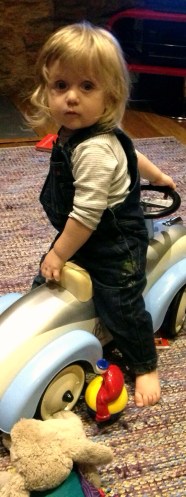
Since Arthur was very small a recurring theme in our wonderment about him has been how he reflects our world back at us.

There’s the very physical reflection: the way his genes manifest themselves in the image of me or Leigh or another of our relations. Though his hair was dark when he was born it soon turned blonde, and that along with his piercing blue eyes made him look so much like his dad. Then as his features have developed he has come to more and more resemble me. Our colouring will always be very different, but there are definitely strong similarities – and especially since my mum cut his hair in a style remarkably similar to the one she chose for me at his age it’s a bit like looking at a reflection of my younger self.


Arthur’s facial expressions and mannerisms are often also strangely familiar. There’s a picture of my dad at our wedding where he is uncharacteristically overcome with emotion, his lower lip wobbling and eyebrows furrowed. It is the exact same face that we see on Arthur in the rare moments when the world all becomes a bit too much. Then other times he looks exactly like his cousin, Anna – the beautiful and forthright daughter of Leigh’s brother with her determined lips and wise eyes.

It’s not just the physical characteristics that reflect our world though. Since Arthur was tiny, as all babies do, his emotions have hung on the energy projected by others into the space around him. Sometimes I realise I’m getting stressed out not because I’m feeling tense but because Arthur’s getting antsy. Or my already good mood is amplified by his giggles and adoring gaze. It’s made me very conscious of the moods I choose to project – and more than that, the moods I feel. More often than not whatever it is that’s stressing me out isn’t worth passing that negativity on to him, so with his mirror-like qualities he’s helping me reframe my emotions and learn to see things in a more positive light.

Of course though we are learning from Arthur he is learning so much from us, and this too forms a facet of the world he’s reflecting back at us. He’s picking up gestures rapidly at the moment, from blowing kisses to copying our silly dinner table dance moves. He’s copying words too – developing an increasingly sophisticated vocabulary including words like ‘raisins’ which we offer daily as his favourite snack and ‘turtle’ which is the form of the starry nightlight that lulls us all to sleep. He’s even started saying ‘right!’ in mimicry of my teacherly call to action. It’s definitely the time to keep the swearing out of earshot.

I’m aware that I’ve been posting lots recently about how much Arthur is teaching me, but where he is now, on the cusp of baby and toddlerhood, really is quite magical. I cannot wait to see that little mirror reflect back more and more of the world as he grows older, shaping it into a whole new universe in that wonderfully unique way he does.

Thank you to Sara at ‘Mum turned Mom’ for inspiring this post with her prompt of ‘reflection’.

Post Comment Love

Looking through the eyes of a child

Whenever I tell anyone I’m using motherhood as an excuse to start writing novels they look at me like I’m bonkers. But you’d be surprised how conducive a new person is to writing about the world.

Firstly, they go an awfully long way to giving you the discipline that’s needed to be a proper writer. It’s remarkably motivating to have a small creature attached to you who could go off at any moment. I know I can rely on about an hour and a half of quiet time, so that’s now how long it takes me to write my 1500 words.

Secondly, and this is actually entirely an addendum of the above, they remind you what’s important. I am at home with my son because I’ve managed to convince myself and those who are close to me that I’m a writer. So if I stop writing… Well, I’d just have to go and get a proper job, and I doubt I’d be able to bring my son along.

The third reason is the one that brings me to this week’s prompt:

‘Seek the wisdom of the ages but look at the world through the eyes of a child’ Ron Wild

I’ve studied writing for forever. I could tell you exactly what you need to do to produce something worthwhile. And yet there are still moments when I am trying to write and I have no idea what I’m doing.

I could think about the accepted wisdom, about the writers whose work I admire. I could think about the theory, about the tricks I know would manipulate my reader. But actually what works better than anything else is to think about my child.

My child, who has no idea of what a cliche is or why you might want to avoid one. My child, who can help me see anew the world which has made me weary over the years. My child, who inspires a fresh approach to the most mundane of experiences.

I spent years as a grown-up trying to conjure the time and the confidence that I needed to write, but it is only since I’ve been a mother that I’ve been able to make that a reality.

The wisdom of the ages has its place in what I do for sure, but it is my son who is my biggest inspiration.

mumturnedmom

Why ‘passivity’ in our learners is most definitely something to be criticised

Some weeks ago now, Michael Wilshaw sent a letter to OFSTED inspectors impressing on them the need to leave out of their reports any comments on how teachers teach, focusing only on the outcomes of said teaching.

This missive has been lauded as a breath of fresh air by teachers, school leaders and unions – a sign that perhaps this Michael at least has some respect left for the professional autonomy of teachers. It has also been welcomed by those who believe that today’s teachers are wedded to ‘trendy Left-wing ideology’, and that it is this that holds our students back from excelling in global league tables.

In this letter, Wilshaw said that ‘on occasions… pupils are rightly passive rather than active recipients of learning’ and that inspectors should not ‘criticise passivity’. This struck me as a little odd when I read it, and I touched on my concerns last week in the context of calls for schools to build character and resilience. But his choice of words has been playing on my mind since then, and I just couldn’t let it go without examining the implications of this statement further.

There are several definitions of passive, none of which sit terribly comfortably with me as descriptions of a child in a learning environment. We surely wouldn’t want them to be ‘not active or not participating’ and certainly ‘not working’ would be the opposite of our aims for a school pupil in lesson time. Perhaps there are those who would like young people to be ‘unresisting and receptive to external forces’, but it is my experience that other humans, even little ones, don’t tend to be that malleable without actively engaging in a process themselves.

Looking at synonyms for passive is even more worrying. Do we really want our young people sitting in classrooms to be described as ‘apathetic’, ‘indifferent’ or ‘uninvolved’?

In trying to gauge opinion on this amongst other education professionals, the general consensus seems to be that Wilshaw probably didn’t really mean ‘passive’, at least not in the way that I’ve defined it above. But if that were really the case then why not choose another word? Why pick a word – and then repeat it – which has so many connotations that are the antithesis of what we would like to see going on in our classrooms?

I fear that teachers have been so quick to welcome Wilshaw’s statement because they are desperate for someone in a position of power in education to throw them a lifeline – to tell them it’s ok, I trust you to teach however you like as long as you get the results. I would argue that if that’s the case why are inspectors bothering to go into lessons at all? Why not just look at the results if they don’t care about what’s happening in the classroom? Actually reading further into Wilshaw’s letter there are plenty of pedagogical preferences evident, from what resources teachers are choosing to use in the classroom to how they choose to set homework, but apparently questioning these choices does not ‘infring[e] the professional judgement of teachers’.

To be honest, though, it’s not really the teachers I’m worried about. Ok – there are probably a few who will use Wilshaw’s words as an excuse to make their workload lighter, will stop worrying so much about whether pupils are engaged or not because hey – even the HMCI says it’s ok for them to be passive. But in reality the vast majority of teachers want their students to be engaged and to learn, and they have the skills and professionalism to help them achieve that in a myriad of different ways.

What concerns me is what this acceptance of passivity – or in fact its promotion above more active learning methods if you look at the right wing interpretation – says about this governments aspirations for its young people.

Does it want to nurture a generation who can think for themselves, who can question the status quo, who can come up with new ways to face the world’s problems? Or does it want to create a society who will be easily controlled, accept authority without question, carry forward a canon of knowledge whilst quietly going about their business and being exploited by those in positions of power?

Certainly the tactics used by the Tories so far, from their denigration of the right to strike to their desire to curb peaceful political protests, from Gove’s attempts to falsify information and then rewrite history to hide his tracks to their incredible attempts today to rebrand themselves as the worker’s party, would indicate the latter. As Tony Benn articulates so clearly, ‘a healthy, educated and confident nation is harder to govern‘.

Casual references to passivity being an acceptable mode for the classroom effectively discard decades of educational research aimed at creating empowered and effective citizens to return us to a model of learning whereby the child is an empty vessel waiting to be filled with the superior knowledge of the teacher and of wider society. This is not how I want our world to view young people, either as a teacher or as a parent, and I think we should be very wary of anyone who has such low expectations of our future generations.

Becoming a mum: a birth story

IMG_2287

As it finally begins to sink in that my baby is now well over a year old and fast growing into a little boy, I have been thinking a lot about how much my life has changed over the past fourteen months. This feels even more pertinent at the moment as two good friends are just embarking on this journey: one gave birth in the early hours of Friday morning, and the other is due any day now. I don’t want to forget any of the seismic shifts I’ve gone through this year – neither the joy nor the pain that becoming a mum has brought.

And so with this in mind I’ve decided to put together a little series to document my journey. From birth to breastfeeding, from babywearing to sleep, these posts over the next few weeks will attempt to capture at least some of what Arthur has taught me in the days and nights we’ve spent together so far.

The story begins with an account I wrote in January last year to share my birth experience with my new friends from the NCT course Leigh and I attended in an attempt to prepare ourselves for what was to come. Reading it back now it’s a little clinical in parts, which is ironic as I definitely don’t remember it that way at all. I suspect I was still a little shell-shocked when I wrote it – and considering how exhausted I must have been am just glad I managed to get anything down at all.

IMG_1992

My waters broke in the middle of an extended family outing on the Dartmouth-Paignton steam train at twelve thirty on the afternoon of the 28th December, and contractions started soon afterwards. We were home by about two, and decided that we definitely wanted to stay there if at all possible! The initial call to the midwife was met with a request to stay calm and call back when things were more established – which ended up being less than an hour later as things progressed pretty quickly. The tens machine was great at this stage, and in between pretty intense contractions I managed to wolf down some pasta to give me some energy.

By the time the midwife (Helen) arrived soon after three I was 4cm dilated, progressing to 9cm over the next three hours. I continued to use the tens machine over this time, taking it off to get into the bath – somewhere I’d imagined spending much of my labour – but found that I was actually much happier on dry land. The birthing ball was invaluable as a support for different positions, and there were also periods when I just wanted to sprawl out on my bed – the whole process was pretty exhausting.

About halfway through the first stage I started on the entonox – and that was amazing. It left me very spaced out initially, but really helped ease the pain as things progressed. The second stage started around six thirty, and Helen began trying to get a second midwife. It was a very busy night at Torbay hospital as we later found out, and it was two hours before Rachel, the second midwife, turned up. All in all the pushing stage lasted for about two and a half hours and there were various points when I really didn’t think I could do it, but Leigh and my mum were an amazing support, physically holding me up, pushing and breathing with me and generally keeping me strong. I ended up having to have an episiotomy as things were taking so long and I was at risk of tearing – and literally one minute later, at nine fifteen pm, Arthur arrived weighing 3460g.

arthur arrives

I kept the cord pulsing for a while whilst Leigh and I marveled over this tiny human we’d brought into the world – I’d fully intended to go for a natural third stage, but the contractions were pretty painful and, especially after I realised the entonox had run out, I asked for the syntometrine – which got the placenta out straight away once Leigh had cut the cord.

Then followed a couple of blissed out hours of skin to skin as we got to know our new baby, broken only by the need to stitch up the episiotomy which Helen did under local anaesthetic using Leigh’s head torch and two kitchen chairs for my legs! Helen left at midnight, and we enjoyed a glass of champagne whilst introducing Arthur to his uncles and aunts, grandparents and even his great Grampa who’d all been waiting in the pub getting updates from my mum.

We’ve had a wonderful week and a bit since the birth, spending very little time out of our bedroom which has become overrun with nappies and breast milk. We have had a bit of trouble with getting breastfeeding established, with a stressful couple of visits to the special care baby unit when we found out that Arthur had lost 14% of his birth weight in his first three days – and his weight has been hovering around 3000g since, though he’s otherwise perfectly healthy. We’re now supplementing him with cup feeds of my expressed milk on top of three hourly breast feeds, and have an appointment with the breast feeding consultant tomorrow at Torbay hospital. The likely diagnosis is a posterior tongue tie which is making it very difficult for him to suckle properly. Hopefully if this is the case we can get it sorted quickly as it’s not much fun for any of us at the moment!

Overall the whole experience has been amazing, and we’re now left with this gorgeous little man who we’re falling more in love with every day.

IMG_2122

The Reading Residence


Why all this talk of character and resilience education is totally topsy turvey

In 2007, a new National Curriculum was born. It wasn’t perfect, but as a teacher and leader in Secondary English I liked it.

It was largely skills based, with the scope for teachers to use their professional judgement to build programmes of study which suited their students and their schools. There was lots of potential for cross-curricular work, with signs that we might be able to move away from the subject-shaped boxes that learning was often inefficiently forced into. The arts were promoted both as subjects in their own right and as vehicles for learning elsewhere. And at its heart were the Personal Learning and Thinking Skills (PLTS) which aimed to look beyond the needs of school to set students up for a lifetime of learning, complementing the older initiative of Social and Emotional Aspects of Learning (SEAL). Fresh creativity was injected into our pedagogical approaches as teachers focused on ways to engage students as active learners in the curriculum. Couple all this with a government who had raised the status of teachers beginning with the ‘Those who can, teach’ campaign back in 2000, and you had an environment that was full of potential and ripe for further development of teaching and learning.

Fast-forward three years to 2010 and the Tories, albeit in coalition, were in power. I remember distinctly the sombre mood amongst the senior leadership team and the rest of the staff at my school as we mourned for the impact this would have on education. We were not wrong: under Gove’s watch, PLTS and SEAL have been scrapped, the arts have seen their funding slashed and have been reduced in status to the extent that they are being sidelined in many schools, speaking and listening has been removed from the sphere of assessment, active learning methods have been denigrated and teachers have been continually undermined and demotivated. All this in favour of an easily quantifiable facts-based curriculum and exam-based assessment that will begin as young as four and continue throughout children’s school career.

And now we have a cross-party group saying ‘there is a growing body of research linking social mobility to social and emotional skills’, that schools must be ‘more than just exam factories’. They call for the ‘requirement to participate in extra-curricular activities [to be] a formal aspect of teacher’s contract of employment’ – something which fits very conveniently with Gove’s plans for an extended school day. Tristram Hunt agrees that ‘instilling [character and resilience] in young people “should not be left to chance”‘, calling for ‘a holistic approach that goes beyond extra-curricular activities and into the classroom’.

But aren’t they all forgetting something?

The only reason we don’t have these so-called ‘soft’ skills at the heart of our curriculum is because Gove ripped them out. All of the aspects of character and resilience that the APPG assert are so important in their manifesto were already embedded in the curriculum through SEAL and PLTS, given life in different forms by schools using the structure of Building Learning Power, the International Baccalaureate Learner Profile or numerous other well-researched and intelligently put together schemes.

Teachers do not need to be told that we need to build character and resilience in our most vulnerable children in order to level the playing field, and, as with so much else, they certainly don’t need the private sector to tell them how to do it. Despite the attacks on their own resilience by an increasingly unsupportive government, it is something they do on a daily basis, both within and beyond the curriculum. In lessons it is something they do through facilitating group work, through encouraging independent learning, through supporting students to set their own goals and structuring the ways in which they can achieve them. It is something that evidences itself particularly strongly in arts subjects – drama or media studies for example – where students work on a creative project for an extended period of time, often far surpassing their own or others’ expectations. Though with the threat to the place of the arts in the curriculum, and without the clarity of purpose offered by PLTS and associated schemes, it’s going to get harder and harder to do all this.

I realise I’m treading dangerously close to the territory of advocating ‘trendy left-wing ideology‘ in the name of a more holistic and human education system. And for that I make no apology. It’s not easy to empower children to take charge of their own learning journeys, even harder to demonstrate to those who do not understand what it is they’re learning in a snapshot of sometimes-rowdy group discussion, but all of my experience as a teacher has taught me that a child-centred approach is one we should aspire to. There is a wealth of research that backs this up, indicating that collaborative learning and actively engaging students in the learning process can be an extremely efficient and effective way to improve achievement. Rarely do I believe there will be a period of twenty minutes in a classroom where students will be ‘rightly passive‘, and I think Wilshaw has started down a very dangerous road by saying passivity is ok.

Whether or not Gove will entertain a further revision of approaches to teaching and learning in schools to embed character and resilience education in the classroom or, more likely, use the APPG’s manifesto as fuel for his drive towards longer school days, I’m finding the lack of joined-up thinking in the world of education policy making frustrating to the extreme.

Being used as a political pawn is destroying our education system. Why throw out a raft of extensively researched and sound initiatives before they’ve had a chance to embed themselves, only to then have to work out how to put back in what you’ve lost? Babies and bathwater come to mind…

In the longer term I definitely believe we need to look towards a way of running our education system that is beyond party political point scoring. But in the meantime, and especially whilst character and resilience education is on the table, I just wish Gove et al would look back in that bathwater to see if there any babies they can nurture back to life without needing to start the whole process from scratch.

My Fictional World

bookshelves

It’s been hard to find the time to read since Arthur came along. As an English teacher my working life was filled with books, and that was always one of my favourite parts of the job. Now that I’m a writer, reading’s taken on a whole new significance: analysing how other writers use language, create characters and weave whole worlds on the page, borrowing ideas – and seeing what doesn’t work so well too. But there are still few things I like better than to lose myself in a good book, and the middle of the night will often find me sandwiched between a sleeping husband and baby, book in hand, snatching a few precious minutes to myself.

Thanks to Jocelyn at The Reading Residence‘s Q & A meme I have the perfect opportunity to share some thoughts about myself as a reader – not just of picture books, but of real, full length novels! 

What were your favourite reads from your childhood?

There was one particular book that fascinated me called La Corona and the Tin Frog, a collection of strange and magical stories by Russell Hoban and Nicola Bayley. I also loved Enid Blyton as a child – I was slightly obsessed with anything to do with fairies, and especially loved The Magic Faraway Tree, though I enjoyed her adventure books too. I also read everything written by Roald Dahl, who spent some of his childhood near to my grandparents’ home in Radyr and was most definitely a genius. I think The BFG was probably my favourite book of his, though Matilda would be a very close second.

There are always those books that defined your teen reads and stay with you – what were yours?

I had fairly eclectic tastes as a teen. I loved freaking myself out with horror, especially Stephen King. I also enjoyed John Grisham’s novels which convinced me at the time that I wanted to be a lawyer. And then there was Judy Blume, who furnished me with a significant amount of my sex education – I remember Forever making a particular impression on me.

Who are your favourite authors currently?

There are quite a few… Ian McEwan, Iain Banks, Will Self, Salman Rushdie, Haruki Murakami, Neil Gaiman, Maggie O’Farrell, Esther Freud, Monica Ali and Kazuo Ishiguro would probably be my top ten!

Which 3 genres do you gravitate towards most often?

I love the escapism of magic realism and science fiction, especially dystopias – the sense that literally anything can happen, and the way in which a world a million miles away can tell us so much about our own. I also enjoy contemporary realist fiction, both books set in the UK that hold a mirror up to our society and those by foreign authors which give me an insight into cultures I know little about.

Can you choose your top titles from each of those genres?

Hmmm… Narrowing down favourite books is really rather tricky! In terms of magic realism, I love Rushdie’s Midnight’s Children, an epic and engrossing tale told against the backdrop of the birth of modern India. Laura Esquivel’s Like Water for Chocolate, whose protagonist’s emotions infuse the food she makes, is also captivating. For dystopian science fiction, I found Ishiguro’s Never Let Me Go, with its dark secrets hiding behind a boarding school’s doors, totally compelling. And then there’s Margaret Atwood’s The Handmaid’s Tale with its devastating representation of the place of women on society. And when it comes to realism the book I most recently read was fantastic – Maggie O’Farrell’s Instructions for a Heatwave with its beautifully drawn portrait of a family in crisis. I also love Khaled Hosseini’s A Thousand Splendid Suns, a fascinating and moving story of life in Afghanistan.

And your least favourite genres?

I’m not sure I have any ‘least favourites’. I’ll read anything given half the chance!

Of the many, many fictional and fantastical worlds, where would you most like to visit?

I’d love to hang out with any number of Murakami’s protagonists in Japan. I always find myself craving sushi and Sapporo beer after reading his books. I’d also be intrigued to visit the mythical land of Gaiman’s American Gods.  I like the idea of mythological beings existing alongside humans in the modern world – though I’d have to be careful not to get on the wrong side of them!

Everyone loves a villain, right?! Who would make your favourites list?

I really love to hate the Magisterium and The Authority in Philip Pullman’s His Dark Materials trilogy. I think he has important things to say about the darker sides of religion and society’s desire to constrain children to its will, and the characters he creates to embody his views are compellingly corrupt and cruel.

Share the books that have had you sobbing?

One of my favourite books ever is Ian McEwan’s The Child in Time, about a man struggling to cope after the loss of his daughter. I’ve read it more times than I can remember and it never fails to have me in tears.

And let’s end on a high! Which books leave a smile on your face, and maybe elicit a few laughs?!

Pretty much anything by Jonathan Coe – I especially liked A Touch of Love. I also remember laughing quite a lot at Will Self’s How the Dead Live, but he does have a very particular sense of humour…

I think that just about covers it – there are many more books on my shelves that haven’t quite made it into my answers here, but the ones I’ve picked should definitely give you a taste of my fictional world.

The Reading Residence
mumturnedmom