Tag Archives: editing

All change

At the start of the summer, I thought I knew where my writing life was going. I was certain in fact: I had discovered Mslexia’s brilliant guide to Indie Presses, and I had resolved to find a home for my writing through one of those.

And then…

I picked up the Writer’s and Artist’s Yearbook Guide to Getting Published, and my resolve weakened. The approach it advocated was much more traditional. It didn’t reject independent publishers entirely, but it cautioned against them as a way of launching a career.

My personal jury is still out on the pros and cons of the various routes into getting my words in print, but I was forced to acknowledge that there was a third book, waiting on my hard-drive in its unpolished state, that might still hold the key to the prized arrival on the literary scene that resided in the enclave of the bigwigs in the publishing world.

So I read it.

And I really enjoyed what I read.

IMG_1606.jpg

From what I could see at first glance, there were none of the obvious roadblocks that my first two novels contained within their pages: the question over cultural integrity in my young adult novel exploring my experiences as a teacher; the doubts over a generic home for my slightly obscure hybrid between psychoactive thriller and mental-health steeped realism. In fact this third novel reflects much more of where I’m at now, of my life by the sea with its echoes of the city. The characters are ones which resonate with my own experience rather than one I’ve observed, and though the path they choose is unconventional it is not unbelievable.

So I decided to give it a chance.

Having read through my words in print – a much more satisfying print, incidentally, having tried to approximate an actual novel in the way I presented the words on the page rather than just the standard sheets of A4 – I returned to Scrivener to tweak the narrative to one that rang true.

And then today I sent it to my agent.

Who knows whether her optimism will match mine, but right now I’m feeling pretty positive about our prospects.

This change of heart has been made all the more possible by a change in my circumstances that I’m just starting to get my head around. Leigh has finished his medical school training, and launched into his career as a junior doctor. This might have spelled the end of any time to myself, but we decided as a family that the next phase of his training would be better carried out part time.

So suddenly I have two whole days a week when he is taking the lead in parenting. Two whole days a week where I can focus on my council and freelance work, and on my writing.

It’s amazing how much you can get done when you don’t have a three year old to entertain at the same time.

Now, having submitted that first draft, I am looking forwards. I haven’t yet written a synopsis of novel number three, so that is top of the list. And then there’s a short story competition which perfectly resonates with my love of outdoor swimming, and a children’s novel competition that I am going to bite the bullet and submit my first manuscript to.

I’m feeling pretty positive about it all, despite the fact that my agenda has undergone such a major u-turn. It’s a writer’s prerogative, right? To follow the thing that feels true?

It’s hard to know for now how that might change again in the future, but finally I have the time to really work out the best way forward for me – and for my writing.


Writing Bubble

Letting go

Yesterday I got to the end of my manuscript for the third time this draft. I’ve been trying to be systematic about it, giving myself plenty of opportunities to pick things up that need work: the first time I went through looking at my agent’s notes, then with those of my most recent beta reader, then back through again interrogating every single word trying to make sure the ones I’ve picked say exactly what I want them to.

IMG_1225

I know that I’m coming up to the point where I will have to let it go, to send it back off into the ether with everything crossed that it might this time contain the magic it needs to take it to the next stage. But I can’t, not yet. And I’m not sure how I’m going to know when it’s ready.

I’m feeling pretty positive about all the changes I’ve made. Overall it’s ended up 89 words longer than it was before, but given that I’ve written loads more in – bringing conversations to life, taking the reader a little deeper into my protagonist’s mind – that’s meant a lot of cutting too. The opening has changed, bringing in a darker tone from the beginning – one which I think I’ve managed to weave through the novel as a whole, making it much more in keeping with the story I’m trying to tell.

And I think I know what that is now. I’m much clearer on what’s going on than I was, anyway. But I’m still having trouble with my elevator pitch – fumbling around for a concise explanation whenever anyone asks me what the book’s about. I need to work on that.

But whether I can do any more work on the story itself I’m not so sure…

The fact that this is draft number four is not helping my resolve. I thought it was ready last time I sent it in, but it so wasn’t. That took me months to realise. And whilst I’ve sorted out the problems that held it back then – I hope – who knows whether there are new ones that are evading me?

I do still have time on my side. I’d set myself the deadline of the end of November to get this draft completed and sent off, so I still have twelve days. I might just let it rest for a little bit, mull it over in my head, dip back in every now and then to make sure it really is the best that it can be.

It’s almost tempting not to go past this stage – there’s a warm fuzzy feeling that comes with finishing a novel (even for the fourth time), and right now I like what I’ve written. I know that once I send it out into the world again there will inevitably be things I’ve missed, and I’m quite enjoying the blissful ignorance that comes from it just sitting on my hard drive.

But novels are meant to be read, right? And not just by the person who wrote them…

So if you catch me procrastinating for too much longer then I might need a little push – it might just be time to let it go.


Writing Bubble


Setting the tone

I came across an article this week which really resonated with where I am right now with the novel. It was outlining Zadie Smith’s perception of the two kinds of writers, quoting from a lecture she delivered in 2008. Aside from making me realise that I really should read more of what writers I admire have to say about what it is we do, it got me thinking about the thorny issue of tone.

IMG_1218

I’ve really struggled with the tone of this novel. I’ve known the main characters pretty intimately since they first appeared in my mind, and the plot – though it evolved in the writing of it as they so often do – has remained basically the same since my earliest outlines. I thought I knew what the novel was about too – on a big, important, thematic level – but that has all changed recently. And as it has I’ve started to see the cracks in my manuscript that had somehow remained invisible up until now.

According to Smith’s ideas, I am pretty solidly a Macro Planner. Not entirely – I can’t quite conceive of starting to write anywhere but at the beginning, can’t imagine flitting around my plan and shifting the structure as many writers apparently do. But I do need a roadmap of sorts – I couldn’t plunge into writing without a fairly detailed plan. At least I don’t think I could.

But there were elements of Smith’s description of her process as a Micro Manager which really appealed to me – not least her assertion that when she finished writing a novel she was actually finished, with redrafts being unnecessary. For her, everything begins with setting the tone – making the first twenty pages a crucial and lengthy process:

“Worrying over the first twenty pages is a way of working on the whole novel, a way of finding its structure, its plot, its characters — all of which, for a Micro Manager, are contained in the sensibility of a sentence. Once the tone is there, all else follows.”

This is pretty much the opposite of where I’m at right now. Four drafts in, I have a structure, plot, characters – but the tone which seemed to come so naturally on first writing (so much so that I didn’t really think about it at the time) suddenly doesn’t quite fit.

I think perhaps part of the problem is that I’m only now really beginning to understand what tone is. That might be a bit of a bold admission for an experienced English teacher to make, but for all of my ability to recognise tone, to use it effectively, to explain it through examples, I’m not sure I really got what it is all about. Now though the definition, borrowed here from Wikipedia, suddenly seems to make a whole lot more sense.

“Tone … shows the attitudes toward the subject and toward the audience implied in a literary work.”

It is here, I realise now, that everything starts to come together. My attitude to the subject (my characters, the story I’m trying to tell) meets my attitude to the reader (where I’m positioning myself in relation to them, the genre in which my novel sits). As I type this it seems far too obvious for me even to need to say it at all, but then it is sometimes the simplest lessons that are the most powerful.

So I will hold those things in my head as I make my way once more through my manuscript, creeping forwards through the words and sentences and paragraphs whilst darting back from time to time to tweak details that no longer fit. There are a lot of words to get through, but I believe it will be worth it.

And what of my initial approach, of the type of writer I am? Could I have avoided this quandary by micro managing, by manipulating the tone in the creation of those first twenty pages until everything else fell into place? I’m not sure, to be honest. So much of Grace’s story only became clear when I could see it from the outside – and actually crucial elements of her character were only revealed to me once I had taken her through her journey.

I guess like everything there is no black and white: whilst the two approaches Smith describes seem on one level to be mutually exclusive I suspect that most writers embrace elements of both.

As for me, I think I’m still working out what type of writer I am.

And I think that that’s ok.


Writing Bubble

Tidy house, tidy mind?

I’ve been on something of a mission the past few weeks: a mission to finally bring order to the chaos that we live in. Or at least to tidy up the house a bit and make sure everything has a home…

It’s a job that’s been a long time coming. We first moved into this house just over four years ago. Then we had the builders in to renovate from top to bottom which took about a year and a half, with most of our stuff still in boxes and us shifting from room to room as our plans took shape around us.

During that time I was heading up an English department at a school in Plymouth, where Leigh was also based for the first two years of his med school training. Days were long and life was fast, and then I got pregnant: Arthur arrived approximately ten days after the builders finally left, bringing with him all the joy and craziness that accompanies a newborn.

The upshot of which is that, coming up for three years later, there were still boxes of stuff which had not actually been unpacked since we left London. And on top of those were more boxes delivered by my parents when they sold the family home. And one of the reasons none of them had been unpacked was that too many cupboards and drawers were full of I knew not what stuffed haphazardly in on the days when I snatched ten minutes to attempt to tidy up a bit.

And suddenly, having been saying for months that I needed to get on top if it all, I decided enough was enough: as soon as my feet touched the ground after our summer of adventures I was struck by an overwhelming desire to get organised.

And so I have.

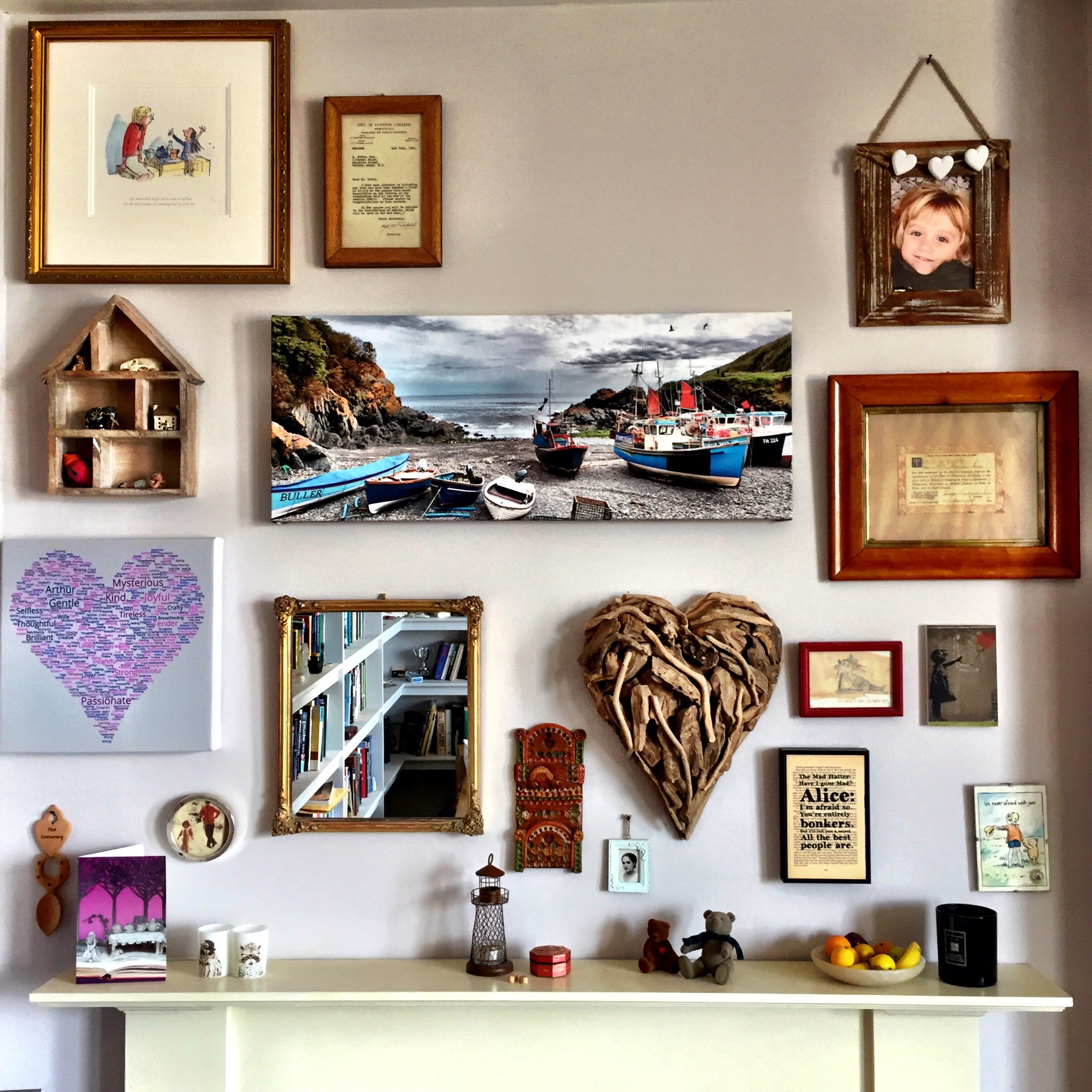
I’m not quite there yet, but things are looking so much better: I’ve sorted Arthur’s toys and clothes and found homes for the many he’s grown out of, I’ve unpacked box after box of artefacts from my past, I’ve moved furniture around to make better use of space, I’ve sourced frames for all the pictures that needed them and have finally created the picture walls I’ve been visualising for years.

IMG_1216

It’s all been a bit manic, and as much as I’ve been feeling a real sense of achievement I’ve been wondering why – why on earth have I decided now to get my house in order, just at the point when I have possibly the most challenging edit yet of my novel to get my head around?

But I think that’s precisely it.

I’ve never been the tidiest of people (don’t laugh, mum), and it’s never especially bothered me before: I’ve always been pretty good at zoning out the detritus surrounding me to focus on the task in hand. But this time feels different. Maybe it’s the new level of clarity I feel I need to achieve in order to do this draft justice, maybe I’m feeling the pressure of trying to simultaneously be a full-time mum and a successful novelist. Whatever the cause, I’m pretty sure this manuscript is going to turn out a whole lot more polished if it – and I – have space to think and breathe.

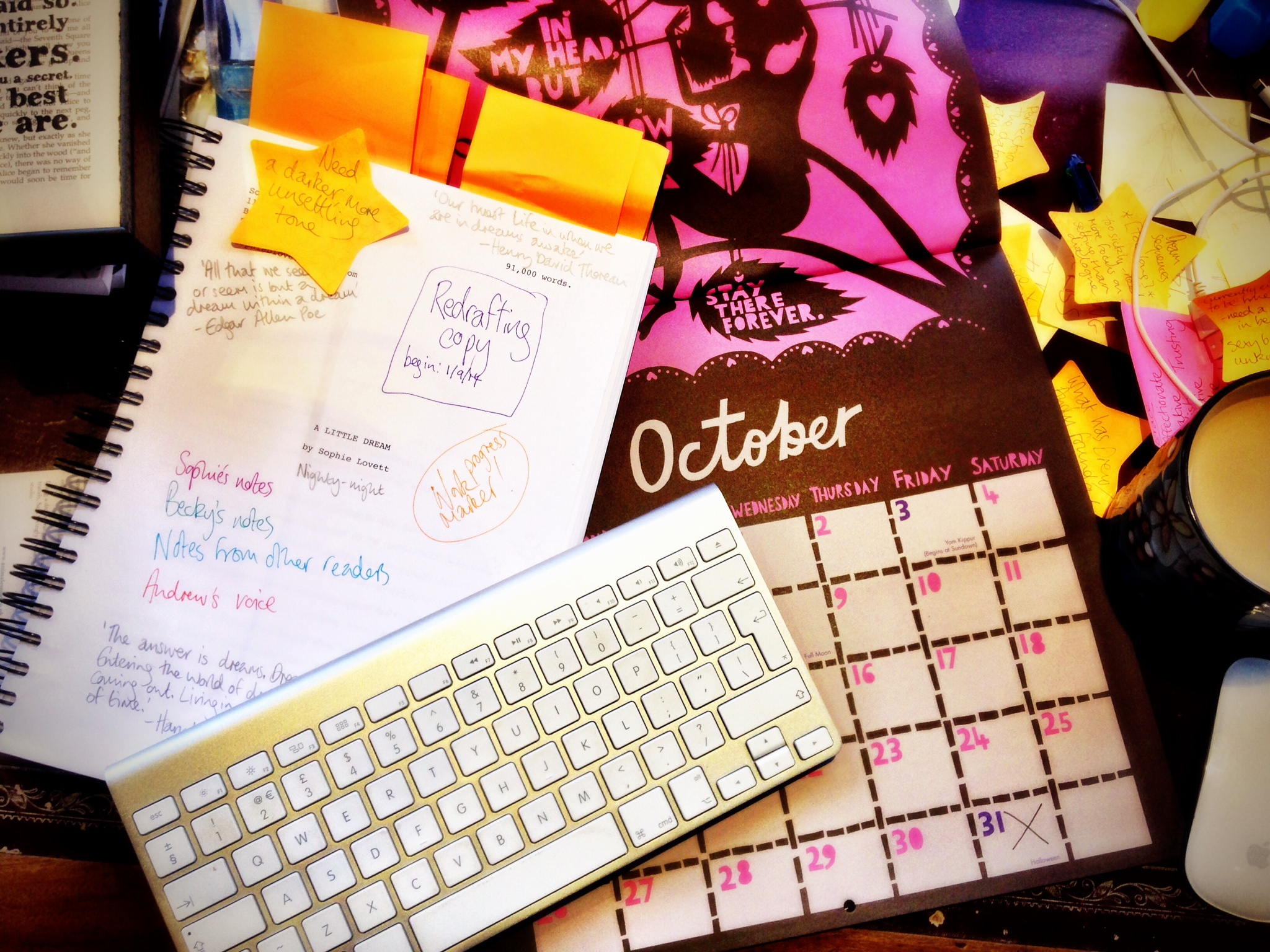
I’m trying not to use the tidying thing as a procrastination tool – I am already well underway with this fourth draft, and have been fitting in an hour or two of editing every day at nap time. But yesterday I finished working through the notes I’ve been given by other readers, so this final push now needs to come from me alone.

There’s still a way to go on the mission for a truly tidy house, but my writing room is very nearly sorted. And once it is, there will be no more excuses not to get in the zone and get this novel ship shape too.


Muddled Manuscript

On lightbulb moments, and cheese

I have been powering ahead with the edit this week. On balance, this is probably a good thing – but it hasn’t always felt like it.

In reality I have spent my days either hanging my head in shame or getting downright angry with myself. And then pondering, in disbelief, how it has taken me until draft number four to notice these things…

IMG_1205

I’m pretty sure that after the third draft I was feeling pretty confident: convinced I’d done all I could to polish my manuscript, ironed out all the niggles that had persisted up until then. And yet suddenly now so much of what I’ve written makes me cringe.

It’s the cheesiness, mostly. Even before I read my agent’s last set of notes I found myself cutting whole paragraphs I happened to cast my eye over, wondering how they could have lasted quite this long. And as I’ve worked through her (very kind) comments I have been both amused and embarrassed at the turns of phrase that at the time must have seemed appropriate.

There have been other painful moments of realisation too – things that, if nothing else, I need to remember in the hope that I might just avoid them next time round.

So, in no particular order, here are those lightbulb moments…

1) I get really lazy on my off days

There is a definite pattern to the notes I’ve received this time round, and there are certain chapters which have way more highlighted than others. In almost every case the problem is the same: instead of writing dialogue, I have described it, committing the cardinal writing sin of telling rather than showing. I think I thought I was doing this for a legitimate reason – that’s what I told myself anyway – but actually as I’ve tried to draw out the actual words from the description I’ve realised I hadn’t entirely thought through what it was that was being said. I suspect sleep deprivation had a lot to answer for – I was intent on keeping to word counts during the first draft, however depleted my brain cells were on any particular day. As a writing mum I’m not sure there’s any way I can entirely avoid that – but I’ll definitely be looking out for that off-day output next time I begin the editing process.

2) I’m a little bit too good at making excuses

The question remains, of course, why I failed to pick up all those lazy days in earlier redrafts. And I think it’s because I had done such a good job of convincing myself that everything I’d written was there for a reason. I can still hear those excuses in my head as I read the words now, but they don’t wash any more. This has to be progress, right?

3) I have a tendency to waffle…

I’ve always considered myself a fairly concise writer – not someone who’ll use ten words when one will do. But as I work through this edit there are paragraphs glaring out at me that have absolutely no business being in my manuscript at all – they’re not advancing the plot or telling the reader anything particularly interesting about characters or settings, and they’re not even especially well written. It is actually remarkably satisfying to be able to slash these sections right down and realise that I am entirely capable of expressing myself more frugally. It just might be good to lose the padding a little earlier in the process next time round…

4) I need to let my characters speak for themselves

This links in to all of the above, but I am discovering that the best way to get through tricky patches in my narrative is to stop trying to second guess what it is my characters want to say and instead just let them say it. Several scenes have evolved in (I think) way more interesting directions now that I’ve let my characters speak, and it turns out that what they actually wanted to say wasn’t quite what I thought it was after all.

5) I’m way better at writing the dark than the light

This shouldn’t really come as a surprise to me given my usual choice of reading matter, but there is no doubt that the best sections of my writing are the ones which are also the most depressing. Or unsettling, or disturbing, or angst-ridden. Just not the bits where I’m trying to convey sweetness and light. That’s where the cheese comes in.

Now I realise reading this back that it might come across as a very negative post – and it’s not supposed to. I’m over the whole frustrated with myself thing, and actually am just so incredibly relieved that this manuscript had not made its way beyond my trusted circle of beta readers to the big wide world.

I am also realising once again how important the editing process is – not just for this particular novel that I’m working on, but for everything it’s teaching me about writing, and about myself.

Writing Bubble
Mums' Days

Back in the saddle

This week, I am actually editing – and it feels good!

It’s been a summer of ups and downs for the novel, with an awful lot of thinking and talking but close to no doing, and it’s a bit of a relief to discover that my writing brain still seems to function. I’d even go so far as to say that it’s in top top condition  – a fresh eye is proving a tremendous asset to what is now the fourth edit and I might just be making progress.

There was a moment at the weekend, though, when I thought the horse might have thrown me off for good…

IMG_1200

Scrolling through my instagram feed, as you do on a lazy Sunday morning, I was stopped in my tracks by an image of my novel waiting to be read. Of course it wasn’t actually my novel – that would have involved mine being finished and, you know, published – but the title was the very one I’d chosen as I first worked on my manuscript, and the cover design did little to allay my concerns.

A few minutes of googling later and my worst fears were realised – someone had written my novel! And had it published! And sold loads of copies!

I emailed my agent, ready to accept her verdict that there was simply no point in continuing now that someone else had got there first. I’d done my research when I first began to work on the idea, and part of what excited me about it was there was nothing out there that even touched on the concept I’d come up with. But then that was two years ago – and a lot can happen in two years.

It turns out that I might have been over-reacting. Whilst the germ of the idea is the same, the direction this other novelist has taken it in is quite different. Crucially, it is in a different genre to the one I am hoping mine will inhabit – and interestingly reading it has shown into sharp relief the elements of my novel that jar in the genre it aspires to.

So I am beginning this fourth edit with renewed focus – not just where the over-arching direction of the novel is concerned, but also in my scrutiny of the words I’m using to bring my characters to life.

And with that in mind it’s time to get back on with today’s instalment…


Muddled Manuscript

A change of perspective

imageedit_3_3093644134

So. Back to the novel.

I’m trying not to think about quite how long it’s been since I’ve done any proper work on it, and am consoling myself instead with the fact that, in the midst of all the not-writing I’ve been doing this summer, I might just have had a teensy bit of a breakthrough.

There’s been something niggling away at me ever since I wrote the first draft – ever since, even, I came up with the concept. It’s the thing that, I think, has led to the inability of my agent to be entirely enthusiastic through all the various rewrites in the months and months that followed, and has led to me clamming up when asked to explain exactly what my novel is about.

Because it turns out that it might not be about what I thought it was at all.

The lightbulb began to flicker into life on a sunny afternoon in my garden when I was sat with a writer friend who had come to visit, discussing what she thought of my manuscript. She was effusively positive, loved the concept, was won over by its uniqueness and its potential for adaptation for the screen. I basked in the glow of her admiration until suddenly it became very apparent that she just hadn’t ‘got’ it. She had totally misinterpreted my main character, and as a result had completely missed the point of the novel I had written.

Or so I thought.

Over the course of the few days we spent together, as I reluctantly let go of the message I’d been trying to communicate and my friend convinced me that actually her reading had way more potential from both a literary and commercial standpoint, I realised that I had inadvertently told a completely different story from the one I thought I had. And actually the one I was left with might just have been what I was looking for all along.

I apologise if this is all coming across as excessively cryptic. I’d love to be able to fill you in on exactly what it is that’s been turned on its head to make me suddenly see the way forward. Unfortunately, though, it would completely spoil the story for you. And I very much hope that you will get to read it, one day.

I have been desperate to get on with editing since this little revelation, but things have been way too hectic. Even now I have a couple more weeks of adventuring before I can properly hunker down and set my story straight – but I do have a plan about what I’m going to do in the meantime.

Firstly, I am writing a synopsis. I started yesterday, and I am really, really hating the process, but it’s pretty essential that I get it done. I need to be able to express, confidently, what the novel I’m working on is all about – to myself, and anyone else who might be interested.

Secondly, I have a pile of inspirational reading that I need to make a bit of a dent in. The final phase of this summer’s adventures involves pootling around in a campervan, and I’m hoping that might go rather well with making my way through a book or five.

Then when we’re back I am diving straight on in to (yet) another edit. This time, though, I’m feeling much more confident about where it’s all going.

Just remember to remind me of that in a month or so!


Writing Bubble

Seven top tips to help you edit your novel

Since I submitted the third draft of my novel last week, I’ve been pondering a lot about how I finally got there. It wasn’t easy, that’s for sure.

I was optimistic when I first got started on the whole redrafting process back in September, but it wasn’t long before I started to flounder. I got things back on track, and completed the second draft almost within my self-imposed deadline.

I knew there was still work to be done at that stage, so it was no surprise when I had to start work on draft number three in January. I had some great feedback to work with, and slowly but surely a third draft began to take shape.

I’m not saying that’s perfect either, but in getting to that stage I’ve learnt a lot about how to go about editing and redrafting a novel: and that is what I want to share with you here.

Tip One: Don’t rush it

It’s easy to get impatient when writing a novel. After the first flush of excitement even getting to the end of the first draft can feel like a slog at times, and that is absolutely nothing in comparison to the arduous process of getting your head round the edit.

Having said that I found that it all came much easier when I was ready. I think you have to trust that if it just doesn’t seem to be working when you’re explicitly focusing on it then maybe your brain just needs a bit more mulling time.

But having said THAT…

Tip Two: Set yourself deadlines – and stick to them

This might not be the way you work, but for me my procrastination skills are so finely tuned that unless I have some sense of urgency I could just drag a task out forever… Especially one as tricksy as this.

Editing deadlines

I found it really helpful to decide on an overall deadline (both times round I gave myself around two months to get the edit done), and then to break it down into daily goals. Those were a bit more flexible. I aimed for a chapter a day, and sometimes I did more, sometimes less. Sometimes I redid what I’d done the day before. Sometimes my brain had been whirring so effectively in between editing sessions that I whizzed through several chapters. But I generally had a sense of where I was at and could therefore balance things out to make sure I got to the end pretty when I wanted to.

And along the way, remember…

Tip Three: Listen to your characters

In my first draft, I think a lot of the details in the story were driven by what I thought the characters might think, or say, or do. But really I was just getting to know them – I had to make presumptions and fill in the gaps because there just wasn’t time to stop and focus and listen.

The bits where I’d just swanned on through were blatantly obvious when I came to look at them later – what was not so obvious was what to do about them. But then I remembered that I wasn’t actually doing this alone. In the process of writing the first draft I’d created several companions to my task – and now they were there, ready and waiting for me to breathe fresh life into their story, I really needed to listen more acutely to them and where they wanted to take things. Even if it wasn’t strictly where I’d thought I wanted to go.

Which brings me to…

Tip Four: Listen to your readers

It goes without saying that you need to find someone you trust to give you feedback at each step of the writing and redrafting process. Preferably more than one person, and preferably people who are avid readers – even better if they enjoy the particular genre that you’re writing in.

But once you’ve found those all-important beta-readers, it can be incredibly tempting to pick and choose what bits of feedback to listen to. It’s your novel after all, right? And if you don’t agree with what they say then it’s your prerogative to ignore it, right?

Except they are in a much better position than you to measure how your novel will be received. Because they are readers – and readers are what it is all about.

There is a big gulf from the novel in your head and the novel that people will read, and that gulf can only be crossed by getting the right words on the page. If you think you’re communicating something, but your readers are telling you that you’re not, then you need to ask yourself why.

Though you mustn’t forget the most important thing…

Tip Five: Trust yourself

This might seem to fly in the face of everything I’ve just said, but it really doesn’t. You may well receive conflicting feedback, or feedback that really doesn’t sit comfortably with what it is you’re trying to achieve. And if you do the you need to remind yourself that, ultimately, you are the author of this work.

As long as you don’t dismiss things out of hand, as long as you really consider how you might be able to make the changes people are proposing, then it’s ok to stick to your guns and find a way to make your way work.

Just remember…

Tip Six: It’s ok to get rid of stuff you like

Writing a good novel is not just about good writing. It’s about how all of your words and sentences and paragraphs and chapters sit together to create people and worlds that are meaningful to your reader.

Some of the bits you end up cutting might be pieces of writing you love. Keep them! Just don’t be afraid to recognise that they might not work in this manuscript, here and now.

Editing a novel

And whilst we’re on the subject of fear…

Tip Seven: Don’t be afraid to experiment

Once you’re past the relatively liberating stage of writing the first draft, you might find a desire for perfection creeping in around the edges. You might feel like you have to get your next draft just right – perfect, in fact. And that – I speak from experience here – can be pretty paralysing.

The only way I was able to move forwards was by freeing myself up to experiment. To try things out, even if I wasn’t entirely sure they worked. To take things in a different direction. For me this was especially true of the second draft. I got rid of lots of those experiments by the time I got to draft number three, but the residue they left behind had undoubtedly made the manuscript stronger.

And that’s it!

There are other things, too. I’ve already written about the more prosaic things that kept me going when the going got tough. But for me the thing that really helped me bring these edits to a conclusion was getting myself into the right mental state. And it is that I hope these tips will help with.


Writing Bubble


The List

Coming up for air

I’ve been increasingly single-minded over the past few weeks. At the beginning of January, I started work on the third draft of my second novel. This was a pretty intimidating prospect – with every new draft the stakes get higher – and I struggled at first to pick up momentum. But as I got deeper and deeper back into it, helped by some great feedback and a couple of lightbulb moments, I became increasingly confident in my ability to make the changes I needed to. And as I got closer and closer to the end, working on the edit was pretty much all I wanted to do.

And then, this Tuesday, I submitted it to my agent. A huge weight was lifted off my shoulders – now all I have to do is wait and see what she thinks!

Well, I say all I have to do. My single-mindedness has definitely impacted on everything else: my blogging activity has slowed to a trickle, the laundry has piled up, and all my good intentions to do more exercise have come to not very much at all. I have also not been giving Arthur quite as much attention as perhaps I should have been. I mean, I’ve been here. Physically. But my mind has not been entirely present…

IMG_0813

So that was my main aim this week – to begin to re-enter the real world and enjoy hanging out with my awesome son. We’ve spent lots of time at the beach, hanging out with friends and just throwing stones.

IMG_0815

IMG_0814

I finally put together the rebounder that’s been cluttering up Leigh’s study and is a key part of my ‘get fit for summer’ exercise plan. That was foiled slightly by Arthur’s insatiable appetite for bouncing… But I’ve had lots of fun getting reacquainted with my hula hoop whilst watching him bounce up and down.

IMG_0817

He’s been asking after yoga lots too, so getting back into that is my next goal – we were doing so well with our morning yoga sessions but those too have suffered in the quest to get this novel finished (again).

My brain is still feeling a bit fuzzy after all its hard work, but fresh air and exercise are definitely helping. I have a growing list of ideas for blog posts, and hopefully soon I’ll find the time to actually write them!

There’s nothing quite like the buzz of adrenalin and sense of achievement that comes from bringing a major project to a close. But there’s something pretty special about the peace and space to breathe that comes in its wake as well – and that’s what I have been enjoying most of all about this week.

IMG_0816


My word of the week this week is breathe.

The Reading Residence

Fingers crossed…

IMG_0811

Having run out of patience with myself last night and stayed up till past midnight to get the last bits done, the third draft of my novel is now winging its way to my agent. Yay!

I hope…

It’s hard to be entirely sure, you see, when these words and worlds and characters you have created have been seeping into every inch of your consciousness as you get deeper and deeper into the manuscript. But I definitely have less reservations about this draft than I did about the others.

I’ve reread the entire thing twice over the past week, each time changing less and less. By last night I was mainly mulling over the effectiveness of a handful of individual words, which is as good a sign as any that it’s time to let it go.

It feels more nerve-wracking this time round. I mean, everyone knows a first draft is meant to be rubbish, right? And with the second one I was experimenting with various things that I knew wouldn’t necessarily work out. But the stakes seem higher now. Which is why my fingers are tightly crossed that this draft reads as well as I think it does.

We shall see.

And in the meantime I have plenty to keep me occupied.

I might even let my mind wander back to that third novel I was getting so excited about before Christmas…

Though I should probably do some laundry first.


Muddled Manuscript