Tag Archives: editing

And relax

IMG_0536

This time last week I was giving myself a serious talking to. The end of the second draft was tantalisingly close, but I just couldn’t see how I was going to get it done.

There’s something funny that happens when I’m close to finishing something big. I find it hard to get a handle on exactly what I’ve done and what needs doing, and in this shimmering, shifting version of reality I oscillate wildly between feeling like I have in my hands a work of genius and being sure that I’ve actually just spent the last year of my life working on a pile of absolute tosh.

Actually this week I’ve realised that just means I’m approaching the point when I need to hand it over to someone else. There’s only so long you can spend moving words around in a four hundred page document before you start to doubt your judgement, and begin to be in danger of causing more harm than good.

So yesterday afternoon, having sat on my finished manuscript for the weekend and then made a final sweep through to tweak things that may or may not have needed tweaking, I finally sent it out into the world.

Well, when I say into the world, I mean to my agent. And when I say finished, I mean finished for now. I’m under no illusion that there will be more redrafting to come, but I’m pretty pleased with the shape of things at the moment.

I hope the changes I’ve made are an improvement. But even if things end up reverting to the way they were or changing again in a different direction the whole process has been extremely valuable.

And for now I need to not think too much about it. That feels weird, in a way, having made the novel my priority for the past two months. There are of course plenty of other projects waiting in the wings, so whilst on one level I can breathe a sigh of relief relaxing is not really an option.

I have a million blog posts in my head, and I need to work out what to do with those. We’re also entering the preparing-for-Christmas-and-Arthur’s-birthday phase, which last year completely took over for a few weeks at least. Then there are all the books I want to read. And of course there’s the next novel, the seeds of which are desperate for a little nourishment. I’m super keen to start formulating the ideas for that too – I’ll be leaving a bit of my brain free for further revisions as and when I get my next wave of feedback, but the rest of it needs to be kept busy lest the doubt sets in.

So not really too much relaxing, but a job done – and done well, I think. We shall see.


Writing Bubble

Nearly there…

IMG_0496 2

After a not entirely planned almost two week break from editing the novel, things seem to be well and truly back on track.

When I started this part of the process, I set myself the arbitrary deadline of the end of October. I needed something to work towards, and two months seemed a reasonable amount of time. There were moments when it seemed like there was no way I’d make it, when the self-doubt demons stuck their oars in and totally messed with my chi, but then my pace picked up and anything seemed possible once again.

I was actually well ahead of the game when I had to down tools two weeks ago – two chapters away from applying all my scribbled changes to the digital draft, with a pretty clear idea of a final wave of additions I wanted to make before the manuscript would be ready for the next phase.

Then on the train home from London on Sunday night the doubt set in again. I was thinking about what to write for this post actually, and realised I had nothing more to add after my nebulous attempts at justifying my week away. I toyed with the idea of giving myself an extension on my deadline, then spending time writing a post explaining why I just didn’t have time to get the novel finished this week. But the irony of that wasn’t lost on me and in the end I decided just to knuckle down and get on with it.

I finished going over those last two chapters yesterday. They’re pretty damned creepy you know, even if I do say so myself. And today I’ve been creeping myself out some more by working on the flashes of insight into my antagonist’s twisted mind.

That’s flowing pretty easily, worryingly enough. I just hope he doesn’t sneak into my dreams like he did last time I tried it. That’s a case of life imitating art I could well do without.

Anyway, I digress. If everything keeps going to plan I think I should have a passable second draft ready by close of play on Friday. And on that note, I’d better get back to it!


Muddled Manuscript

A sense of place

image

My editing process is undergoing something of an enforced hiatus at the moment. After a very difficult week last week Arthur and I are now in London, drawn by two family birthdays and some important new babies to meet!

I packed very optimistically, bringing everything I needed to pick up where I’d left off last Tuesday. But away from the structures and the solitude of our life in Brixham it seems unlikely that I’m actually going to get much done.

But that might not be altogether a bad thing…

I’m ahead of where I thought I’d be by now, my planned one chapter a day having galloped into two then three and sometimes even four as the story drew me back in. In fact I’ve only got two chapters to rework before I’m at the end of the novel – at which point I’m planning on one last sweep through (for now) to pick up anything I’ve missed and add in some bursts of narrative from a different perspective.

And in the meantime, whilst I’m traversing London to catch up with different friends and give Arthur a flavour of the capital, I’m going to open myself up to London’s spirit. I’m going to let its essence infuse my bones once again, remind myself of the multitude of tiny ways it differs from Devon. Because Grace’s story unfolds on these streets, streets which once were so achingly familiar to me but which seem so far away when I’m sitting at my desk staring at the sea.

I may not be able to do much work whilst I’m here, but when I’m finally able to sit back down at that desk next Monday morning I will hopefully be carrying with me those all-important details that will enhance my novel’s sense of place. And the fact that I get to immerse myself once more in London life whilst I’m gathering them is all part of the fun.


Writing Bubble

Writing dreams

IMG_0381

Many people would say that you shouldn’t, ever. That including dream sequences in a novel is mere inches away from the cardinal sin of closing a story with the immortal phrase ‘and then I woke up’. That it’s impossible to capture the ever-shifting intangibility of our dream worlds, and that in trying to do so we end up with writing that is at its best banal – as boring to the reader as when a friend tries to recount the reverie that had so entranced them in their sleep the night before.

If this is true then I have a problem. The entire plot of my novel revolves around the dreams of my protagonist. I didn’t even consider that this might be an issue before now: in the humdrum excitement of writing the first draft I just wanted to get it all down, to tell her story. But there’s no escaping that the middle of that draft lags, that something does not quite ring true, does not quite manage to keep the reader where I want them.

I’ve been able to push it to the back of my mind over the past week, but now my chapter a day has brought me to that crucial point where Grace has her first dream.

I had a bit of feedback to work with: the dreams were too long, too cheesy, too dialogue driven. Reading back over the chapter today I could see that was true. My style is usually quite sparse, but in my desire to thrust the reader deep inside Grace’s experience I had over-written it. I was making the same point twice, maybe three times. I was spelling out the steps of her journey in a way that was far removed from the abstract, impression-driven world that dreams more normally inhabit.

So there were some clear areas to cut. It was quite satisfying, actually – realising that I could convey what I needed to in drastically fewer words than I had previously thought. I did leave some of the detail, more than would normally remain when recalling a dream of one’s own in the cold light of day. Because this dream isn’t a memory – it’s happening to her in the present.

This might be part of the problem when it comes to writing about dreams. Very few of us, if any, will ever have the experience of being truly present in our dreams. I think I’ve come close a handful of times – that realisation that I’m dreaming, an awareness that imprints the experience more solidly in my conscious mind. But dreams more often come to us in fragments, bubbling up from the subconscious and slipping through our fingers before we’ve had the chance to really remember.

It was the desire to make this distinction, between a dream happening now and one remembered, that led to the other major change I made. Whilst most of my novel is written in the past tense, I transposed the dream to the present. It’s still in the third person, but I think it feels more immediate – whilst also managing to convey an otherworldliness and uncertainty that seems to fit.

I’m not 100% sure it works, but I’m going to go with it for now. I think it becomes more challenging to hold the reader’s attention with the dream sequences as the novel goes on, so this is very much only the beginning…

I’d love to hear your thoughts on writing dreams. Have you ever tried incorporating dreams into your fiction? How do you think the dream world can best be conjured up in words? Are there any good examples of dreams in literature that you think I should read? It’s not that I’m afraid of breaking the rules – but if I do then it most definitely needs to be convincing.


Writing Bubble


This time I mean it.

image

This time last week, I claimed that I would be logging into Scrivener the very next day to begin applying the editing notes I’ve scribbled all over my printed manuscript. There is a problem with setting targets for tomorrow though, and that is of course that tomorrow never comes.

I’m not entirely sure what went wrong really.

I found another great book, How to Grow a Novel by Sol Stein, which really made me think about the extent to which I’ve been writing for my reader rather than just myself. In fact every couple of pages I came across another nugget of wisdom that I felt would enhance my next draft – so much so that I didn’t want to go back to my manuscript until I’d finished it.

I’ve done lots of blogging though. Possibly a bit too much. It’s amazing how the inspiration for blog posts just seems to flow when there’s something else you should be doing.

And then there’s hanging out with Arthur, keeping the house looking vaguely presentable, suddenly getting incredibly paranoid about the mummy tummy that I’m still carrying around with me nearly two years down the line…

You get the picture.

So today, before writing this post, I made sure I actually logged on to Scrivener, opened the first draft of my novel in both its electronic and printed form, and began the process of adding and subtracting and changing words around. And do you know what, it wasn’t so bad.

I think I’ve built it up in my mind so much over the last few weeks that it felt like an almost insurmountable task. I had thought of so many things that needed tweaking that I couldn’t see how I was even going to hold them in my head let alone put them into practice. But then that’s what the post-it notes are for isn’t it?

There’s another book I’ve picked up – Bird by Bird by Anne Lamott – which I’m going to try to resist reading for the time being. It gets its title though from something the author’s father said to her then ten year old brother who was agonising over a project on birds that he had to complete. The sage advice which I plan to hold on to over the next few weeks was “Bird by bird, buddy. Just take it bird by bird.”

I still have some more specific research to do, but I’m not going to let that stop me working through my manuscript. I actually enjoyed it this morning, way more than I thought I would – now that I have a pretty clear idea of what I’m trying to do it’s pretty satisfying playing around with the words until it starts to fall into place.

I’m going to set myself a loose goal of a chapter a day. I know some days will be better than others, and different chapters need different amounts of work. But I need some sort of target to keep me working, and it’s most definitely time to get this edit properly underway.

And this time, I mean it.


Writing Bubble


Brilliant blog posts on HonestMum.com

The edit continues

IMG_0349

This week, as well as completing another read through of my manuscript whilst annotating madly with ideas for revisions inspired by the feedback I received, I’ve also been reading some other very useful books.

The first of these is Self Editing for Fiction Writers – or, how to edit yourself into print. Now I do kind of know what I’m doing with the whole editing thing. I’ve been an avid reader (almost) all my life, and add to that ten years as an English teacher and it’s safe to say I know a thing or two about what makes a good novel. It is amazing though what almost two years of late pregnancy and motherhood will do to one’s brain – both in terms of actually erasing some of the skills and knowledge that were vital when I breezed through the editing process of my first novel, but also (and perhaps more importantly) eradicating the confidence that’s needed to trust whatever instincts still remain.

As I was reading through this self-editing handbook, I was heartened to find that none of the top tips or pitfalls it described came as a surprise to me: it seems I haven’t forgotten everything just yet. Nonetheless there were a few things that rang alarm bells, technical and stylistic points that might explain why some parts of my manuscript don’t read quite as well as I’d like them to.

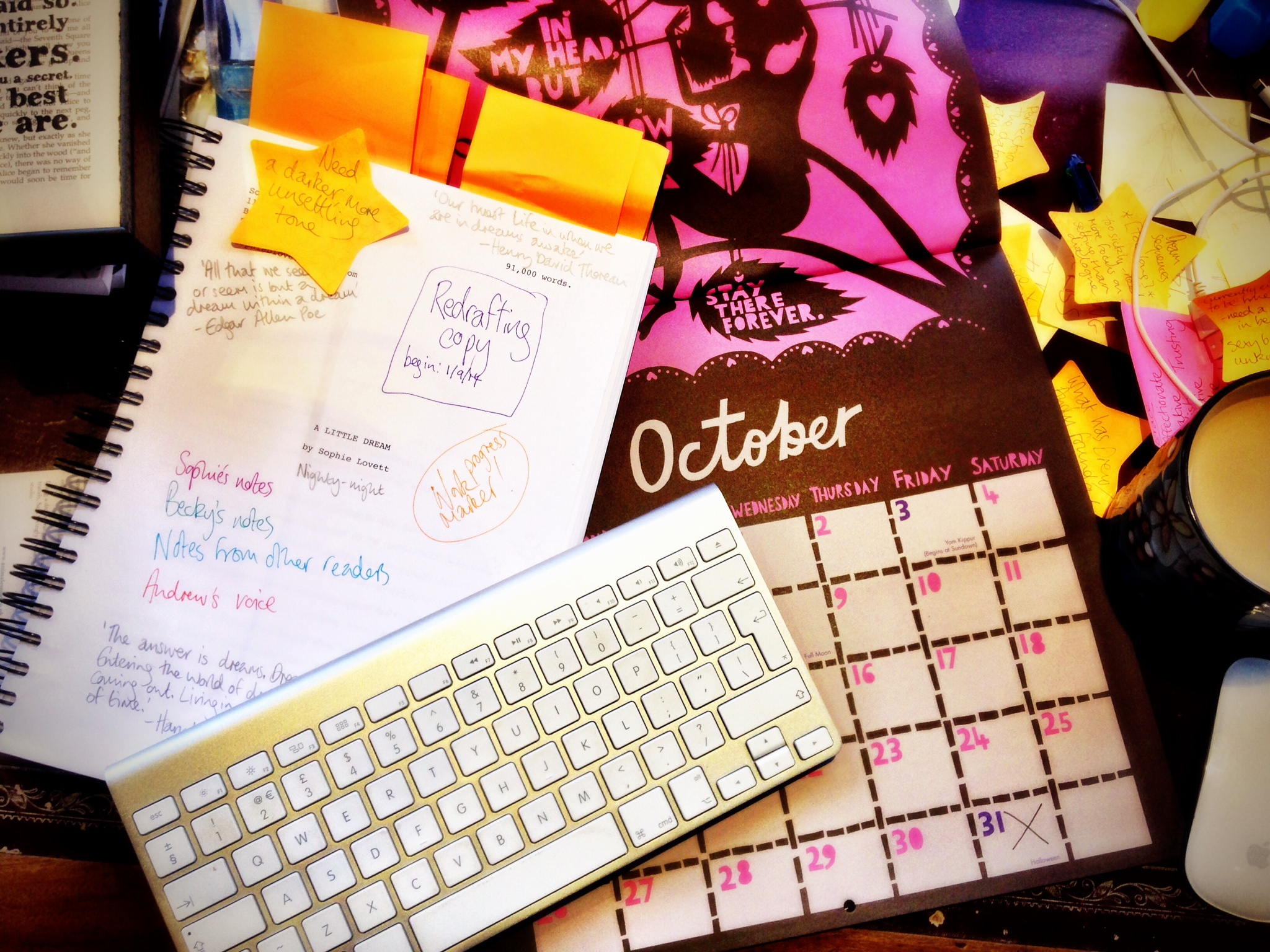
These have made it onto yellow post-it notes around my monitor: six prompts for me to look at when I reach those points in the story that don’t quite ring true so I can check and double check there’s not a simple solution that I’ve overlooked.

These six prompts are:

  • Showing and telling: does any of the narrative summary need converting into scenes? (Or vice versa?)
  • DIALOGUE: Sound? Attribution? Beats?
  • Beware ineffective REPETITION (words/ideas/chapters etc)
  • R.U.E. Resist the Urge to Explain
  • White space
  • Watch the adverbs – find STRONG VERBS

I’m not sure if they will make any sense to anyone else outside of the context of my head or the advice in the book, but I just thought I’d share. If you’re grappling with an edit yourself I would highly recommend checking out the book in its entirety. It’s not rocket science, but it seems to have helped to sharpen my brain which is never a bad thing.

The other two books I’ve found useful this week are similarly simple in their content and approach, but again have helped focus my thinking – this time in the area of characterisation.   They are The Positive Trait Thesaurus and its counterpoint for negative traits – basically lists of the characteristics that make up different personalities with ideas about what might have influenced these traits developing and how they might play out in behaviour.

Having spent months getting to know my key characters inside my head and on the page, it’s been really interesting to see what other people have made of them. And I’ve had to face the stark and slightly frustrating reality that they’re not quite the people I thought they were.

What these books have provided me with is a mirror I can hold my characters up against, identifying the positive and negative traits I believe them to have – and also the ones that have come out accidentally. What I’m left with now (on my pink post-it notes) are the traits that I need to ensure are clearly embedded in my writing of these characters – and also, particularly in the case of my protagonist, some negative ones which I realise have come out in the way she’s ended up on the page but which I really need to play down if she’s going to be the person I want her to be.

There is a part of me that feels like I’m cheating having turned to these books to prop me up at this stage in my writing process. But it can get quite lonely sitting alone with my manuscript, and ultimately I reckon my brain just needed a bit of a boost.

It’s raring to go now, and though there are some more books I want to dip into to help me tackle the tricky business of my characters’ mental health I’m planning to fire up Scrivener tomorrow and start putting this thinking into practice. Wish me luck!


Muddled Manuscript