Tag Archives: education

Raising revolutionaries

Sorry things have been a bit quiet over here lately, but I have some news!

I’ve been thinking for a while that I need to streamline my blog – focus in on a more specific area rather than the scattergun approach I’ve used so far. It’s been fun, and it’s been kinda important for me to work out where my head’s at.

But after more than three years, it’s time for a change…

IMG_1414.jpg

So I’ve started a new blog. It’s called Raising Revolutionaries, and it focuses in on an area that is becoming increasingly important to me as the world gets more and more difficult to fathom: that is, the ways in which the choices we make as parents and educators can influence a better future. I’ve borrowed from my archives here to chart my growing ideas in these areas since I began this blog back in January 2013, and I’ve finally written my first new post today too if you’d like to have a read.

I’ve been doing lots of reading about parenting and education, building on the masters degree I completed forever ago and thinking seriously about possibly moving towards a PhD. But in the meantime I’m going to play around with some ideas in this new little corner of the internet.

There will be politics, and some strong opinions on parenting (generally of the respectful and progressive variety) and on education (generally with a democratic and child-led air). There will be ongoing reflections on my journey as a mother, and the things that Arthur is teaching me along the way. And hopefully there will be lots of learning – for me, and for you if you’d like to join me.

It feels more than a little bit scary to be starting again from the beginning, so if you’d like to pop over and say hi then I’d really appreciate that. I have a new Facebook page where I’m currently rather lonely, so feel free to link up there too.

I’m going to keep ‘Sophie is…’ online for the foreseeable future but I’m not envisaging any new posts here. So if you’re interested in what I have to say about parenting and education then you know where to find me! And if you’re here for more writerly rambles then watch this space… Hopefully I should have my new writing website up and running very soon!

Global gaslighting

We are living in a world where the truth no longer holds any sway in the pursuit and consolidation of power.

Nowhere is this more obvious than in the sordid beginnings of Donald Trump’s America: in the run up to the election the lies were so blatant that it seemed impossible that anyone could take them seriously, but they were dismissed in the name of political rhetoric.

Now that he has taken the reins of the presidency, these lies have become an accepted technique amongst those heading up his regime. There are his tweets, of course – dismissed all too easily as the ravings of a lunatic – but these are given brazen validation by the claims of his team. Sean Spicer insisting that Trump’s embarrassingly small inauguration crowd was the biggest ever seen. Kellyanne Conway inventing a massacre to terrify people into accepting their draconian travel bans.

These outright lies are bad enough on their own, but when combined with accusations of fake news levelled at those who disagree, and the patronising, scathing delivery with which Trumps and his allies address their critics, this segues neatly into classic gaslighting – and gaslighting on a global scale.

IMG_1831.jpg

Too many people I know – liberals, intellectuals, people concerned with truth as a foundation for society – are beginning to doubt their sanity. It seems almost impossible to believe that people in such positions of power can lie so brazenly and not get called out for it. This is, of course, part of the point – and is something which has been explored at length in publications as diverse as The Washington Post and Teen Vogue.

Something that I’m not sure people are admitting quite so openly is the extent to which this is happening on this side of the pond too. We all raged at the lies printed on the sides of buses during the Brexit campaign. We all shook our heads in disbelief as Michael Gove dismissed the opinions of experts, repeatedly calling into question the very value of expertise. Doctors rallied against Jeremy Hunt over the false statistics he used to support his calls for a seven day NHS. And then this week, when Jeremy Corbyn is still being hauled over the coals over his decision to whip his party into going against their instincts and vote in favour of leaving the EU, Theresa May sends a letter to the electorate in the run up to a crucial by election lying about both Labour’s clearly stated intentions and the voting behaviour of local Labour MPs.

Increasingly, as in the disunited states of America, our politicians refuse to acknowledge these untruths even when presented with incontrovertible evidence to the contrary. And even if they do, the damage has already been done.

The media, with its almost entirely right-leaning benefactors, whips up these lies into something bigger than themselves, and our democracy is left gasping for breath at the heart of it with no-one knowing what to believe any more.

Increasingly an ability to analyse the media and move beyond the role of unquestioning consumer is a vital skill – and yet Media Studies continues to be sidelined and ridiculed. The internet provides us with almost endless news sources, yet at both ends of the political spectrum these twist and subvert the truth: even if you want to question the status quo, to seek out some sort of integrity at the heart of it all, it is all too easy to get dragged down someone else’s rabbit hole.

And actually the reality of the direction our education system – and thus our society – is taking could not be further from harnessing that ability to question and challenge. Our childrens’ minds are being suffocated with pointless facts, their teachers’ creativity and professionalism stifled with the relentless drive of ever-increasing ‘standards’. Schools themselves are in very real danger of becoming nothing more than factories which churn out young people chastised into obedience and so desperate to carve out their own little place in the world that they will sacrifice all their dreams of a better world in order to do so.

We owe our children more than this.

We have to give our young people – our society – the tools to survive, morally and intellectually, in this post-truth world.

Of course this is not in the interests of those in power. As parents we need to act, to show the young people in our care that they are valued, they are important – and they are powerful.

So much of what is accepted – expected – in modern parenting is about championing compliance above all else. We need to fuel the fire in our children’s bellies, give them the strength and the confidence to be active members of society, and above all move away from the idea that it is by being ‘good’, and by doing what we say, that they are most valued, most loved.

It is pretty clear that, however much it might be painful to accept, our generation is not doing such a great job at building a society that we are happy to live in. I’d like to think, though, with thoughtfulness and care, that there is hope our children might.

47/52

IMG_1754.jpg

“A portrait of my child once a week, every week, in 2016”

We went to the Advent Fair at South Devon Steiner School at the weekend. It was a lovely event, and a real reminder of how different education can be.

There are still several things about the Steiner approach that make me doubt whether we could embrace it entirely, but Arthur was most definitely inspired. Whenever we’ve talked about school before he has been adamant that he doesn’t want to go, but when I explained to him that this place was a school too his eyes widened: “It’s just like a big boy’s forest school”, he exclaimed. Needless to say, he LOVES forest school.

The highlight of his day came towards the end. I’d got distracted by the stalls, and emerged to find Leigh and Arthur peering through the gate of the forge whilst the school’s blacksmith crafted something in the flames. It turned out that Arthur had got chatting to him and asked for a sword, and the blacksmith cheerfully agreed.

So Arthur watched, fascinated, as the metal was heated and twisted and sculpted into shape, and when it was cool he held it in his hands.

We’ve had some serious chats about the responsibility that comes with such a gift – its end is blunted, but it’s still a solid lump of metal. Arthur chose a hook for it in the kitchen, and we’ve agreed that he will only handle it when we’re there – that he can use it as a prop in his imaginings, but it is not for play fighting.

So far he’s risen to the challenge, and handles his very own sword with the utmost care. It is wonderful to see what these little people are capable of when we trust them.

Writing at the end of the world

Let’s just take stock of where we’re at.

The UK is hurtling towards an ungainly Brexit, voted for by just over a third of the adult population and headed up by an unelected Prime Minister who is swiftly making Margaret Thatcher look like some sort of socialist saint.

The US, not to be outdone, has voted in a billionaire who openly gloats about tax avoidance and assaulting women. The percentage of the population who are happy about this is even lower than the ‘overwhelming mandate’ leading our country into disaster, and both of our nations, who can thank for their successes generations of immigration and open-mindedness, are battening down the hatches for an extreme right-wing orgy of which Hitler would be proud.

Alongside this, the world is still facing (if not yet facing up to) the worst humanitarian crisis since World War One, military leaders from Russia to China are seemingly putting things in place for yet more global conflict, and our media is having a field day in this post-truth age which has never been less interested in the facts of the situation where there’s a good story to be had.

And don’t even get me started on the travesties that are quietly being played out on our doorsteps behind this international shitstorm. The health and education services that are being dismantled and sold off to the highest bidder, the fat cats getting fatter whilst the poorest and most vulnerable in our society are living hand to mouth, or dying behind a smokescreen of spin.

img_1746

It is hard to know what to do.

It is hard to know what the point is of doing anything.

And yet…

I was reminded the other day about why it is I am a writer: why I love books, and art, and culture. Why it matters even more when everything else is falling apart. It was one of those rare moments when the different parts of my life collide: I was at a Torbay Culture Forum meeting to discuss ideas for the future of Shoalstone Pool, and I found myself surrounded by a table of inspiring, talented people who have an unshakable belief in the ability of culture to affect change.

I do, too: that’s why I was passionate about teaching literature and drama and film as well as the more functional elements of literacy and media studies. It is why I trained as an actor many moons ago, and is why I have spent so very many hours over the last few years carefully crafting three novels whilst learning what it is to be a mum.

It is easy to forget, though, at times like this. It is easy to think that it is only by addressing politics head on that you can really make a difference, and that artistic endeavour is frivolous and self-indulgent. I think I’ve been stuck in that space for a while now.

But it’s time to break out. Something clicked when I was away last week, and I have come back with a renewed sense of what I’m doing and why.

I have an idea for a collection of short stories, inspired by this impending sense of doom but altogether more hopeful than that sounds. I’ve been putting pen to paper, playing around with words, and finding the whole process quite therapeutic. As stories emerge I’m planning to set them free into the world and see if any of them can find a home, but I’m feeling strangely liberated by the fact that I’m envisaging this as a collection too, a cohesive work that I might be able to put out there myself someday soon.

I say soon, but I still have no idea where that bigger picture of submissions is taking me. What I do know, though, is I need to own this writer hat, to separate it out from the new-mother angst that spawned this blog. So I have a separate writing blog in the works, which hopefully will be ready to launch in the new year.

This links in to another realisation I’ve had, about what it is that ties together all the stuff on this blog that isn’t about writing – and that is, surprise surprise, linked closely to that sense of creeping armageddon too.

It’s all about changing the world, basically. About nurturing a new generation – as a parent and a teacher – that will do things differently. Do things better. And I think I want to explore this more explicitly, with a blog dedicated to this idea of child rearing as a quiet and determined revolution.

It fits quite neatly with all my thoughts already about parenting and education, but I think the time has come to own that side of me too – not just to voice my thoughts and apologise afterwards for failing to embrace the status quo.

So.

Change is afoot.

Time to silence that demon who has taken a break from criticising my writing to laugh at me for believing that I can make a difference, however small that difference might be.

Because if not me, who? And if not now, when?

Writing Bubble

What History of Art A-level meant to me

I have got used to shaking my head in disbelief when the government’s latest education initiatives are announced, but when I read this week that A-level History of Art had been removed from the options lists forever it hit me harder than I was expecting.

This is not the only subject to have been made a relic by the Tories after all – the full list of opportunities that are no longer available to our young people filled me with fury. But twenty-two years ago History of Art succeeded in saving the dying dregs of interest in academia from the apathy of my sixteen year old self – and it is no exaggeration to say that without it my life could have turned out very differently.

I moved from Birmingham to London for my sixth form studies. I didn’t want to at the time – nothing against London per se, but my mental health was fragile and I couldn’t see a way forwards without my small but trusted circle of friends by my side.

My academic record was strong, but the ‘A’ grades hid a complete lack of interest in my studies – and a complete lack of confidence in my self. I selected my next raft of subjects pretty randomly – A-levels in History, English and Biology, and AS level in French. I wasn’t much more inspired by these than any of the other, mainly traditional, offers on the table, but I figured I’d be able to see them through.

Then in my first week at my new school, and my very first lesson with my new French class, I mustered up the confidence to speak and was laughed at by the stranger who was my teacher because of my (admittedly pretty dodgy) French accent. I walked out of the lesson through a blur of tears, and after a brief conversation with the administrators switched to an A-level in History of Art – one of the few subjects still with space, and something that piqued my interest with its novelty.

It was one of the best decisions I have ever made.

IMG_1686.jpg

Our class was small – there were six of us I think, meaning that in today’s cash-strapped educational climate the course probably wouldn’t have run at all. I couldn’t be invisible in that room though – not like my other classes where I often slept behind a carefully placed hand propped on the desk.

I learnt so much more than was contained within the confines of the subject. I learnt how to plan an essay – techniques which I applied to great success in all of my A-level subjects and have used endlessly since as a student and as a teacher. I learnt how to revise, and how to organise my time. I learnt that it was ok to be interested in something that not many people saw the value of – and that in fact sometimes the most obtuse pursuits can bring the most personal reward.

The subject itself, it turned out, was so much more than I could have ever hoped for.

There was an interplay between art and science, which appealed to the way my brain works: I never have been very good at putting things in boxes. This was particularly true with our study of the history of architecture, with the exploration of classical forms bringing mathematical certainty into the sometimes nebulous analysis of artistic endeavours, and the ways generations of architects riffed around them giving me concrete examples of how creativity evolves.

Understanding how buildings and towns were designed made me think, too, about the way our society is structured – something which we also discussed animatedly when we looked at the work of artists who protested explicitly against the societies they worked within, comparing that in turn with those who played by the rules to fit into the canon. Generally I learnt loads about our culture, and that of other countries. We went on a group trip to Paris (where finally I got to work on that French accent) and wherever else I travelled then and since I found myself looking at the world through a new pair of eyes.

Beyond the studies, my personal self was developing too. I had found my first intellectual tribe – a very necessary counterpoint to my emerging new social group who whilst they would go on to include lifelong friends did not encourage the healthiest of pursuits.

Weekends of clubbing, house parties and festivals meant that (at least) the start of each week often passed in a blur – but I could not let myself let things slip entirely because I didn’t want to sacrifice the learning and the community that my History of Art lessons gave.

This motivation, and the skills I learnt as a result of it, carried me through to another surprisingly good set of grades, and from there on to university – to study History of Art, along with Philosophy.

My History of Art A-level taught me that I am on a fundamental level an intellectual, but that the intellectual study I enjoy is one firmly rooted in society. It taught me that I respect those who know when to play by the rules, and when to break them. It gave me the confidence to express my opinions about the world around me and the people who inhabit it: that even if my opinions are not the same as those shared by others my ability to explain them is more important than just fitting in.

I’m not saying that every teenager would respond the way I did to this particular subject, but I honestly think that the fact that it was not as ‘pure’ as the other subjects I was studying, not quite so epic in its scope, made it easier to delve deeper into it, to create links for myself rather than having to regurgitate the views which were expected of me. It gave me an outlet for my stifled creativity, and the confidence to think.

Studying History of Art gave me the skills to collaborate with a friend to put on art exhibitions, to develop my photography, to teach Media and Film. It enriched my analysis of literature, and ultimately gave me the confidence to put pen to paper myself and give voice to the stories in my head.

It makes me so sad that because besuited politicians in Westminster cannot see the value in this subject future generations of teenagers might not have the opportunity to ignite the spark that might propel them along an unexpected path.

Like so many of the educational reforms that make me angry, this reduction in options seems to be driven by a misplaced certainty in what our society needs. What we really want is the space to make that decision for ourselves.


Writing Bubble

Very hungry caterpillars

The unschooling diaries: week twenty-five

After the success of our tadpole project, I’ve been on the lookout for another opportunity to explore metamorphosis in action. A couple of weeks ago one appeared, in the shape of several very hungry caterpillars eating their way through our lettuces.

IMG_1534.jpg

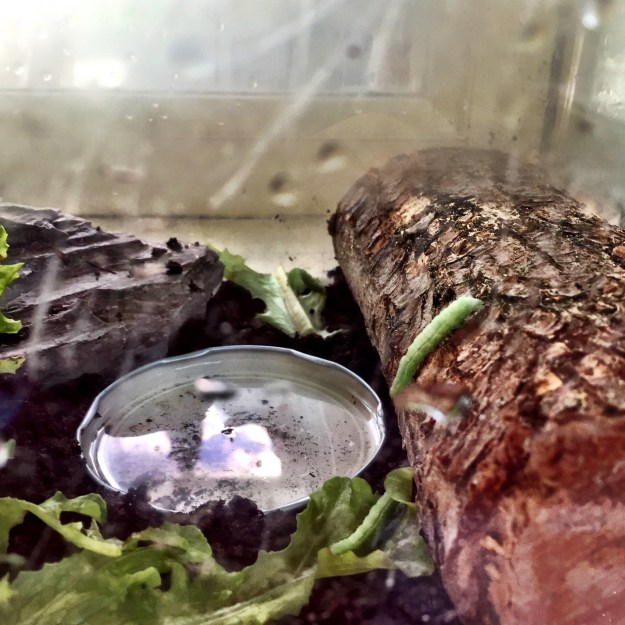
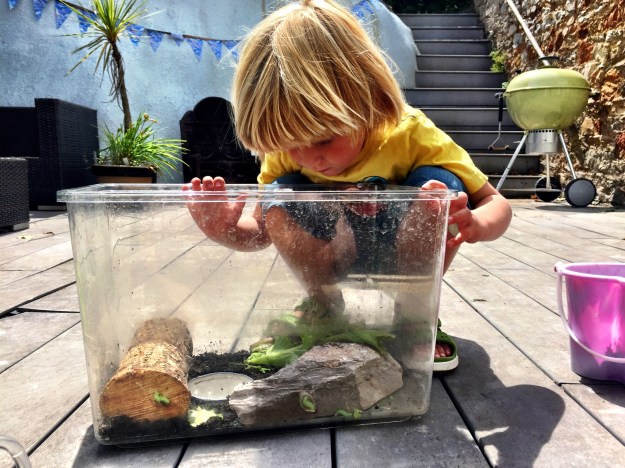
We picked out two, and created a little habitat for them in the fishtank, complete with the remains of one of the lettuces they had been munching so that they could continue to prepare for their transformation.

IMG_1535.jpg

They were already pretty big when we found them, and it wasn’t long at all before they each settled into a crevice in their new home and began to spin a web of silk around themselves.

IMG_1533.jpg

This was fascinating to watch, as was the way their bright green bodies slowly went brown and hard as they pupated.

Whilst we waited for them to hatch, we read up about the process – Usbourne Beginners ‘Caterpillars and Butterflies’ had lots of interesting facts, and of course we re-read Eric Carle’s classic. I also did a bit of googling to try to find out what sort of butterflies we might expect, and discovered that actually the silk cocoons suggested that we were more likely going to be welcoming moths.

And indeed about ten days later first one then the other broke out and spread their wings.

IMG_1537.jpg

We watched them for a couple more days, and when we were sure that their wings were strong enough Arthur reluctantly agreed to let them go.

IMG_1539.jpgIMG_1541.jpgIMG_1540.jpg

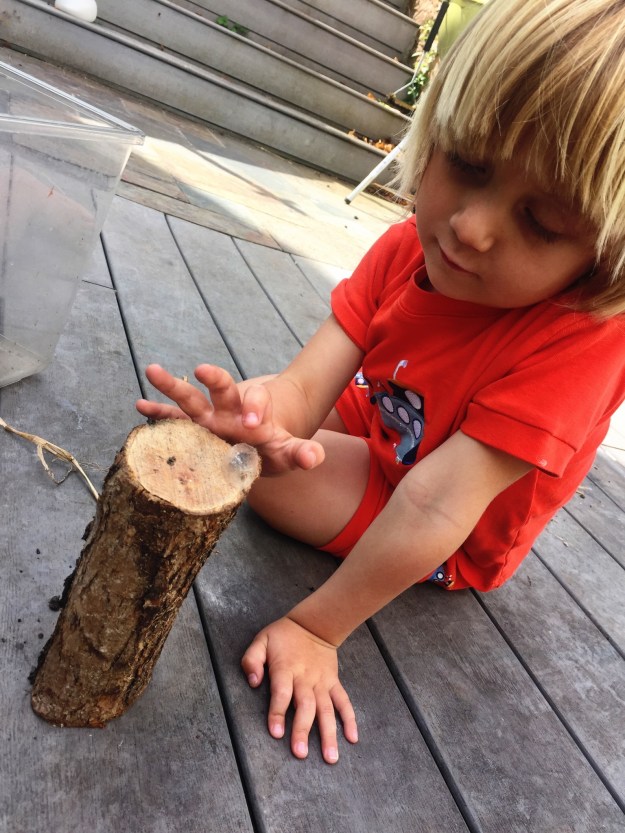
Once they had flown away, he was keen to have a closer look at the empty cocoons. He felt the sticky silk, and prodded at the shell of the pupa within.

IMG_1542.jpg

And after that, whilst I attempted to tidy up our overgrown veg patch, he even washed out the tank, ready for his next pets.

IMG_1543.jpg

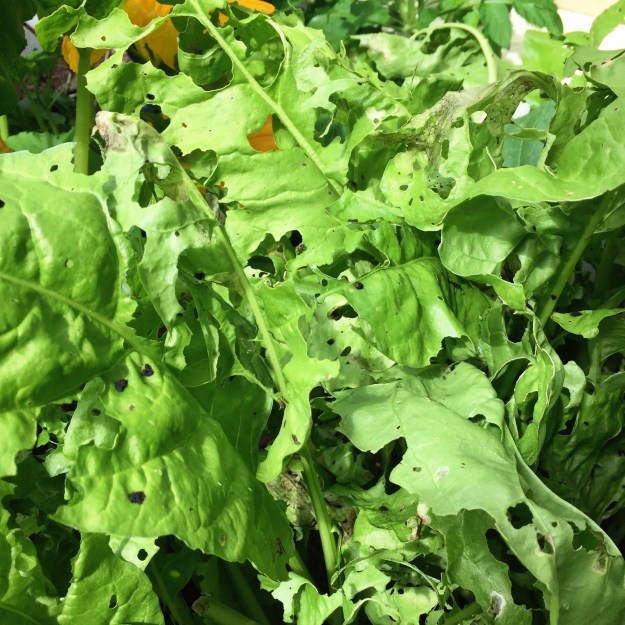
As it happened, he didn’t have to wait very long. I had a feeling that the latticed spinach and calendula might be hiding some more little creatures and, in fact, it was teeming with them.

IMG_1545.jpg

It made for some very interesting conversation, around how these bugs are interesting to watch and study but are also pests, especially when they’re competing for our vegetables! We transferred some of the caterpillars we found to another part of the garden, but because they looked different to the first ones we’d found we decided to keep a few back so we could observe the metamorphosis process again and see if we noticed any changes.

IMG_1544.jpg

After this lot I think we’ll be done though, at least till next year…

Anyone have any ideas how we can make the remains of our crops slightly less attractive to the very hungry caterpillars? After all, it would be quite nice to be able to enjoy some of our vegetables too!

19/52

IMG_1433.jpg

“A portrait of my child, once a week, every week, in 2016.”

I love watching Arthur play, especially outdoors.

He is becoming so imaginative and agile and brave: balancing and climbing and reaching and exploring. Even when he is playing on his own – in fact especially when he is playing on his own – he buzzes with the energy of all that he is discovering about the world.

He fell not long after I took this picture, balancing on the beams that spanned the brook, reaching down for his bucket that had tumbled into the water. He managed to catch the beam before he got too wet, and though he needed help to right himself he never lost his calm. Once he was freed from his precarious position he quickly re-found his focus, and carried on as if nothing had happened.

I’m not sure you can teach skills like that.


Linking up with Jodi at Practising Simplicity for The 52 Project. 

This is literacy

There were all sorts of things that wound me up about the government’s response to yesterday’s kids’ strike, but by the end of the day the number one accusation I was reeling about was that the tens of thousands of parents and teachers who supported the strike did so because they do not have high enough expectations of children’s literacy.

There are many things I may have fallen short of as a teacher and a parent, but having high expectations most definitely isn’t one of them. It is just that, like many others, I seriously doubt the validity of the narrow interpretation of literacy that success in the SATs exams hinges upon – and fear for our children’s sanity when they are expected to be able to absorb and regurgitate complex grammar knowledge that stumps everyone from masters graduates to the very Schools minister who champions this rigorous approach to assessment.

I am not convinced, actually, that Nick Gibb knows much about the content of the tests he reveres. In press statements yesterday he talked about the importance of basic comprehension and the use of capital letters. It made the people opposing the tests look pretty stupid – and fuelled the hundred of trolls who engulfed social media to pour scorn on the intentions of parents who pulled their children out of school. The fact is, though, that we’re not just talking about learning basic literacy here: we’re talking about learning (by rote) huge swathes of linguistic terminology. There are many people who have written about this more expertly than I have – I especially like Michael Rosen’s blog for no nonsense critique of literacy in schools. What I want to highlight here though is not only that what primary school children are being expected to learn (and be summatively tested on) is excessive and in many case irrelevant, it is on the most basic level the opposite of what literacy really is.

IMG_1420 (1).jpg

The simplest definition of literacy is being able to read and write. As an English teacher, and then a parent, and now a writer, these are both skills that I believe of course to be essential: being a confident reader and writer opens a door to a whole other world of learning and communication. But is being able to confidently label fronted adverbials and subordinating conjunctions really a central part of literacy, or even any part of it, for ten year old children? I think not.

Nicky Morgan says that the new tough regime of SATs exams will help increase the numbers of young people achieving the top grades at GCSE, but if it extinguishes the curiosity that drives the desire to learn then there’s no way it will do that. She insists that the knowledge that the SATs examines will, once children have mastered it, allow them to be more creative. But in saying this she is completely ignoring the much-researched developmental window before the age of seven which has inspired play-based curricula worldwide – and leads to many successful education systems holding off from any formal education for children before that age.

The government accuses us of dumbing down, but I would argue that what they are doing is dumbing down our children: producing a factory line of automatons who have missed out on the opportunity to fully develop their own personalities or a sense of who they are as members of our society.

My concept of literacy is considerably more ambitious. My desire to truly understand how children become confident readers and writers has been rekindled by watching my three year old son learn and grow, and that is what is at the root of my fear of what the SATs, and the pedagogy that is seeping out from them, is doing to our children.

My son is a reader. He tells me the story of pictures in the books we share, interpreting the images themselves and augmenting that with his imagination and his memory of the words being read aloud. He seeks out letters in the world around us – not yet being able to differentiate between more than a handful, but knowing that letters make words and that words label things and concepts. I am confident that, as we continue to make books and stories an integral part of our lives, he will make the transition to reading independently. He will begin to use the multitude of cues available to us as readers to make his own sense of the written word – and he will want to, because he already knows what treasures there are to be found within the pages of his books.

As an aside, I have to admit I really don’t understand the government’s obsession with synthetic phonics when it comes to teaching children to read. Some degree of phonics, sure. But to strip back the process of reading to solely decoding? To insult children’s intelligence by making them read ‘nonsense’ words just for the sake of catching them out? That doesn’t make sense to me . But I guess it’s easier to test than a system that recognises the real nuances that underpin the process of becoming a confident reader.

My son is also a writer. Don’t get me wrong – he can’t actually form letters yet. In fact he shows very little interest in concentrating on the fine motor skills that will eventually lead to him writing down the thoughts that are in his head. But what thoughts he has! He picks up new vocabulary like a sponge, knows exactly how to use words to achieve particular effects, mirrors the complex sentences he hears and reshuffles them for himself to suit his purpose. He tells stories to his teddies and his trains, comes up with brilliant if unlikely explanations for particular juxtapositions of objects in his play, and is developing a very strong line in persuasive reasoning. When he is ready to put pen to paper I have no doubt that these skills and knowledge will underpin his actual writing, but he already demonstrates the aptitude that I admire in any writer who has mastered their craft.

I know my son is not unique. He is doing exactly what every three year old instinctively does – experimenting with language and relating it to the world around him. But I worry about what will happen if he is asked to put all of those thoughts and ideas into nice tidy boxes for the sake of standardised assessment.

I worry for him, and I worry for all of our children.

This worry has not come about because my expectations are low. I have the highest expectation of young people, one that will empower them and motivate them whilst they are at school and throughout their lives: I expect them to want to learn. If they want to learn, if they want to achieve, if they are inspired, they will use that as a drive to overcome whatever obstacles are in their way – including those basic reading and writing skills. Hell, one day they might even be driven by the desire to be able to confidently identify those subordinating conjunctions and fronted adverbials. But if they aren’t? I think they’ll be ok.

I am not sure though that our kids will be ok if this government is allowed to plough on unchecked with its imposition of an increasingly restrictive straightjacket on literacy and learning. And it is our responsibility to stand up for them.

May 3rd 2016 was a momentous day, and it was incredible to see the impact that parents can have on the dialogue surrounding education in this country. We cannot stop now though: parents and teachers need to draw strength from this groundswell of passion and purpose. There is still so much work to be done.


Writing Bubble

Together we are stronger

Whilst momentum gathers for the kids’ strike on 3rd May, there are still a lot of parents who are undecided. Unsure if they are the sort of people who do this sort of thing, unsure if they or their kids will be punished for taking a stand, unsure if the issues at stake actually effect them very much at all.

One of the things I am hearing time and time again is that people love their schools. They don’t want to insult their kids’ teachers, they don’t want them to feel like they’re doing something wrong. But seriously – the time has come for us to act together. I remember – when I was teaching – having conversations with colleagues despairing over the negative impact of the Key Stage 3 SATs. We longed for parents to recognise how counterproductive this whole process was for their children, to petition us to stop the tests, to refuse to send their children into school. But they never did.

Fast forward ten years, and I am thrilled to see parents making their voices heard to say enough is enough. I am a parent now, too: and whilst my son is still a few years away from the Key Stage 1 SATs that initially inspired this campaign, I am already concerned about their impact on his future education. So much so that, at the moment, I can’t see any other option but to homeschool.

It’s not just the SATs though. There is so much that has changed in education in the three years since I took a step away from teaching, so much that the Tories are getting wrong.

So if you’re doubting whether or not to take a stand, wondering whether or not it applies to you and your kids, then I ask that you take a few minutes to consider this.

1) I would fail the new Key Stage 2 SATs

I am 38 years old. I have an A* in GCSE English, and an A in A-Level. I taught English to secondary school students for over ten years, and was head of faculty for the last two of those. I am currently in the process of writing my third novel.

And yet, last weekend, I sat a sample SATs test, and I only managed to get 50%. It’s taken me this long to admit it, because on one level I am mortified. But actually – I had trouble even reading to the end of the questions without glazing over, and my considerable knowledge of the English language has taught me that many of the answers would most definitely be open to debate in the real world.

Which brings me to my next point…

2) The knowledge and skills our kids are being told to prioritise is almost entirely irrelevant

I am (thankfully for me) far from the only well-educated person to have taken these tests and be utterly humiliated. Teachers, academics, writers, and many more people who in theory should know better have fallen foul of the particular demands of these exams.

It’s not that the technicalities of grammar aren’t important – it’s just that there are so many different ways to learn about them than by being able to recall the ins and outs by rote.

It’s ok for us – we have already found our path in life, have already succeeded. But what of the ten year old who takes these tests and declares themselves a failure because they are not able to jump through this government’s spectacularly misplaced hoops? If this action were to spare just one child from that fate, then it would have been worth it.

And the fact is, our children are suffering.

So much so that…

3) The relentless assessment regime our kids are subjected to is starting to seriously effect their mental health

One in ten children in the UK is diagnosed with a mental health problem. That is an alarming statistic, by anyone’s standards.

It is a leap to say that this is entirely down to the assessment regime, but there is a general consensus that it is a major factor. It would be very hard not to jump to this conclusion when reading the many testaments from parents that have come out of the Let Our Kids be Kids campaign. There are so many heartbreaking stories, but just this one from a parent of a year 6 boy should be enough to make us want to act.

In fact things are getting so bad that questions are being raised about whether the way in which our children are being treated in the education system is in breach of their human rights. I would very much argue that it is, and cannot imagine subjecting my son to the situations being described by parents in just three years time.

He’s ok right now, but it is the world that he is entering into that scares me.

Which is why…

4) Even if your child is not yet old enough for SATs, now is the time to act

Very few protests have the potential to directly impact on the people who are taking a stand: it is future generations who will benefit most.

I’ve been discussing this this week with my soon-to-be-a-junior-doctor husband. The doctors on the picket lines, the ones resigning their posts and speaking out so eloquently, are not protecting their own interests. The people who will immediately be affected by the new contracts are final year medical students, like my husband, and all of the future doctors currently slogging their way through the training system. It is likely that all junior doctors will ultimately be affected, but the action they are taking at the moment has very little to do with them and everything to do with the bigger picture.

It’s not a direct parallel to the kids’ strike, but it’s not a million miles away either. The parents who initiated this whole campaign have children in year two. Those children will still, most probably, have to sit the tests this year (unless of course a miracle happens and Nicky Morgan actually listens). The children who will most benefit, though, are the children who are facing the SATs in the years to come.

The NUT are considering a boycott of the SATs for next year: they will be even more likely to act with the strength of the nations parents behind them.

And anyway…

5) It’s not just about the SATs

The pressures on the curriculum at all levels is completely squeezing out arts subjects. The proposal to force all schools to become academies is essentially a back door to privatisation where we lose all ownership and democratic control of our schools. The knock on effect of the raising of the bar at Key Stage 1 is that Early Years education as we know it is under threat. Teachers are feeling such despair at all of this that they are leaving the profession in droves.

And yet…

6) The government does not expect you to act

If you are sitting thinking that it’s not really about you, that there is nothing you can do to make a difference and that your kids seem ok right now so it might be better not to rock the boat, then you are doing exactly what the government wants you to do.

And if you are not that bothered by the points that I’ve made above, then fair enough. But if you think our kids – your kids – deserve better, then maybe now is the time to make a stand.

IMG_1415
There are 16,743 people behind the Let Our Kids be Kids campaign on Facebook, and that is growing by the second. News outlets across the country are starting to take notice of the movement that is emerging. In my small town alone I know that there are two major television news stations planning to cover the events of the day.

And the question I would ask you is, what would you like to show them? Would you like them to see just a few parents out there making their voices heard, and silently applaud their intentions whilst not being quite brave enough to make the move yourself? Or would you like to see parents out there in droves, saying that our children are better than this? We are all better than this.

My son is only three, so we cannot strike as such. We will be doing what we do every day which is to seek out learning in the world around us. I am only hoping, on the 3rd of May, that we might come across you, and many, many other parents too, doing exactly that: and making the government fully aware of just how much their plans for our children are unwelcome.


In the absence of any real striking power my son and I, along with many other parents across the country, are participating in the #THISislearning campaign. Click here to find out more!
 

How to grow a writer

It is easy to be negative at the moment when thinking about education. In fact it’s easy to be negative about most things to be honest – I’ve spent most of this week dwelling on the seemingly inevitable fate of the NHS, while intermittently wondering whether there is anything we can do to bring our schools back from the brink.

But of course there is.

Beneath all the doomsaying around the utterly depressing state of assessment – the unbelievably detrimental SATs exams, and ill-thought-out reforms to GCSEs – there are teachers just getting on with doing their jobs. Jobs which, incidentally, align the vast majority of them much more closely with the interests of the young people in their care than with the government and its dictats.

Much of what we have shared through the #THISislearning campaign so far has been rooted in the Early Years. And it is a relief to know that here the notion of play as a vehicle of learning still predominates; that our children, at least when they are very young, can follow their own path to creativity and fun.

But of course play does not become defunct as children grow older. In fact I would argue that its magic becomes all the more important.

IMG_1412.jpg

It was always one of my key goals as a secondary school teacher, to harness the power of play.

There is a tightrope of engagement when you are working with teenagers, hung tentatively between the towers of curriculum and assessment. My job, the way I saw it, was to enable my students to balance on that high wire – to give them the skills they needed to succeed whilst simultaneously not losing sight of the love of learning that motivated them all, once upon a time.

Of course inherent in this is the notion of success, and this is where my views diverge most from those of our our current government. For me, success (from an English teacher’s perspective) is a young person who can think, read, write and speak with confidence. I imagine what that looks like for me is very different to Nicky Morgan’s idea of a perfectly educated child. To be honest I seriously doubt whether confidence, and all of the dangerous individuality that goes with it, factors anywhere at all in this government’s vision for our children. But that’s a story for another post.

So back to my job, as a teacher.

I established very early on in my career that I was not a ‘filling empty pails’ kind of educator, but rather one more interested in kindling fires. I have never had much time for bare facts – knowledge without context leaves me cold, and I admit to finding myself so completely disengaged with the approach to learning about grammar intrinsic to the new KS2 SATs papers that I can hardly read to the end of a sample question without switching off.

That’s not to say grammar is not important, or fascinating – of course it is, given the right situation. It’s just that there are so many more interesting ways to understand it than by methodical categorisation and endless rules – especially given that our language is often not very interested in following the rules itself.

My goal in the classroom was to get my students interested in things. To get them asking questions, being genuinely curious – to get them to a place where the answers (where they existed) might just stick.

I remember sitting down with a colleague (and friend) to plan a scheme of learning for Year Eight which needed to get down to the nitty gritty of word and sentence level analysis, as well as improving students’ use of grammar and punctuation in their own writing. We wanted to use a multimodal approach to engage students in a dialogue about how texts were constructed, the similarities and differences in the way meaning is conveyed through images, film and the written word. It ended up being based around a range of texts including ‘Where the Wild Things Are’, ‘Persepolis’ and ‘Stand By Me’, weaving back and forward through the narratives in their different forms and inviting an intelligent discussion which did – inevitably – lead us to the technicalities of how language was being used, and how the students could manipulate it to their own ends. I can tell you now that at the end of it none of those kids would have been any closer to passing the exams that, according to our current government, they should have been sitting two years earlier. But they were more confident readers and writers, and could explain why they (and others) used words the way they did.

All of that aside, it was fun. Not easy – in fact arguably harder than going through the motions of learning by rote because of the degree of thinking involved. But it was interesting: informed by the personalities of myself and my friend, and inviting our students to engage with it on a personal level.

There are a couple of other schemes of learning that stand out to me from Year Nine – a notoriously tricky year where the emotions of puberty are in danger of taking over completely, but an exciting one too when the new level of maturity students are beginning to exhibit can take everything up to another level. One was inspired by a brilliant set of resources from BT, using an exploration of all forms of spoken language as the hook into learning more about how words work. Another took its starting point from an excellent study guide produced by the English and Media Centre to explore the Sherlock Holmes stories, and detective fiction in general. We encouraged students to go into role as detectives as they read and studied the texts, to look out for clues in the language to the meaning that was being created and then be able to apply the techniques themselves as they grew into more confident writers. My kids produced some fantastic stories as a result of what they learnt, with some exhibiting incredibly sophisticated and effective manipulation of language. Could they have told me exactly what grammatical devices they were using and why? I doubt it. Did they need to? No! Not back then anyway…

I could go on, but I imagine you get my point. The nurturing of a writer has very little to do with teaching them to identify fronted adverbials and subordinate clauses, to carefully construct expanded noun phrases and employ the correct balance of semi-colons and exclamation marks. It has everything to do with introducing them to a wide range of texts, with letting them discover for themselves the thrill that comes from reading words that truly speak to you, with giving them the tools and the confidence to be able to construct their own sentences and paragraphs and weave them into whole texts that they are proud of and that mean something.

I know that, in English classrooms up and down the country, that is exactly what is happening. But I fear that it is happening less and less. Because, in our overloaded education system, this sort of learning seems to no longer be valued. And I don’t mean by the teachers – they know what learning looks like, and how to inspire.

But they also have an obligation to get the children in their charge to pass the tests. And if this government remains insistent on testing the wrong things (and testing them way too often) then there will be no space for real learning left at all.


Writing Bubble