Tag Archives: politics

Global gaslighting

We are living in a world where the truth no longer holds any sway in the pursuit and consolidation of power.

Nowhere is this more obvious than in the sordid beginnings of Donald Trump’s America: in the run up to the election the lies were so blatant that it seemed impossible that anyone could take them seriously, but they were dismissed in the name of political rhetoric.

Now that he has taken the reins of the presidency, these lies have become an accepted technique amongst those heading up his regime. There are his tweets, of course – dismissed all too easily as the ravings of a lunatic – but these are given brazen validation by the claims of his team. Sean Spicer insisting that Trump’s embarrassingly small inauguration crowd was the biggest ever seen. Kellyanne Conway inventing a massacre to terrify people into accepting their draconian travel bans.

These outright lies are bad enough on their own, but when combined with accusations of fake news levelled at those who disagree, and the patronising, scathing delivery with which Trumps and his allies address their critics, this segues neatly into classic gaslighting – and gaslighting on a global scale.

IMG_1831.jpg

Too many people I know – liberals, intellectuals, people concerned with truth as a foundation for society – are beginning to doubt their sanity. It seems almost impossible to believe that people in such positions of power can lie so brazenly and not get called out for it. This is, of course, part of the point – and is something which has been explored at length in publications as diverse as The Washington Post and Teen Vogue.

Something that I’m not sure people are admitting quite so openly is the extent to which this is happening on this side of the pond too. We all raged at the lies printed on the sides of buses during the Brexit campaign. We all shook our heads in disbelief as Michael Gove dismissed the opinions of experts, repeatedly calling into question the very value of expertise. Doctors rallied against Jeremy Hunt over the false statistics he used to support his calls for a seven day NHS. And then this week, when Jeremy Corbyn is still being hauled over the coals over his decision to whip his party into going against their instincts and vote in favour of leaving the EU, Theresa May sends a letter to the electorate in the run up to a crucial by election lying about both Labour’s clearly stated intentions and the voting behaviour of local Labour MPs.

Increasingly, as in the disunited states of America, our politicians refuse to acknowledge these untruths even when presented with incontrovertible evidence to the contrary. And even if they do, the damage has already been done.

The media, with its almost entirely right-leaning benefactors, whips up these lies into something bigger than themselves, and our democracy is left gasping for breath at the heart of it with no-one knowing what to believe any more.

Increasingly an ability to analyse the media and move beyond the role of unquestioning consumer is a vital skill – and yet Media Studies continues to be sidelined and ridiculed. The internet provides us with almost endless news sources, yet at both ends of the political spectrum these twist and subvert the truth: even if you want to question the status quo, to seek out some sort of integrity at the heart of it all, it is all too easy to get dragged down someone else’s rabbit hole.

And actually the reality of the direction our education system – and thus our society – is taking could not be further from harnessing that ability to question and challenge. Our childrens’ minds are being suffocated with pointless facts, their teachers’ creativity and professionalism stifled with the relentless drive of ever-increasing ‘standards’. Schools themselves are in very real danger of becoming nothing more than factories which churn out young people chastised into obedience and so desperate to carve out their own little place in the world that they will sacrifice all their dreams of a better world in order to do so.

We owe our children more than this.

We have to give our young people – our society – the tools to survive, morally and intellectually, in this post-truth world.

Of course this is not in the interests of those in power. As parents we need to act, to show the young people in our care that they are valued, they are important – and they are powerful.

So much of what is accepted – expected – in modern parenting is about championing compliance above all else. We need to fuel the fire in our children’s bellies, give them the strength and the confidence to be active members of society, and above all move away from the idea that it is by being ‘good’, and by doing what we say, that they are most valued, most loved.

It is pretty clear that, however much it might be painful to accept, our generation is not doing such a great job at building a society that we are happy to live in. I’d like to think, though, with thoughtfulness and care, that there is hope our children might.
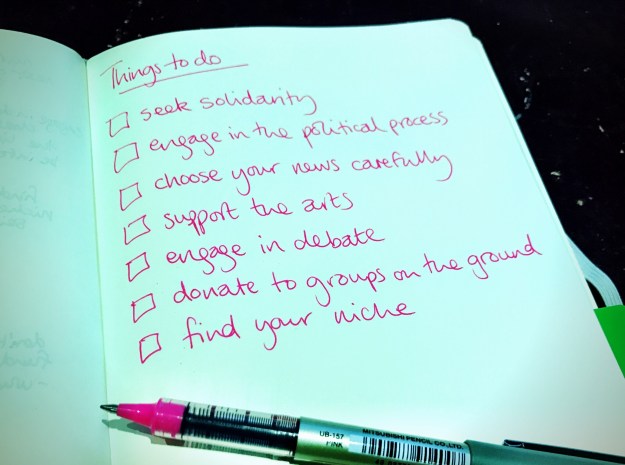
Things to do

A recurring conversation I have been finding myself having lately, both online and face to face, is what on earth we can possibly do in the face of a world that has turned itself upside down.

Trump, Brexit, the demise of the NHS, the rise of the right across Europe, the devastating refugee crisis, an increasingly vulnerable natural environment, and increasingly terrifying global instability. There is so much that is wrong with the world at the moment it can be hard to know where to start.

There are those who have dedicated themselves to a very clear path of activism, honing in on one cause and throwing their time and energy behind it, and others who are convinced that there is very little point in doing anything – that the cogs will keep turning in the same direction however big the groundswell of people that want things to change.

I am still trying to work out what my one clear path is – the aspect of all this mess that I feel most passionate about and where I have the knowledge and skills to be able to make a real difference. But in the meantime I know I cannot sit pessimistically back and just do nothing.

There have been lots of articles doing the rounds to kickstart people into action, some of which I have found more useful than others. In no particular order, here is my current list of things to do to begin to affect positive change. Hopefully there will be something here to keep you moving forward!

IMG_1827.jpg

Seek solidarity

Sign petitions. Join rallies. Go on protests. Take part in twitterstorms. On their own, these things might not always achieve an awful lot – but the very process of coming together with other people who feel as strongly as you do that things need to change can help you to keep going and find the strength to take things to the next level. If you seek out local action you might meet people close to you who can help you generate ideas and turn your frustrations into campaigns – and at the very least we are collectively sending out a message that our political leaders do not speak for us. It might not feel like they’re paying much attention, but there are plenty of people who are.

Engage in the political process

Like it or not, our imperfect political system is an essential piece of the puzzle in getting our voices heard by those who have the power to do things differently. If you’re not already a member, join a political party. Get involved in local campaigning on the issues you care about. Write to your MP. Arrange to meet with them. Email the Prime Minister about those issues that you get so irate about on Facebook. It’s easy to dismiss the impact an email might make, but if every single person feeling disenfranchised and disillusioned took ten minutes out of their day to explain why to the people running the country then the millions of emails that would ensue would be hard for them to ignore.  Of course the ultimate engagement in politics would be to stand for office: somebody has to represent our communities, and if you don’t believe that those who do are doing a very good job then do something about it! And obviously, don’t forget to vote – whatever chance you get. The political climate might be very different right now if everyone had protested with a cross in a box rather than by crossing their arms and staying silent.

IMG_1828.jpg

Choose your news carefully 

With the abundance of fake news stories doing the rounds online it can be all too easy to get suckered in to something that supports your point of view without checking that it’s actually true, and that’s not going to help anyone. It’s worth using a range of different stories to get closer to the truth of what’s going on, and it’s really important to support serious journalism – financially, if you can. So much of our media is controlled by those with the money to manipulate consumers’ views in whatever ways suit them. If we want more independent news outlets to survive we need to fill the gaps left by the dearth of big business backers.

Support the arts

In a world where the mainstream narrative is becoming increasingly divisive and exclusionary the arts have a vital part to play in fuelling an alternative way of looking at the world. There has been some really positive action coming out of the arts community recently: from publishing houses vowing to help authors from marginalised countries to get their voices heard to New York’s MoMA showcasing contemporary artists barred from the US and actors using their position on the West End stage to publicly challenge Trump’s policies. We all have a part to play in this: we can all read the books, visit the exhibitions, watch the plays; we can talk about them, and we can help fuel an alternative narrative.

Engage in debate

Don’t let hate go unchallenged. Don’t help liars keep up their masquerade of truth. Whether it is stepping in when you witness acts of prejudice in the street or commenting on a questionable Facebook post that pops up in your timeline, don’t be a silent bystander to all the stuff that makes your blood boil. Maybe try not to get too obviously furious about it – we are in the business of building bridges here, not burning them – but if you can become that voice of doubt in the mind of those who are accepting the status quo without stopping to think about it then you are on to a good thing. And if it’s the mainstream media that is spouting the lies then challenge that too – the Independent Press Standards Organisation investigates complaints about newspapers and magazines, and Ofcom does the same for television and radio.

Donate to groups on the ground

Money again. Just as with the media and with the arts the most surefire way of supporting the activists making change happen is to put your hand in your pocket. There are so many different groups that could use your cash – Planned Parenthood, In Facts, the White Helmets, the NHS Support Federation, the Environmental Defense Fund, the ACLU to name just a few. None of us could donate to them all- but we could all choose one to make our priority. The flip side of this is of course not financially supporting organisations who are part of the problem… The recent high profile boycott of Uber showed just how powerful the consumer purse can be – and the #grabyourwallet campaign lists many other businesses you might want to think twice about supporting.

Find your niche

This is not a fight for the short term: if we are going to be able to harness our considerable collective power to really make a difference to the future we are going to need to buckle in for a long and bumpy ride. If you can, find a way to use your skills and your interests to really focus in on an area where you can bring about change. The potential scope for this is huge, and will be different for each of us. Whether it’s academic study, artistic endeavour, advocacy, direct campaigning or something else, think about how you can make your efforts count.

Whatever you decide to do, make sure you hold your nerve. With the Trump regime indulging in its campaign of global gaslighting and our Tory government becoming increasingly removed from any sense of truth it can be all too easy to put your head in the sand and pretend that none of it is happening. But it is, and it is up to all of us to try and turn the tide.

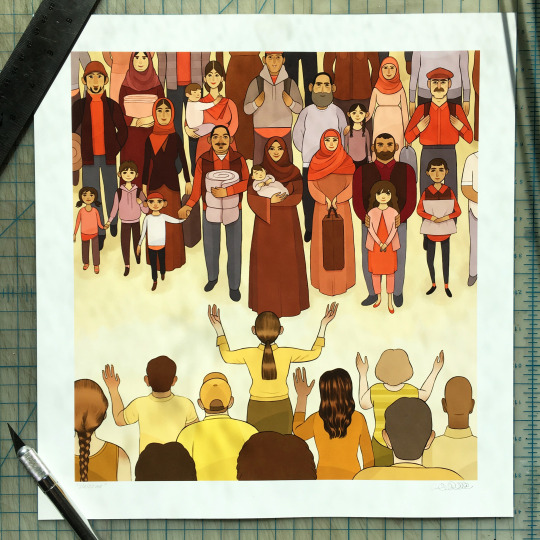
CaitlinKuhwaldWelcome.jpg

If you’re looking for a quick and easy way to make a stand you might want to check out this stunning print by my friend Caitlin – a vision of acceptance and international community, with 50% of the proceeds going to the American Civil Liberties Union.

And if you have any other ideas about positive actions we can take, then please do share them in the comments.

The power of connection

Recently, my trips to London have been more about connection than ever before. I mean, they always are in a way – catching up with family or friends, seeing the people I miss since we made the move down to Devon.

But the last couple of visits – as with many of my recent encounters with friends – have meant more than that.

The conversations I have shared have been on a different level. Driven at first by growing incredulity about 2016 as its carnage unfolded, and now by hope that 2017 might just be a time for change, we have discussed our fears about the world and revealed our plans to combat them in whatever small way we can.

Sometimes this has meant continuing conversations started online, or dusting off shared values that have lain dormant for years. And sometimes tentative comments about the state of things have led to entirely new connections being revealed, the realisation that people with whom I became friends mainly through circumstance in fact have way more in common with me than I ever dreamed.

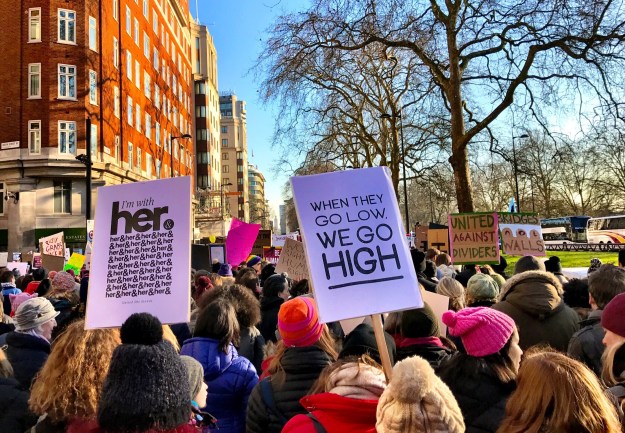
Yesterday began with the donning of pussyhats with one of my bestest buddies. We made our way to Grosvenor Square to join the women (and men, and children) marching in protest at Trump’s inauguration, marching to say that we do not agree with the values that he represents and in fact find them reprehensible, marching to say that we will not stay silent in a world where those values are being normalised through his rise to power, and the rise of right wing divisiveness all over the world.

IMG_1826.jpg

Ours was a quiet and familiar connection in the midst of the crowd, a togetherness that we used to enjoy on a daily basis and now happens way too infrequently, a standing side by side with the values we know we share without even having to talk about them. The words we did exchange spoke of trying desperately to overcome the sense of helplessness that simmered beneath our convictions – thoughts of what on earth we and all of the people we stood shoulder to shoulder with were supposed to actually do to make a difference once the march was over.

I’m still mulling that, but what came next strengthened my resolution afresh to make sure it was something, and something good.

Even before the march was scheduled I had planned to be in London yesterday. We had to duck out of it early, not having anticipated quite how well supported it was going to be, in order to arrive almost on time for a memorial service.

The person we were remembering would not have minded that we were a little late. In fact were she still around she would undoubtedly have been marching by our side.

We were celebrating the life of a mentor, colleague and friend we lost far too early at the end of last summer: the indomitable Morlette Lindsay, a force of nature unsurpassed by anyone I have met before or since, the woman who not only taught me how to follow my heart and be the teacher I wanted to be but taught me to stand up for what I believed in and knew was right even if (especially if) it felt like the whole world was telling me I was wrong. Sitting in St Bride’s church yesterday afternoon, and afterwards at the pub, it was clear that she had touched the souls of every single person there in similar ways.

I hope she had some inkling of how important she was to me. I’m not sure I ever came out and told her, and I regret that – but I can make sure that her spirit lives on in my refusal to stand by and watch whilst our humanity gets twisted out of shape, and in the playing out of my determination to find a way to make things better.

I could have happily stayed in that pub, remembering Morlette and reconnecting with friends and colleagues who I have lost touch with over the years, for the rest of the evening, but my day was not done yet.

From there it was on to the West End, to meet old drama school buddies. These were friends who I got very drunk with the week before the EU referendum last June and realised that we were all fighting the slide towards a society driven by fear and hate in our own ways.

Yesterday we were headed to see one of our number perform in The Kite Runner at Wyndham’s Theatre. It was exciting to see him on such a significant stage, wonderful to see this story I had loved in book and film form brought to life through theatre – and humbling to be reminded how the narrative we are in the middle of right now has played out in so many different places and times before, and never with positive consequences.

Again the conversation turned to what we are supposed to do to stop this permutation of that narrative in its tracks, and the realisation hit that the things we can do will be different for all of us – and in fact all of us are working out our path to a better future even as we worry that it doesn’t exist.

From the actor bringing Khaled Hosseini’s powerful story to new audiences, to the translator embodying internationalism and connectedness with every new commission, to the sports journalist planning a move to current affairs in order to influence the way people engage with what’s going on in the world.

And the writer, trying to find a way to make my words mean something beyond the spilling onto the page of the thoughts inside my brain.

There is more we can all do – more we will do – but it is heartening to remember that in many ways the revolution has already begun.

Impartiality in our post-truth age

At what point, I wonder, will history judge us to have crossed the line?

There’s no doubt that this year will factor large in the curriculum in the years to come. Maybe as part of a wider module, one on the collapse of neoliberalism and the rise of the right. Or perhaps just all on its own: a year which, in its myriad of tragedies and political upheavals, will come to symbolise the downfall of modern society.

I have been trying to keep abreast of the news this week, but every time I read a headline or watch a report I feel like I have accidentally sidestepped into an alternate reality – one where the rules have all changed, and the values that I and so many others have fought to protect for so long have become obsolete.

I have found myself shouting at the screen, exasperatedly suggesting alternative ways of presenting things which would cut to the heart of what is actually going on.

IMG_2792.jpg

Like when The Guardian suggested that Trump’s insistence that Farage would do a ‘great job’ as the British ambassador to the US put Theresa May in ‘a difficult position’. I mean, what? Since when do foreign leaders get a say in who is appointed as ambassador to their country? And since when would the government even consider a man who has failed in his attempts to be elected as MP no less than seven times? It’s absurd, even when you take party politics out of the equation, but the attempt to keep a distance, to balance both sides, makes it sound like Trump is being genuinely reasonable.

There’s the language being used to describe Trump too. BBC journalists have been referring to the president elect and his allies as ‘controversial’ and ‘populist’ – both things which sound pretty positive to disenchanted ears, and completely belittle the fact that he has publicly bragged of sexually assaulting women and has vowed to remove an entire religious group from the United States. In comparison Corbyn is regularly described as ‘hard left’ and ‘extreme’ – mainly as a result, it seems, of his desire to move towards a more equal society.

This comparison of the way right and left wing politicians are described is significant, especially when it comes to the BBC. For years the beeb has been attacked by conservatives for showing bias towards left wing ideals – though as someone who has closely followed both politics and BBC journalism for at least the last thirteen years this simply doesn’t ring true. Ironically most of the people I know who work for the BBC – and I know a few – largely share my political views. If you were just to look at the demographic of the broadcaster’s staff then an accusation of bias might hold some sway. But as they are educated, thoughtful professionals, and closely bound by the directives they have to follow – directives which ultimately come from the government, upon whom the BBC are reliant for their funding – they would not dream of allowing their personal views to influence their reporting.

There appears to be a fear amongst left-wing journalists of seeming to take sides – especially with the side they are, ultimately, on. And yet in their pursuit of balance, of attempting to appear impartial, very often the content that is produced leans heavily towards the right. Or at least towards the status quo, which with our current staunchly conservative government is very much the same thing.

I think the problem lies in the way in which this concept of balance is realised. I’ve experienced it first hand, in interviews for local TV news. For every opinion I expressed, there had to be one on the opposite side to counter it. So far so straightforward – except in reality it was more problematic.

There was a story on my work as a councillor exploring bringing refugees to Brixham, for example. In order to balance out my opinion (tentatively expressed as an elected representative) that this would be the morally right and appropriate course of action to take, the opposite view had to be shown – represented in this case by screenshots from the Facebook pages of the extreme right ‘Populist Party’ and ‘Refugees not Welcome in Devon’, pages which are full of racist bile (the latter has since been taken down). They both declined to comment, but their views were validated by being given that platform, and no doubt gave weight to the unease some local people were already feeling in the wake of the bombardment of scaremongering from the tabloid press.

I got into a discussion which reminded me about all this with an old friend on Facebook today. His argument was that we had to give a platform to these views, had to bring them out into the open, as otherwise they would just fester. We were specifically discussing Milo Yiannopolous, whose appearance on Channel 4 news made my jaw hit the floor when I saw it earlier.

He is charming, charismatic, persuasively condescending. And, like others who are part of the ‘alt-right’ movement, he views women, non-whites, people with disabilities as essentially non-humans, who have no right to be offended by the verbal attacks he perpetrates.

This is a view that no doubt resonates with many to some extent or other. And yet for Yiannopolous, and for others like him, you could substitute ‘neo-nazi’ for ‘alt-right’ and find it hard to separate out their views.

And I’m pretty damned sure we should not be impartial about that.

It is possible to argue, convincingly, that in a free press all of these opinions, however reprehensible, should be given air time in order for people to make up their own minds.

But we live in a society where the whole of our media is dominated by right-wing propaganda. Where the vast majority of headlines evoke fear through their demonisation of minority groups. Where the outspoken voices of the far right are not afraid to employ overt rhetoric in order to get their views across – where charisma and personality count for infinitely more than the facts at the heart of the matter.

It’s ironic, given that the ‘alt-right’ claim to be reclaiming facts over feelings. But in their post-truth universe spin trumps integrity – and that universe is emerging all too neatly out of our own.

Meanwhile our few remaining ‘respectable’ news outlets are too polite to play the game. They let people have their turn, they trust that the population will see through the spin to the immorality that lies beneath it.

And yet nothing about 2016 suggests that will be the case.

So when does it stop? At which point do these hate-fuelled, extremist views get recognised for what they are, and at which point do our journalists refuse to endorse them? To be impartial when faced with racism, misogyny and xenophobia is to condone it, to qualify it as a justifiable way of looking at the world.

But it is wrong. It is all so wrong. And one day people will look back on us, on the media we bankrolled and the news we accepted as truth, and they will judge us with the outrage and disgust that we deserve.


Writing Bubble

Writing at the end of the world

Let’s just take stock of where we’re at.

The UK is hurtling towards an ungainly Brexit, voted for by just over a third of the adult population and headed up by an unelected Prime Minister who is swiftly making Margaret Thatcher look like some sort of socialist saint.

The US, not to be outdone, has voted in a billionaire who openly gloats about tax avoidance and assaulting women. The percentage of the population who are happy about this is even lower than the ‘overwhelming mandate’ leading our country into disaster, and both of our nations, who can thank for their successes generations of immigration and open-mindedness, are battening down the hatches for an extreme right-wing orgy of which Hitler would be proud.

Alongside this, the world is still facing (if not yet facing up to) the worst humanitarian crisis since World War One, military leaders from Russia to China are seemingly putting things in place for yet more global conflict, and our media is having a field day in this post-truth age which has never been less interested in the facts of the situation where there’s a good story to be had.

And don’t even get me started on the travesties that are quietly being played out on our doorsteps behind this international shitstorm. The health and education services that are being dismantled and sold off to the highest bidder, the fat cats getting fatter whilst the poorest and most vulnerable in our society are living hand to mouth, or dying behind a smokescreen of spin.

img_1746

It is hard to know what to do.

It is hard to know what the point is of doing anything.

And yet…

I was reminded the other day about why it is I am a writer: why I love books, and art, and culture. Why it matters even more when everything else is falling apart. It was one of those rare moments when the different parts of my life collide: I was at a Torbay Culture Forum meeting to discuss ideas for the future of Shoalstone Pool, and I found myself surrounded by a table of inspiring, talented people who have an unshakable belief in the ability of culture to affect change.

I do, too: that’s why I was passionate about teaching literature and drama and film as well as the more functional elements of literacy and media studies. It is why I trained as an actor many moons ago, and is why I have spent so very many hours over the last few years carefully crafting three novels whilst learning what it is to be a mum.

It is easy to forget, though, at times like this. It is easy to think that it is only by addressing politics head on that you can really make a difference, and that artistic endeavour is frivolous and self-indulgent. I think I’ve been stuck in that space for a while now.

But it’s time to break out. Something clicked when I was away last week, and I have come back with a renewed sense of what I’m doing and why.

I have an idea for a collection of short stories, inspired by this impending sense of doom but altogether more hopeful than that sounds. I’ve been putting pen to paper, playing around with words, and finding the whole process quite therapeutic. As stories emerge I’m planning to set them free into the world and see if any of them can find a home, but I’m feeling strangely liberated by the fact that I’m envisaging this as a collection too, a cohesive work that I might be able to put out there myself someday soon.

I say soon, but I still have no idea where that bigger picture of submissions is taking me. What I do know, though, is I need to own this writer hat, to separate it out from the new-mother angst that spawned this blog. So I have a separate writing blog in the works, which hopefully will be ready to launch in the new year.

This links in to another realisation I’ve had, about what it is that ties together all the stuff on this blog that isn’t about writing – and that is, surprise surprise, linked closely to that sense of creeping armageddon too.

It’s all about changing the world, basically. About nurturing a new generation – as a parent and a teacher – that will do things differently. Do things better. And I think I want to explore this more explicitly, with a blog dedicated to this idea of child rearing as a quiet and determined revolution.

It fits quite neatly with all my thoughts already about parenting and education, but I think the time has come to own that side of me too – not just to voice my thoughts and apologise afterwards for failing to embrace the status quo.

So.

Change is afoot.

Time to silence that demon who has taken a break from criticising my writing to laugh at me for believing that I can make a difference, however small that difference might be.

Because if not me, who? And if not now, when?

Writing Bubble

What History of Art A-level meant to me

I have got used to shaking my head in disbelief when the government’s latest education initiatives are announced, but when I read this week that A-level History of Art had been removed from the options lists forever it hit me harder than I was expecting.

This is not the only subject to have been made a relic by the Tories after all – the full list of opportunities that are no longer available to our young people filled me with fury. But twenty-two years ago History of Art succeeded in saving the dying dregs of interest in academia from the apathy of my sixteen year old self – and it is no exaggeration to say that without it my life could have turned out very differently.

I moved from Birmingham to London for my sixth form studies. I didn’t want to at the time – nothing against London per se, but my mental health was fragile and I couldn’t see a way forwards without my small but trusted circle of friends by my side.

My academic record was strong, but the ‘A’ grades hid a complete lack of interest in my studies – and a complete lack of confidence in my self. I selected my next raft of subjects pretty randomly – A-levels in History, English and Biology, and AS level in French. I wasn’t much more inspired by these than any of the other, mainly traditional, offers on the table, but I figured I’d be able to see them through.

Then in my first week at my new school, and my very first lesson with my new French class, I mustered up the confidence to speak and was laughed at by the stranger who was my teacher because of my (admittedly pretty dodgy) French accent. I walked out of the lesson through a blur of tears, and after a brief conversation with the administrators switched to an A-level in History of Art – one of the few subjects still with space, and something that piqued my interest with its novelty.

It was one of the best decisions I have ever made.

IMG_1686.jpg

Our class was small – there were six of us I think, meaning that in today’s cash-strapped educational climate the course probably wouldn’t have run at all. I couldn’t be invisible in that room though – not like my other classes where I often slept behind a carefully placed hand propped on the desk.

I learnt so much more than was contained within the confines of the subject. I learnt how to plan an essay – techniques which I applied to great success in all of my A-level subjects and have used endlessly since as a student and as a teacher. I learnt how to revise, and how to organise my time. I learnt that it was ok to be interested in something that not many people saw the value of – and that in fact sometimes the most obtuse pursuits can bring the most personal reward.

The subject itself, it turned out, was so much more than I could have ever hoped for.

There was an interplay between art and science, which appealed to the way my brain works: I never have been very good at putting things in boxes. This was particularly true with our study of the history of architecture, with the exploration of classical forms bringing mathematical certainty into the sometimes nebulous analysis of artistic endeavours, and the ways generations of architects riffed around them giving me concrete examples of how creativity evolves.

Understanding how buildings and towns were designed made me think, too, about the way our society is structured – something which we also discussed animatedly when we looked at the work of artists who protested explicitly against the societies they worked within, comparing that in turn with those who played by the rules to fit into the canon. Generally I learnt loads about our culture, and that of other countries. We went on a group trip to Paris (where finally I got to work on that French accent) and wherever else I travelled then and since I found myself looking at the world through a new pair of eyes.

Beyond the studies, my personal self was developing too. I had found my first intellectual tribe – a very necessary counterpoint to my emerging new social group who whilst they would go on to include lifelong friends did not encourage the healthiest of pursuits.

Weekends of clubbing, house parties and festivals meant that (at least) the start of each week often passed in a blur – but I could not let myself let things slip entirely because I didn’t want to sacrifice the learning and the community that my History of Art lessons gave.

This motivation, and the skills I learnt as a result of it, carried me through to another surprisingly good set of grades, and from there on to university – to study History of Art, along with Philosophy.

My History of Art A-level taught me that I am on a fundamental level an intellectual, but that the intellectual study I enjoy is one firmly rooted in society. It taught me that I respect those who know when to play by the rules, and when to break them. It gave me the confidence to express my opinions about the world around me and the people who inhabit it: that even if my opinions are not the same as those shared by others my ability to explain them is more important than just fitting in.

I’m not saying that every teenager would respond the way I did to this particular subject, but I honestly think that the fact that it was not as ‘pure’ as the other subjects I was studying, not quite so epic in its scope, made it easier to delve deeper into it, to create links for myself rather than having to regurgitate the views which were expected of me. It gave me an outlet for my stifled creativity, and the confidence to think.

Studying History of Art gave me the skills to collaborate with a friend to put on art exhibitions, to develop my photography, to teach Media and Film. It enriched my analysis of literature, and ultimately gave me the confidence to put pen to paper myself and give voice to the stories in my head.

It makes me so sad that because besuited politicians in Westminster cannot see the value in this subject future generations of teenagers might not have the opportunity to ignite the spark that might propel them along an unexpected path.

Like so many of the educational reforms that make me angry, this reduction in options seems to be driven by a misplaced certainty in what our society needs. What we really want is the space to make that decision for ourselves.


Writing Bubble

Crocodile tears?

So there is something that’s been bugging me, and I haven’t said anything because it’s all a bit contentious. I can hear the arguments already: about how I’m cold-hearted, or blinkered to the concerns of others, or so biased that I just can’t see the hurt some people are feeling. But do you know what? I’m going to say it anyway.

So here it is: what on earth is going on with all these female MPs being reduced to tears lately?

IMG_1553.jpg

It started with Labour leadership challenger Angela Eagle, bemoaning her ‘agonising decision’ to resign by insisting that ‘it’s just not working’. A couple of days later we had Margaret Beckett, again pleading for Jeremy Corbyn to resign by comparing him unfavourably to the eight previous Labour leaders she has felt able to be ‘loyal to’. And then of course there was Ruth Smeeth, who left an antisemitism event in tears after being accused by a supporter of Corbyn of ‘being part of a media conspiracy’.

As a woman, I am embarrassed.

This is an incredibly stressful time for our politicians, I get that. The disastrous EU referendum project brought out the worst in everybody, breeding hatred and animosity that has been felt at every level of our society. My social media timelines have been filled with anger and with grief, and I have no doubt that many tears have been shed behind closed doors over what is happening to our country.

But to do it in public, when what is happening to our country is actually your job, your responsibility? No, that does not sit comfortably with me at all.

I know what it feels like to be pushed to the edge, to be beaten down by the system and by the task that lies before you. As a teacher and a leader in secondary schools I felt that biting pain of tears behind the eyes both in the classroom and in meetings, but I did not let my smile drop until I was alone – or at least alone amongst the most trusted of my colleagues. It takes strength, but keeping those emotions at bay is vital not only to maintain a semblance of professionalism but also to be able to continue to act professionally.

These women who have let down their guard have not been overlooked in some private place: they have let their emotions rise to the surface in front of politicians and journalists. And I do not believe they have done it because they are weak. If I did then I would not be writing this. These are strong, powerful, empowered women – they are choosing to let themselves cry.

The reasons why are to me pretty clear. There is a narrative at work here, a narrative which is placing Jeremy Corbyn and his supporters in role as bullies. There are undoubtedly within the people who have flocked around Momentum (as with any political cause) those that give the whole movement a bad name. But to blame it on the movement itself is laughable. Jeremy Corbyn is a peacemaker, a champion of kindness and equality, a speaker of truth. He is not a bully. He is being bullied, that much is certain, by the PLP and the media. But I have yet to see his emotions show in public beyond a flicker of resentment and a determination to continue with the job he was elected to do.

And this steely resolve is being used against him. Women are crying as they say his name, and he is being aligned with the bullies. And I do not think that is fair.

It is not fair on him, and it is not fair on us.

Just over a year ago, Tim Hunt and Boris Johnson were at the centre of a furore over gender discrimination: Hunt said, and Johnson agreed, that ‘when you criticise [girls], they cry’ – that ‘it is a scientific fact that women cry more readily than men’. They were despicable comments to have made, and revealed a truth about the underlying misogyny in our society that women have to battle against every single day in order to be taken seriously.

I cannot help but feel that, with their tears, Eagle, Beckett and Smeeth have taken us back even further.


Writing Bubble


Beyond Brexit

It has come to something when, five days since I woke up to discover that the people of the UK had voted to leave the EU, this news has now been relegated to third in my list of things that are keeping me awake at night.

IMG_1518.jpg

Firmly at the top is my incredulity at what is happening within the Parliamentary Labour Party. As a fully paid up Labour member, I am incensed that they have chosen now to mount their nefarious coup on Jeremy Corbyn. It has little to do with the referendum result – Corbyn after all succeeded in bringing two thirds of Labour voters with him into the remain camp – and everything to do with the fact that, for a range of reasons, a huge number of Labour MPs just don’t like him or what he stands for. Their numbers have swelled now, of course, with others making a frenzied guess as to the most likely winning side and plumping their allegiance there, and the leader of the Opposition, elected by an overwhelming mandate less than a year ago, is left clinging on by his fingertips. The PLP has yet to present a single alternative candidate for the leadership role, and polls suggest that even if they did Corbyn would still win the support of the members – and rightly so, from where I stand.

Then over in the Tory camp, we have had the resignation of Cameron (even though he said he wouldn’t) leaving us with the terrifying prospect of Boris Johnson for PM. He might not win, but our other options don’t exactly fill me with optimism: Theresa May, who wants to repeal the Human Rights Act, Michael Gove (or his successor Nicky Morgan) who have ripped apart our education system, or maybe perhaps Jeremy Hunt, who is still in the process of dismantling our NHS. I quite genuinely want rid of the lot of them, but given the state of the Labour party I can’t see that happening in a general election which could be called as early as October this year. In fact the only people who are likely to benefit significantly from all of this are UKIP, who despite the continuing odious behaviour of their leader are currently celebrating the validation of everything they stand for.

Which brings me to the fallout from that Brexit vote itself. Naturally, pretty much every major claim the Leave camp made is proving to be false – from that £350 million a week for the NHS, to the reduction of immigration, to improved fortunes for our fishermen, with more revelations coming out each day. Our economy is in dire straits, Osbourne is promising tax rises and spending cuts, and the EU seems intent on making an example of us despite the government’s continuing assertions that they can use this as leverage to cut a better deal.

More important than any of this though is that seemingly the vote to leave the EU has opened the floodgates to a torrent of racist and xenophobic abuse up and down the country. My own work recently on the resettlement of Syrian refugee families in Torbay has shown me how close to the surface these racist views have been hiding, waiting for validation that a hatred of ‘the other’ is not only ok, but a justified move in the name of self defence. That validation has been growing in the rhetoric of the Leave campaigners over the past few months, most notably that of course of Nigel Farage, and now that the Leave campaign has ‘won’ there are many who seem incapable of extricating that ‘victory’ from supposed proof that the rhetoric was actually fact, and that those who would never before have voiced their racist views in public can now do so with impunity.

As someone who generally has a pretty strong sense of self-efficacy, I have been almost completely floored by this barrage of contradictions to my conception of the world we live in. When I haven’t been frantically cross-referencing media sources to try to discern some sort of truth in the midst of it all, I have been scouring property websites for somewhere to hide on a distant Scottish loch, and eagerly encouraging my husband to renew his lapsed Canadian passport.

But actually, I quite like where I live. I am quite fond, despite all of its efforts to put me off, of the UK. And so, through stubbornness or denial or a combination of the two I will not, for now, be going anywhere.

There are, however, some things I need to do for myself if I am going to survive in this post-Brexit world:

1) See the result of the referendum for what it is

Despite the glee of many factions of the Leave camp over the narrowly won referendum, I do not believe that there is anything to celebrate here. That is not just because I staunchly believe that remaining in the EU was the best thing for our country, but because I believe that the vote to leave was a symptom more than anything of a broken society.

I wholeheartedly appreciate the motivations behind those calling for a second referendum – it is becoming increasingly clear after all that the Leave campaign was won on lies, and that no-one actually has a plan for what to do next. However I also believe that a second referendum would only succeed in disenfranchising further the millions of people who have voted for change, and whose trust for the political system hangs from a fast-fraying thread.

For what it’s worth, I’m not entirely convinced that we will actually be leaving the EU at all given the various barriers that still lie between our government and that decisive action, but we cannot simply ignore the seventeen million people who voted for that, however unfounded or misguided we might believe their reasons to have been.

Rather we need to look at those reasons, and look at how we address them moving forward. We also need to seriously shake up our politicians and our press, who have wilfully moved from barely acceptable propaganda to outright lies in order to deceive and manipulate the population. Those are not the foundations on which a democracy survives, and all of us deserve better.

2) Re-evaluate my political engagement

Since I was elected to my town council last May, I have been directly involved in politics in a way I haven’t been before. As a teacher, I was always politically engaged – keen to work with the unions, and to recognise that being a public servant was not just about the very important business of teaching itself. I worry, though, that in local politics my view has become narrowed.

You would not believe the amount of things a town council has to do in the wake of government funding cuts, and the upshot of that is that a group of volunteers who care passionately about their community are being kept extremely busy just making sure no vital services fall through the gaps, with very little time or energy to engage in the bigger picture of the real forces that are making everyday life so very difficult for so many people.

I don’t think I’m ready to step down from being a town councillor quite yet, but I do want to become more involved with my local Labour party – perhaps even actually switching my allegiance to them as a councillor rather than continuing as an Independent. More and more I believe that it is Labour’s vision, on a local and a national level, that will really make a difference to communities like mine. Though of course that vision at the moment is under threat, and unless Labour can maintain the commitment to progressive politics rather than returning to a dance around the centre line with the Tories I may have to have a serious rethink.

3) Join those standing up against racists and bigots in pursuit of a tolerant, inclusive society

It drives me to distraction that this even has to be a ‘thing’, but there is no doubt that our society is currently experiencing something of a free-fall into the past as far as equality is concerned. The myriad of incidents that have been reported in just the past few days are no doubt only the tip of the iceberg, and whilst I have yet to witness anything myself there is no way I will be ignoring it if I do.

In the meantime I have a safety pin firmly attached to my lapel, and I will continue to support and promote the groups who are working tirelessly to ensure that the bigots do not win.

4) Take a step back from social media

There is a difficult balance to be found, here, between making sure I am as informed as I can reasonably expect to be and not getting completely suckered in to the internet at the expense of the real world. There are so many incredibly complex, multi-layered issues to grapple with, and there will be for some considerable time to come as all of this crazy takes its course. I need to somehow accept that there is no panacea for my aching brain to be found amidst the conflicting words flying around the world wide web, and that if I am going to maintain some semblance of sanity I need to take a step back and trust that somehow good will prevail. If it doesn’t there’s always that loch.

5) Make time for the things that are important in my life

Friends and family, and my writing. When all is said and done it comes back to these.

I have lots of events to look forward to over the next few weeks where thrashing out the truth in all the chaos can be done over a cold drink rather than through a keyboard: who knows, we might even be able to talk about something else!

And then there’s Arthur of course, who is most definitely getting frustrated with the political monolith that has inserted itself so ungraciously into our lives. Whilst it is his future I am most afeared of in the middle of the night, I clearly have a responsibility not to let it impact unnecessarily on his present – and to be present, both physically and emotionally, as much as I possibly can.

And finally there is writing, and the plans I made for summer before this cataclysm hit. Those poor novels are still languishing on my hard drive, and I can’t let political turmoil be just another excuse for not showing them the light of day.

For better or for worse, we are living in interesting times. It is up to us – as it has always been – to make the most of them.


Writing Bubble

26/52

IMG_1517.jpg

“A portrait of my child, once a week, every week, in 2016.”

It has been a strange few days. The EU referendum result has ignited such shock, grief and anger – not just amongst me and my friends, but amongst many millions of people in the UK and beyond.

I have spent hours dwelling on the impact that impending Brexit will have on the life of this little one – the identity shifted, the opportunities missed, the unity unknown.

We had to escape on Saturday morning, taking our van to a campsite not far away but far enough to immerse ourselves in nature for a while. It didn’t entirely drag me away from social media and its outpouring of emotion, analysis and dismay, but it stopped me from going completely mad.

There was something strangely comforting about the fact that most of the weekend was mired in cloud and slow drizzle, belying the forecast of sunshine we had been looking forward to all week. It was as if the universe was grieving with us for all that we have lost.

And then this morning the sun came up, and bathed our campsite in warmth and beauty. We went for a swim in the sea, cool and invigorating, and I began to see things with fresh eyes.

I still believe that something terrible has happened to our country, but I am beginning to see the referendum result as a symptom rather than a cause – and as a call to act, for all of our futures.

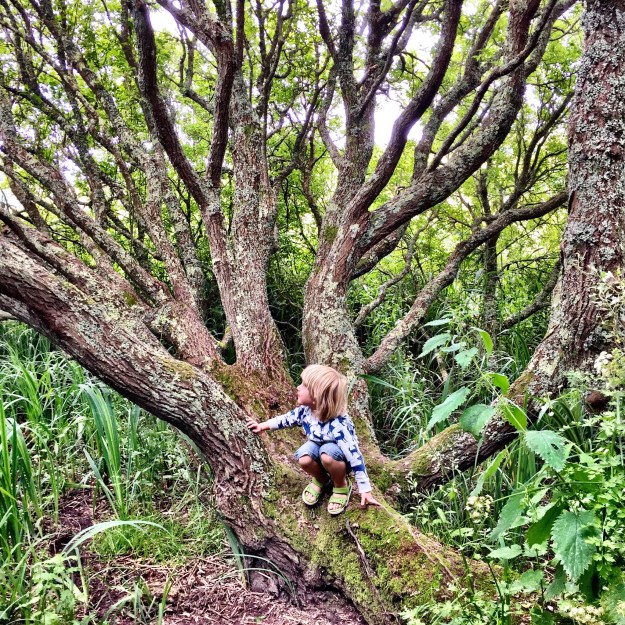
Looking at this boy, poised and full of wonder at the heart of an ancient tree budding with new life, gives me hope that we, too, can find a way to bring ourselves back from the winter that has befallen us.

Linking up with Jodi at Practising Simplicity for The 52 Project. 

On words, and truth

This past week, for me as for many others, has been almost entirely consumed by the EU referendum.

I have been pretty certain of how I would vote since the idea of a referendum was even mooted – I feel more European than I do British, and the thought of walking away from an institution that has successfully secured peace on our volatile continent, and has always been there as a buffer to protect us from the increasingly right-wing leanings of our government, just does not sit easily with me.

IMG_1512.jpg

Still, though, I have wanted to put my conviction to the test – both as an individual and as a town councillor I have wanted to ensure that I am not missing a trick: that I am not so blindly caught up in an emotional response to this seminal issue that I skirt over the facts, and promote a stance that is, in fact, not in the best interests of me or my community.

I expected to discover, as I delved deeper into the realities behind the propaganda, that things were not as clear cut as my gut was telling me. That whilst there were good reasons to Remain, the Leave camp would also have compelling evidence to support their point of view. After all, there are many people just as passionate about getting rid of the EU as there are about staying within it – almost exactly as many, if the polls are to be believed.

But the more I dug, and read, and reflected, the more I became convinced that not only is remaining in the EU the right thing do, but that a huge number of people who are planning to vote to leave are doing so not because they believe that it will lead to a better future, but because they are fed up with the status quo.

They are fed up of there not being enough money to go round, of our resources not being enough to sustain us, of other people deciding their destinies. With this referendum, they have been offered a scapegoat: and bolstered by the lies of the Leave campaigners they have been fuelled to protest against this (to them) faceless organisation that (they believe) has done far more harm than good.

Except they are participating in a ‘revolution’ led by the very people who have the most to gain by reducing their voice even further, and they are protesting against a reality which doesn’t actually exist.

Take fishing, for example.

This is probably the key issue for voters here in Brixham, and the reason why even breathing in the direction of the Remain campaign gets you labelled a traitor and an enemy of our community. When I started looking into what it was that had prompted the fishermen to bedeck their boats with the livery of the Leave campaign, I was almost certain that this was one area where I would be proven wrong: everybody knows that our fishing industry has suffered at the hands of the EU, right? Meaning that, surely, leaving the EU would solve all their woes.

Except the reality isn’t quite that simple.

There is little doubt that, over its lifetime, the fishing policies introduced by the EU have had a negative effect on our fishermen. However, the policies were introduced in response to very real concerns about over-fishing – the impact of which has a potentially devastating effect on both the environment and fish stocks, and therefore on fishermen themselves.

Since Hugh Fearnley-Whittingstall’s Fish Fight campaign the Common Fisheries Policy has actually been subject to considerable reform – and is one of the best examples of how we as a member state of the EU can affect change from within. The figures now actually point to a real growth within our fishing industry, which is heavily reliant on the EU as a market for its exports.

There is still a problem with quotas, but the allocation of these is within the hands of the U.K. Government – it is them that have chosen to favour the huge commercial players at the expense of smaller-scale fishermen.

I completely understand why people in the fishing industry might want to use their referendum vote to retaliate against past injustices, but I do not believe that their position reflects the current realities. Given how many other areas – the NHS, the arts, scientific research (to name but a few) – will suffer if the UK votes to leave the EU, a Leave vote as a protest seems a very, very risky move to make indeed.

This whole issue of risk seems to be the thing that the referendum is hinging on right now. The Leave camp have somehow manipulated themselves into the position where to support them is the maverick move, the thing to do if you are fed up with any aspect of your life within the current system. Nigel Farage, with his hate-fuelled political career, is on the verge of precipitating the biggest shift in our government in my lifetime: he has made people believe that this is the only real opportunity to effect change that we will ever be offered.

But let’s just leap forward thirty-six hours to Friday morning. Let’s imagine what that vote to leave would really mean. We would have not only rejected the views of our current Prime Minister – someone who, on the vast majority of issues, I am utterly polarised from – but we would also have rejected the views of the vast majority of our academics, our business leaders, our artists, our scientists, our health practitioners, our trade unionists. The only group who would be united in celebration of this outcome would be UKIP, and in a blur of fear and propaganda they would have leapt from being a minor political force to the key drivers of our future as a country.

I really hope that is not going to be the case.

There is no doubt that Europe is not perfect, but no aspect of our political system really is. If we vote Leave, we are decisively saying to all of the European countries who want to be our friends, that we have no regard for them – and we have no regard either for the myriad of experts and professionals who have been warning us that this is a very bad idea. And that vote to leave would be conclusive: whatever the consequences there will be no going back, not without convincing the rest of Europe that despite us shunning them so hugely we deserve to be welcomed back into the fold.

If we vote Remain, we are putting our faith in unity. We are recognising that, in the words of the late Jo Cox, “we are far more united and have far more in common with each other than things that divide us”.

There is still a long way to go before this European Union that we are a part of is the perfect fit for all of its members, but those are words that I would like to strive for, and a truth that I believe is the key to the future of our world.


Writing Bubble