Monthly Archives: April 2016

Mud glorious mud

The unschooling diaries: week thirteen

This week, we have finally managed to start sorting the garden out for summer.

It’s not an especially big space, and because our house is essentially built into the cliff face it’s on three different levels – and has no grass. So over the wet, windy Devon winter it really does start to look quite sorry for itself, and I start yearning for a house with a proper garden with room to run and explore.

I’ve realised, though, that there is actually an awful lot we can do with the space we have. Rather than bemoan the lack of lawn, I’ve decided instead to focus on what an interesting space it is, and its huge potential as an outdoor classroom. So, with Arthur taking the lead of course, we’ve been exploring exactly what that might look like – and having lots of messy fun in the process.

We started with some digging and pulling up of weeds in our raised beds. Arthur was very keen to get involved, and was fascinated by the bugs we came across along the way. We found snails, slugs, earthworms, a centipede, woodlice and a caterpillar – and had a good chat about each of them before getting on with our work.

IMG_1397.jpg

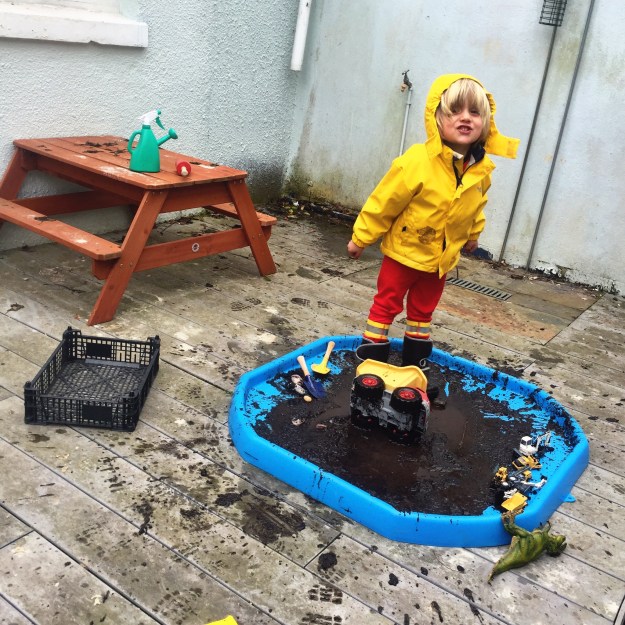
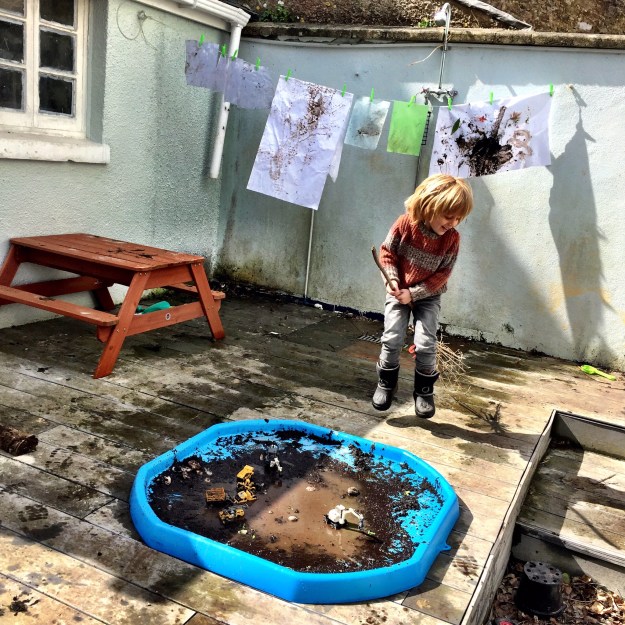
We also got the tuff spot out into the garden, creating a mud-filled paradise for Arthur’s beloved diggers, made even more fun when we added water to the equation.

IMG_1396.jpg

IMG_1395.jpg

We managed to work some arts and crafts in there too. When we were in Lanzarote we’d talked about how Cesar Manrique had used volcanic ash in his paintings – Arthur had been quite intrigued by the unusual textures it created. So, inspired by the puddle that formed after some overnight rainfall, we decided to try some mud art.

We started with some puddle painting, using oil and food colouring to create colourful swirls on the water. This didn’t work brilliantly as Arthur got a bit over excited with the amount of oil he added, but it was still lots of fun!

IMG_1394.jpg

Especially fun was, of course, stamping in the oily puddle – and seeing how much Arthur was enjoying making footsteps on the deck I decided to give him a bit of a canvas.

IMG_1385.jpg

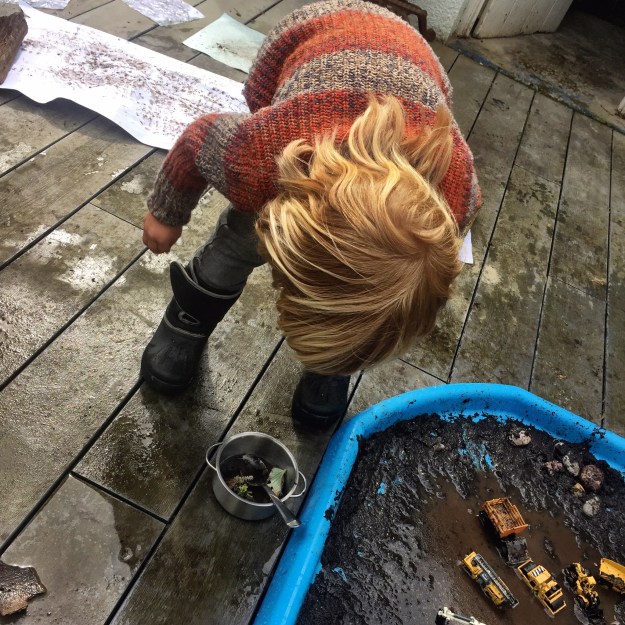
Then, after a slight diversion to make a magic potion, we got properly stuck in and covered a large sheet of paper with pva glue before pouring on the muddy concoction and mixing it up with anything else that took our fancy…

IMG_1393.jpg

There was more focused preparation too, with Arthur climbing inside the raised beds to get the earth ready for planting (and make some mud castles).

IMG_1388.jpg

It was all so much fun! And tidying up was even more so: Arthur was super keen to use the hosepipe, and I in my infinite wisdom let him. It was going great until he accidentally splashed me whilst I was holding the tuff spot, and I yelped, and he laughed, and… well, let’s just say we both got very wet!

IMG_1387.jpg

IMG_1386.jpg

All in all it’s made me very excited about our little garden, and the fun and learning that is going to happen there in the weeks and months to come. There is something about being outdoors that just can’t be beat.


Why SATs are bad for our children

There are many moments that have stayed with me from my ten years of teaching. The overwhelming majority of them are positive, but there is one in particular that has been circling around my head the past few days that makes me feel so sad about what current government policy is doing to our children’s experience of learning.

Early on in the first term of Year Seven, I often broached the question to my English class “What makes good writing?”. It’s a big question, and not one I ever expected to hear answered in its entirety, but still the responses that I got were pretty telling. The particular set of responses I remember was from Autumn 2012, just before I disappeared on maternity leave. Fresh from SATs preparation, hands shot up as I wrote the question on the board, and the answers spilled out proudly into the classroom: “varied sentence starters”, “correct use of conjunctions”, “fronted adverbial clauses”, “using semi-colons”.

Now none of this is strictly wrong, of course – and I dutifully noted each response on the whiteboard before mooting my own ideas. But it was still incredibly deflating to hear it from a room full of eleven year olds. Where was the talk of imagination? Of storytelling? Of creativity? Where was the space for them to fly?
IMG_1384

It is this reduction of learning to rote mechanics that worries me most about the SATs, because the world doesn’t work like that – and yet in order for children to be able to succeed in these exams they have to be trained as if it does. When Key Stage 3 SATs were still around, I remember as an English department poring over questions trying to work out what it was they were actually getting at, and then teaching our students which right answers to put down for which type of question to make sure they got the marks they deserved. It was a preposterous waste of time and energy at a delicate stage in young people’s lives when the cocktail of hormones they were dealing with made the conventions of school pretty challenging anyway.

Still, I can get the argument that (at least within the limitations of our current system) being able to ‘do’ exams is kind of necessary. And I can just about stomach the concept of putting thirteen year olds through that process – at least we could explain to them the whole idea of the hoops they had to jump through, and begin to separate out different types of learning so that the experience didn’t completely extinguish the fire within.

I find it harder to justify for ten year olds, and I think it is such a crushing shame that children’s final year in primary school, a period in education which for many has been characterised by creativity and imagination, is reduced to drills and mock exams and learning ‘right’ answers to the most complex of questions making reopening the door to the potential for real learning a dauntingly challenging task in the years that follow.

Except of course primary school isn’t really like that any more. Not since the reintroduction of KS1 SATs, where children as young as six are now expected to sit formal tests in spelling, punctuation, grammar, reading, arithmetic and reasoning. SIX! The notion of what constitutes correct answers is, from what I have seen, just as convoluted as it was in KS3 – and so drilling is, if teachers are not going to sacrifice the children in their charge (and themselves) on the pyre of government assessment, inevitable.

And then of course there is the question of what all of this drilling occurs at the expense of. Play, for example, and creativity. Various other government initiatives are squeezing out the arts as children move up through the school system, but it is beyond belief that they should be marginalised at this crucial early stage. It goes against all of the research, the experience and the professional instinct that should guide our education system. When I admit that as a result of the regressive nature of government reforms I am reluctant to enrol my child in nursery, friends are quick to defend the relative freedoms that are still enjoyed in the early years. They go quiet when we get on to what starts to happen in year one.

All of this is part of why I am no longer teaching, and is a major driver in my decision to home-educate my son – for the first few years at least. My approach as a teacher always meant that there was a degree of rallying against the system – I wanted to see my students grow as individuals, to try to find creative ways of managing assessment that did not compromise their own personal development. During the bulk of my career, it felt at least as if I was moving with the tide – that what I innovated with one year I could integrate the next as Labour education policy responded to the needs of teachers and schools. And then the Tories came to power.

I could still be fighting the battle from the inside – I have untold respect and admiration for my former colleagues that are – but it is just so exhausting to have to make your classroom a fortress against the outside world, and I have a family to think about now.

My son is three: he is curious, brave, funny, unique and creative. He has many subjects he is passionate about, and is developing his own clear preferences for how he likes to learn about them. I want to nurture those in him, to enable him to find his way through the world in a way that it keeps its wonder, and where he gets to cherish his uniqueness, not play it down to fit in within the system and win validation for himself, his teachers and his school.

These KS1 SATs don’t give children levels; they don’t take a formative approach to identifying their strengths and areas for development; they don’t recognise that each and every child will progress in different areas at a different pace: they just indicate whether they have reached the required standard, whether they have passed or failed, whether or not they are ‘good enough’ at this stage in their lives.

I cannot imagine putting my little boy through that in three years time.

And it looks like I am not alone.

A campaign is gathering pace to undermine the KS1 SATs with a children’s strike on the 3rd of May. Yet more parents are calling for a boycott of the KS2 SATs, where the expected standards have risen so sharply that children are being set up to fail more than ever before. Parents up and down the country are uniting to say that this dismantling of their children’s childhood is simply not OK, that to stop their kid’s learning in its tracks by subjecting it to meaningless assessment is not something they want to be a part of.

My son is too young for me to be able to make a stand in this way, but I will be taking the opportunity on that day to demonstrate just what learning can look like when we set it free: to tell the story of our learning journey on this blog and on social media, to show how much fits into a day when it is not constrained by the need to learn to jump through hoops.

If you too are angry about what current government policy is doing to our schools, teachers and most importantly our children, then I hope that you will join me.


Edited 16th April 2016:

In response to our general disbelief at the way the government are decimating our education system, myself and Maddy from Writing Bubble have started a campaign to show them what learning really looks like. 

To find out more, check out our launch post and join our Facebook group. It would be awesome to have you on board.


Writing Bubble

15/52

IMG_1380.jpg

“A portrait of my child, once a week, every week, in 2016.”

I will never get tired of being able to just pop to the beach on our way home from whatever else it is we’re doing. And I love that this one thinks it is entirely normal: sand in his toes and the sea stretched out behind him, his world an ocean of possibilities just waiting to be explored.

Linking up with Jodi at Practising Simplicity for The 52 Project. 

Learning (loads) in Lanzarote

The unschooling diaries: weeks eleven and twelve

We spent a week in the Canary Islands over Easter, and once again I have been blown away by just how much there is to be learnt from travelling. We weren’t even motivated by anything more than the desire to get away somewhere warm and spend some quality time as a family, but the tremendous scope for discovery and new experiences that Lanzarote had to offer completely surpassed our expectations.

SAM_1787.jpg

We were especially lucky, I think, with the base we chose. We stayed in the most wonderful eco-resort in the North of the island, away from the main tourist trail. We slept in gorgeous yurts, which was an experience in itself. Our closest neighbours were chickens, ducks and donkeys, and there was a lovely solar-heated pool. Not forgetting the playground, which was right outside our little complex: it had a trampoline, and climbing frames, and a boat, and sand, and dump trucks, and little houses, and for Arthur it very quickly became home.

Outside of our little idyll, there was a whole new world to explore.

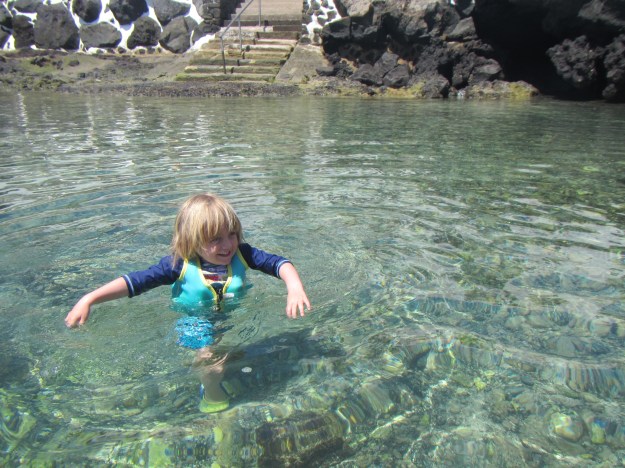
Unsurprisingly, the sea was central to much of our experience: admiring it, travelling across it, eating its many fruits, and of course swimming in it. We found an incredible lagoon, and some magical tidal pools. Between those and the pool Arthur well and truly shook off any wintery reluctance to jump right in, and his confidence and skill in the water came on in (literal) leaps and bounds.

IMG_9660.jpg

IMG_9403.jpg

He was mesmerised by the little fish that swam around our ankles as we paddled and splashed, but it didn’t stop him enjoying them on his plate, too… I’m not sure how many three year olds would demolish boquerones with quite as much relish as this one did. I like that he’s happy to eat fish that looks like fish, though – and that it gave us the opportunity to talk about where it came from and how it had been caught. I don’t want to freak him out about the food he eats, but I think it’s useful to be able to make the connections and understand our world better – especially when it’s him asking all the questions!

IMG_4039.jpg

Away from the sea, there were of course the volcanoes. In the run up to our trip we’d watched some videos and talked about the volcanoes we were likely to see there, and wherever we went Arthur was full of questions about the nature of the mountains around us. We took a (very windy) trek into the lava fields, climbing up to the top of one volcano to peer into the caldera and walking into the depths of another. Both were long dormant, but that didn’t stop the incredible power of nature being evident everywhere we looked.

IMG_4537.jpg

IMG_1365.jpg


One of the other highlights of our trip was completely unexpected. I had never heard of Cesar Manrique, but he was an inspirational artist and architect who through his work and his vision had an enormous impact on the infrastructure of the island. We visited several of the sites he created, and Arthur soaked up the paintings and the sculptures and the unusual spaces, as well as being fascinated by the exhibitions about the landscape around us.

IMG_1376.jpg

IMG_1378.jpg

Last but very much not least, inspired by an advertising board that caught Arthur’s eye in the airport, we took a trip on a submarine. It was the first time any of us had been on an actual submarine voyage, and it blew all of our minds a little bit – but especially Arthur’s. Just the whole mechanics of it was pretty exciting, watching the little screen at our seat compute our depth, the pilots with their illuminated control panel and the propellers at the rear. And out of the window we saw wrecks, lots of fish, and even a diver feeding a huge ray. It was pretty cool.

It was all pretty cool, actually. And it really got me thinking about how we can work some longer trips into the next few years. It’s one of the main reasons I’m not super keen about getting stuck back into the constraints of the school system any earlier than I have to, and why I’m trying to evolve my working life into one I can take on the road with me.

We shall see…

For now, though, we have plenty of memories to be mulling over. I’m going to make a photobook for Arthur so that we can pull it out from time to time and be inspired afresh by our experiences. It’s a lot to compute for a growing mind after all!


Why early mornings are good for my wellbeing as well as my word count

My efforts to be an early bird have ground to a halt since coming back from holiday. It was only a week, but I clearly did such a good job on getting away from it all and relaxing that I have completely forgotten how to motivate myself to get up in the morning – and it’s not just my writing that’s suffering.

Before I went away I had a post milling around in my head about how many unexpected upsides there were to getting up early to write: now seems like a very good time to get it down, and remind myself of all those reasons in the process…

IMG_1361.jpg

It makes for a much healthier start to the day

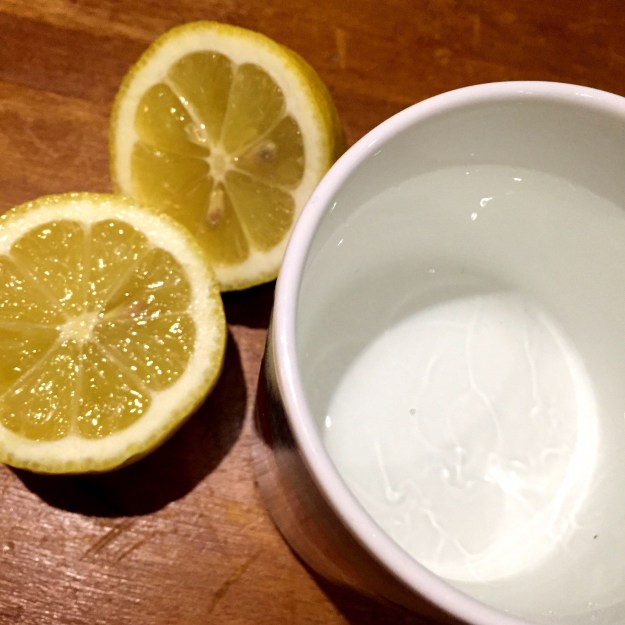
I’m not entirely sure why, but waking up earlier seems to reduce my desire for coffee. I find myself feeling all virtuous and full of good intentions, so my early-morning typing will be accompanied by hot water and lemon and a large glass of berocca – saving the all-important coffee for later. My mum has long extolled the benefits of lemon water first thing, and it certainly seems to have some sort of magical properties! It might just be that I’m taking time to hydrate myself properly before starting on the caffeine, but for whatever reason that just doesn’t seem to happen when I’m getting up an hour or two later with a toddler scampering around my ankles.

It lets me focus on writing before my head gets too full with everything else

I’ve written about the positive effect starting early has on my writing before, and in the six weeks since then my word count has climbed by almost 25,000 to 38,000 words. I’m not going to pretend those words have always been easy to come by, but they are a damn sight easier to put my finger on first thing in the morning than later in the day. The last two days, having wasted away those precious minutes with the snooze button, I’ve tried to sit down and write in the afternoon – but nothing. Not a jot. There is simply so much else going on in my world that even if I turn over my to do list it’s still glaring at me from the corners of my mind. First thing in the morning, it doesn’t get a look in – I’m pretty sure my brain knows that it should count itself lucky enough that I’m even awake, let alone tackling all the other things I should be doing.

It means I can spend the rest of the morning playing without feeling guilty

Playing is a serious business in this house. Having taken the decision to unschool my preschooler rather than sending him to a childminder or nursery to engage in the early years curriculum, I know that I have a responsibility to tune in to his learning needs – which at the moment are all about play. He is getting increasingly good at playing independently, but he of course loves it when I join in – and we try to get out of the house as much as we can too, to meet friends or do group activities or just explore our neighbourhood. If I’m not careful, I can spend half of this time with my mind elsewhere or my eyes on my phone, trying desperately to fit in little snippets of work. But if I’ve already squared away a good stint of writing before he’s even up then I find it way easier to be fully present for this time, saving up the other tasks for when he’s chilling in the afternoon.

It lowers my stress levels for the rest of the day

This completely links to the point above, but I think it’s important not to underestimate how powerful starting your day with a good dose of achieving is for your self-esteem. When I don’t manage to get up to write, I spend the rest of the day chasing my tail, being eaten away by the niggling feeling that I’ve let myself down.

It makes me less tired

Now this one’s a bit counter-intuitive, but I guess makes sense when considering everything else. My justification for the repeated tap of the snooze button as 6am gradually disappears from view is that if I could only get a bit more sleep then the rest of the day would be so much more manageable. But that never actually seems to be the case. If I don’t take charge of my day, and instead fritter away the beginnings of it in broken sleep, then when I am finally forced out of bed by a hungry toddler I am way more weary than I would otherwise have been. And it doesn’t go away either – without the boost of confidence and everything else that comes from starting early I find myself sleepwalking through the rest of the day, counting down the minutes until I can collapse into bed again. Until the evening of course, when that second wind creeps over me and makes me stay up way too late. Again.

Now I realise that for those of you to whom early morning chirpiness comes naturally much of this will seem painfully obvious. But it does not come naturally to me: I have, for as many of the last thirty-seven years that I can remember, been a fully fledged night owl.

The time has clearly come for a shift, though. And I’ll be taking these words with me to bed tonight to make sure that at 6am tomorrow morning that snooze button doesn’t even get a look in.


Writing Bubble


You Baby Me Mummy

13/52 & 14/52

IMG_1360

IMG_1358

“A portrait of my child, once a week, every week, in 2016.”

We were away last week, on a much-needed family holiday in Lanzarote. We have come back with wonderful memories and far too many fabulous photos. It’s going to take me a while to process them all, but in the meantime here are two of my favourites…

The first, from Easter Sunday. Our yurts made an unusual setting for an egg hunt, but I was determined that Arthur would have that experience this year. He loved it – a little confused as to how he’d manage to miss the Easter bunny whilst he was having his breakfast, but delighting in finding the little foil wrapped morsels of chocolate. He unwrapped each one with such care, savouring the aroma before taking little bites and letting the flavour explode in his mouth.

The second, towards the end of our trip. We joined a trek to two of the island’s volcanoes, and entering the lava fields was much like I imagine it might be to walk on the moon. Arthur was happy to stay in the sling for the first part of our explorations, but when the ground flattened out he was desperate to get down for a run. Buffeted by the wind, he squealed with joy as he immersed himself in this strange new world.

Linking up with Jodi at Practising Simplicity for The 52 Project.