Category Archives: Sophie is educating

Mud glorious mud

The unschooling diaries: week thirteen

This week, we have finally managed to start sorting the garden out for summer.

It’s not an especially big space, and because our house is essentially built into the cliff face it’s on three different levels – and has no grass. So over the wet, windy Devon winter it really does start to look quite sorry for itself, and I start yearning for a house with a proper garden with room to run and explore.

I’ve realised, though, that there is actually an awful lot we can do with the space we have. Rather than bemoan the lack of lawn, I’ve decided instead to focus on what an interesting space it is, and its huge potential as an outdoor classroom. So, with Arthur taking the lead of course, we’ve been exploring exactly what that might look like – and having lots of messy fun in the process.

We started with some digging and pulling up of weeds in our raised beds. Arthur was very keen to get involved, and was fascinated by the bugs we came across along the way. We found snails, slugs, earthworms, a centipede, woodlice and a caterpillar – and had a good chat about each of them before getting on with our work.

IMG_1397.jpg

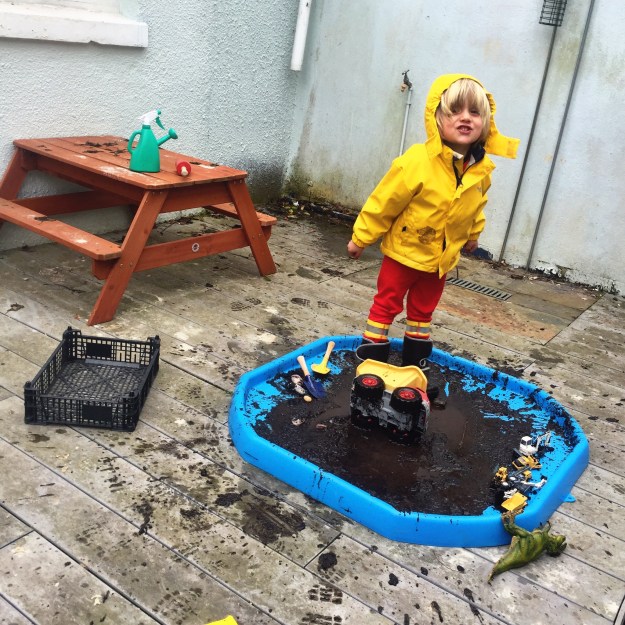
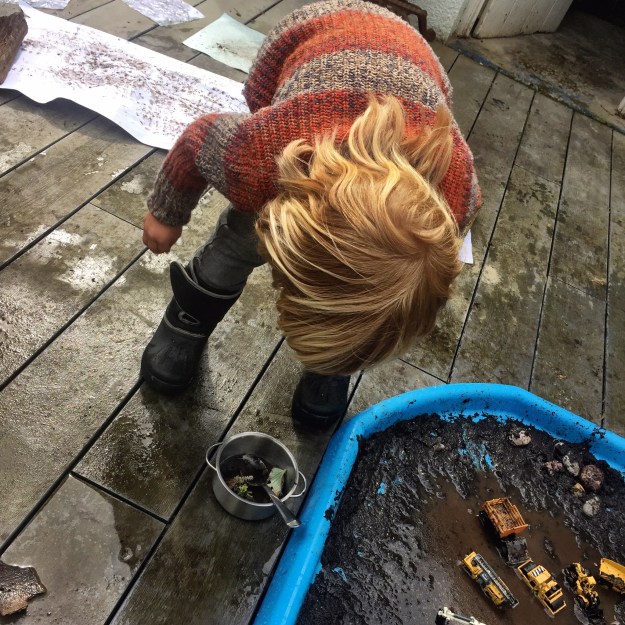
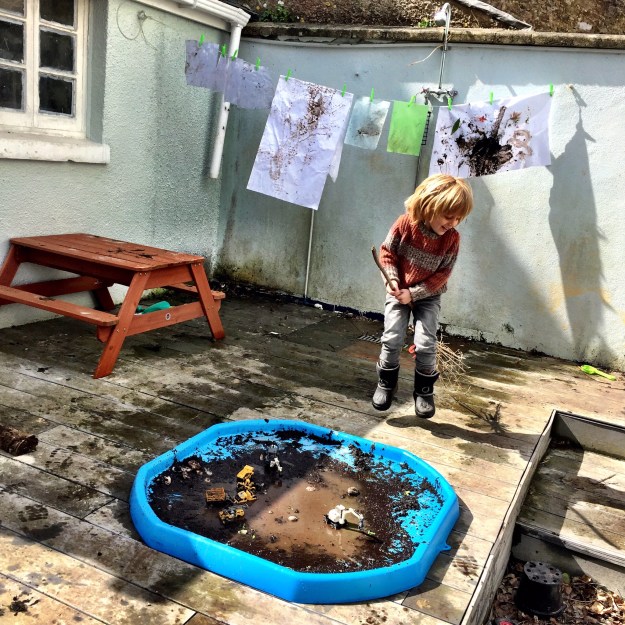
We also got the tuff spot out into the garden, creating a mud-filled paradise for Arthur’s beloved diggers, made even more fun when we added water to the equation.

IMG_1396.jpg

IMG_1395.jpg

We managed to work some arts and crafts in there too. When we were in Lanzarote we’d talked about how Cesar Manrique had used volcanic ash in his paintings – Arthur had been quite intrigued by the unusual textures it created. So, inspired by the puddle that formed after some overnight rainfall, we decided to try some mud art.

We started with some puddle painting, using oil and food colouring to create colourful swirls on the water. This didn’t work brilliantly as Arthur got a bit over excited with the amount of oil he added, but it was still lots of fun!

IMG_1394.jpg

Especially fun was, of course, stamping in the oily puddle – and seeing how much Arthur was enjoying making footsteps on the deck I decided to give him a bit of a canvas.

IMG_1385.jpg

Then, after a slight diversion to make a magic potion, we got properly stuck in and covered a large sheet of paper with pva glue before pouring on the muddy concoction and mixing it up with anything else that took our fancy…

IMG_1393.jpg

There was more focused preparation too, with Arthur climbing inside the raised beds to get the earth ready for planting (and make some mud castles).

IMG_1388.jpg

It was all so much fun! And tidying up was even more so: Arthur was super keen to use the hosepipe, and I in my infinite wisdom let him. It was going great until he accidentally splashed me whilst I was holding the tuff spot, and I yelped, and he laughed, and… well, let’s just say we both got very wet!

IMG_1387.jpg

IMG_1386.jpg

All in all it’s made me very excited about our little garden, and the fun and learning that is going to happen there in the weeks and months to come. There is something about being outdoors that just can’t be beat.


Why SATs are bad for our children

There are many moments that have stayed with me from my ten years of teaching. The overwhelming majority of them are positive, but there is one in particular that has been circling around my head the past few days that makes me feel so sad about what current government policy is doing to our children’s experience of learning.

Early on in the first term of Year Seven, I often broached the question to my English class “What makes good writing?”. It’s a big question, and not one I ever expected to hear answered in its entirety, but still the responses that I got were pretty telling. The particular set of responses I remember was from Autumn 2012, just before I disappeared on maternity leave. Fresh from SATs preparation, hands shot up as I wrote the question on the board, and the answers spilled out proudly into the classroom: “varied sentence starters”, “correct use of conjunctions”, “fronted adverbial clauses”, “using semi-colons”.

Now none of this is strictly wrong, of course – and I dutifully noted each response on the whiteboard before mooting my own ideas. But it was still incredibly deflating to hear it from a room full of eleven year olds. Where was the talk of imagination? Of storytelling? Of creativity? Where was the space for them to fly?
IMG_1384

It is this reduction of learning to rote mechanics that worries me most about the SATs, because the world doesn’t work like that – and yet in order for children to be able to succeed in these exams they have to be trained as if it does. When Key Stage 3 SATs were still around, I remember as an English department poring over questions trying to work out what it was they were actually getting at, and then teaching our students which right answers to put down for which type of question to make sure they got the marks they deserved. It was a preposterous waste of time and energy at a delicate stage in young people’s lives when the cocktail of hormones they were dealing with made the conventions of school pretty challenging anyway.

Still, I can get the argument that (at least within the limitations of our current system) being able to ‘do’ exams is kind of necessary. And I can just about stomach the concept of putting thirteen year olds through that process – at least we could explain to them the whole idea of the hoops they had to jump through, and begin to separate out different types of learning so that the experience didn’t completely extinguish the fire within.

I find it harder to justify for ten year olds, and I think it is such a crushing shame that children’s final year in primary school, a period in education which for many has been characterised by creativity and imagination, is reduced to drills and mock exams and learning ‘right’ answers to the most complex of questions making reopening the door to the potential for real learning a dauntingly challenging task in the years that follow.

Except of course primary school isn’t really like that any more. Not since the reintroduction of KS1 SATs, where children as young as six are now expected to sit formal tests in spelling, punctuation, grammar, reading, arithmetic and reasoning. SIX! The notion of what constitutes correct answers is, from what I have seen, just as convoluted as it was in KS3 – and so drilling is, if teachers are not going to sacrifice the children in their charge (and themselves) on the pyre of government assessment, inevitable.

And then of course there is the question of what all of this drilling occurs at the expense of. Play, for example, and creativity. Various other government initiatives are squeezing out the arts as children move up through the school system, but it is beyond belief that they should be marginalised at this crucial early stage. It goes against all of the research, the experience and the professional instinct that should guide our education system. When I admit that as a result of the regressive nature of government reforms I am reluctant to enrol my child in nursery, friends are quick to defend the relative freedoms that are still enjoyed in the early years. They go quiet when we get on to what starts to happen in year one.

All of this is part of why I am no longer teaching, and is a major driver in my decision to home-educate my son – for the first few years at least. My approach as a teacher always meant that there was a degree of rallying against the system – I wanted to see my students grow as individuals, to try to find creative ways of managing assessment that did not compromise their own personal development. During the bulk of my career, it felt at least as if I was moving with the tide – that what I innovated with one year I could integrate the next as Labour education policy responded to the needs of teachers and schools. And then the Tories came to power.

I could still be fighting the battle from the inside – I have untold respect and admiration for my former colleagues that are – but it is just so exhausting to have to make your classroom a fortress against the outside world, and I have a family to think about now.

My son is three: he is curious, brave, funny, unique and creative. He has many subjects he is passionate about, and is developing his own clear preferences for how he likes to learn about them. I want to nurture those in him, to enable him to find his way through the world in a way that it keeps its wonder, and where he gets to cherish his uniqueness, not play it down to fit in within the system and win validation for himself, his teachers and his school.

These KS1 SATs don’t give children levels; they don’t take a formative approach to identifying their strengths and areas for development; they don’t recognise that each and every child will progress in different areas at a different pace: they just indicate whether they have reached the required standard, whether they have passed or failed, whether or not they are ‘good enough’ at this stage in their lives.

I cannot imagine putting my little boy through that in three years time.

And it looks like I am not alone.

A campaign is gathering pace to undermine the KS1 SATs with a children’s strike on the 3rd of May. Yet more parents are calling for a boycott of the KS2 SATs, where the expected standards have risen so sharply that children are being set up to fail more than ever before. Parents up and down the country are uniting to say that this dismantling of their children’s childhood is simply not OK, that to stop their kid’s learning in its tracks by subjecting it to meaningless assessment is not something they want to be a part of.

My son is too young for me to be able to make a stand in this way, but I will be taking the opportunity on that day to demonstrate just what learning can look like when we set it free: to tell the story of our learning journey on this blog and on social media, to show how much fits into a day when it is not constrained by the need to learn to jump through hoops.

If you too are angry about what current government policy is doing to our schools, teachers and most importantly our children, then I hope that you will join me.


Edited 16th April 2016:

In response to our general disbelief at the way the government are decimating our education system, myself and Maddy from Writing Bubble have started a campaign to show them what learning really looks like. 

To find out more, check out our launch post and join our Facebook group. It would be awesome to have you on board.


Writing Bubble

A lesson in slow crafting

The unschooling diaries: week ten

Arthur has yet to show much of an interest in arts and crafts. When he was tiny he just couldn’t abide the mess – he’s still not super keen on getting paint on his hands. Now that he’s older he’ll dabble, but it’s still really not his ‘thing’.

I’m ok with that – mostly – even though my inner crafter is crying out for an excuse to spend afternoons surrounded by tissue paper and glitter and it really doesn’t help my fear that he’s missing out on something by not being at nursery when I see all the pictures of toddler creations fellow mums share proudly on Facebook. But when over breakfast one day last week he started getting enthusiastic about the idea of making some Easter cards I couldn’t help but get a bit excited. Not least because it meant we might finally got round to saying an extremely belated thank you for his birthday and Christmas presents…
The teacher in me leapt to the blackboard to note down his ideas (sidetracked a little by Winnie the Pooh as his most vivid understanding of Easter comes from ‘Springtime with Roo’ – I have no idea where the armour came from).

He happily settled on the idea of painted eggs though – he frequently dances around singing ‘we’re hunting eggs today!’ at the moment, and I’m very much looking forward to his very own egg hunt on Sunday. He then decided he wanted chicks in his eggs (well he said ducks, but I think that’s what he meant…) which led us very nicely to an easy to accomplish collaborative card idea. It might not be very original, but he liked it.

Having bought in some supplies (very important to have the right shades of glitter), and prepped some eggs for him to decorate, we set aside a couple of hours last weekend to make a start. And he of course lost interest within approximately three and a half minutes.

I battled with him for another two before reminding myself that that really was not the point, and calmly telling him that it was fine – we’d come back to it when he felt like it. I didn’t tidy everything away, just organised his workstation enough for it not to descend into total chaos. And sure enough the next day he gravitated towards his eggs again, did a few more minutes of gluing and glitter scattering, and moved on.

And that’s sort of been the background to this week, really. Every so often this little activity has piqued his interest again, and he’s added a little to his eggs. We’ve tried out a few different techniques along the way – stamping, mixing colours to get the shade of pink he wanted, watering paint down so he could ‘dye’ his eggs, mixing it in with glue and glitter. And every time, just as I thought he might be getting into it, he’s walked away again, his attention taken by his diggers or the urgent need for a banana.

We’re still not quite done, but we’re getting there. He’s declared that the eggs are finished at least, so there’s just a bit of cutting and sticking left. I might need to take the lead on that bit, what with it being Good Friday tomorrow and everything, but I reckon that’s ok. I can’t expect him to do all the work!


The unschooling diaries: week one

The past week or so has been somewhat dominated by potty training. I say ‘training’… My approach to this has been as much led by Arthur as anything else – hence why perhaps it has taken so long! I think it was about a year ago that we last broached the idea – let him sit on the potty from time to time, hung around naked if he felt like it (which wasn’t very often). We had sort of decided that last summer was going to be when we cracked it, but he had other ideas. And if there’s one bit of advice that seems to crop up again and again when it comes to potty training it’s don’t rush it. So we waited.

And suddenly he seems to be up for it. Which is great. But a little all consuming too… We haven’t quite worked out the logistics of wearing trousers, or leaving the house. And I need to make sure I’m paying attention as things are all pretty time dependent at the moment. But, you know, we’re getting there.

IMG_1270.jpg

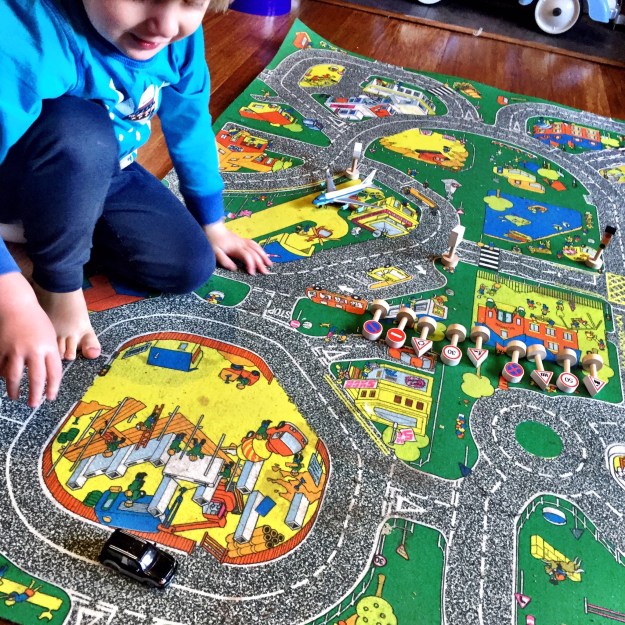
As well as learning to use the potty, Arthur is really enjoying creating worlds with his cars at the moment. And trucks, and nee naws, and planes. He’ll start them on his road mat but their adventures often take them all over the house. We’ve been experimenting with road signs, too. He always wants to know what different signs mean when we’re out and about, and having these little toy signs is adding another dimension to his play.

IMG_1260.jpg

It’s not just signs he’s interested in – he wants to know what letters and numbers mean too. He likes the challenge of his alphabet puzzle, and loves the song that we’ve decided goes with it. It’s going to be a while before he really understands what it’s all about, but we’re having lots of fun with it in the mean time.

IMG_1259.jpg

He’s been interested in another puzzle too, one we’ve had for ages but hasn’t kept his focus until now. I like it because it isn’t exactly clear how you’re ‘meant’ to organise it – so there’s plenty of opportunity for interesting chat whilst we’re thinking about how its pieces might group together.

IMG_1263.jpg

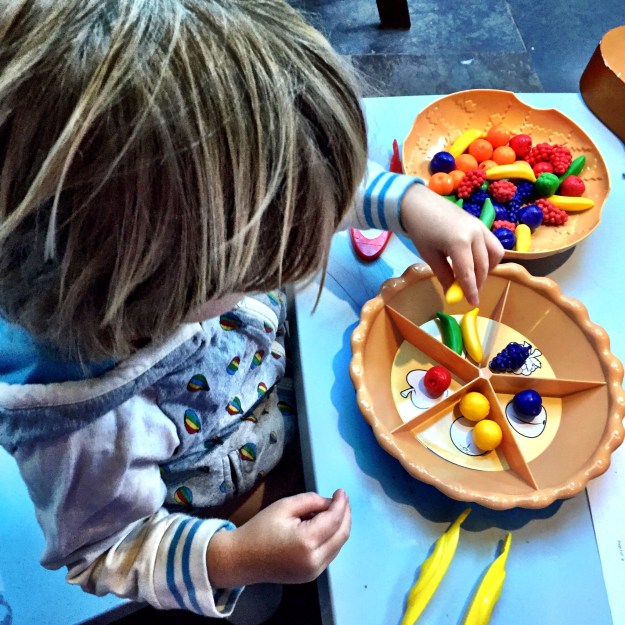
Exploring options for grouping things has been fun with the sorting pie too. Up until now we’ve mainly done it by colour, but now that Arthur’s mastered that he’s been trying it by different types of fruit instead. It was clear at first that he really didn’t like putting the green bananas with the yellow ones but he’s been getting the hang of it…

IMG_1268.jpg

We’ve had the playdoh out this week too – just for playing, really, rather than making anything in particular. Though Arthur did fashion a rather fetching moustache!

IMG_1265.jpg

IMG_1271.jpg

And for more mushy creative fun there was SUSHI! One of this household’s hands down favourite foods, and one we will definitely be making more of in the future.

IMG_1269.jpg

We haven’t managed to get out and about that much (potty training and WEATHER), but when we have it has mainly involved Arthur’s new scooter. He’s definitely getting the hang of it, but I’ve been very grateful for his helmet!

IMG_1267.jpg

IMG_1266.jpg

We’ve been out to Arthur’s various groups too, drama and singing at Project Performers, and his gymnastics class where he has really impressed me by holding his own in a new group without me by his side. Last weekend he went to his first Rugby Cub’s session too – I’m not entirely convinced about rugby as he gets older, but whilst it’s just ball play I reckon we might as well make the most of it!

And today we went for a family swim – our first in ages. Arthur loved it so much I think we’re going to need to make that a regular thing too. I’m still toying with the idea of lessons, but he’s getting on so well in his float suit we might just keep having fun with it for now.

Finally there are of course the drums. There’s a strong sense of rhythm there, that’s for sure. And I’ve invested in some practice pads, so hopefully it’s not proving too unbearable for the neighbours…

IMG_9542.jpg

Unschooling a preschooler

I am fascinated by learning. What ignites the first spark, how knowledge and understanding become embedded, the directions these can take people in as their lives unfold. As a teacher, this informed my whole pedagogy. I didn’t want to stand at the front of a silent classroom and speak, filling supposed empty vessels with the fruits of my superior intellect. I wanted to inspire, to start the young people in my charge on a journey of discovery which would hopefully take them way beyond the walls of the school. So much of education, it seemed to me, was about fitting square pegs into round holes – and I just didn’t want to be part of that.

If as a teacher, though, the constraints of our education system were frustrating, as a parent I find them positively frightening.

I look at my unique, bright, inquisitive boy and I can’t quite comprehend how he will benefit from being subjected to rigorous standardised tests. Whilst I have every faith in the intentions of the vast majority of teachers to bring out the best in each of their students, I worry about how their resolve will hold in the face of ever-increasing external pressures. Fundamentally, my fear is that the government do not want to foster a populace driven by individual thought and opinion. And I do not want to do my son the disservice of reducing him to being merely a cog in the machine.

IMG_1246

It is for these reasons that, after years of being a passionate supporter of state education, I find myself reluctant to begin the process of enrolling him in one of our local schools. He is a while off compulsory education, but at three years old he is already unusual amongst his peers in that he does not attend nursery or pre-school. He will be more unusual still if I follow through on my instinct, bubbling just below the surface, to keep him out of formal education until he is at least seven. By this age, I would hope, he would be resilient enough to navigate school as an informed and engaged individual. Many educational experts believe that this is the age at which children are best suited to enter formal schooling – a theory born out by successful education systems all over the world.

I am mindful, though, that there is an awful lot I am trying to do with my days: writing novels, representing my community on my town council and as a school governor, acting as a subject consultant for Ofqual. The question of how I am going to find time to provide meaningful learning experiences for my preschooler has not passed me by.

Except… My experience as a teacher has taught me that much of the school day is spent managing a large volume of children rather than focusing on individual learning – I can only imagine that this is even more pronounced in early years than it is in Secondary. And my aspiration with my son, just as much as with the pupils I have taught in a school environment, is to be a facilitator rather than a font of all knowledge. I want his learning to be driven by his natural inquisitiveness, not constrained by what I feel he needs to know and understand.

And it is this that has led me to unschooling. As an advocate of child-led parenting in the baby and toddler years, and student-centred learning in the secondary school, it seems the logical path for me to follow as I look to foster a love of learning in my son.

With this in the back of my mind, I am beginning to see the play that unfolds in our everyday lives – both self-directed by Arthur and shaped (loosely) by me – in a new light. It is my intention to begin to document this, for my own reflection and maybe to inspire others too. I will never be able to capture every aspect of his learning, but what I can do is focus in on some little key moments from our weeks and reflect on them as a sort of learning journal: an unschooling journal, if you like.

It was that I had intended to do when I sat down to write this post, but thought I should maybe take a little time to explain my approach – something which took a little longer than I’d thought it might. As with many things, though, I’m much more convinced about what it is I am actually doing having taken the time to write about it: so the first instalment should be coming up very soon!

Inspiring teachers, inspiring change

When I was teaching, one of my favourite parts of the job was writing resources: designing activities, constructing lessons, developing whole schemes of learning. In a profession that regularly came under fire from different angles, it was a way of maintaining some semblance of control. And I enjoyed the creativity it required – the challenge of fitting all of the different external requirements into activities that I felt were genuinely a good use of my – and my students’ – time. Above all it was a way of ensuring that I could be the teacher I wanted to be – both in the content I taught, and how it was delivered.

As well as offering plenty of opportunities for developing different skills, the subjects I taught – English, Media and Drama – lent themselves well to exploring ‘issues’. I felt that a vital part of my role was engaging students in the world around them; opening their eyes to things they might not otherwise know about, and challenging the status quo. There was something very political about it, though not in the sense of trying to impose my views on others. What I strove to do was to get young people asking questions, to present them with a range of resources but equip them also with the tools they needed to find things out for themselves.

Though I’m extremely busy not teaching at the moment, the burgeoning refugee crisis we are currently facing has made me long to be back in the classroom. It really bothers me that the mainstream media presents such a narrow (often heavily biased) range of views, and that depending on the online circles people move in the (mis)information on social media can be even worse. And it bothers me too that with the avalanche of new demands teachers have faced in recent years they might struggle to find time to tackle these issues with young people.

So, as the most recent draft of my novel neared completion, I found my mind wandering to a scheme of learning I’d been involved in writing some years back. We called it ‘Refugees and the Media‘, and the focus was on trying to uncover the truth behind the headlines which were – at the time – often extremely biased against refugees and asylum seekers.

IMG_1226

It needed updating, and reining back in after various evolutions, but I thought it might be one thing I could do to attempt to make just a small difference in the lives of the people who are affected by our misconceptions.

The title of this blog post might be ambitious, but it is this that I am attempting to do: to inspire teachers to use some of their time in the classroom to open up discussion around the way in which meaning is constructed in the media, particularly around refugee issues, so that they might inspire their students to think differently, and that through them we might begin to inspire change in our world.

I’ve decided to share the resources here on my blog. They’re not especially groundbreaking, and they borrow from a range of different sources, but they are comprehensively researched and tried and tested in the classroom. So if you are a teacher and you think you might be able to use them, then please do. And if you know anyone else that might find them useful, then please pass them on.

It’s hard to know how to make a difference these days – sat here at my keyboard rather than stood at the front of a classroom – but I’m hoping that this might just be one small way I can.


Writing Bubble

Why teaching is actually pretty awesome

image

I’ve spent a lot of time on here pondering on what’s wrong with education. And for good reason – there’s much about the system that frustrates me enormously, especially under the current government. But actually I truly loved the time I spent as a teacher, and I hope to go back to it one day. When I was teaching, I threw myself into it wholeheartedly. Great when I had no ties but not so great with a young family.

There’s a lot of work to be done on ensuring teaching remains a good career choice for people once their own children become part of the equation. But I’m still pretty convinced that for enthusiastic and ambitious graduates there are not many career paths that are as fulfilling.

So when I was asked by The Guardian to write an article encouraging sixth-form students to consider training as a teacher when they leave school, I jumped at the chance.

You can read that article here.

And if you want to read some of my other (slightly more cynical) articles on the world of education you’ll find them here.

Because teaching as a career isn’t perfect – but it’s still pretty awesome.

Mama and More