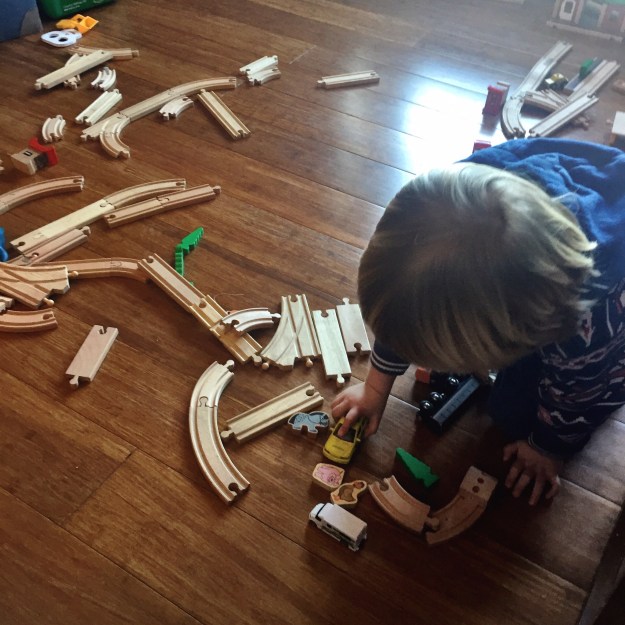
My son has not been 100% the past few days, which has meant much more time sitting on the sofa having cuddles than usual. During one of these moments yesterday afternoon, whilst savouring the calmness of the three year old nestled at my chest, I had a bit of a revelation.
I found myself looking at my bookshelves, idly imagining my own published work sitting up there one day, and then it struck me: the overwhelming majority of the books in my life were written by men.
I couldn’t in that moment put my finger on why that was, but I knew it was significant for me – as a woman and as a writer. So today, what with it being International Women’s Day, I decided to do a little investigation.
As I am so often wont to do, I turned my gaze inwards first: tried to work out what it was about me that had led to such a literary gender imbalance. These books I have around me chart my reading history back to my teens. I have never got around to organising them in any particular way, and the resulting cacophony of titles is not easy to analyse, but however many times I went back again to look the facts remained the same: I have, over the past twenty years of my life as an avid adult reader, amassed a library which is almost entirely male-generated.
McEwan, Banks, Rushdie, Murakami, Self: all literary idols of my teens and twenties, all fantastic authors in their own right, but peculiar role models for a young woman trying to find her way in the world.
I didn’t think so at the time of course. I remember having a strong desire to be taken seriously as a reader and as an intellectual in my very male-dominated social and family circle. I remember arrogantly dismissing Austen – the only female author I remember studying at school – for what I saw as her obsession with vacuous romance. I remember being switched off by chick-lit as frivolous and a waste of reading energy (though I never looked beyond the covers to find out if that was actually true).
Of course as time went on I read – and loved – books by female authors too. Just not enough.
As my mind shifted to the context of all this I began to wonder whether it was merely a phenomenon isolated to my own book collection. I suspected probably not – certainly my sense of the world of the professionally respected writer is of one that is very male dominated. But I had already established that my lifetime’s research in this field was somewhat skewed, so I figured it was worth investigating.
Turns out it wasn’t just me. A quick google search threw up a woman whose novel proved eight times more attractive to agents when submitted under a male pseudonym; a study which revealed that 75% of the books reviewed in the London Review of Books and the Times Literary Supplement were written by men. I’m sure further research would have given me plenty more reassurance, but I’m pretty confident that it’s not just my bookshelves that are biased.
The reason why is somewhat more elusive. Are there actually less female authors than male ones – or good ones anyway? This question was explored at length in a fascinating essay written by Francine Prose in 1998, resurfacing when V.S.Naipaul expressed a similar disparagement towards Jane Austen as my teenage self in comments he made in 2011. The answer is of course complex and multilayered, with a multitude of reasons why women write, or don’t, and why people want to read what women write, or don’t (or at least what the publishers think in this regard).
A hypothesis that has recurred over the years is that is has something to do with motherhood: that ‘there is no more sombre enemy of good art than the pram in the hall’. Or if you are going to succumb to kids, just make sure you only have the one.
For me, the opposite is true. Or at least I thought it was. I found becoming a mother extremely motivating – liberating, even – and the birth of my son will always be intrinsically linked with my reasons for finally putting virtual pen to paper and writing my first novel. However as time goes on it has all started to feel a little self-indulgent, a waste of my ‘potential’, of my ‘education’ – both the desire to plunge myself headfirst into parenthood, and the equally strong desire to use all my spare moments to write. The voices from my past are surfacing and telling me that just writing and looking after a kid are hardly valuable uses of my time. So those precious minutes are being eaten away because I feel like I should be earning money (though I am lucky enough at the moment not to strictly need to) and because I feel that I should be doing something ‘worthwhile’ (though I have already dedicated ten years of my life to teaching).
I am wondering now, as I work all this through, whether I shouldn’t be seriously rethinking my priorities. But that would mean a commitment to this role of Writer, an assertion to myself and to others that I am good enough, and it is worthwhile.
I’m not sure that I’m there yet. Though coming across another article about how what separates unsuccessful female writers from successful male ones is the very reticence that I recognise wholeheartedly in myself has given me even more pause for thought.
And I am glad to say that my explorations did not throw up only negatives. I found this article about ten women authors who published after age forty particularly encouraging – there is still time, and hopefully plenty of it.
Also encouraging is the fact that one of these authors is currently sitting on top of my reading pile: a reading pile which for perhaps the first time ever is made up of books entirely written by women.
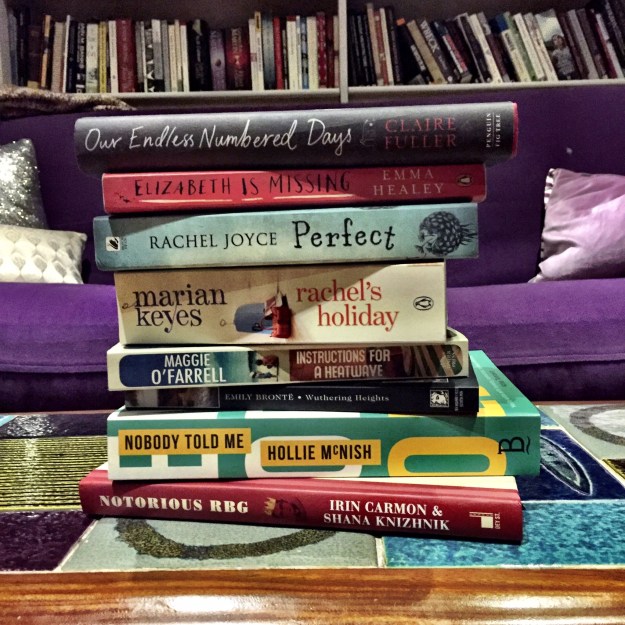
None of this is by design. I never consciously set out to not read books by women, or indeed to seek them out as I grew older. But the shift in my literary gender balance is not entirely accidental either. I think it speaks to where I am right now with myself, as a woman and as a writer.
I’m still figuring out exactly where that is, but once I do? You’d better watch out, world.









 Sophie is...