Tag Archives: education

#THISislearning update

It has been a week and a day since Maddy and I launched the #THISislearning campaign, and already it is beginning to gather momentum.

THISislearning badge final

We have 272 members of our Facebook group – parents and teachers, from up and down the country, united in their belief that there is something seriously wrong with the lack of understanding and respect our government shows towards the art of learning.

There has been lots of interest in the campaign on Twitter, with some of my favourite educationalists (including Michael Rosen and Sue Cowley) showing their support. The links that people have shared using the hashtag #THISislearning have led me to some fantastic posts, including one which sums up perfectly why it is time for parents and teachers to unite and fight the decimation of our education system.

And support from parents is certainly strong.


I love that not only are people beginning to share their own images and stories that promote a positive and passionate vision of learning, but also that the stories that are being shared are actually beginning to inspire people to think more deeply about learning – something which has been an unexpected side effect of the campaign for me as well.

The blogging community is beginning to come together, sharing their posts about learning and the activities which inspire it. I particularly like this story-inspired rainbow activity, and the hands-on learning about the butterfly life cycle using the ever-versatile tuff spot.

Of course this is all leading up to the 3rd May, when children across the country will be kept out of school and will have the chance to engage in exciting learning opportunities in their communities. I am particularly excited about what is going to be happening in my little town: a Celebrating Children’s Creativity day organised by the fantastic Flossy and Jim.

But perhaps most of all, I am excited by the general tide of enthusiasm in the world of education. The sense that, whilst things might be pretty rubbish right now, there IS another way – and that by standing together we really do have the chance to create a better future for our children. There are all sorts of campaigns kicking off, with people making the most of their expertise and interests to galvanise support from far and wide. And the wider campaign now has a soundtrack, in the form of this protest song which is in the process of being created by a group of teachers in London.

So what can you do – what can we all do – to take things further?

As far as #THISislearning is concerned, we would love it if you could do the following:

  • Join our Facebook group if you haven’t already, and share it with your friends
  • Use the #THISislearning hashtag to share your experiences of (or thoughts about) learning on Facebook, Instagram and Twitter
  • Link up your blog posts to inspire others with your experiences, ideas or activities
  • Share our badge (link in sidebar) to raise awareness of the campaign

Thank you for your support: together we are stronger.


A space to learn

The unschooling diaries: week fourteen

It may be taking up rather a lot of time and headspace, but one major benefit of the #THISislearning campaign for me has been the renewed focus I have found on the way Arthur learns, and how I can best facilitate it. I’ve been reading lots of articles about what does – and doesn’t – inspire effective learning and I in turn am feeling very much inspired.

One of the key concerns parents and teachers have about the SATs is the space they take up – both in terms of time and the room they occupy in peoples’ heads – meaning that other learning, proper learning, is squeezed out as a result. With Arthur learning at home (and out and about) with me, I don’t need to worry about his learning time (and quality) being reduced by assessment or administration. I do, however, want to make sure that his learning does not get lost in the focus on the everyday.

This is a bit of an oxymoron when it comes to unschooling. After all, everyday life IS learning – everything we do, enhanced by talk and questions, is teaching Arthur about a different aspect of the way the world works. But all of that is fairly ordinary, and I want to make sure he is inspired by the extraordinary too – that he has the chance to explore familiar (and less familiar) objects and materials in his own way, and in doing so learn things that might challenge his perceptions and everyday experiences.

Part of that means making sure he has the time in the day to play, and to immerse himself in that extra-ordinary learning. And part of it means dedicating physical space for him to do it – space that inspires curiosity and exploration, space that is his.

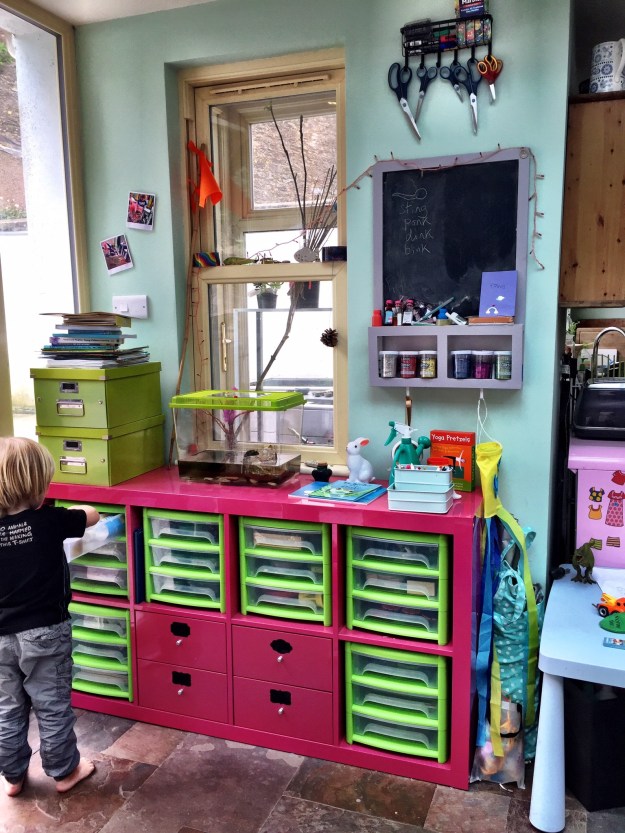
He actually has various little places around the house for this – his room, obviously, and a corner of my study. The area we’ve been working on this week, though, is in the kitchen. It started off just over a year ago as Arthur’s art corner, but as the months have passed it has evolved: he has acquired an increasing amount of resources for building and creating and experimenting, and the more things we’ve had to try to cram in to his corner the harder it’s been to actually access them.

I dream of Montessori-style open shelves, with carefully curated learning materials rotated on a regular basis. But then I have to get realistic, and remember just how quickly the space around me can descend into chaos if I’m not careful. So we’ve gone for clear drawers instead – I trawled the internet to find ones which would fit on our Ikea unit and finally found the perfect ones. I’m still waiting for another column of shelving to arrive which should (hopefully) fit perfectly into the corner by the window, and then there will be space for books and boxes of miscellaneous bits and pieces.

IMG_1408.jpg

The idea with the drawers is that each of them has one type of resource. The way I’ve grouped them has varied, but there is a logic to it all. I’m hoping each one contains something that will inspire Arthur towards creative play: very few of the resources have a ‘right’ application, so it’s going to be interesting to see how he interprets their potential.

My favourite at the moment is definitely the seaside drawer, with shells and stones and sand collected from local beaches and our travels all over the world. I have so many ideas of what we might be able to do with them, but I’m trying to hold back at the moment to see what Arthur comes up with first.

IMG_1403.jpg

As for Arthur, he seems especially intrigued by the ‘small worlds’ drawer, and I can’t blame him. We have yet to collect all of the weird and wonderful creatures he has secreted around the house and introduce them to their new home, but the ones that are there are already inspiring some interesting play – I particularly liked this morning’s conversation between the bear and the octopus.

IMG_1404

On the subject of creatures, this learning space is also home to Arthur’s first pets – four tadpoles collected from the pond at my parents’ place. We are both fascinated by their habits and their creeping metamorphosis – in the last forty eight hours they have just begun to grow legs. They have inspired so many fascinating conversations already – I can’t wait to see Arthur’s wonder when their transformation is complete!

IMG_1410

There is generally something incredibly powerful about focusing Arthur’s creative and conceptual energies around this space. He tends to oscillate round it as we go through our day, picking up new things to explore or pausing to investigate something further. It has certainly become the place he gravitates towards first thing in the morning. With things being accessible and clearly laid out he has proved more likely to just leap straight in – like yesterday, when I came downstairs to find him drawing on his easel (welly boots on of course ready to escape into the garden the second I opened the door).

IMG_6195.jpg

The more I learn about learning the more I realise I have yet to learn – which is exactly as it should be. I am just very grateful to be spending my days with such a good little teacher, and will continue to do all I can to make the adventures we have together as inspiring and enlightening as possible.


Why SATs are bad for our children

There are many moments that have stayed with me from my ten years of teaching. The overwhelming majority of them are positive, but there is one in particular that has been circling around my head the past few days that makes me feel so sad about what current government policy is doing to our children’s experience of learning.

Early on in the first term of Year Seven, I often broached the question to my English class “What makes good writing?”. It’s a big question, and not one I ever expected to hear answered in its entirety, but still the responses that I got were pretty telling. The particular set of responses I remember was from Autumn 2012, just before I disappeared on maternity leave. Fresh from SATs preparation, hands shot up as I wrote the question on the board, and the answers spilled out proudly into the classroom: “varied sentence starters”, “correct use of conjunctions”, “fronted adverbial clauses”, “using semi-colons”.

Now none of this is strictly wrong, of course – and I dutifully noted each response on the whiteboard before mooting my own ideas. But it was still incredibly deflating to hear it from a room full of eleven year olds. Where was the talk of imagination? Of storytelling? Of creativity? Where was the space for them to fly?
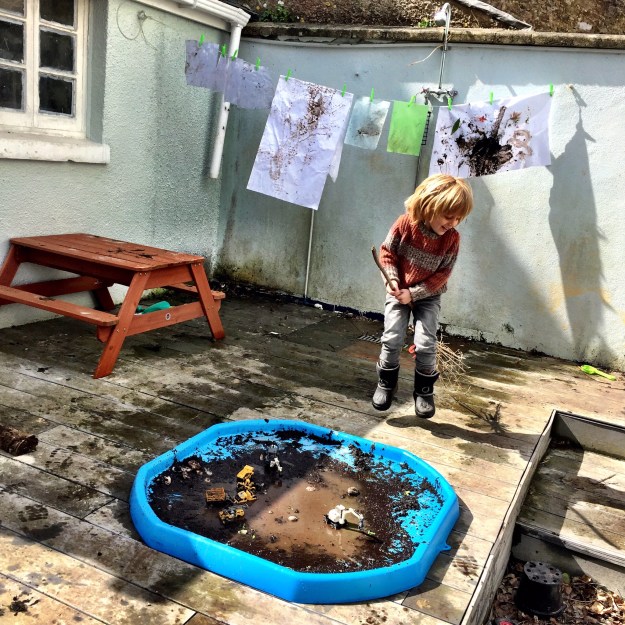
IMG_1384

It is this reduction of learning to rote mechanics that worries me most about the SATs, because the world doesn’t work like that – and yet in order for children to be able to succeed in these exams they have to be trained as if it does. When Key Stage 3 SATs were still around, I remember as an English department poring over questions trying to work out what it was they were actually getting at, and then teaching our students which right answers to put down for which type of question to make sure they got the marks they deserved. It was a preposterous waste of time and energy at a delicate stage in young people’s lives when the cocktail of hormones they were dealing with made the conventions of school pretty challenging anyway.

Still, I can get the argument that (at least within the limitations of our current system) being able to ‘do’ exams is kind of necessary. And I can just about stomach the concept of putting thirteen year olds through that process – at least we could explain to them the whole idea of the hoops they had to jump through, and begin to separate out different types of learning so that the experience didn’t completely extinguish the fire within.

I find it harder to justify for ten year olds, and I think it is such a crushing shame that children’s final year in primary school, a period in education which for many has been characterised by creativity and imagination, is reduced to drills and mock exams and learning ‘right’ answers to the most complex of questions making reopening the door to the potential for real learning a dauntingly challenging task in the years that follow.

Except of course primary school isn’t really like that any more. Not since the reintroduction of KS1 SATs, where children as young as six are now expected to sit formal tests in spelling, punctuation, grammar, reading, arithmetic and reasoning. SIX! The notion of what constitutes correct answers is, from what I have seen, just as convoluted as it was in KS3 – and so drilling is, if teachers are not going to sacrifice the children in their charge (and themselves) on the pyre of government assessment, inevitable.

And then of course there is the question of what all of this drilling occurs at the expense of. Play, for example, and creativity. Various other government initiatives are squeezing out the arts as children move up through the school system, but it is beyond belief that they should be marginalised at this crucial early stage. It goes against all of the research, the experience and the professional instinct that should guide our education system. When I admit that as a result of the regressive nature of government reforms I am reluctant to enrol my child in nursery, friends are quick to defend the relative freedoms that are still enjoyed in the early years. They go quiet when we get on to what starts to happen in year one.

All of this is part of why I am no longer teaching, and is a major driver in my decision to home-educate my son – for the first few years at least. My approach as a teacher always meant that there was a degree of rallying against the system – I wanted to see my students grow as individuals, to try to find creative ways of managing assessment that did not compromise their own personal development. During the bulk of my career, it felt at least as if I was moving with the tide – that what I innovated with one year I could integrate the next as Labour education policy responded to the needs of teachers and schools. And then the Tories came to power.

I could still be fighting the battle from the inside – I have untold respect and admiration for my former colleagues that are – but it is just so exhausting to have to make your classroom a fortress against the outside world, and I have a family to think about now.

My son is three: he is curious, brave, funny, unique and creative. He has many subjects he is passionate about, and is developing his own clear preferences for how he likes to learn about them. I want to nurture those in him, to enable him to find his way through the world in a way that it keeps its wonder, and where he gets to cherish his uniqueness, not play it down to fit in within the system and win validation for himself, his teachers and his school.

These KS1 SATs don’t give children levels; they don’t take a formative approach to identifying their strengths and areas for development; they don’t recognise that each and every child will progress in different areas at a different pace: they just indicate whether they have reached the required standard, whether they have passed or failed, whether or not they are ‘good enough’ at this stage in their lives.

I cannot imagine putting my little boy through that in three years time.

And it looks like I am not alone.

A campaign is gathering pace to undermine the KS1 SATs with a children’s strike on the 3rd of May. Yet more parents are calling for a boycott of the KS2 SATs, where the expected standards have risen so sharply that children are being set up to fail more than ever before. Parents up and down the country are uniting to say that this dismantling of their children’s childhood is simply not OK, that to stop their kid’s learning in its tracks by subjecting it to meaningless assessment is not something they want to be a part of.

My son is too young for me to be able to make a stand in this way, but I will be taking the opportunity on that day to demonstrate just what learning can look like when we set it free: to tell the story of our learning journey on this blog and on social media, to show how much fits into a day when it is not constrained by the need to learn to jump through hoops.

If you too are angry about what current government policy is doing to our schools, teachers and most importantly our children, then I hope that you will join me.


Edited 16th April 2016:

In response to our general disbelief at the way the government are decimating our education system, myself and Maddy from Writing Bubble have started a campaign to show them what learning really looks like. 

To find out more, check out our launch post and join our Facebook group. It would be awesome to have you on board.
 

Writing Bubble

On puzzles and perseverance

The unschooling diaries: week two

This week, we have been building LOTS of train tracks, making an impressive amount of mess with kinetic sand, and getting increasingly confident on the scooter. We have been counting fingers and toes, being a doctor like daddy, and finding out which stones make the biggest splash in the sea.

There’s been more too, but rather than just run through all of the things we’ve done, I want to focus in this week on just one little bit of learning – what Arthur (and I) discovered when we put together a puzzle.

IMG_1273.jpg

Arthur has a bit of a love-hate relationship with jigsaw puzzles. He’s drawn to them initially, but gets quite frustrated if he can’t work out how all the pieces fit right away. For my part, it’s tempting to help. To give him a strategy – like starting with the corners, and lining up all the straight edges. To show him how it works, how much quicker and easier he’d find it if he just did it that way.

I’m not really sure where that approach to putting puzzles together came from, for me. I’ve always found them a bit boring, and I wonder whether partly that might be because I’ve been approaching it wrong all along.

When I stopped myself from interfering, and started listening to Arthur and watching how he was making decisions about what bits went where, I realised that actually his approach was far more fun. He was focusing in on the characters first, on the trains he loves from his stories, and seeking out all the bits that made them. Then he looked for bridges, and flowers. It was all a bit haphazard at first, but it all started to come together.

There were moments when he got frustrated – I could see him fighting the urge to smash it all up and cast the pieces to the wind. I intervened a little then, but not to tell him how to do it. I asked him questions instead: why was he getting annoyed? What was he looking for? What was he trying to do? And through articulating his answers he calmed down, and refocused, and persevered.

It was only a short period of time (though longer than it would have been if I had made him do it my way), but it was so much more rewarding for me to step back and let him work it out himself. It was more rewarding for him too.

The process of putting that puzzle together reminded me a lot about learning in general. It might be possible to get to the end of a task quicker someone tells you how to do it, but so rarely is the completion of that particular task the most valuable goal. If you take your time, do it your way, find a way through the challenges that works for you, then not only do you have that sense of satisfaction of having succeeded by yourself but you are also laying down the foundations for deeper learning in the future.

Worth bearing in mind, I think, as we continue on our unschooling journey…


Unschooling a preschooler

I am fascinated by learning. What ignites the first spark, how knowledge and understanding become embedded, the directions these can take people in as their lives unfold. As a teacher, this informed my whole pedagogy. I didn’t want to stand at the front of a silent classroom and speak, filling supposed empty vessels with the fruits of my superior intellect. I wanted to inspire, to start the young people in my charge on a journey of discovery which would hopefully take them way beyond the walls of the school. So much of education, it seemed to me, was about fitting square pegs into round holes – and I just didn’t want to be part of that.

If as a teacher, though, the constraints of our education system were frustrating, as a parent I find them positively frightening.

I look at my unique, bright, inquisitive boy and I can’t quite comprehend how he will benefit from being subjected to rigorous standardised tests. Whilst I have every faith in the intentions of the vast majority of teachers to bring out the best in each of their students, I worry about how their resolve will hold in the face of ever-increasing external pressures. Fundamentally, my fear is that the government do not want to foster a populace driven by individual thought and opinion. And I do not want to do my son the disservice of reducing him to being merely a cog in the machine.

IMG_1246

It is for these reasons that, after years of being a passionate supporter of state education, I find myself reluctant to begin the process of enrolling him in one of our local schools. He is a while off compulsory education, but at three years old he is already unusual amongst his peers in that he does not attend nursery or pre-school. He will be more unusual still if I follow through on my instinct, bubbling just below the surface, to keep him out of formal education until he is at least seven. By this age, I would hope, he would be resilient enough to navigate school as an informed and engaged individual. Many educational experts believe that this is the age at which children are best suited to enter formal schooling – a theory born out by successful education systems all over the world.

I am mindful, though, that there is an awful lot I am trying to do with my days: writing novels, representing my community on my town council and as a school governor, acting as a subject consultant for Ofqual. The question of how I am going to find time to provide meaningful learning experiences for my preschooler has not passed me by.

Except… My experience as a teacher has taught me that much of the school day is spent managing a large volume of children rather than focusing on individual learning – I can only imagine that this is even more pronounced in early years than it is in Secondary. And my aspiration with my son, just as much as with the pupils I have taught in a school environment, is to be a facilitator rather than a font of all knowledge. I want his learning to be driven by his natural inquisitiveness, not constrained by what I feel he needs to know and understand.

And it is this that has led me to unschooling. As an advocate of child-led parenting in the baby and toddler years, and student-centred learning in the secondary school, it seems the logical path for me to follow as I look to foster a love of learning in my son.

With this in the back of my mind, I am beginning to see the play that unfolds in our everyday lives – both self-directed by Arthur and shaped (loosely) by me – in a new light. It is my intention to begin to document this, for my own reflection and maybe to inspire others too. I will never be able to capture every aspect of his learning, but what I can do is focus in on some little key moments from our weeks and reflect on them as a sort of learning journal: an unschooling journal, if you like.

It was that I had intended to do when I sat down to write this post, but thought I should maybe take a little time to explain my approach – something which took a little longer than I’d thought it might. As with many things, though, I’m much more convinced about what it is I am actually doing having taken the time to write about it: so the first instalment should be coming up very soon!

Blackberries, bike rides and bravery

I’ve been mulling over how Arthur and I spend our days rather a lot lately. He’s coming up for three, and I am still almost solely responsible for his childcare. Generally I’m happy with this – I know there will be benefits he is getting from me that just aren’t accessible anywhere else – but still, sometimes I worry. Most of his friends are in nursery, and their parents naturally extol the benefits of that. Sometimes I worry that I’m just not fun enough, creative enough, hands on enough to have taken on this level of responsibility for my son’s education.

And then…

image

Then I have days like the one we enjoyed on Thursday. We got up, we hung out and played for a while, Arthur napped and I wrote. And then we had lunch. And then we went exploring.

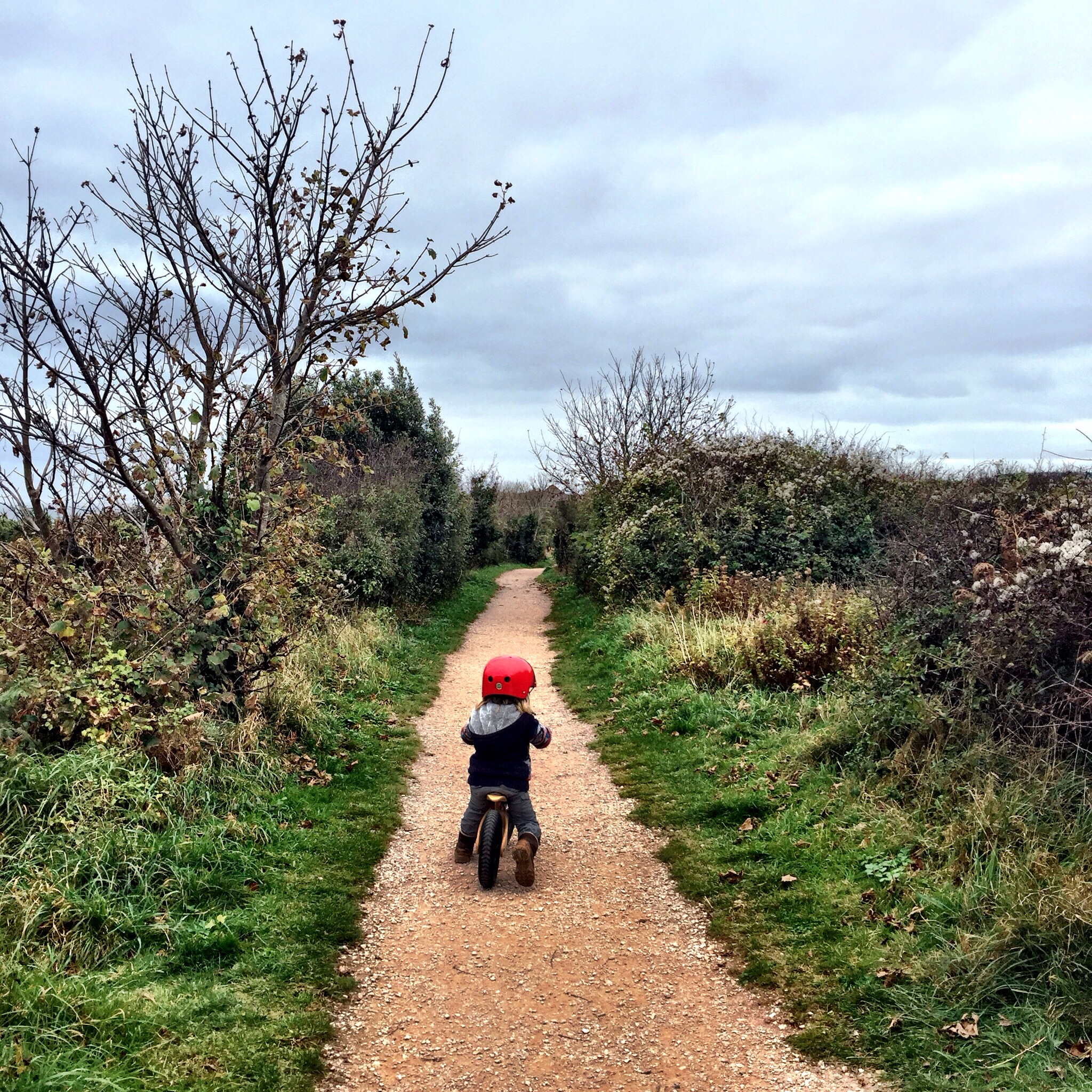
And I saw Arthur’s learning, his development, in every step he took. He’d been zooming his balance bike around the kitchen for a few days already, showing a confidence that had been lacking in months of experimentation. He was more reticent, out in the big wide world, but still he wanted to ride, pacing around the headland with barely concealed glee.

image

He did get tired, eventually. But then his bravery transferred to another sphere.

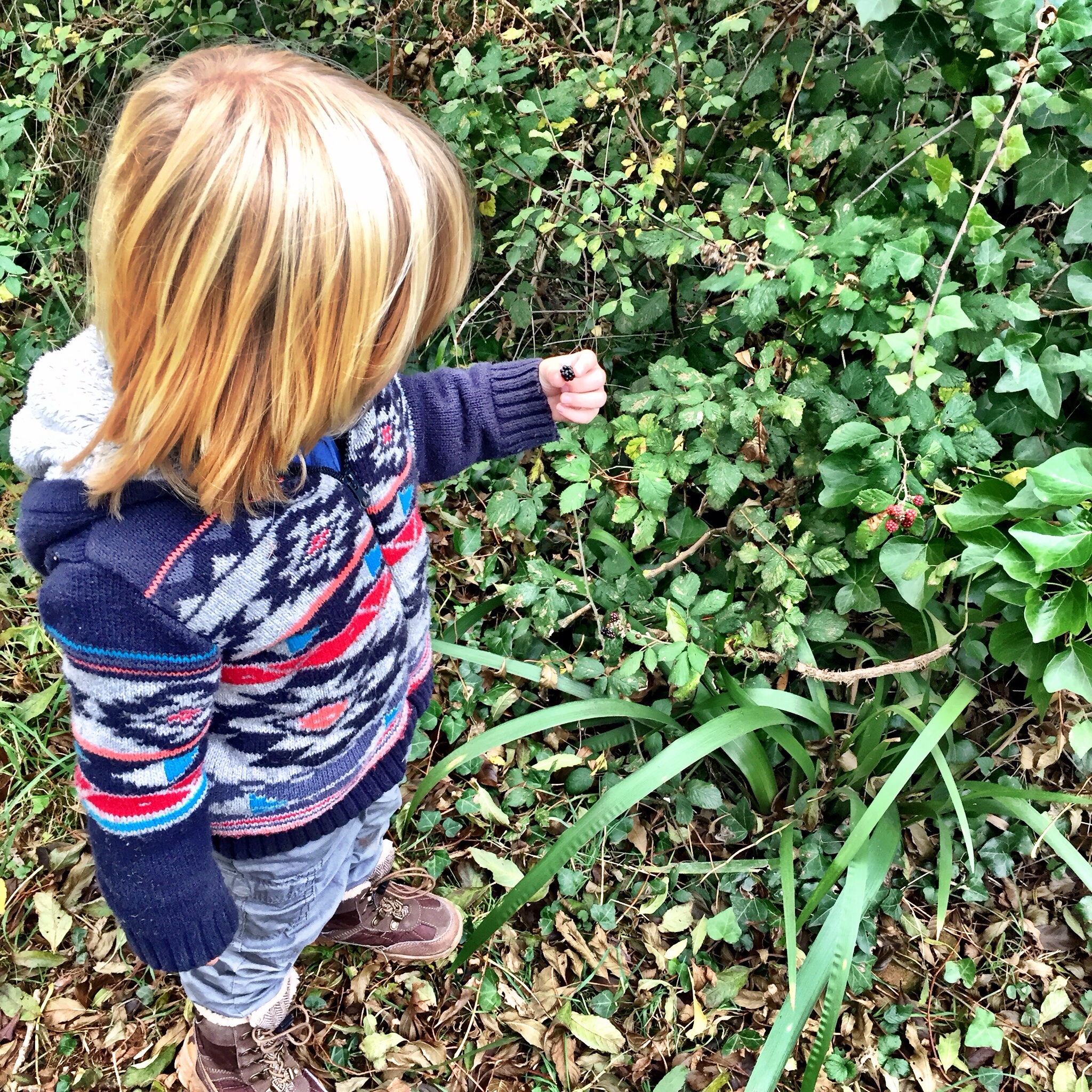
All summer, we have talked to him about berries: the ones he can eat, and the ones he can’t; the ones we’ve grown in our garden, and the ones that flourish freely on the hedgerows. It is those that have been most significant over the last month or so: the inky blackberries that in my mind form the perfect snack yet for Arthur have been a concept just too unfamiliar to get his head around.

Until this week. When suddenly he wanted to try this delicious wild fruit, and having succumbed to its sweetness stood and gorged himself until his fingers and mouth were stained with black.

image

Both of these things, the bike riding and the blackberry picking, represent huge steps of freedom for my little boy. I am proud of his bravery, of his confidence. But I am scared too, just a little. Because picking wild berries brings with it the danger of choosing the wrong ones, and lifting your feet from the floor when riding a bike means that you will one day surely fall.

But then these are precisely the sorts of risks that I need to be prepared to take if I am going to take on the challenge of educating my child myself.

He is still very young, but his curiosity is beginning to lead us to amazing places.

I just need to make sure I give it the space to work its magic.
Country Kids from Coombe Mill Family Farm Holidays Cornwall

Why teaching is actually pretty awesome

image

I’ve spent a lot of time on here pondering on what’s wrong with education. And for good reason – there’s much about the system that frustrates me enormously, especially under the current government. But actually I truly loved the time I spent as a teacher, and I hope to go back to it one day. When I was teaching, I threw myself into it wholeheartedly. Great when I had no ties but not so great with a young family.

There’s a lot of work to be done on ensuring teaching remains a good career choice for people once their own children become part of the equation. But I’m still pretty convinced that for enthusiastic and ambitious graduates there are not many career paths that are as fulfilling.

So when I was asked by The Guardian to write an article encouraging sixth-form students to consider training as a teacher when they leave school, I jumped at the chance.

You can read that article here.

And if you want to read some of my other (slightly more cynical) articles on the world of education you’ll find them here.

Because teaching as a career isn’t perfect – but it’s still pretty awesome.

Mama and More

Why anyone has to be better than Gove

gove tombstone

When I heard the news on the radio this morning I felt my spirit lighten: after all of the heartbreak he has caused as he dismantled our education system brick by brick, Gove was being removed as education secretary. Finally it appeared that teachers, parents, children and educationalists up and down the country were being listened to: we had roared ‘Gove must go’ until we were hoarse, and now our pleas had been answered.

Of course I am not naive enough to think that placating the victims of Gove’s reforms was Cameron’s motivation. I cannot allow myself to hope that now that he has been replaced the misguided direction of the Tory education policy will change significantly. I’m trying to avoid finding out too much about his successor, Nicky Morgan: I’d rather spend just one day in blissful ignorance. From what has seeped into my twitter feed I gather that her politics are at least as unsavoury as Gove’s, but then given her political allegiance that’s not entirely surprising.

The thing is it was not just his politics that made me so angry whenever Gove opened his mouth to say something about education. In fact the political stance he was taking was generally the least of my worries – after all, there were so many other things to be angry about.

There was the way he completely disregarded the professional opinion of people who had devoted their lives to education, presuming that his own experience of school could over-ride decades of evidence-based research.

Worse, there was his coining of the term ‘the blob’ for those who disagreed with his reforms – the sneering condescension with which he dismissed their concerns about the impact those reforms might have on young people.

There was the exploitation of those young people for photo opportunities to try to disguise the archaic nature of his mission with a vulgar attempt to get down with the kids.

The total failure to acknowledge the impact his race to lead the world might have on the mental health of young people and their teachers – along with his buddy Wilshaw he seemed determined to wear down all of the stakeholders in the education system, deciding that misery was a mark of success.

Another thing that made me furious was the way new policies appeared to have been scribbled on the back of a cigar box after one too many glasses of claret at a dinner party. Dropped on to breakfast tables with the Sunday papers they often bore more than a whiff of the public school education of his peers, and very rarely stood up to tight scrutiny in the cold light of day.

There was also, of course, the way he held up the private sector as the pinnacle of education, blithely ignoring all of the other factors that influenced the success of its alumni to wrongly presume that these fee-paying schools were fundamentally doing everything better than their state-funded equivalents, that within their ivy-clad walls and manicured lawns was the cure for all the maladies of the education system.

At the core of all this was the way Gove completely ignored the truth wherever it got in the way of his vision. He took this to ridiculous lengths – if rumours are to be believed he rewrote syllabi for English and History GCSEs, an absurd arrogance and grossly overstepping his role as education secretary.

There is so much more I could add to this list, but I can feel my blood beginning to boil just remembering all of the injustices served to our nation’s young people by that man. I am however finding great solace in the repetition of the phrase ‘there was’. He is now in the past, at least as far as our education system is concerned, and hopefully schools and teachers and students and everyone with their best interests at heart can begin the slow process of recovery from the damage he has done to their sense of worth.

There is much for Nicky Morgan to consider as she steps into this role, but there is one key thing I would ask of her: to listen. To recognise how much people care, and how much they know. To rebuild the bridges between the policy makers and the professionals, so that together we can work to carve out a better future for our children.


Why schools fining ‘bad parents’ is a really, really bad idea

Another day, another ludicrous idea from one of the Michaels. This time it’s Michael Wilshaw, chief of Ofsted, saying that parents should be fined if they don’t, amongst other things, make children do their homework.

This story made my blood boil when I read it this morning, and I can feel the fury rising inside me reading it again now. I mean, who does this man think he is? To make sweeping statements about the causes of underachievement amongst children growing up in poverty, to drive a wedge between parents and schools in the communities where close collaboration is perhaps most important, to blithely dictate what it is that makes a good parent in such a patronising and unpleasant manner. There are so many things wrong with his proposals that I almost don’t know where to start, but I will try.

Let’s just begin with what he expects of good parents. I agree that communicating with the school is pretty important, though I also know there are a multitude of reason why someone may not be able to attend a designated parents’ evening – and the realities of those evenings (or afternoons, or days) is that there is little scope for in depth discussion about young people’s progress, especially if they’re struggling.

I agree, of course, that reading is something to be encouraged – urgently so given the impact it can have on children’s lives. But you can’t force someone to read for pleasure – adult or child – and the real focus should surely be on expanding local libraries rather than closing them, or maybe reinstating the funding that would bring inspirational authors into schools on a regular basis.

And then we come to the tricky subject of homework. I never much liked homework, neither as a child nor as a teacher. And with educational research throwing up little to support its position as a tool to improve learning, and officials in countries from China to France and Sweden seeking to reduce it or ban it altogether, it seems a funny time for Wilshaw to be insisting on its importance. I’m not saying that there aren’t times when it is appropriate for students to work on something at home, but teachers setting tasks for the sake of it then parents battling with demotivated kids to complete homework that’s only going to increase teachers’ workloads when they have to mark it just makes no sense at all to me.

But to be honest it’s not the nitty gritty of Wilshaw’s proposals that I find so offensive, even if they are typically narrow-minded and outdated in their origins. What I find really unbelievable is that he can think that pitching schools and parents against each other is really the best way to get them to work together to support the young people in their care. The bullying tactics he used against the parents at his old school in Hackney are really not going to work for anyone – and I can’t imagine that many head teachers would want to take the approach he describes.

The issues that lead to underachievement in impoverished communities are complex and far-reaching. Many of them have their roots in low self-esteem perpetuated by generations of un- or under-employment – in a lack of trust in the system, and schools in particular. The only way to truly overcome this is to help communities believe in themselves again, to show what they can achieve for themselves and for their children when they work hard, to celebrate successes and find the things that motivate them to change.

Treating parents as naughty school kids themselves would have the opposite effect – sure people might purport to play the game, might jump through the hoops they need to to escape the fines, but that is a long way from nurturing the impetus for learning that will truly help young people escape the cycle of poverty.

And what if parents don’t play the game? To be honest the ones that are hardest to reach, that aren’t already responding to schools’ attempts to engage them, are highly unlikely to give two hoots about the prospect of a fine. And what then? Protracted and costly legal proceedings, culminating in poor families being poorer still and so condemning the young people who most need our help to an even harder struggle?

I don’t know whether Wilshaw intended to be taken seriously, or whether he was just firing off another simplistic idea for the sake of it. But I do know that his way of thinking is incredibly damaging to our society – and it is time that parents stood together with schools to tell him that enough is enough.


Why schools need to do what they know is right (just don’t tell Gove)

So after many, many months of reasoning, protesting and pleading from teachers and parents alike, Gove is still ploughing on with his ill-guided reforms of the education system. With Tristram Hunt pledging to undo little of this government’s bad work it looks like we’re in this for the long haul: a system devoid of creativity, culturally narrow and reducing the next generation to empty vessels to be filled to the brim with facts, neither questioning nor challenging the status quo and most definitely not thinking for themselves.

But it doesn’t need to be like this.

Some big hitters in the world of education finally appear to have given up hope in the state system altogether. Sir Alasdair MacDonald, one time head of Morpeth Secondary School in Tower Hamlets and now the Welsh Assembly’s ‘Raising Attainment’ tsar, has claimed that the only chance British pupils have of a rounded education now is to go to a private school. Michael Rosen has just finished a book written for parents to help them fill the gaps in their child’s education left by the direction that schools are being forced to take.

But it doesn’t need to be like this.

There are three secondary schools in the UK that I can currently claim to know well, and I know that all of them are full of teachers doing their best to provide the education that they know their young people need. They will jump through the ever-changing hoops presented to them by the government, play by the rules as much as they need to to be left alone, but they will keep on doing what they know is right. The leaders in those schools will seek out frameworks to support a more holistic education: Building Learning Power for example, or the International Baccalaureate. They may no longer be required to filter personal, learning and thinking skills through the curriculum – but they will, because they know it’s right. Speaking and Listening may no longer be assessed, Music and Drama may have fallen down the pecking order – but these aspects of their students’ learning will not be ignored because they are vital to their all-round education. Multicultural texts may no longer appear on GCSE syllabi, but these schools will find a way to fit them into their curriculum because to do otherwise would be to do the young people in their care a disservice.

And yet there are other schools who are, if media reports and TES forums are to be believed, collapsing under Gove’s reforms and following his rules unwaveringly. They are narrowing the curriculum in order to teach directly to the tests that he says matter, they are closing Music and Drama departments because those subjects are invisible in league tables.

And on one level I don’t entirely blame them. Because it’s hard, jumping through all those hoops. When teachers and school leaders are worked almost to breaking point it’s easy for them to forget what brought them to their classrooms in the first place. It’s easy to think that all that matters is being judged good by whatever the latest criteria happens to be, to climb up that league table and away from the reaches of those who would remove you from post if they deemed you to be failing.

But it doesn’t need to be like this.

In the arts, tight constraints – whether externally enforced or self imposed – have generated some of the most innovative and creative results. The Iranian film industry always comes to mind when I think of this: so many rules and restrictions and yet a body of work that almost any country would find it hard to rival.

The constraints facing our teachers operate on a different level, but they are still numerous and growing: restricted finances, an archaic new curriculum, seemingly endless bureaucracy, narrowly focused and high stakes tests. Rather than being defeated by these, schools need to see them as a challenge to be overcome. School leaders and teachers need to remember why they are doing what they do and find the confidence and strength to trust their professional judgement.

Because the pleading and the protesting and the reasoning is getting us nowhere, and if we’re not careful a whole generation of young people is going to be trampled underneath Gove’s stampede for standards. We owe it to them – and to our own sanity – to do what we know is right.


Thanks to Sara at Mum Turned Mom for inspiring this post with her prompt ‘rules are meant to be broken’.

mumturnedmom