Tag Archives: learning

Mud glorious mud

The unschooling diaries: week thirteen

This week, we have finally managed to start sorting the garden out for summer.

It’s not an especially big space, and because our house is essentially built into the cliff face it’s on three different levels – and has no grass. So over the wet, windy Devon winter it really does start to look quite sorry for itself, and I start yearning for a house with a proper garden with room to run and explore.

I’ve realised, though, that there is actually an awful lot we can do with the space we have. Rather than bemoan the lack of lawn, I’ve decided instead to focus on what an interesting space it is, and its huge potential as an outdoor classroom. So, with Arthur taking the lead of course, we’ve been exploring exactly what that might look like – and having lots of messy fun in the process.

We started with some digging and pulling up of weeds in our raised beds. Arthur was very keen to get involved, and was fascinated by the bugs we came across along the way. We found snails, slugs, earthworms, a centipede, woodlice and a caterpillar – and had a good chat about each of them before getting on with our work.

IMG_1397.jpg

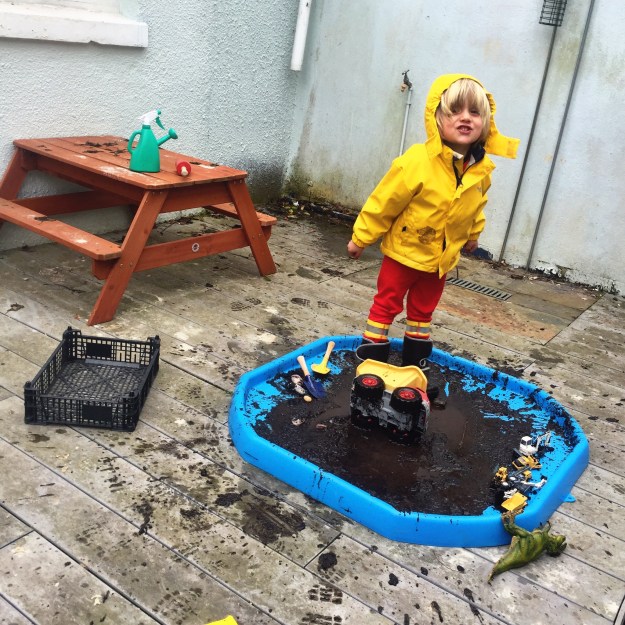
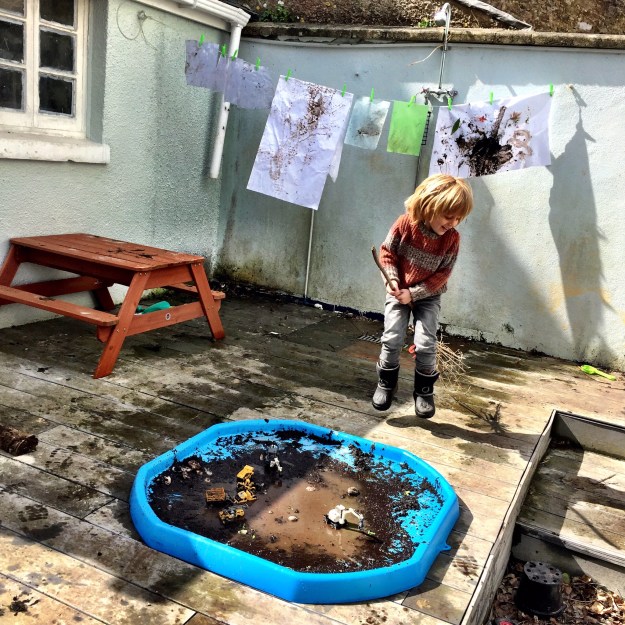
We also got the tuff spot out into the garden, creating a mud-filled paradise for Arthur’s beloved diggers, made even more fun when we added water to the equation.

IMG_1396.jpg

IMG_1395.jpg

We managed to work some arts and crafts in there too. When we were in Lanzarote we’d talked about how Cesar Manrique had used volcanic ash in his paintings – Arthur had been quite intrigued by the unusual textures it created. So, inspired by the puddle that formed after some overnight rainfall, we decided to try some mud art.

We started with some puddle painting, using oil and food colouring to create colourful swirls on the water. This didn’t work brilliantly as Arthur got a bit over excited with the amount of oil he added, but it was still lots of fun!

IMG_1394.jpg

Especially fun was, of course, stamping in the oily puddle – and seeing how much Arthur was enjoying making footsteps on the deck I decided to give him a bit of a canvas.

IMG_1385.jpg

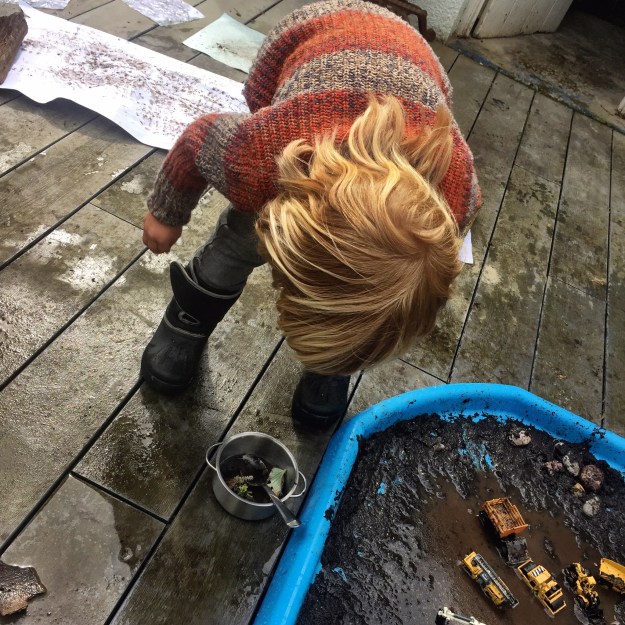
Then, after a slight diversion to make a magic potion, we got properly stuck in and covered a large sheet of paper with pva glue before pouring on the muddy concoction and mixing it up with anything else that took our fancy…

IMG_1393.jpg

There was more focused preparation too, with Arthur climbing inside the raised beds to get the earth ready for planting (and make some mud castles).

IMG_1388.jpg

It was all so much fun! And tidying up was even more so: Arthur was super keen to use the hosepipe, and I in my infinite wisdom let him. It was going great until he accidentally splashed me whilst I was holding the tuff spot, and I yelped, and he laughed, and… well, let’s just say we both got very wet!

IMG_1387.jpg

IMG_1386.jpg

All in all it’s made me very excited about our little garden, and the fun and learning that is going to happen there in the weeks and months to come. There is something about being outdoors that just can’t be beat.


Why SATs are bad for our children

There are many moments that have stayed with me from my ten years of teaching. The overwhelming majority of them are positive, but there is one in particular that has been circling around my head the past few days that makes me feel so sad about what current government policy is doing to our children’s experience of learning.

Early on in the first term of Year Seven, I often broached the question to my English class “What makes good writing?”. It’s a big question, and not one I ever expected to hear answered in its entirety, but still the responses that I got were pretty telling. The particular set of responses I remember was from Autumn 2012, just before I disappeared on maternity leave. Fresh from SATs preparation, hands shot up as I wrote the question on the board, and the answers spilled out proudly into the classroom: “varied sentence starters”, “correct use of conjunctions”, “fronted adverbial clauses”, “using semi-colons”.

Now none of this is strictly wrong, of course – and I dutifully noted each response on the whiteboard before mooting my own ideas. But it was still incredibly deflating to hear it from a room full of eleven year olds. Where was the talk of imagination? Of storytelling? Of creativity? Where was the space for them to fly?
IMG_1384

It is this reduction of learning to rote mechanics that worries me most about the SATs, because the world doesn’t work like that – and yet in order for children to be able to succeed in these exams they have to be trained as if it does. When Key Stage 3 SATs were still around, I remember as an English department poring over questions trying to work out what it was they were actually getting at, and then teaching our students which right answers to put down for which type of question to make sure they got the marks they deserved. It was a preposterous waste of time and energy at a delicate stage in young people’s lives when the cocktail of hormones they were dealing with made the conventions of school pretty challenging anyway.

Still, I can get the argument that (at least within the limitations of our current system) being able to ‘do’ exams is kind of necessary. And I can just about stomach the concept of putting thirteen year olds through that process – at least we could explain to them the whole idea of the hoops they had to jump through, and begin to separate out different types of learning so that the experience didn’t completely extinguish the fire within.

I find it harder to justify for ten year olds, and I think it is such a crushing shame that children’s final year in primary school, a period in education which for many has been characterised by creativity and imagination, is reduced to drills and mock exams and learning ‘right’ answers to the most complex of questions making reopening the door to the potential for real learning a dauntingly challenging task in the years that follow.

Except of course primary school isn’t really like that any more. Not since the reintroduction of KS1 SATs, where children as young as six are now expected to sit formal tests in spelling, punctuation, grammar, reading, arithmetic and reasoning. SIX! The notion of what constitutes correct answers is, from what I have seen, just as convoluted as it was in KS3 – and so drilling is, if teachers are not going to sacrifice the children in their charge (and themselves) on the pyre of government assessment, inevitable.

And then of course there is the question of what all of this drilling occurs at the expense of. Play, for example, and creativity. Various other government initiatives are squeezing out the arts as children move up through the school system, but it is beyond belief that they should be marginalised at this crucial early stage. It goes against all of the research, the experience and the professional instinct that should guide our education system. When I admit that as a result of the regressive nature of government reforms I am reluctant to enrol my child in nursery, friends are quick to defend the relative freedoms that are still enjoyed in the early years. They go quiet when we get on to what starts to happen in year one.

All of this is part of why I am no longer teaching, and is a major driver in my decision to home-educate my son – for the first few years at least. My approach as a teacher always meant that there was a degree of rallying against the system – I wanted to see my students grow as individuals, to try to find creative ways of managing assessment that did not compromise their own personal development. During the bulk of my career, it felt at least as if I was moving with the tide – that what I innovated with one year I could integrate the next as Labour education policy responded to the needs of teachers and schools. And then the Tories came to power.

I could still be fighting the battle from the inside – I have untold respect and admiration for my former colleagues that are – but it is just so exhausting to have to make your classroom a fortress against the outside world, and I have a family to think about now.

My son is three: he is curious, brave, funny, unique and creative. He has many subjects he is passionate about, and is developing his own clear preferences for how he likes to learn about them. I want to nurture those in him, to enable him to find his way through the world in a way that it keeps its wonder, and where he gets to cherish his uniqueness, not play it down to fit in within the system and win validation for himself, his teachers and his school.

These KS1 SATs don’t give children levels; they don’t take a formative approach to identifying their strengths and areas for development; they don’t recognise that each and every child will progress in different areas at a different pace: they just indicate whether they have reached the required standard, whether they have passed or failed, whether or not they are ‘good enough’ at this stage in their lives.

I cannot imagine putting my little boy through that in three years time.

And it looks like I am not alone.

A campaign is gathering pace to undermine the KS1 SATs with a children’s strike on the 3rd of May. Yet more parents are calling for a boycott of the KS2 SATs, where the expected standards have risen so sharply that children are being set up to fail more than ever before. Parents up and down the country are uniting to say that this dismantling of their children’s childhood is simply not OK, that to stop their kid’s learning in its tracks by subjecting it to meaningless assessment is not something they want to be a part of.

My son is too young for me to be able to make a stand in this way, but I will be taking the opportunity on that day to demonstrate just what learning can look like when we set it free: to tell the story of our learning journey on this blog and on social media, to show how much fits into a day when it is not constrained by the need to learn to jump through hoops.

If you too are angry about what current government policy is doing to our schools, teachers and most importantly our children, then I hope that you will join me.


Edited 16th April 2016:

In response to our general disbelief at the way the government are decimating our education system, myself and Maddy from Writing Bubble have started a campaign to show them what learning really looks like. 

To find out more, check out our launch post and join our Facebook group. It would be awesome to have you on board.


Writing Bubble

Learning (loads) in Lanzarote

The unschooling diaries: weeks eleven and twelve

We spent a week in the Canary Islands over Easter, and once again I have been blown away by just how much there is to be learnt from travelling. We weren’t even motivated by anything more than the desire to get away somewhere warm and spend some quality time as a family, but the tremendous scope for discovery and new experiences that Lanzarote had to offer completely surpassed our expectations.

SAM_1787.jpg

We were especially lucky, I think, with the base we chose. We stayed in the most wonderful eco-resort in the North of the island, away from the main tourist trail. We slept in gorgeous yurts, which was an experience in itself. Our closest neighbours were chickens, ducks and donkeys, and there was a lovely solar-heated pool. Not forgetting the playground, which was right outside our little complex: it had a trampoline, and climbing frames, and a boat, and sand, and dump trucks, and little houses, and for Arthur it very quickly became home.

Outside of our little idyll, there was a whole new world to explore.

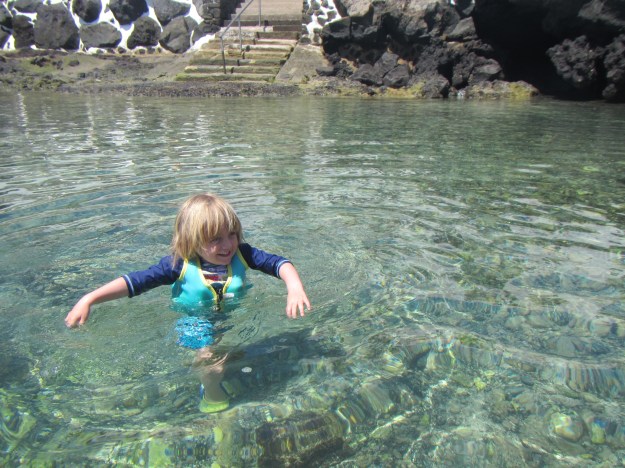
Unsurprisingly, the sea was central to much of our experience: admiring it, travelling across it, eating its many fruits, and of course swimming in it. We found an incredible lagoon, and some magical tidal pools. Between those and the pool Arthur well and truly shook off any wintery reluctance to jump right in, and his confidence and skill in the water came on in (literal) leaps and bounds.

IMG_9660.jpg

IMG_9403.jpg

He was mesmerised by the little fish that swam around our ankles as we paddled and splashed, but it didn’t stop him enjoying them on his plate, too… I’m not sure how many three year olds would demolish boquerones with quite as much relish as this one did. I like that he’s happy to eat fish that looks like fish, though – and that it gave us the opportunity to talk about where it came from and how it had been caught. I don’t want to freak him out about the food he eats, but I think it’s useful to be able to make the connections and understand our world better – especially when it’s him asking all the questions!

IMG_4039.jpg

Away from the sea, there were of course the volcanoes. In the run up to our trip we’d watched some videos and talked about the volcanoes we were likely to see there, and wherever we went Arthur was full of questions about the nature of the mountains around us. We took a (very windy) trek into the lava fields, climbing up to the top of one volcano to peer into the caldera and walking into the depths of another. Both were long dormant, but that didn’t stop the incredible power of nature being evident everywhere we looked.

IMG_4537.jpg

IMG_1365.jpg


One of the other highlights of our trip was completely unexpected. I had never heard of Cesar Manrique, but he was an inspirational artist and architect who through his work and his vision had an enormous impact on the infrastructure of the island. We visited several of the sites he created, and Arthur soaked up the paintings and the sculptures and the unusual spaces, as well as being fascinated by the exhibitions about the landscape around us.

IMG_1376.jpg

IMG_1378.jpg

Last but very much not least, inspired by an advertising board that caught Arthur’s eye in the airport, we took a trip on a submarine. It was the first time any of us had been on an actual submarine voyage, and it blew all of our minds a little bit – but especially Arthur’s. Just the whole mechanics of it was pretty exciting, watching the little screen at our seat compute our depth, the pilots with their illuminated control panel and the propellers at the rear. And out of the window we saw wrecks, lots of fish, and even a diver feeding a huge ray. It was pretty cool.

It was all pretty cool, actually. And it really got me thinking about how we can work some longer trips into the next few years. It’s one of the main reasons I’m not super keen about getting stuck back into the constraints of the school system any earlier than I have to, and why I’m trying to evolve my working life into one I can take on the road with me.

We shall see…

For now, though, we have plenty of memories to be mulling over. I’m going to make a photobook for Arthur so that we can pull it out from time to time and be inspired afresh by our experiences. It’s a lot to compute for a growing mind after all!


A lesson in slow crafting

The unschooling diaries: week ten

Arthur has yet to show much of an interest in arts and crafts. When he was tiny he just couldn’t abide the mess – he’s still not super keen on getting paint on his hands. Now that he’s older he’ll dabble, but it’s still really not his ‘thing’.

I’m ok with that – mostly – even though my inner crafter is crying out for an excuse to spend afternoons surrounded by tissue paper and glitter and it really doesn’t help my fear that he’s missing out on something by not being at nursery when I see all the pictures of toddler creations fellow mums share proudly on Facebook. But when over breakfast one day last week he started getting enthusiastic about the idea of making some Easter cards I couldn’t help but get a bit excited. Not least because it meant we might finally got round to saying an extremely belated thank you for his birthday and Christmas presents…

The teacher in me leapt to the blackboard to note down his ideas (sidetracked a little by Winnie the Pooh as his most vivid understanding of Easter comes from ‘Springtime with Roo’ – I have no idea where the armour came from).

He happily settled on the idea of painted eggs though – he frequently dances around singing ‘we’re hunting eggs today!’ at the moment, and I’m very much looking forward to his very own egg hunt on Sunday. He then decided he wanted chicks in his eggs (well he said ducks, but I think that’s what he meant…) which led us very nicely to an easy to accomplish collaborative card idea. It might not be very original, but he liked it.

Having bought in some supplies (very important to have the right shades of glitter), and prepped some eggs for him to decorate, we set aside a couple of hours last weekend to make a start. And he of course lost interest within approximately three and a half minutes.

I battled with him for another two before reminding myself that that really was not the point, and calmly telling him that it was fine – we’d come back to it when he felt like it. I didn’t tidy everything away, just organised his workstation enough for it not to descend into total chaos. And sure enough the next day he gravitated towards his eggs again, did a few more minutes of gluing and glitter scattering, and moved on.

And that’s sort of been the background to this week, really. Every so often this little activity has piqued his interest again, and he’s added a little to his eggs. We’ve tried out a few different techniques along the way – stamping, mixing colours to get the shade of pink he wanted, watering paint down so he could ‘dye’ his eggs, mixing it in with glue and glitter. And every time, just as I thought he might be getting into it, he’s walked away again, his attention taken by his diggers or the urgent need for a banana.

We’re still not quite done, but we’re getting there. He’s declared that the eggs are finished at least, so there’s just a bit of cutting and sticking left. I might need to take the lead on that bit, what with it being Good Friday tomorrow and everything, but I reckon that’s ok. I can’t expect him to do all the work!


On first drafts and freedom

I realised a few key things today – about my writing, and about me as a writer.

It was three years ago, almost exactly, that I began to write the first draft of my first novel. In the time that has passed, I’ve written in the region of 200,000 words of fiction. They have, collectively, taught me an awful lot; and in doing so they have liberated me from some of the self-imposed rules that may previously have held me back.

Not just the words themselves, or the processes by which I came up with them in the first place, but also – perhaps mostly – the reworking that has happened along the way.

Most of 2015 was taken up with editing and redrafting my second novel. I didn’t enjoy it much – not as much as the heady excitement of the first draft anyway. And I’m still not entirely convinced that story is where it needs to be. But as my third novel gathers pace it is clear to me that it was an incredibly valuable learning process.

IMG_1351.jpg

I am loving being back in the unknown territory where a new adventure is beginning to unfold. One where I know the final destination (or at least I think I do), but still have much to discover about the intervening terrain. And having spent so long agonising over the details of second, third and fourth drafts last year I really am relishing the freedom that comes with the first.

I realise now that this is where I get to try things out. That I need to be bold, and follow my instincts. If a scene wants to be written in a particular way then I need to let that happen – even if it doesn’t entirely fit with what has gone before. Last time round I think I worried too much about the finished product, even at this very early stage. I didn’t want things to be inconsistent, but in avoiding that I might have fallen into beigeness – I didn’t let myself  pursue my whims, figured I’d save that for later. But there is no better time to be true to your characters and their voice than the first time you hear them speak.

I’m letting myself be freer with the plot, too. I sort of know which way I’m going, but when I come to an unexpected fork in the road I’m more confident now to follow my instincts even if it means taking a different path to the one I’d thought I would.

And in fact the most important path – the overall structure that will eventually lead the reader through the narrative – is hardly featuring in my mind at all. In the past I remember deliberating for ages about where chapters should start and end, whether what was happening in this particular scene would fit with what the reader already knew. Now, though, I’m relinquishing control to the narrative itself. I’m letting that lead the way, and I know I will have plenty of time to mould it into a structure later.

I think that what I’m ending up with is more authentic, more true to me and my voice. It’s rougher round the edges than my previous first drafts have been, but I don’t think that’s a bad thing – potentially quite the opposite.

More than anything I am not allowing myself to be paralysed by the pursuit of perfection – either in what I’m writing, or how I’m writing it. This whole thing is just the latest phase in this epic learning journey I’ve entered into, and if I can trust myself and the words that want to flow then I’m pretty confident I’m heading in the right direction.


Writing Bubble

The web of research

Have you ever stopped to wonder what the internet search history of a writer looks like?

As I was pootling along with my draft this week I couldn’t help but smile at the diverse directions my ongoing research is taking me in.

IMG_1234

It’s not quite as extreme as my last novel, where the bulk of my online explorations were delving into the psychology of narcissism, manic depression and schizophrenia, not forgetting the murky world of electronic surveillance. Still, though, when writing a novel which (at least for the thirty thousand words I’ve written so far) is set in the 1970s and early 80s, it turns out there are an awful lot of gaps in my knowledge that need filling.

Most of them come from the fact that, having only been born in 1978, I have no personal experience of the little details of everyday life. Like, what were people called? What did they wear? Teenagers specifically? How did they do their make-up? Did they smoke? What did they drink at parties? What did they study for A-levels? When did they take their exams? When was the Walkman invented? What music did people listen to?

It’s all well and good talking to people who were around at the time, but I’m not just talking about general trends here – I’m talking about the specific aspects of fashion and popular culture that would have appealed to the blossoming characters I have been developing over the past few months, my two protagonists especially but the supporting cast as well.

Then there are the other details that anchor the world of my novel in time and place. The coordinates of my key locations, and the relation between them and the rise and setting of the sun (and the moon). The times of sunrise and sunset in summer, and any notable weather in between. Impossible to begin a novel in 1976 after all and not acknowledge the heatwave and the impact it had on peoples’ lives.

There was the politics too of course, and what it meant for peoples’ working days, as well as things like the prevalence of streetlights in a small seaside town.

Time and place aside, there are other things too I’ve found myself investigating to get up to speed with my characters’ interests and areas of expertise. The mechanics of butterfly stroke, for example. And the names of the different parts of a fishing boat. Not forgetting how to kill a mackerel.

It is all quite fascinating, and much as I’m trying to make sure I don’t get so completely sucked into the research that I fail to do any actual writing I can’t deny that I’m enjoying all the little bits of learning along the way. I know it doesn’t matter if not every little detail matches the facts, but if I’m having to make decisions anyway it’s nice to be helped along by the wealth of information that’s out there.

Remind me what people did before the internet again?


Writing Bubble

10/52

IMG_1325.jpg

“A portrait of my child, once a week, every week, in 2016.”

These diggers have come everywhere with us since we bought them last week.

I really try not to just randomly buy stuff for Arthur, but he is so completely fascinated by anything to do with construction that when I saw them online I couldn’t resist. They are the first things he wants when he wakes up: he came out of his room a few mornings ago, earlier than usual, and headed straight towards the stairs instead of into me for cuddles. When I asked what he was doing he said that his diggers needed him because they had been having bad dreams.

At home he plays with them with kinetic sand, or on his road mat, or with his trains. Sometimes he just lines them up carefully in front of him so he can look at them more closely: he knows the names of almost every part of them, and will happily relay them to anyone who will listen.

He’s been having some trouble with the tracked excavator, because the rubber tracks keep coming off when he drives it on the floor or in the tuff spot. We worked out, though, when we took them to the beach, that it just needs rough ground beneath it and it works just fine.

The things you learn when you spend your days with a three year old…

Linking up with Jodi at Practising Simplicity for The 52 Project. 

Creative construction

The unschooling diaries: week seven

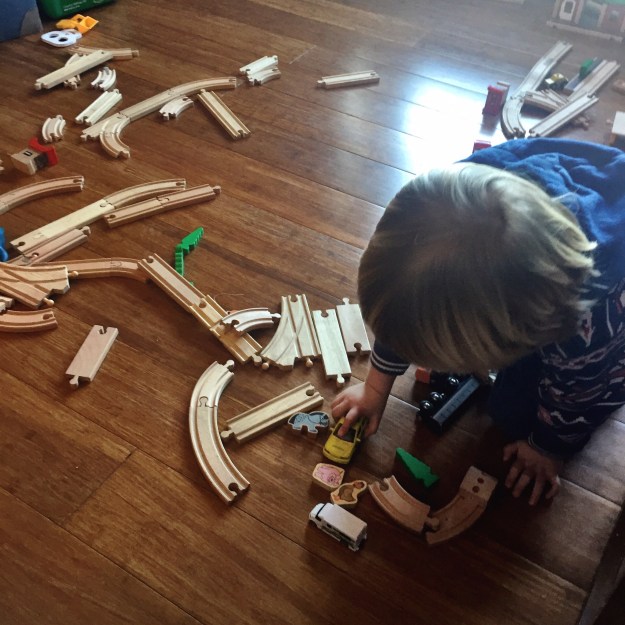
The fascination with all things construction (and demolition) that last week led us to the library has directed lots of Arthur’s play over the past few days. He has gathered his motley collection of construction vehicles with the kinetic sand in the tuff spot, brrrrming them round his little building site which I sense still has further to evolve.

IMG_1323.jpg

Whenever we’ve been out and about he’s been drawn to diggers and steam rollers and cranes. There seem to be plenty around – way more than I’ve ever noticed before. But maybe that’s just because I wasn’t looking properly.

Back at home, he has taken tremendous delight in directing me to build increasingly complex creations using duplo and his train track only to smash them to smithereens, scattering pieces across the lounge and declaring an emergency as he brings in the nee naws to sort it all out. I’ve had to resist the primal urge in me to get irritated at this wave of destruction – I know it’s important that he explores how things break as well as how they come together.

IMG_1322.jpg

His impulse to understand how things work has been focused on the vehicles themselves. We’ve found a great selection of YouTube videos that he watches with studied concentration as they break down the complex operation of an excavator, for example, into language that a preschooler can understand. The vocabulary is precise and the mechanics stretches even my understanding.

IMG_1317

The most fascinating aspect of this play for me, though, has been how he has taken it into his whole body – a kinaesthetic exploration of the engineering concepts underlying the things he observes. He stretches his arm out like a crane, his movements slow and robotic as he fashions his hand into a scoop, all the time replicating the mechanical noises he has heard with his voice. He loves it if I join in too, both of us together forming a human construction site.

IMG_1321.jpg

If I were taking the lead on his learning, I’m not sure I ever would have thought to take this topic in all these different directions. Even with my background in physical theatre I don’t think I’ve ever stood and worked out how to move my body like a crane. He is literally consumed by learning – and the power of that is more than a little awesome to behold.


Library love

The unschooling diaries: week six

I used to visit the library all the time as a kid. I loved to read, and it was the perfect way to feed my insatiable appetite for books. My mum tells me that she used to take me and my three brothers every week: we’d each choose our books, and when we got home I’d power through my selection before hoovering up everyone else’s.

I’ve never stopped loving books, but somewhere over the years my enthusiasm for the library (at least as a source of stories) faltered. I’m pretty sure it had something to do with all the fines I managed to amass as a teenager…

And then libraries began to fulfil a different need as I began to study. I savoured the quiet and calm they offered in the midst of my frenetic student life, but I would use them to sit and pore through piles of reference books instead. Before Arthur came along it had been many, many years since I had given the fiction section more than a passing glance. And it has taken us until very recently to begin to see its full potential.

IMG_1306.jpg

We signed Arthur up to the library when he was tiny of course, and enjoyed several sessions of ‘rhythm and rhyme’ until somehow other things started to take over. There were so many other activities to go to, playdates to be had – and that’s all before the irresistible pull of the beach come rain or shine. He’s always loved books, but there have always seemed to be plenty at home.

Except when I started to think seriously about unschooling the library started to take on a whole new significance. What better place to let Arthur loose on the captivating potential for human learning? A place where he was not restricted by prior choices I’d made on his behalf and could truly follow his instincts to find the things he was interested in and wanted to learn more about.

IMG_1309.jpg

On our first visit a couple of weeks ago that meant mainly playing with puzzles and looking at the globe whilst I picked out a few books I thought he might like to read at home.

IMG_1310.jpg

But this week was different. To start with the trip was initiated by him – he’d been flicking through a ‘Thomas and Friends’ magazine we’d picked up and come across an advert for ‘Bob the Builder’. He’s never actually watched or read anything about the eponymous handy man, but still somehow he was on his radar, and he wanted more. I said maybe we could go and see what we could find at the library, and his eyes lit up with enthusiasm.

IMG_1308.jpg

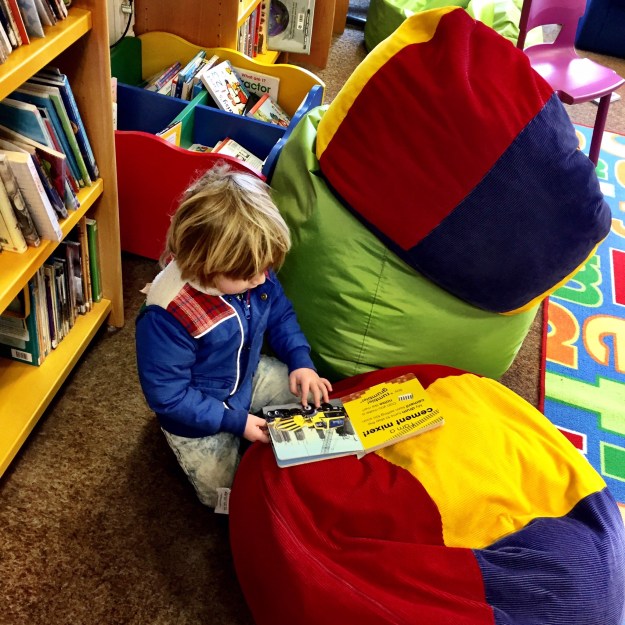
He gravitated straight for the board books when we arrived, finding one all about construction which he began to read to himself. We then went together to the longer picture books and found a brilliant book about demolition. The new concepts and vocabulary he learnt has influenced his play all week, and talks are now afoot with his dad about building a crane…

IMG_1307.jpg

We chose some other books together too, read one on the sofa in the library and took the rest home. Not only has he enjoyed the ones we picked out, but he’s also found a renewed enthusiasm for reading his own collection. It’s made bedtime a bit more of a protracted process, but I reckon on the whole it can only be a good thing.


Building blocks

The unschooling diaries: week five

One of Arthur’s favourite activities at the moment is building things with Duplo. He was given a set for his second birthday, but it took a little while for him to see the appeal (beyond eating or throwing the bricks anyway). This year, with the addition of a fire station and Batman set, he is well and truly away.

He is sometimes quite happy to build on his own, but he especially loves to direct: sitting down with me or Leigh and getting us to help him create the structures in his mind. We had a great session this week, straight after breakfast one morning.

IMG_1302.jpg

I’d cleared my writing goals before he’d woken up so I was free to play without worrying about my to do list. And as we played, I was fascinated to see where the building blocks of his inspiration came from: not just the plastic bricks themselves, but the characters and narratives he was drawing from the stories he loves and the world around him to weave into the little world he was creating.

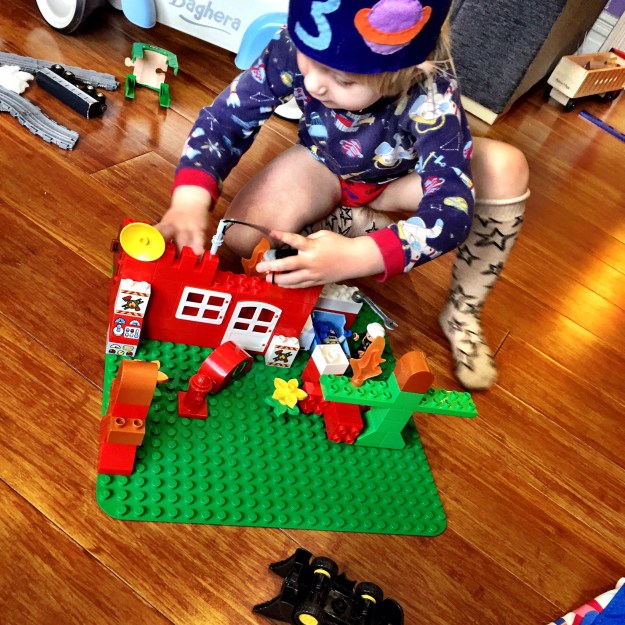
It started with a hospital – the red cross emerging from the pile of bricks and Arthur making connections about what it symbolised, and where his Daddy was working. He decided batman had an ouchy, and put him to bed to be made better by the doctor/fireman. Then he wanted a fire station next to the hospital. And then he decided maybe the hospital was on fire.

As the drama unfolded, more characters were drafted in. One of his favourite films at the moment is Toy Story, and he soon asked for Woody and Buzz Lightyear to come and play too.

IMG_1299.jpg

They were roughly approximated from duplo bricks, but even just the suggestion of his much-loved characters was enough to enhance his play.

IMG_1303.jpg

Sending Buzz flying through the air ‘to infinity and beyond’ got Arthur thinking about space and rockets, one of his other current obsessions (not that you’d ever have guessed form his outfit). The fire station/hospital was soon dismantled, and in its place we built a ‘Saturn V’. With some creative use of windows we managed to include some space for passengers, and that fired his imagination even further.

IMG_1298.jpg

He was quite particular with his directions for building the rocket itself. The books he’s read and the videos he’s watched have given him a clear idea of the parts needed to make up a spacecraft – he is already much more knowledgeable than me!

IMG_1296.jpg

We both had so much fun putting together those multi-coloured bricks, and with them cementing learning and weaving new stories. Once I’d helped him lay the foundations Arthur was happy to sit and play for ages whilst I watched, utterly engrossed in the imaginary world he was continuing to create from the building blocks around him.

IMG_1295.jpg