Tag Archives: learning

5/52

IMG_1279.jpg

“A portrait of my child, once a week, every week, in 2016.”

We’ve settled into a lovely afternoon routine these past few weeks. After lunch we’ve been going up to my study, lighting a fire and some candles, and sharing a story before Arthur settles down on the sofa for his afternoon nap whilst I get on with some work.

More often than not when he wakes up I’m still in the midst of things, so he’ll potter around – playing or drawing or watching something on his iPad.

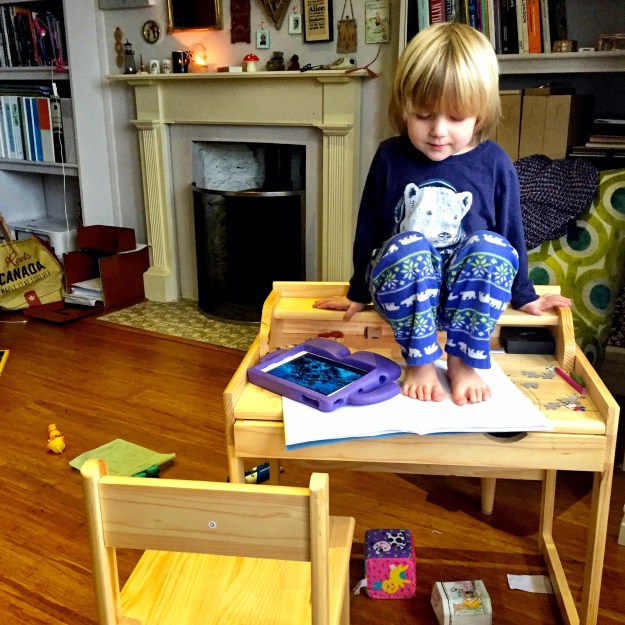
He’d been watching ‘Under the Sea‘ moments before I took this pic, sat in front of the fire as he cross-referenced with his ‘First Big Book of the Ocean‘. Clearly his concentration wavered though, and I turned around to find him sitting on his little desk, looking simultaneously so grown up and so tiny.

He does that rather a lot these days.

Linking up with Jodi at Practising Simplicity for The 52 Project. 

On joy and freedom and making links

The unschooling diaries: week three

This past week has been super busy, with precious little time for stopping to reflect. Before I miss the window completely, though, here are three little moments that have stuck in my mind.

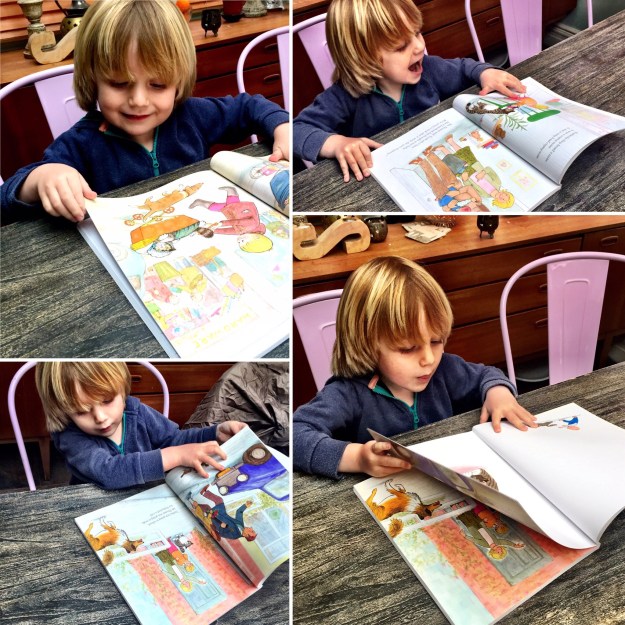
First up, there was Arthur’s unbridled joy and wonder at discovering the book ‘Mog and the Baby’.

image

He’s been listening to the story for the past few weeks: for his birthday we bought him an MP3 music player to feed his growing enjoyment of listening to stories. Almost every time he settled down to listen he would request ‘Mog and the Baby’. The way it works it would then scroll through the other Mog stories we’d saved for him, but he kept coming back to that one.

We’d intended these audiobooks to supplement our enjoyment of reading together rather than replace it, but I’d become increasingly aware that Leigh and I were reading to him less and less. So this week we’ve both made an effort to make physical books available whenever we can – not to force Arthur into engaging with them, but just to remind him that they exist. And he’s loved it.

More than anything, though, he loved discovering the book of the story he’s been listening to so often – seeing the pictures bring the characters to life, and sharing his favourite moments with me and his dad.

The second thing that sticks in my mind from this past week was a moment of learning for me more than Arthur.

I’d had a pang of doubt, fuelled as usual by comparing us to others, when I realised that Arthur had shown no interest at all in figurative drawing. He’d gone through the motions of copying lines and circles for his two year developmental check, but since then has not shown much interest in drawing beyond scribbles and swirls of paint – and we haven’t pushed it.

I’d found myself wondering whether we shouldn’t in fact be encouraging him to draw in a more structured way, accelerating his progress towards that fine motor control that will of course be so important for when he comes to write!

But then I checked myself. I read some more about unschooling, and the Montessori methods I find myself gravitating towards. And I remembered that of course there is no rush to begin to constrain his explorations into more easily recognisable forms. So instead I waited, and watched.

And then one day whilst I was preparing lunch I noticed Arthur rooting around by his easel, looking for something to paint with. Together we chose some colours, and I left him to it whilst I got on with making lunch. I glanced over from time to time, and freed from any concerns about whether he was drawing people or things that we could label, marvelled instead at the care he was taking about each seemingly abstract line and curve. I watched as he picked out his colours, stepped back from time to time to make decisions about where to go next, and waited until he had decided he was done before we sat down together for lunch.

image

He was so proud of his painting, and so was I. And I’m definitely not in any rush to put any constraints on his creative freedom any time soon – I have a feeling he’ll be able to come up with way more interesting ideas all by himself.

And on the topic of interesting ideas comes moment number three. We were having a chat in the car on Friday, and Arthur started telling me about how astronauts carry their air on their backs so they can breathe (something we’ve talked about before). Then he told me that divers were just like astronauts. I asked him why, trying to work out the connection, and he explained that they have to carry their air on their backs too. He’s been becoming increasingly interested in both space travel and underwater exploration, fuelled by inspiration from all sorts of stories, but it was fascinating to see him drawing links between them and getting to the core of understanding some of the processes behind them.

I’m curious to see where these interests will lead us in the next few weeks – it’s definitely uncharted territory for me, on all sorts of levels.


On puzzles and perseverance

The unschooling diaries: week two

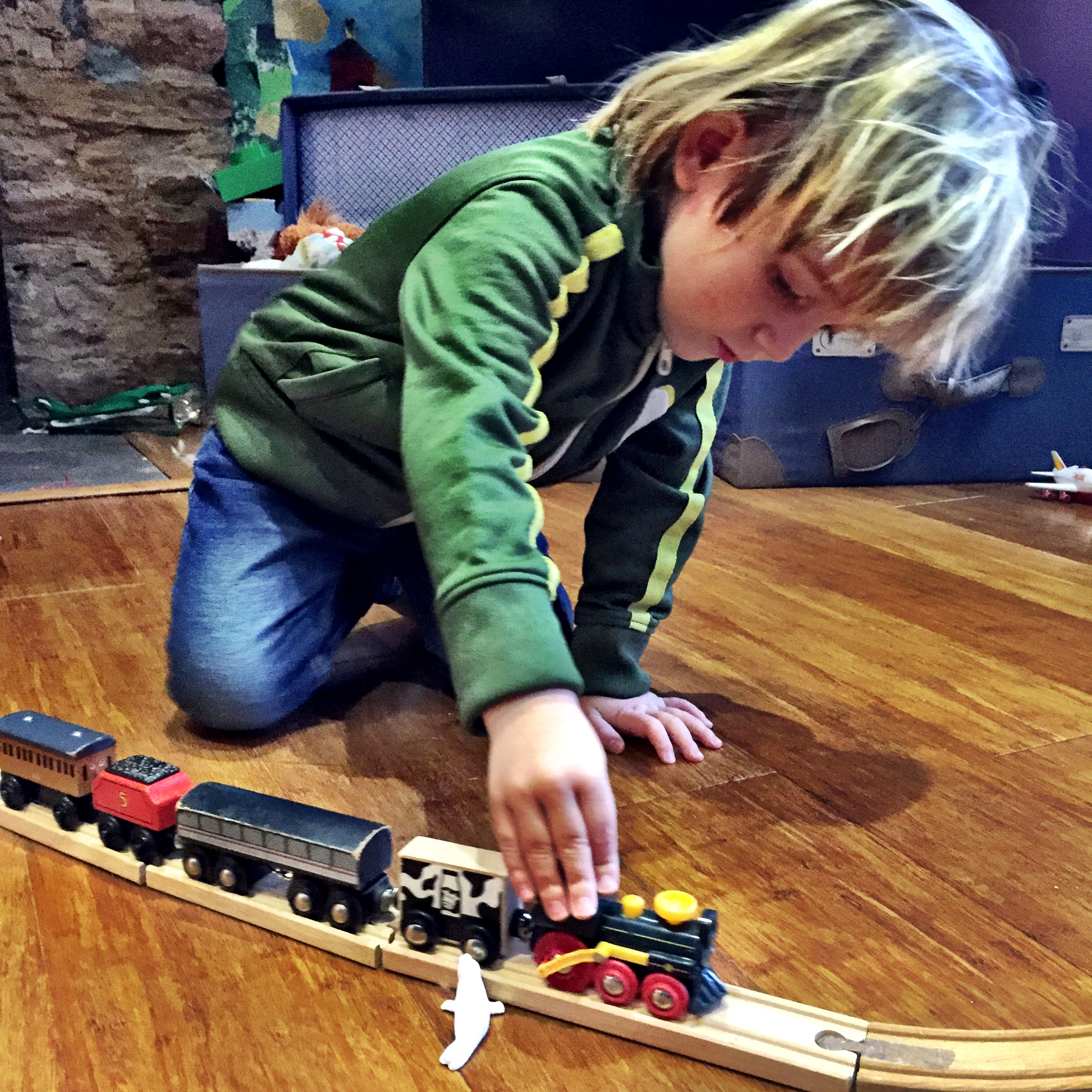
This week, we have been building LOTS of train tracks, making an impressive amount of mess with kinetic sand, and getting increasingly confident on the scooter. We have been counting fingers and toes, being a doctor like daddy, and finding out which stones make the biggest splash in the sea.

There’s been more too, but rather than just run through all of the things we’ve done, I want to focus in this week on just one little bit of learning – what Arthur (and I) discovered when we put together a puzzle.

IMG_1273.jpg

Arthur has a bit of a love-hate relationship with jigsaw puzzles. He’s drawn to them initially, but gets quite frustrated if he can’t work out how all the pieces fit right away. For my part, it’s tempting to help. To give him a strategy – like starting with the corners, and lining up all the straight edges. To show him how it works, how much quicker and easier he’d find it if he just did it that way.

I’m not really sure where that approach to putting puzzles together came from, for me. I’ve always found them a bit boring, and I wonder whether partly that might be because I’ve been approaching it wrong all along.

When I stopped myself from interfering, and started listening to Arthur and watching how he was making decisions about what bits went where, I realised that actually his approach was far more fun. He was focusing in on the characters first, on the trains he loves from his stories, and seeking out all the bits that made them. Then he looked for bridges, and flowers. It was all a bit haphazard at first, but it all started to come together.

There were moments when he got frustrated – I could see him fighting the urge to smash it all up and cast the pieces to the wind. I intervened a little then, but not to tell him how to do it. I asked him questions instead: why was he getting annoyed? What was he looking for? What was he trying to do? And through articulating his answers he calmed down, and refocused, and persevered.

It was only a short period of time (though longer than it would have been if I had made him do it my way), but it was so much more rewarding for me to step back and let him work it out himself. It was more rewarding for him too.

The process of putting that puzzle together reminded me a lot about learning in general. It might be possible to get to the end of a task quicker someone tells you how to do it, but so rarely is the completion of that particular task the most valuable goal. If you take your time, do it your way, find a way through the challenges that works for you, then not only do you have that sense of satisfaction of having succeeded by yourself but you are also laying down the foundations for deeper learning in the future.

Worth bearing in mind, I think, as we continue on our unschooling journey…


Unschooling a preschooler

I am fascinated by learning. What ignites the first spark, how knowledge and understanding become embedded, the directions these can take people in as their lives unfold. As a teacher, this informed my whole pedagogy. I didn’t want to stand at the front of a silent classroom and speak, filling supposed empty vessels with the fruits of my superior intellect. I wanted to inspire, to start the young people in my charge on a journey of discovery which would hopefully take them way beyond the walls of the school. So much of education, it seemed to me, was about fitting square pegs into round holes – and I just didn’t want to be part of that.

If as a teacher, though, the constraints of our education system were frustrating, as a parent I find them positively frightening.

I look at my unique, bright, inquisitive boy and I can’t quite comprehend how he will benefit from being subjected to rigorous standardised tests. Whilst I have every faith in the intentions of the vast majority of teachers to bring out the best in each of their students, I worry about how their resolve will hold in the face of ever-increasing external pressures. Fundamentally, my fear is that the government do not want to foster a populace driven by individual thought and opinion. And I do not want to do my son the disservice of reducing him to being merely a cog in the machine.

IMG_1246

It is for these reasons that, after years of being a passionate supporter of state education, I find myself reluctant to begin the process of enrolling him in one of our local schools. He is a while off compulsory education, but at three years old he is already unusual amongst his peers in that he does not attend nursery or pre-school. He will be more unusual still if I follow through on my instinct, bubbling just below the surface, to keep him out of formal education until he is at least seven. By this age, I would hope, he would be resilient enough to navigate school as an informed and engaged individual. Many educational experts believe that this is the age at which children are best suited to enter formal schooling – a theory born out by successful education systems all over the world.

I am mindful, though, that there is an awful lot I am trying to do with my days: writing novels, representing my community on my town council and as a school governor, acting as a subject consultant for Ofqual. The question of how I am going to find time to provide meaningful learning experiences for my preschooler has not passed me by.

Except… My experience as a teacher has taught me that much of the school day is spent managing a large volume of children rather than focusing on individual learning – I can only imagine that this is even more pronounced in early years than it is in Secondary. And my aspiration with my son, just as much as with the pupils I have taught in a school environment, is to be a facilitator rather than a font of all knowledge. I want his learning to be driven by his natural inquisitiveness, not constrained by what I feel he needs to know and understand.

And it is this that has led me to unschooling. As an advocate of child-led parenting in the baby and toddler years, and student-centred learning in the secondary school, it seems the logical path for me to follow as I look to foster a love of learning in my son.

With this in the back of my mind, I am beginning to see the play that unfolds in our everyday lives – both self-directed by Arthur and shaped (loosely) by me – in a new light. It is my intention to begin to document this, for my own reflection and maybe to inspire others too. I will never be able to capture every aspect of his learning, but what I can do is focus in on some little key moments from our weeks and reflect on them as a sort of learning journal: an unschooling journal, if you like.

It was that I had intended to do when I sat down to write this post, but thought I should maybe take a little time to explain my approach – something which took a little longer than I’d thought it might. As with many things, though, I’m much more convinced about what it is I am actually doing having taken the time to write about it: so the first instalment should be coming up very soon!

Sunday photo: 6th December 2015

IMG_6464

We’ve spent a lot of time indoors this week. I’ve had loads of work to do, and between the weather and still not feeling 100%, Arthur has been more than happy to focus his energies on play.

He’s really been stepping things up in that department: his imagination has shot up again to a whole other level, and he is finding an independence, a freedom, that is quite exhilarating to watch. Along with this independence has come a new cacophony of playmates.

The taps in the bath have become a chicken who he will happily chat away to as he splashes about.

At night we hear him recounting his dreams to the bears who share his bed.

And here he’s initiating a new companion, the Arctic seal who appeared on the first day of advent, by teaching her all about his train tracks.

With all this has come a new role he’s developing for himself. There was one day this week when conversation turned on a few occasions to the things adults do with their time, how they define themselves – who they are. We discussed how Daddy is a doctor (almost). And I asked him what I was – a genuine question on my part. He instantly replied that Mummy is ‘a writer’. Which, you know, was pretty cool.

But back to our boy and how he sees himself.

The three of us were sat that evening, chatting and making plans, and I noticed a particularly clever contraption that Arthur had created from a digger, a torch, and a shoelace. Leigh commented that he could be a doctor with intricate skills like that. And Arthur’s reply?

“I’m not a doctor, I’m a… Playing teacher.”

It could not have been a more accurate reflection of where he’s at right now. And I cannot wait to discover all the things I have yet to learn.


Linking up today’s post with Darren at One Dad 3 Girls for My Sunday Photo and Jodi at Practising Simplicity for The 52 Project. 

On lightbulb moments, and cheese

I have been powering ahead with the edit this week. On balance, this is probably a good thing – but it hasn’t always felt like it.

In reality I have spent my days either hanging my head in shame or getting downright angry with myself. And then pondering, in disbelief, how it has taken me until draft number four to notice these things…

IMG_1205

I’m pretty sure that after the third draft I was feeling pretty confident: convinced I’d done all I could to polish my manuscript, ironed out all the niggles that had persisted up until then. And yet suddenly now so much of what I’ve written makes me cringe.

It’s the cheesiness, mostly. Even before I read my agent’s last set of notes I found myself cutting whole paragraphs I happened to cast my eye over, wondering how they could have lasted quite this long. And as I’ve worked through her (very kind) comments I have been both amused and embarrassed at the turns of phrase that at the time must have seemed appropriate.

There have been other painful moments of realisation too – things that, if nothing else, I need to remember in the hope that I might just avoid them next time round.

So, in no particular order, here are those lightbulb moments…

1) I get really lazy on my off days

There is a definite pattern to the notes I’ve received this time round, and there are certain chapters which have way more highlighted than others. In almost every case the problem is the same: instead of writing dialogue, I have described it, committing the cardinal writing sin of telling rather than showing. I think I thought I was doing this for a legitimate reason – that’s what I told myself anyway – but actually as I’ve tried to draw out the actual words from the description I’ve realised I hadn’t entirely thought through what it was that was being said. I suspect sleep deprivation had a lot to answer for – I was intent on keeping to word counts during the first draft, however depleted my brain cells were on any particular day. As a writing mum I’m not sure there’s any way I can entirely avoid that – but I’ll definitely be looking out for that off-day output next time I begin the editing process.

2) I’m a little bit too good at making excuses

The question remains, of course, why I failed to pick up all those lazy days in earlier redrafts. And I think it’s because I had done such a good job of convincing myself that everything I’d written was there for a reason. I can still hear those excuses in my head as I read the words now, but they don’t wash any more. This has to be progress, right?

3) I have a tendency to waffle…

I’ve always considered myself a fairly concise writer – not someone who’ll use ten words when one will do. But as I work through this edit there are paragraphs glaring out at me that have absolutely no business being in my manuscript at all – they’re not advancing the plot or telling the reader anything particularly interesting about characters or settings, and they’re not even especially well written. It is actually remarkably satisfying to be able to slash these sections right down and realise that I am entirely capable of expressing myself more frugally. It just might be good to lose the padding a little earlier in the process next time round…

4) I need to let my characters speak for themselves

This links in to all of the above, but I am discovering that the best way to get through tricky patches in my narrative is to stop trying to second guess what it is my characters want to say and instead just let them say it. Several scenes have evolved in (I think) way more interesting directions now that I’ve let my characters speak, and it turns out that what they actually wanted to say wasn’t quite what I thought it was after all.

5) I’m way better at writing the dark than the light

This shouldn’t really come as a surprise to me given my usual choice of reading matter, but there is no doubt that the best sections of my writing are the ones which are also the most depressing. Or unsettling, or disturbing, or angst-ridden. Just not the bits where I’m trying to convey sweetness and light. That’s where the cheese comes in.

Now I realise reading this back that it might come across as a very negative post – and it’s not supposed to. I’m over the whole frustrated with myself thing, and actually am just so incredibly relieved that this manuscript had not made its way beyond my trusted circle of beta readers to the big wide world.

I am also realising once again how important the editing process is – not just for this particular novel that I’m working on, but for everything it’s teaching me about writing, and about myself.
Writing Bubble
Mums' Days

The most important meal of the day

When I was a teacher, I was always more than slightly alarmed to see teenagers clutching litre bottles of cut price energy drinks as they arrived at school in the morning. Sometimes this was supplemented with a packet of crisps, but either way I doubted it was going to do much to set them up for a day of learning.

Just by talking to kids about their breakfast habits, it was clear that there was a strong correlation between a healthy and nutritious morning meal and the ability to focus, study and learn – something that has been confirmed by numerous studies over the years.

It is a sad fact that one in seven British schoolchildren go to school without having eaten breakfast at all, but when you look at Africa the figures are even more stark. Research has highlighted that about a third of people in Uganda and Rwanda are gravely undernourished – an estimated fifteen million people. For children, this becomes yet another factor which holds them back from reaching their full potential.

It is for this reason that Send A Cow has launched the Break… Fast Appeal which aims to raise £500,000 to give children in Africa a better start to their days and to their lives. And as part of this appeal they have launched a fantastic free recipe book, ‘The Most Important Meals of Their Lives’, which is available online here and captures in stunning images the food that fuelled the achievements of some of the greatest people in the history of humankind.

From Winston Churchill to Rosa Parks, from Florence Nightingale to Nelson Mandela, this intriguing and inspiring book offers an insight into the meals that created history. And not only that, the clear and straightforward recipes offer you the chance to recreate the meals for yourself.

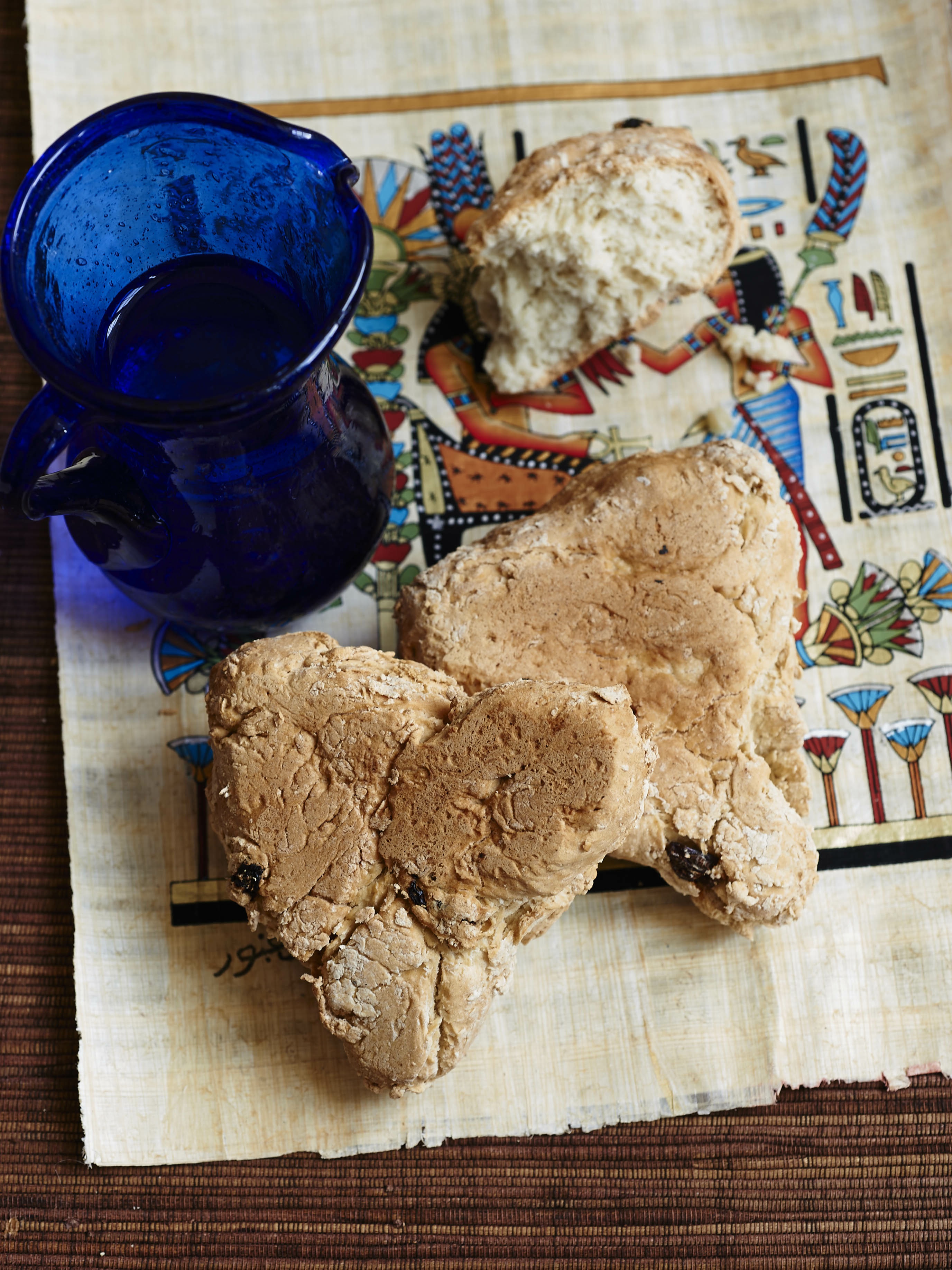
I rather like the look of Cleopatra’s Ancient Egyptian bread sweetened with honey and dried fruits.

image

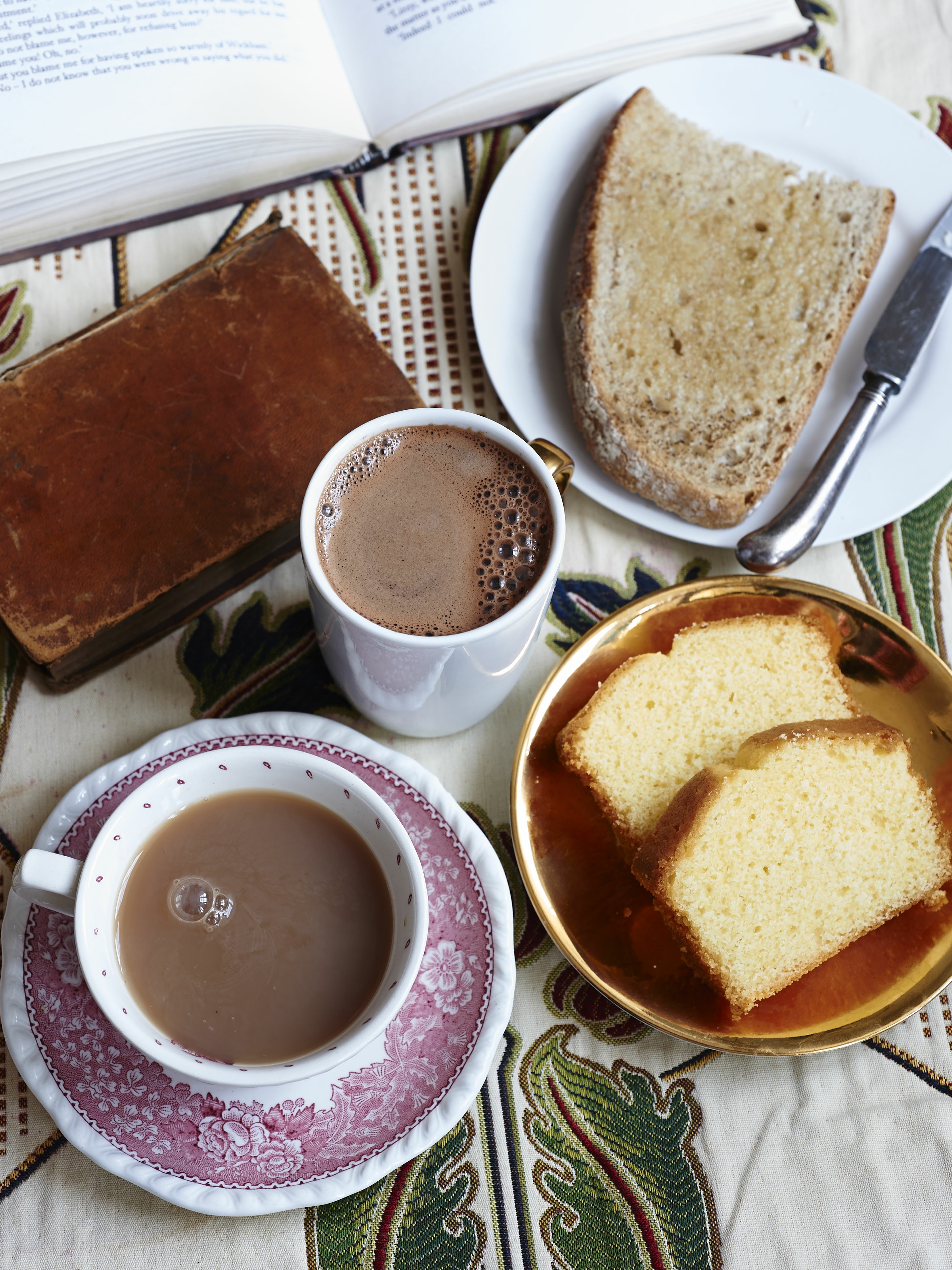
Someone else who was keen on a starchy start to the day was Jane Austen, with her breakfast of bread and cake accompanied by tea and cocoa.

image

Or perhaps you’d rather go for something a little more savoury, like Charles Darwin’s feast of game and eggs?

image

Whatever your tastebuds crave in the morning you’re bound to find something in this book to tickle your fancy. I’m certainly looking forward to trying out some of the recipes as an alternative to our breakfast staple of porridge and fruit.

But this is more than just a recipe book. It is a fantastic educational resource that could be used at home or in school not only to raise awareness of the importance of breakfast for children in Africa, but also to spark off conversations with young people about how they start their day. Perhaps by exploring the meals that their heroes enjoyed, teenagers might be encouraged to rediscover this essential meal for themselves – who knows, it might just be enough to release the potential of the people who will shape our future just its subjects have shaped our past.

You can find out more about the appeal and download your copy of the book at www.sendacow.org.uk/breakfast. Whilst the book is free, there is a suggested contribution of £2.50 to the appeal. The UK government are doubling all donations made until the end of June 2014, meaning that your £2.50 would provide enough to support an African child for a month. For £30, you could support a child for an entire year! Now that’s a lot of breakfasts…


image


Post Comment Love