Tag Archives: writing

Close to home

There has been something incredibly satisfying about working on a novel over the past couple of weeks that draws its inspiration from the town I now call home.

I’ve been here five years, but the first two novels that I wrote at my desk overlooking the sea were based on a very different life. Their plots and characters were woven from memories which, as memories do, have faded as my distance from them increases, and whilst there is nothing wrong with seeking inspiration from the past I have found my present a much richer source of detail.

IMG_9651.jpg

It’s kind of ironic, really, given that this third novel is historical, playing out its story between the 1970s and the dawn of the new millennium, and thus further away temporally than each of the others. The world I have created within it is not the same as the one I live in now, but that has not stopped my senses seeking out the experiences it needs to strengthen its authenticity.

Going back to edit the draft, its stifling seventies’ summers conjured in the winter months, I brought to bear another layer of experience from the summer just passed. My love affair with life by the sea has inevitably found its way onto its pages, and I believe that it is an altogether better novel for it.

There is something in that journey that feels good for my soul, too. To be living and breathing the words that I write rather than tearing myself between my current reality and another, far removed, that I am trying to make true.

This past week’s writing, now that I have submitted that draft to my agent, has focused in even more on the experiences that define me now. When I am not trying to carve out this niche for myself as a writer, a large amount of my remaining energies go into my local lido – both in swimming whenever I get the chance and in working to help run it, restore it and preserve it for years to come.

On Saturday I took part in a fundraising challenge, swimming thirty lengths alongside other lovers of its watery charms. As I swam my 1500 metres, a longer distance than I’ve attempted in many years, my mind worked on a story I’ve been developing to answer a call for submissions for new writing from lido lovers. I finished writing the first draft of that on the beach yesterday afternoon, and after a few hours of polishing emailed it off this morning.

I can’t guarantee that my next wave of inspiration will come from the water that surrounds me here – and in fact it would be an impoverished body of work that was too insular in its outlook – but I think perhaps I needed grounding, and it feels like these projects have achieved just that.

It will be interesting to see where they take me next…


Writing Bubble

All change

At the start of the summer, I thought I knew where my writing life was going. I was certain in fact: I had discovered Mslexia’s brilliant guide to Indie Presses, and I had resolved to find a home for my writing through one of those.

And then…

I picked up the Writer’s and Artist’s Yearbook Guide to Getting Published, and my resolve weakened. The approach it advocated was much more traditional. It didn’t reject independent publishers entirely, but it cautioned against them as a way of launching a career.

My personal jury is still out on the pros and cons of the various routes into getting my words in print, but I was forced to acknowledge that there was a third book, waiting on my hard-drive in its unpolished state, that might still hold the key to the prized arrival on the literary scene that resided in the enclave of the bigwigs in the publishing world.

So I read it.

And I really enjoyed what I read.

IMG_1606.jpg

From what I could see at first glance, there were none of the obvious roadblocks that my first two novels contained within their pages: the question over cultural integrity in my young adult novel exploring my experiences as a teacher; the doubts over a generic home for my slightly obscure hybrid between psychoactive thriller and mental-health steeped realism. In fact this third novel reflects much more of where I’m at now, of my life by the sea with its echoes of the city. The characters are ones which resonate with my own experience rather than one I’ve observed, and though the path they choose is unconventional it is not unbelievable.

So I decided to give it a chance.

Having read through my words in print – a much more satisfying print, incidentally, having tried to approximate an actual novel in the way I presented the words on the page rather than just the standard sheets of A4 – I returned to Scrivener to tweak the narrative to one that rang true.

And then today I sent it to my agent.

Who knows whether her optimism will match mine, but right now I’m feeling pretty positive about our prospects.

This change of heart has been made all the more possible by a change in my circumstances that I’m just starting to get my head around. Leigh has finished his medical school training, and launched into his career as a junior doctor. This might have spelled the end of any time to myself, but we decided as a family that the next phase of his training would be better carried out part time.

So suddenly I have two whole days a week when he is taking the lead in parenting. Two whole days a week where I can focus on my council and freelance work, and on my writing.

It’s amazing how much you can get done when you don’t have a three year old to entertain at the same time.

Now, having submitted that first draft, I am looking forwards. I haven’t yet written a synopsis of novel number three, so that is top of the list. And then there’s a short story competition which perfectly resonates with my love of outdoor swimming, and a children’s novel competition that I am going to bite the bullet and submit my first manuscript to.

I’m feeling pretty positive about it all, despite the fact that my agenda has undergone such a major u-turn. It’s a writer’s prerogative, right? To follow the thing that feels true?

It’s hard to know for now how that might change again in the future, but finally I have the time to really work out the best way forward for me – and for my writing.


Writing Bubble

The perfect fit

So I have finally this week managed to begin the process of getting my head around this whole getting published malarky.

It hasn’t been easy: my to-do list seems to be expanding almost as enthusiastically as my veg patch, and I am still finding the political car crash so horrifically compelling that it is taking almost all my energy to secure the headspace to think about anything else.

But part of my post-Brexit survival plan was to be just a little bit selfish, and with that in mind I sat down in the garden one sunny afternoon with the two books that have sat forlorn and unopened since they arrived in those innocent pre-referendum days and took a look at what they had to offer.

IMG_1532.jpg

A lot, is the answer.

I started with the Mslexia guide to Indie Presses (thank you Teika for the recommendation). The world of independent publishers is fairly new to me, so I was keen to see what was out there. I scoured each description, marking any that seemed a good fit for either of my completed novels to come back to later.

Once I was sat at my computer, I started a spreadsheet. I wouldn’t normally be quite so rigidly organised about something like this, but the careful structure of the columns and rows helped to still my chaotic mind, and made me believe that I might just possibly be able to do this.

For each publisher, I noted down their web address, the relevant genres they were interested in, submission guidelines, and whether they were in fact currently accepting unsolicited submissions. That last column narrowed things down a bit, but of the ones that were left I explored their websites a little further, deciding which of my novels I would approach them with before adding that to the table. The final columns, yet to be filled, are for the date I submit, the date I intend to follow up, and what feedback, if any, I receive.

Its funny, but even just going over that process here has calmed and focused me again. If feels like a big thing, to be preparing to submit my work to people who might be able to help me get it out into the world. There is still lots to be done before I actually get to the point of submitting – honing and re-honing those crucial first chapters, reworking my synopses, crafting an elegant and engaging covering letter. The more I think about it, though, and the more I discover about independent publishers and why they are there, the more I believe it is the right route for me.

My writing is not mainstream. It is not easy to fit into a box. I can completely see why the ‘Big Five’ publishers might not think that my novels are worth the punt.

But I do.

And I’m sure, with time and effort and plenty of willpower, I will eventually find a publisher who is the perfect fit.


Writing Bubble

And relax… (sort of)

On Thursday evening, I wrote until my brain could take no more and went to bed frustrated.

On Friday morning, I got up in time to shower and feed and dress Arthur and I before we had to leave the house just after half past eight, managing to squeeze a couple more hundred words in between it all: but still it wasn’t enough.

Once Arthur had been safely delivered to his gymnastics class, I sat myself down with my laptop. I was surrounded by screaming kids and chatting mums, and had just under an hour to bring my story to its conclusion. And with seconds to spare before I wrapped Arthur up in a cuddle and we continued with our day, this happened:

IMG_1508.jpg

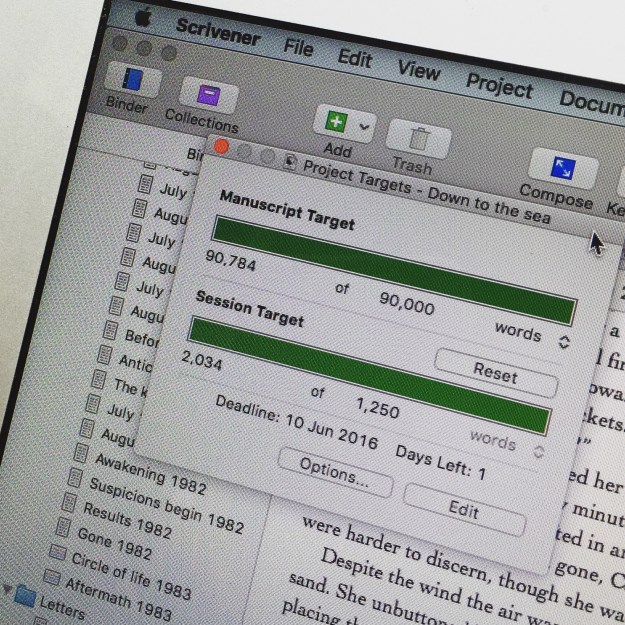
Having set myself a somewhat cursory target of 90,000 words, and broken it down way less rigidly than with my first two novels, I was a little intrigued to discover that as I approached that magic number the story did appear to naturally be coming to a close. I had been all prepared, after the two ‘deadline extensions’ I already given myself, to move the goalposts yet again even after that progress bar had turned its satisfying deep green. But, as it turned out, only 784 additional words were needed before I could safely say that the first draft was done.

It’s a good feeling, coming to the end of a first draft. Even now that I understand just how much work goes on after that point – way more, actually, in terms of both hours and mental exertion – it still feels good to get all of the raw material out of my head and onto (virtual) paper.

And so, to an extent, I can now relax. Except, of course, I can’t.

Along with all of the other endless jobs on my to-do list, I have set myself a bit of an epic mission for this summer. It’s the mission that, if I’m successful, will take me beyond the realm of ‘someone who writes’ into the heady heights of ‘professional writer’.

It is the mission to get published.

I’m keeping an open mind at the moment about how that will happen and with whose help, but it really is time I started to take things to the next level. I haven’t had the confidence before now to really push it, and even now I’m quaking in my boots a little.

But I’ve written three whole books.

And whilst they all still need a bit more work, I have reached a point where I don’t think I can justify turning my attention to another before the ones I’ve written are given a real opportunity to shine.

So there won’t be much relaxing here. There will be lots of research, and investigation, and soul-searching, and letter-writing, and self-promotion. But hopefully by the end of it, once this latest first draft has sat for a while and is ready for me to turn my attention to it once again, I will have a much clearer idea of where it’s all going.

That’s the plan, anyway…


Writing Bubble

Stolen moments

I had such a lovely writing day today.

I don’t take any of my writing time for granted: it took years for me to pluck up the courage to put pen to paper at all, and when I was teaching full time I rarely had the headspace to write anything longer than flash fiction, or sometimes a bad poem.

Getting stuff written has moved much higher up my list of priorities since I became a mum, but between entertaining a three year old and a growing smorgasbord of employment it can still be hard to find the time. I’m still working on making mornings work, and otherwise guiltily catching up during Arthur’s afternoon nap when I should really be focusing on the rest of my to-do list.

Today, though, was different.

I dropped Arthur off at forest school at 9.15. That may seem like an innocuous statement, but it was actually the first time we’d left him with anyone other than my folks, and the first time he’d been in an ‘educational setting’ for longer than the hour his gym class lasts. I wasn’t worried: the couple of sessions I’ve been to with him convinced me that it was exactly the sort of environment I wanted him to be spending his time in. Still, though, his wobbling lip and wide eyes almost weakened my resolve.

But I have a deadline to keep. And I’ve already put it back twice.

I wandered off through the little village of Stoke Gabriel, heading for a cafe by the waterfront. It was such a beautiful morning that I decided to start off outside, pitching myself up with my laptop on a bench overlooking the weir. There’s definitely a lot to be said for not being tied to my desk.

IMG_1491.jpg

After the first few hundred words, I decided I needed a coffee. So inside, for a flat white and a glass of water and a few more hundred words.

Then when I hit a wall again, I went for another meander. I didn’t really know where I was going, but I figured it would be difficult to get lost. I found a bench, up above the road with a view down towards the river, just at the point when the next flash of inspiration hit, so I stayed there for a while.

My last port of call was a pub, for a pint of lime and soda and a little burst of internet. Despite being connected to the world I still managed to get something written, ending my morning’s mobile session at 2,669 words.

What was especially wonderful was that I hadn’t had to rush. I had almost four hours of writing time in total, broken up by walks to kick my brain into gear again. And in that time I could let my mind wander too, and find new ideas in my daydreams.

I’m not sure how often I will have days like today – in the time I was gifted or the headspace to use it well – but I am grateful for this one I had.

And, at the end of it, I am that little bit closer to achieving my goal…


Writing Bubble

Writing in transit

Up until recently, I have been very much tied to my desktop when it comes to working on my novel. My trusty Scrivener is not available on the iPad, and besides there is something about this space that focuses me. Both of my first two novels were written here in their entirety, and there is an energy and an association of success that makes it (relatively) easy to get the words on the page.

Except…

Lately it has got harder and harder to find the time to write. Even with getting up early, my progress towards my word count target has slowed, and various excursions to London and further afield have meant my desk has been a very long way away just when I needed it most. So I have finally got round to dusting off my old laptop, dredging the (limited) depths of my technical expertise to get it working again, and setting up the Scrivener and Dropbox combo that means my novel can be with me wherever I am.

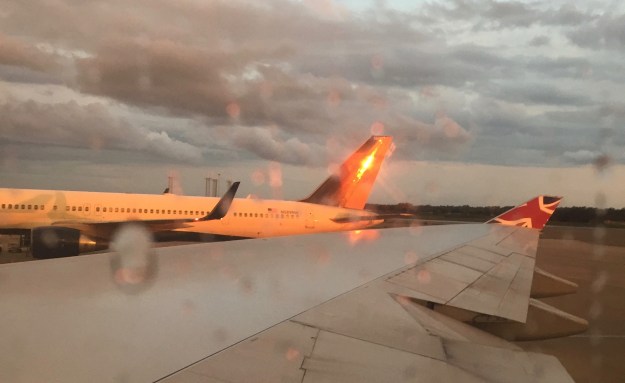
It’s taking a bit of getting used to, but it seems to be working. I’ve had a couple of writing stints, one on a train, the other on a plane, where I have found the words pouring out – so much so that arriving at my destination has ended up being quite frustrating!

IMG_9574.jpg

It seems there is something about being on the move that is quite conducive to writing. I have always found the ambient noise of trains and planes quite hypnotic, and in this instance it seems to have shaken me out of my comfort zone and help me see things differently. It is as if the physical shift in time and place has helped me get over the initial stumbling blocks that the changing landscape of my story had presented.

Whatever, now that I am back on solid ground I am very much closing in on my end goal. Even the tricksy issues of structure are beginning to find some sort of resolution in my mind, and I have some ideas that I’m really looking forward to exploring when this first draft is done.

Most of all, though, I’m looking forward to the potential freedom in my future writing life – one where the inability to be at my desk does not translate into an inability to write, where I can use my environment to my advantage as I develop different aspects of my stories.

I have always envisaged a life as a writer where I can be free to travel, and work wherever the mood takes me. Suddenly that possibility seems closer than it ever has before.


Writing Bubble

Keeping focused

For once, this isn’t actually a blog post about the struggle to focus on the novel in the midst of everything else that’s going on in my world. That is still (and will ever be) a challenge, though the early mornings are definitely keeping things ticking over.

My latest issue, though, is keeping my focus where it should be within the novel writing process itself. Since I’ve jumped almost twenty years into the future, picking up with my teenage protagonist as she navigates her way through adult life, I’m finding my mind increasingly drifting towards structure.

IMG_8444.JPG

I think it’s partly because, 75,000 words in, I can begin to taste what the novel might be like in its finished form. It is still a long way off that – far more than either of my first two novels I have really let myself be liberated by the first draft, and I know what I’ve ended up with is much rougher around the edges. Still, though, I’m finding it hard not to project a response onto future readers, trying to imagine how satisfied they will be with how I’ve told the story, how much they will empathise with my protagonist both now and in her past.

And actually, ultimately, what is seeping in at the corners of my mind are those questions about how exactly am I going to tell this story.

I’ve written it chronologically, starting when my main character was ten and peeking into every summer until she was sixteen, and everything began to come tumbling down. There’s loads I’ve left out – some I’ve alluded to in dialogue, some that is there in an exchange of letters. And then of course there’s a whole seventeen years that’s missing between the two different phases of life the novel covers. The bulk of the story happens – and is told – in the past, but the ‘present’ is vital to understanding its significance.

I always imagined that I would structure the final narrative in a way which travelled between those two phases, and that is still my goal. I told myself just to get the story down first, and to worry about that particular (albeit major) detail later. And that is ultimately still what I’m trying to do. But it’s so odd writing something when you’re not entirely sure what your reader already knows at that point – or what they don’t. So hard to think about building suspense when you know that you might already – intentionally – have given the game away.

I’m not expecting any answers here. It’s an interesting process, and one which I think I just need to hold my course on if I’m going to be able to find out whether it will work. There are a handful of key scenes that remain to be written, and once I’ve done that the solutions may well emerge all by themselves. Even if they don’t, I’m quite looking forward to the jigsaw puzzle challenge that the next phase of this novel looks likely to present.

I just need to make sure that I have all of the pieces on the table first before I try to see the bigger picture.


Writing Bubble

A new voice

So despite all of the crazy busyness of the last couple of weeks, the novel has managed somehow to hold its own. In fact last week I was flying – on Thursday and Friday alone I managed five thousand words, which helped me get my head well and truly back above the water.

It wasn’t just about the words, either: plot points fell into place, my characters led me through some tricky resolutions, and my head was bursting with ideas about where I wanted to take things next. Out of nowhere I had found some much-needed momentum, and just for a while it felt as if the story was writing itself.

But of course that didn’t last; I knew it wouldn’t.

The downhill cartwheels that were powering me through were gathering speed as I grew closer to an ending: the end of my protagonist’s childhood, and also the end of the section of the novel that is set in the (not so distant) past. But it is not the end of the novel. My task now is to get to know the adult she has grown into, and that is a whole new challenge.

IMG_1439.jpg

Yesterday, I mainly scribbled notes – adding to the initial ideas I’d had about those almost-present-day chapters and hovering my pen over emotions and actions that suddenly didn’t feel right. I thought I knew her, adult Catherine, but it turns out that maybe I didn’t.

I suppose it is only right that having spent several months (and sixty seven thousand words) travelling through her teenage years the woman who I am faced with now at thirty three is different to how I had imagined. She’s much more rounded, which is good. Initially when I was planning I only had the outline of the tumultuous events that had shaped her, I didn’t know exactly how she would respond. So I am almost starting again, in some respects, mapping out those future echoes with a preciseness that was previously beyond my reach.

Much of the details will come out in the writing itself. I began a scene today which, when I let it, filled in the gaps for me. It’s slower work though: finding a character who is changed and yet consistent, a tone which is complementary and yet not just more of the same.

I’m trying hard not to get frustrated.

I can see that 24th May deadline that I set myself looming up fast over the horizon, and I suspect I might not meet it. I don’t even know right now whether ninety thousand words are going to be enough to tell the story I want to. There’s definitely going to be some serious editing when it comes to the next draft, but I suspect the raw material may spill over once I’ve found my flow again.

And ultimately, I have to remind myself what’s important. The deadline was only ever a cursory one, the word counts plucked out of the air to give me something to aim for. Part of me is impatient for the next stage. I want to see how all of these parts are going to fit together, how the story will weave its way between past and future. But I know I need to get the whole of the story down before I can do that.

So I will carry on, listening hard to the voice of this damaged and disillusioned woman at the dawn of the new millennium. After all there is nobody else that can tell me the rest of her story as well as Catherine herself.


This is literacy

There were all sorts of things that wound me up about the government’s response to yesterday’s kids’ strike, but by the end of the day the number one accusation I was reeling about was that the tens of thousands of parents and teachers who supported the strike did so because they do not have high enough expectations of children’s literacy.

There are many things I may have fallen short of as a teacher and a parent, but having high expectations most definitely isn’t one of them. It is just that, like many others, I seriously doubt the validity of the narrow interpretation of literacy that success in the SATs exams hinges upon – and fear for our children’s sanity when they are expected to be able to absorb and regurgitate complex grammar knowledge that stumps everyone from masters graduates to the very Schools minister who champions this rigorous approach to assessment.

I am not convinced, actually, that Nick Gibb knows much about the content of the tests he reveres. In press statements yesterday he talked about the importance of basic comprehension and the use of capital letters. It made the people opposing the tests look pretty stupid – and fuelled the hundred of trolls who engulfed social media to pour scorn on the intentions of parents who pulled their children out of school. The fact is, though, that we’re not just talking about learning basic literacy here: we’re talking about learning (by rote) huge swathes of linguistic terminology. There are many people who have written about this more expertly than I have – I especially like Michael Rosen’s blog for no nonsense critique of literacy in schools. What I want to highlight here though is not only that what primary school children are being expected to learn (and be summatively tested on) is excessive and in many case irrelevant, it is on the most basic level the opposite of what literacy really is.

IMG_1420 (1).jpg

The simplest definition of literacy is being able to read and write. As an English teacher, and then a parent, and now a writer, these are both skills that I believe of course to be essential: being a confident reader and writer opens a door to a whole other world of learning and communication. But is being able to confidently label fronted adverbials and subordinating conjunctions really a central part of literacy, or even any part of it, for ten year old children? I think not.

Nicky Morgan says that the new tough regime of SATs exams will help increase the numbers of young people achieving the top grades at GCSE, but if it extinguishes the curiosity that drives the desire to learn then there’s no way it will do that. She insists that the knowledge that the SATs examines will, once children have mastered it, allow them to be more creative. But in saying this she is completely ignoring the much-researched developmental window before the age of seven which has inspired play-based curricula worldwide – and leads to many successful education systems holding off from any formal education for children before that age.

The government accuses us of dumbing down, but I would argue that what they are doing is dumbing down our children: producing a factory line of automatons who have missed out on the opportunity to fully develop their own personalities or a sense of who they are as members of our society.

My concept of literacy is considerably more ambitious. My desire to truly understand how children become confident readers and writers has been rekindled by watching my three year old son learn and grow, and that is what is at the root of my fear of what the SATs, and the pedagogy that is seeping out from them, is doing to our children.

My son is a reader. He tells me the story of pictures in the books we share, interpreting the images themselves and augmenting that with his imagination and his memory of the words being read aloud. He seeks out letters in the world around us – not yet being able to differentiate between more than a handful, but knowing that letters make words and that words label things and concepts. I am confident that, as we continue to make books and stories an integral part of our lives, he will make the transition to reading independently. He will begin to use the multitude of cues available to us as readers to make his own sense of the written word – and he will want to, because he already knows what treasures there are to be found within the pages of his books.

As an aside, I have to admit I really don’t understand the government’s obsession with synthetic phonics when it comes to teaching children to read. Some degree of phonics, sure. But to strip back the process of reading to solely decoding? To insult children’s intelligence by making them read ‘nonsense’ words just for the sake of catching them out? That doesn’t make sense to me . But I guess it’s easier to test than a system that recognises the real nuances that underpin the process of becoming a confident reader.

My son is also a writer. Don’t get me wrong – he can’t actually form letters yet. In fact he shows very little interest in concentrating on the fine motor skills that will eventually lead to him writing down the thoughts that are in his head. But what thoughts he has! He picks up new vocabulary like a sponge, knows exactly how to use words to achieve particular effects, mirrors the complex sentences he hears and reshuffles them for himself to suit his purpose. He tells stories to his teddies and his trains, comes up with brilliant if unlikely explanations for particular juxtapositions of objects in his play, and is developing a very strong line in persuasive reasoning. When he is ready to put pen to paper I have no doubt that these skills and knowledge will underpin his actual writing, but he already demonstrates the aptitude that I admire in any writer who has mastered their craft.

I know my son is not unique. He is doing exactly what every three year old instinctively does – experimenting with language and relating it to the world around him. But I worry about what will happen if he is asked to put all of those thoughts and ideas into nice tidy boxes for the sake of standardised assessment.

I worry for him, and I worry for all of our children.

This worry has not come about because my expectations are low. I have the highest expectation of young people, one that will empower them and motivate them whilst they are at school and throughout their lives: I expect them to want to learn. If they want to learn, if they want to achieve, if they are inspired, they will use that as a drive to overcome whatever obstacles are in their way – including those basic reading and writing skills. Hell, one day they might even be driven by the desire to be able to confidently identify those subordinating conjunctions and fronted adverbials. But if they aren’t? I think they’ll be ok.

I am not sure though that our kids will be ok if this government is allowed to plough on unchecked with its imposition of an increasingly restrictive straightjacket on literacy and learning. And it is our responsibility to stand up for them.

May 3rd 2016 was a momentous day, and it was incredible to see the impact that parents can have on the dialogue surrounding education in this country. We cannot stop now though: parents and teachers need to draw strength from this groundswell of passion and purpose. There is still so much work to be done.


Writing Bubble

How to grow a writer

It is easy to be negative at the moment when thinking about education. In fact it’s easy to be negative about most things to be honest – I’ve spent most of this week dwelling on the seemingly inevitable fate of the NHS, while intermittently wondering whether there is anything we can do to bring our schools back from the brink.

But of course there is.

Beneath all the doomsaying around the utterly depressing state of assessment – the unbelievably detrimental SATs exams, and ill-thought-out reforms to GCSEs – there are teachers just getting on with doing their jobs. Jobs which, incidentally, align the vast majority of them much more closely with the interests of the young people in their care than with the government and its dictats.

Much of what we have shared through the #THISislearning campaign so far has been rooted in the Early Years. And it is a relief to know that here the notion of play as a vehicle of learning still predominates; that our children, at least when they are very young, can follow their own path to creativity and fun.

But of course play does not become defunct as children grow older. In fact I would argue that its magic becomes all the more important.

IMG_1412.jpg

It was always one of my key goals as a secondary school teacher, to harness the power of play.

There is a tightrope of engagement when you are working with teenagers, hung tentatively between the towers of curriculum and assessment. My job, the way I saw it, was to enable my students to balance on that high wire – to give them the skills they needed to succeed whilst simultaneously not losing sight of the love of learning that motivated them all, once upon a time.

Of course inherent in this is the notion of success, and this is where my views diverge most from those of our our current government. For me, success (from an English teacher’s perspective) is a young person who can think, read, write and speak with confidence. I imagine what that looks like for me is very different to Nicky Morgan’s idea of a perfectly educated child. To be honest I seriously doubt whether confidence, and all of the dangerous individuality that goes with it, factors anywhere at all in this government’s vision for our children. But that’s a story for another post.

So back to my job, as a teacher.

I established very early on in my career that I was not a ‘filling empty pails’ kind of educator, but rather one more interested in kindling fires. I have never had much time for bare facts – knowledge without context leaves me cold, and I admit to finding myself so completely disengaged with the approach to learning about grammar intrinsic to the new KS2 SATs papers that I can hardly read to the end of a sample question without switching off.

That’s not to say grammar is not important, or fascinating – of course it is, given the right situation. It’s just that there are so many more interesting ways to understand it than by methodical categorisation and endless rules – especially given that our language is often not very interested in following the rules itself.

My goal in the classroom was to get my students interested in things. To get them asking questions, being genuinely curious – to get them to a place where the answers (where they existed) might just stick.

I remember sitting down with a colleague (and friend) to plan a scheme of learning for Year Eight which needed to get down to the nitty gritty of word and sentence level analysis, as well as improving students’ use of grammar and punctuation in their own writing. We wanted to use a multimodal approach to engage students in a dialogue about how texts were constructed, the similarities and differences in the way meaning is conveyed through images, film and the written word. It ended up being based around a range of texts including ‘Where the Wild Things Are’, ‘Persepolis’ and ‘Stand By Me’, weaving back and forward through the narratives in their different forms and inviting an intelligent discussion which did – inevitably – lead us to the technicalities of how language was being used, and how the students could manipulate it to their own ends. I can tell you now that at the end of it none of those kids would have been any closer to passing the exams that, according to our current government, they should have been sitting two years earlier. But they were more confident readers and writers, and could explain why they (and others) used words the way they did.

All of that aside, it was fun. Not easy – in fact arguably harder than going through the motions of learning by rote because of the degree of thinking involved. But it was interesting: informed by the personalities of myself and my friend, and inviting our students to engage with it on a personal level.

There are a couple of other schemes of learning that stand out to me from Year Nine – a notoriously tricky year where the emotions of puberty are in danger of taking over completely, but an exciting one too when the new level of maturity students are beginning to exhibit can take everything up to another level. One was inspired by a brilliant set of resources from BT, using an exploration of all forms of spoken language as the hook into learning more about how words work. Another took its starting point from an excellent study guide produced by the English and Media Centre to explore the Sherlock Holmes stories, and detective fiction in general. We encouraged students to go into role as detectives as they read and studied the texts, to look out for clues in the language to the meaning that was being created and then be able to apply the techniques themselves as they grew into more confident writers. My kids produced some fantastic stories as a result of what they learnt, with some exhibiting incredibly sophisticated and effective manipulation of language. Could they have told me exactly what grammatical devices they were using and why? I doubt it. Did they need to? No! Not back then anyway…

I could go on, but I imagine you get my point. The nurturing of a writer has very little to do with teaching them to identify fronted adverbials and subordinate clauses, to carefully construct expanded noun phrases and employ the correct balance of semi-colons and exclamation marks. It has everything to do with introducing them to a wide range of texts, with letting them discover for themselves the thrill that comes from reading words that truly speak to you, with giving them the tools and the confidence to be able to construct their own sentences and paragraphs and weave them into whole texts that they are proud of and that mean something.

I know that, in English classrooms up and down the country, that is exactly what is happening. But I fear that it is happening less and less. Because, in our overloaded education system, this sort of learning seems to no longer be valued. And I don’t mean by the teachers – they know what learning looks like, and how to inspire.

But they also have an obligation to get the children in their charge to pass the tests. And if this government remains insistent on testing the wrong things (and testing them way too often) then there will be no space for real learning left at all.


Writing Bubble