Category Archives: Sophie is parenting

Why SATs are bad for our children

There are many moments that have stayed with me from my ten years of teaching. The overwhelming majority of them are positive, but there is one in particular that has been circling around my head the past few days that makes me feel so sad about what current government policy is doing to our children’s experience of learning.

Early on in the first term of Year Seven, I often broached the question to my English class “What makes good writing?”. It’s a big question, and not one I ever expected to hear answered in its entirety, but still the responses that I got were pretty telling. The particular set of responses I remember was from Autumn 2012, just before I disappeared on maternity leave. Fresh from SATs preparation, hands shot up as I wrote the question on the board, and the answers spilled out proudly into the classroom: “varied sentence starters”, “correct use of conjunctions”, “fronted adverbial clauses”, “using semi-colons”.

Now none of this is strictly wrong, of course – and I dutifully noted each response on the whiteboard before mooting my own ideas. But it was still incredibly deflating to hear it from a room full of eleven year olds. Where was the talk of imagination? Of storytelling? Of creativity? Where was the space for them to fly?

IMG_1384

It is this reduction of learning to rote mechanics that worries me most about the SATs, because the world doesn’t work like that – and yet in order for children to be able to succeed in these exams they have to be trained as if it does. When Key Stage 3 SATs were still around, I remember as an English department poring over questions trying to work out what it was they were actually getting at, and then teaching our students which right answers to put down for which type of question to make sure they got the marks they deserved. It was a preposterous waste of time and energy at a delicate stage in young people’s lives when the cocktail of hormones they were dealing with made the conventions of school pretty challenging anyway.

Still, I can get the argument that (at least within the limitations of our current system) being able to ‘do’ exams is kind of necessary. And I can just about stomach the concept of putting thirteen year olds through that process – at least we could explain to them the whole idea of the hoops they had to jump through, and begin to separate out different types of learning so that the experience didn’t completely extinguish the fire within.

I find it harder to justify for ten year olds, and I think it is such a crushing shame that children’s final year in primary school, a period in education which for many has been characterised by creativity and imagination, is reduced to drills and mock exams and learning ‘right’ answers to the most complex of questions making reopening the door to the potential for real learning a dauntingly challenging task in the years that follow.

Except of course primary school isn’t really like that any more. Not since the reintroduction of KS1 SATs, where children as young as six are now expected to sit formal tests in spelling, punctuation, grammar, reading, arithmetic and reasoning. SIX! The notion of what constitutes correct answers is, from what I have seen, just as convoluted as it was in KS3 – and so drilling is, if teachers are not going to sacrifice the children in their charge (and themselves) on the pyre of government assessment, inevitable.

And then of course there is the question of what all of this drilling occurs at the expense of. Play, for example, and creativity. Various other government initiatives are squeezing out the arts as children move up through the school system, but it is beyond belief that they should be marginalised at this crucial early stage. It goes against all of the research, the experience and the professional instinct that should guide our education system. When I admit that as a result of the regressive nature of government reforms I am reluctant to enrol my child in nursery, friends are quick to defend the relative freedoms that are still enjoyed in the early years. They go quiet when we get on to what starts to happen in year one.

All of this is part of why I am no longer teaching, and is a major driver in my decision to home-educate my son – for the first few years at least. My approach as a teacher always meant that there was a degree of rallying against the system – I wanted to see my students grow as individuals, to try to find creative ways of managing assessment that did not compromise their own personal development. During the bulk of my career, it felt at least as if I was moving with the tide – that what I innovated with one year I could integrate the next as Labour education policy responded to the needs of teachers and schools. And then the Tories came to power.

I could still be fighting the battle from the inside – I have untold respect and admiration for my former colleagues that are – but it is just so exhausting to have to make your classroom a fortress against the outside world, and I have a family to think about now.

My son is three: he is curious, brave, funny, unique and creative. He has many subjects he is passionate about, and is developing his own clear preferences for how he likes to learn about them. I want to nurture those in him, to enable him to find his way through the world in a way that it keeps its wonder, and where he gets to cherish his uniqueness, not play it down to fit in within the system and win validation for himself, his teachers and his school.

These KS1 SATs don’t give children levels; they don’t take a formative approach to identifying their strengths and areas for development; they don’t recognise that each and every child will progress in different areas at a different pace: they just indicate whether they have reached the required standard, whether they have passed or failed, whether or not they are ‘good enough’ at this stage in their lives.

I cannot imagine putting my little boy through that in three years time.

And it looks like I am not alone.

A campaign is gathering pace to undermine the KS1 SATs with a children’s strike on the 3rd of May. Yet more parents are calling for a boycott of the KS2 SATs, where the expected standards have risen so sharply that children are being set up to fail more than ever before. Parents up and down the country are uniting to say that this dismantling of their children’s childhood is simply not OK, that to stop their kid’s learning in its tracks by subjecting it to meaningless assessment is not something they want to be a part of.

My son is too young for me to be able to make a stand in this way, but I will be taking the opportunity on that day to demonstrate just what learning can look like when we set it free: to tell the story of our learning journey on this blog and on social media, to show how much fits into a day when it is not constrained by the need to learn to jump through hoops.

If you too are angry about what current government policy is doing to our schools, teachers and most importantly our children, then I hope that you will join me.


Edited 16th April 2016:

In response to our general disbelief at the way the government are decimating our education system, myself and Maddy from Writing Bubble have started a campaign to show them what learning really looks like. 

To find out more, check out our launch post and join our Facebook group. It would be awesome to have you on board.


Writing Bubble

Learning (loads) in Lanzarote

The unschooling diaries: weeks eleven and twelve

We spent a week in the Canary Islands over Easter, and once again I have been blown away by just how much there is to be learnt from travelling. We weren’t even motivated by anything more than the desire to get away somewhere warm and spend some quality time as a family, but the tremendous scope for discovery and new experiences that Lanzarote had to offer completely surpassed our expectations.

SAM_1787.jpg

We were especially lucky, I think, with the base we chose. We stayed in the most wonderful eco-resort in the North of the island, away from the main tourist trail. We slept in gorgeous yurts, which was an experience in itself. Our closest neighbours were chickens, ducks and donkeys, and there was a lovely solar-heated pool. Not forgetting the playground, which was right outside our little complex: it had a trampoline, and climbing frames, and a boat, and sand, and dump trucks, and little houses, and for Arthur it very quickly became home.

Outside of our little idyll, there was a whole new world to explore.

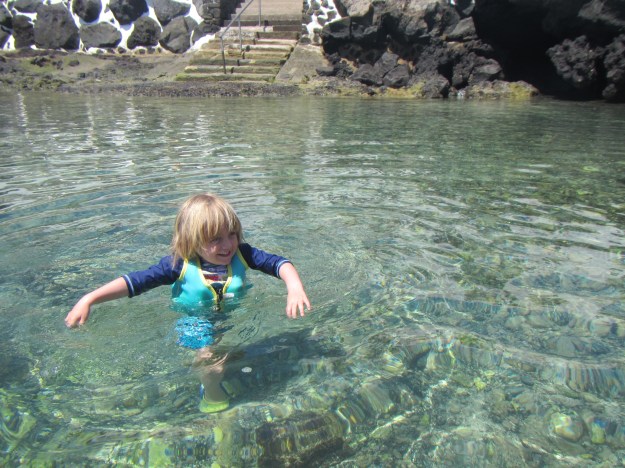
Unsurprisingly, the sea was central to much of our experience: admiring it, travelling across it, eating its many fruits, and of course swimming in it. We found an incredible lagoon, and some magical tidal pools. Between those and the pool Arthur well and truly shook off any wintery reluctance to jump right in, and his confidence and skill in the water came on in (literal) leaps and bounds.

IMG_9660.jpg

IMG_9403.jpg

He was mesmerised by the little fish that swam around our ankles as we paddled and splashed, but it didn’t stop him enjoying them on his plate, too… I’m not sure how many three year olds would demolish boquerones with quite as much relish as this one did. I like that he’s happy to eat fish that looks like fish, though – and that it gave us the opportunity to talk about where it came from and how it had been caught. I don’t want to freak him out about the food he eats, but I think it’s useful to be able to make the connections and understand our world better – especially when it’s him asking all the questions!

IMG_4039.jpg

Away from the sea, there were of course the volcanoes. In the run up to our trip we’d watched some videos and talked about the volcanoes we were likely to see there, and wherever we went Arthur was full of questions about the nature of the mountains around us. We took a (very windy) trek into the lava fields, climbing up to the top of one volcano to peer into the caldera and walking into the depths of another. Both were long dormant, but that didn’t stop the incredible power of nature being evident everywhere we looked.

IMG_4537.jpg

IMG_1365.jpg


One of the other highlights of our trip was completely unexpected. I had never heard of Cesar Manrique, but he was an inspirational artist and architect who through his work and his vision had an enormous impact on the infrastructure of the island. We visited several of the sites he created, and Arthur soaked up the paintings and the sculptures and the unusual spaces, as well as being fascinated by the exhibitions about the landscape around us.

IMG_1376.jpg

IMG_1378.jpg

Last but very much not least, inspired by an advertising board that caught Arthur’s eye in the airport, we took a trip on a submarine. It was the first time any of us had been on an actual submarine voyage, and it blew all of our minds a little bit – but especially Arthur’s. Just the whole mechanics of it was pretty exciting, watching the little screen at our seat compute our depth, the pilots with their illuminated control panel and the propellers at the rear. And out of the window we saw wrecks, lots of fish, and even a diver feeding a huge ray. It was pretty cool.

It was all pretty cool, actually. And it really got me thinking about how we can work some longer trips into the next few years. It’s one of the main reasons I’m not super keen about getting stuck back into the constraints of the school system any earlier than I have to, and why I’m trying to evolve my working life into one I can take on the road with me.

We shall see…

For now, though, we have plenty of memories to be mulling over. I’m going to make a photobook for Arthur so that we can pull it out from time to time and be inspired afresh by our experiences. It’s a lot to compute for a growing mind after all!


13/52 & 14/52

IMG_1360

IMG_1358

“A portrait of my child, once a week, every week, in 2016.”

We were away last week, on a much-needed family holiday in Lanzarote. We have come back with wonderful memories and far too many fabulous photos. It’s going to take me a while to process them all, but in the meantime here are two of my favourites…

The first, from Easter Sunday. Our yurts made an unusual setting for an egg hunt, but I was determined that Arthur would have that experience this year. He loved it – a little confused as to how he’d manage to miss the Easter bunny whilst he was having his breakfast, but delighting in finding the little foil wrapped morsels of chocolate. He unwrapped each one with such care, savouring the aroma before taking little bites and letting the flavour explode in his mouth.

The second, towards the end of our trip. We joined a trek to two of the island’s volcanoes, and entering the lava fields was much like I imagine it might be to walk on the moon. Arthur was happy to stay in the sling for the first part of our explorations, but when the ground flattened out he was desperate to get down for a run. Buffeted by the wind, he squealed with joy as he immersed himself in this strange new world.

Linking up with Jodi at Practising Simplicity for The 52 Project. 

A lesson in slow crafting

The unschooling diaries: week ten

Arthur has yet to show much of an interest in arts and crafts. When he was tiny he just couldn’t abide the mess – he’s still not super keen on getting paint on his hands. Now that he’s older he’ll dabble, but it’s still really not his ‘thing’.

I’m ok with that – mostly – even though my inner crafter is crying out for an excuse to spend afternoons surrounded by tissue paper and glitter and it really doesn’t help my fear that he’s missing out on something by not being at nursery when I see all the pictures of toddler creations fellow mums share proudly on Facebook. But when over breakfast one day last week he started getting enthusiastic about the idea of making some Easter cards I couldn’t help but get a bit excited. Not least because it meant we might finally got round to saying an extremely belated thank you for his birthday and Christmas presents…

The teacher in me leapt to the blackboard to note down his ideas (sidetracked a little by Winnie the Pooh as his most vivid understanding of Easter comes from ‘Springtime with Roo’ – I have no idea where the armour came from).

He happily settled on the idea of painted eggs though – he frequently dances around singing ‘we’re hunting eggs today!’ at the moment, and I’m very much looking forward to his very own egg hunt on Sunday. He then decided he wanted chicks in his eggs (well he said ducks, but I think that’s what he meant…) which led us very nicely to an easy to accomplish collaborative card idea. It might not be very original, but he liked it.

Having bought in some supplies (very important to have the right shades of glitter), and prepped some eggs for him to decorate, we set aside a couple of hours last weekend to make a start. And he of course lost interest within approximately three and a half minutes.

I battled with him for another two before reminding myself that that really was not the point, and calmly telling him that it was fine – we’d come back to it when he felt like it. I didn’t tidy everything away, just organised his workstation enough for it not to descend into total chaos. And sure enough the next day he gravitated towards his eggs again, did a few more minutes of gluing and glitter scattering, and moved on.

And that’s sort of been the background to this week, really. Every so often this little activity has piqued his interest again, and he’s added a little to his eggs. We’ve tried out a few different techniques along the way – stamping, mixing colours to get the shade of pink he wanted, watering paint down so he could ‘dye’ his eggs, mixing it in with glue and glitter. And every time, just as I thought he might be getting into it, he’s walked away again, his attention taken by his diggers or the urgent need for a banana.

We’re still not quite done, but we’re getting there. He’s declared that the eggs are finished at least, so there’s just a bit of cutting and sticking left. I might need to take the lead on that bit, what with it being Good Friday tomorrow and everything, but I reckon that’s ok. I can’t expect him to do all the work!


12/52

image

“A portrait of my child, once a week, every week, in 2016.”

Hurrah for Spring!

For warmer days and shorter nights, for grass running and tree climbing, for sunshine smiles and muddy knees.

Living where we do, it’s pretty hard not to get out and about all year round. Still, though, this time of year makes everything into an adventure.

I love nothing more than following the lead of my little explorer, and watching him absorb and embrace so much more than he could a year ago. His world is just buzzing with potential: and that means mine is, too.

Linking up with Jodi at Practising Simplicity for The 52 Project. 

Going with the flow

The unschooling diaries: week nine

I’ve been mulling over various different options for this post today – Arthur’s delight in playing with sand at Paignton sea front, his growing interest in helping in the kitchen, the hours of roleplay that followed when we found a Buzz Lightyear costume in the charity shop – but it’s actually an almost inconsequential moment that I keep coming back to.

Leigh was late home on Friday, but with it being the weekend I figured we’d wait for him before pushing on to bed after Arthur had finished his dinner. That’s daddy time, generally – the chats about the day and the washing things and the stories – and both of them miss it on the odd occasions when he can’t be around.

I didn’t really have a plan – which could, at the end of a long day, have ended in disaster – but as it was distraction came in the most unexpected form. I’d been unpacking a delivery whilst Arthur ate his dinner, and it had arrived in a box filled with little polystyrene pellets. I normally whip them away from Arthur whenever I order from this company, but on Friday I guess I was feeling a bit more relaxed and so I let him explore. And the resulting play was, I think, the best fun he’d had all week.

IMG_1343.jpg

Things started pretty simply: having watched me unpack my order from the box, he proceeded to fill it with all of his precious things and offer it to me as a present.

Then once I’d gone through and admired each of his ‘gifts’, he decided that he wanted to see what it was like in there himself.

IMG_1339.jpg

Then of course came the tipping out, and the moment when on another day I might have put a halt to all of it. The tuff spot comes in handy for that – even if it didn’t contain the pellets for long…

IMG_1342.jpg

He piled them up and drove his diggers into them, threw them in the air to see how they fell, smooshed them and squeezed them and generally just experimented with this new material that had previously been off limits.

And whilst he played I sat and watched and laughed, until his daddy arrived at the door and came in to find us giggling in the midst of a pile of mess. Fortunately he got it too.

IMG_1340.jpg

I couldn’t tell you exactly what Arthur learnt from this little bit of unplanned and unstructured play, but still it felt important: to give him permission to go a little bit wild at the end of the day, to go with the flow even if a part of me was raising some serious eyebrows, to let him lead and explore and make us both laugh.

As much as it’s great to have some carefully thought out activities on hand too I think it is moments like this that remind me why I am leaning towards unschooling, and the freedom it gives my son to be who he wants to be.


11/52

IMG_1338.jpg

“A portrait of my child, once a week, every week, in 2016.”

Looking back over my photos from this week, it is the ones of me and Arthur together that stand out the most. I know it’s cheating a little bit to call this a portrait of him, but in my defence he still, even as a confident and independent three year old, feels in many ways like an extension of my self.

I wonder if it always feels like that, being a mother? There’s a quote it brings to mind:

“Making the decision to have a child – it’s momentous. It is to decide forever to have your heart go walking around outside your body” Elizabeth Stone

For me these toddler years, with all of their wonder and challenge, are a critical moment in this. Perhaps it is because I have chosen a route through parenting where we are very much attached, but it is only now that I am really starting to feel us begin to articulate our separateness. Him as an incredible bundle of energy and potential, me as a whole new creature to the one I was before I bore him.

It’s exciting, but it brings with it too a sense of loss.

The cuddles help with that though. And this week we have loved exploring our together-yet-apart bodies through yoga. By which I mean mainly me attempting to rediscover well-worn poses whilst he clambers delightedly all over me.

I pretend to be annoyed that it makes it near impossible to practice how I used to, but secretly I love it.

Linking up with Jodi at Practising Simplicity for The 52 Project. 

On women and writing

My son has not been 100% the past few days, which has meant much more time sitting on the sofa having cuddles than usual. During one of these moments yesterday afternoon, whilst savouring the calmness of the three year old nestled at my chest, I had a bit of a revelation.

I found myself looking at my bookshelves, idly imagining my own published work sitting up there one day, and then it struck me: the overwhelming majority of the books in my life were written by men.

I couldn’t in that moment put my finger on why that was, but I knew it was significant for me – as a woman and as a writer. So today, what with it being International Women’s Day, I decided to do a little investigation.

As I am so often wont to do, I turned my gaze inwards first: tried to work out what it was about me that had led to such a literary gender imbalance. These books I have around me chart my reading history back to my teens. I have never got around to organising them in any particular way, and the resulting cacophony of titles is not easy to analyse, but however many times I went back again to look the facts remained the same: I have, over the past twenty years of my life as an avid adult reader, amassed a library which is almost entirely male-generated.

McEwan, Banks, Rushdie, Murakami, Self: all literary idols of my teens and twenties, all fantastic authors in their own right, but peculiar role models for a young woman trying to find her way in the world.

I didn’t think so at the time of course. I remember having a strong desire to be taken seriously as a reader and as an intellectual in my very male-dominated social and family circle. I remember arrogantly dismissing Austen – the only female author I remember studying at school – for what I saw as her obsession with vacuous romance. I remember being switched off by chick-lit as frivolous and a waste of reading energy (though I never looked beyond the covers to find out if that was actually true).

Of course as time went on I read – and loved – books by female authors too. Just not enough.

As my mind shifted to the context of all this I began to wonder whether it was merely a phenomenon isolated to my own book collection. I suspected probably not – certainly my sense of the world of the professionally respected writer is of one that is very male dominated. But I had already established that my lifetime’s research in this field was somewhat skewed, so I figured it was worth investigating.

Turns out it wasn’t just me. A quick google search threw up a woman whose novel proved eight times more attractive to agents when submitted under a male pseudonym; a study which revealed that 75% of the books reviewed in the London Review of Books and the Times Literary Supplement were written by men. I’m sure further research would have given me plenty more reassurance, but I’m pretty confident that it’s not just my bookshelves that are biased.

The reason why is somewhat more elusive. Are there actually less female authors than male ones – or good ones anyway? This question was explored at length in a fascinating essay written by Francine Prose in 1998, resurfacing when V.S.Naipaul expressed a similar disparagement towards Jane Austen as my teenage self in comments he made in 2011. The answer is of course complex and multilayered, with a multitude of reasons why women write, or don’t, and why people want to read what women write, or don’t (or at least what the publishers think in this regard).

A hypothesis that has recurred over the years is that is has something to do with motherhood: that ‘there is no more sombre enemy of good art than the pram in the hall’. Or if you are going to succumb to kids, just make sure you only have the one.

For me, the opposite is true. Or at least I thought it was. I found becoming a mother extremely motivating – liberating, even – and the birth of my son will always be intrinsically linked with my reasons for finally putting virtual pen to paper and writing my first novel. However as time goes on it has all started to feel a little self-indulgent, a waste of my ‘potential’, of my ‘education’  – both the desire to plunge myself headfirst into parenthood, and the equally strong desire to use all my spare moments to write. The voices from my past are surfacing and telling me that just writing and looking after a kid are hardly valuable uses of my time. So those precious minutes are being eaten away because I feel like I should be earning money (though I am lucky enough at the moment not to strictly need to) and because I feel that I should be doing something ‘worthwhile’ (though I have already dedicated ten years of my life to teaching).

I am wondering now, as I work all this through, whether I shouldn’t be seriously rethinking my priorities. But that would mean a commitment to this role of Writer, an assertion to myself and to others that I am good enough, and it is worthwhile.

I’m not sure that I’m there yet. Though coming across another article about how what separates unsuccessful female writers from successful male ones is the very reticence that I recognise wholeheartedly in myself has given me even more pause for thought.

And I am glad to say that my explorations did not throw up only negatives. I found this article about ten women authors who published after age forty particularly encouraging – there is still time, and hopefully plenty of it.

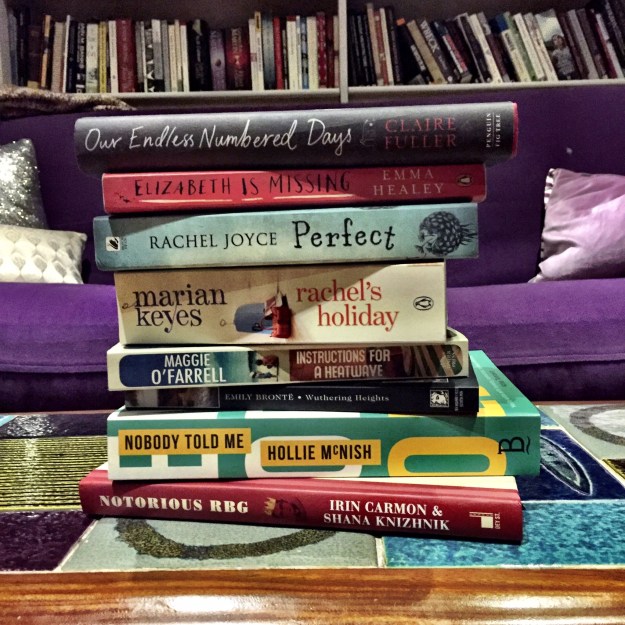
Also encouraging is the fact that one of these authors is currently sitting on top of my reading pile: a reading pile which for perhaps the first time ever is made up of books entirely written by women.

IMG_1334.jpg

None of this is by design. I never consciously set out to not read books by women, or indeed to seek them out as I grew older. But the shift in my literary gender balance is not entirely accidental either. I think it speaks to where I am right now with myself, as a woman and as a writer.

I’m still figuring out exactly where that is, but once I do? You’d better watch out, world.


Writing Bubble

Deconstructing daffodils

The unschooling diaries: week eight

Between Valentine’s, an anniversary and Mother’s Day we have had a lot of flowers in the house recently. Which of course has been lovely, but for Arthur has also proved an irresistible draw. Several times I have come into the kitchen and found him looking sheepish with pollen on his fingers and petals scattered on the floor at his feet. It’s hard to get cross, because I know he’s just curious. So this week I thought I’d play him at his own game…

image

Our garden is generally looking a little sorry for itself at the moment, but in the midst of all the work that needs doing there is a determined patch of daffodils that Arthur and I have watched grow and flower into a sea of yellow and green. One particularly dreary morning I ventured out whilst Arthur watched me through the rain in his pyjamas, sticking a tentative toe over the threshold before deciding that inside was a much better place to be.

I picked out a daffodil and handed it over, explaining that I thought it might be interesting to break it apart together and see what was inside. He was a bit reticent at first, taking time to hold and admire the whole flower as the rain broke and sun began streaming in through the windows. I’d never actually seen him handle a flower so carefully. Still, it didn’t take him long before he took me up on my offer.

He explored the daffodil’s trumpet before taking it apart in strips, then gently peeling away the petals. I encouraged him to smooth the pollen with his fingertip, and we paused at that point to talk about what it was all for.

We talked about the bright yellow colour attracting the bees, who buzzed around between the flowers and took the pollen from stigma to stamen so the flowers could make babies. He was curious, so I found a video on YouTube showing a bee doing exactly that, and he watched, intrigued. He’s generally quite interested in bees at the moment because of his current obsession with Winne the Pooh (when I asked him what he thought the pollen might taste of he answered quite confidently ‘honey’), but that’s another story…

After our little introduction to botany he wandered off to do something else for a while, and when he came back I’d set out paper and glue so he could stick the parts of the daffodil on. He was keen to cut up the stem at this point – a good time to practise using scissors, and discover that the metal ones were much more effective for the job than plastic. We talked too about how the stem was like a straw, sucking up water to keep the flower alive.

imageimage

I had thought of labelling the parts of the flower once he’d stuck them down, but he’d lost interest by that point and it probably would have been a step too far anyway! As it was he began to understand, I think, a little about the fascinating construction of a flower, laying down foundations for future conversations when we’re out and about.

And now I come to think of it he has held back from randomly destroying any flowers since, so maybe it has served to satisfy the curiousity that was driving him – for now at least.


*A little note of caution: daffodils, whilst fascinating, are not edible and are actually toxic if consumed. I made sure Arthur was aware of this and washed his hands carefully after our exploration. Please make sure you supervise your little ones closely and seek medical attention if they do accidentally ingest any part of a daffodil.*

10/52

IMG_1325.jpg

“A portrait of my child, once a week, every week, in 2016.”

These diggers have come everywhere with us since we bought them last week.

I really try not to just randomly buy stuff for Arthur, but he is so completely fascinated by anything to do with construction that when I saw them online I couldn’t resist. They are the first things he wants when he wakes up: he came out of his room a few mornings ago, earlier than usual, and headed straight towards the stairs instead of into me for cuddles. When I asked what he was doing he said that his diggers needed him because they had been having bad dreams.

At home he plays with them with kinetic sand, or on his road mat, or with his trains. Sometimes he just lines them up carefully in front of him so he can look at them more closely: he knows the names of almost every part of them, and will happily relay them to anyone who will listen.

He’s been having some trouble with the tracked excavator, because the rubber tracks keep coming off when he drives it on the floor or in the tuff spot. We worked out, though, when we took them to the beach, that it just needs rough ground beneath it and it works just fine.

The things you learn when you spend your days with a three year old…

Linking up with Jodi at Practising Simplicity for The 52 Project.