Tag Archives: editing

The final chapter?

How long is a piece of string?

Despite a busy week of non-writing related things, including a trip to Brighton and some well-overdue catch-up time with old friends, the edit is continuing apace.

After getting to the end of the novel last week, I have now swept through it again – getting rid of continuity errors and unnecessary repetition, tightening up description and dialogue, adding in a few little layers of intrigue to the plot. Overall it is maturing nicely.

But as with so many of these things this ‘final’ sweep has thrown up more questions. Most significantly, have I organised it as effectively as I could?

I’m talking chapters here – how long, how many, where they begin and end. I thought I had that all figured out. I began the whole writing process with chapters after all – once I’d done my initial planning and a story had begun to take shape I neatly split it into 30-odd sections to structure the first draft. They weren’t all individual scenes, but they seemed to be the natural chapters – or so I thought. I gave all of these an identical word count target. I didn’t stick to it religiously, but they all turned out pretty uniform.

And I figured that was fine, until the bird’s eye view the latest read through afforded me made me doubt that.

I started to see chapter breaks elsewhere, and to link scenes in my mind that I’d previously separated. Some events seemed to warrant being surrounded by white space all of their own. And in general I found myself wanting to make the chapters shorter.

Ever the researcher, I did have a bit of a sniff around the internet to see what advice I could find. But the most common response to the question ‘how long is a chapter?’ seems to be ‘how long is a piece of string?’. There were a couple of sites that suggested readers prefer uniform chapter lengths so they can pace themselves more effectively and are more aware of what’s coming next. But then others that said a variety of chapter lengths was preferable, and these artificial divisions in the story should be governed only by the story itself.

The latter opinion definitely resonated more strongly with me. Everything I know about good writing from my years spent teaching it tells me that variety – as long as it’s not purely for the sake of it – is the way to go. This is borne out in the books I enjoy to read too, especially the ones that get me totally hooked. Thinking about it, I realised I like short chapters too. I hate the feeling of having pages and pages to go until I can easily take a break, and if I get to the end of a chapter then I’m more inclined to read on if it’s not going to be too epic.

I think this possibly makes me a bit of a lazy reader, but I figure I can’t be alone in that.

So there are considerably more chapters in my novel now. Most of them are shorter, some significantly so. And their length, and where they begin and end, is dictated by what the story and the characters need – and by default the things that are going to make the reader want to know what happens next.

There is one last thing I’m mulling over (well, for now anyway). And that is – how do I label these chapters? In the very beginning they had titles, but I ditched them fairly early on. Since then they’ve had numbers, but those are starting to feel a bit stilted as I navigate through the manuscript. I’m wondering if there is an alternative, or if in fact the chapters need any label at all. And then I’m wondering if I want to divide the novel into parts, to demarcate the different phases the story goes through.

What do you think? How do you like the novels you read to be organised? Or indeed what techniques have you used in your own writing?

I realise I’m possibly over-thinking things, and this is exactly the sort of detail that a publisher might decide to change if they ever get their hands on my novel, but in the meantime I may as well get things as close to perfect as I can, right?


Writing Bubble

So I think I’m nearly done…

IMG_0801

I reached an important milestone in the edit today. I made it to the end of the novel. Again.

My manuscript now stands at 91,150 words, as opposed to 92,300, though rather more than 1,150 have been cut. I reckon at least 5,000 have been exchanged: unnecessary exposition for punchy dialogue, descriptions of actions for descriptions of emotions. I kind of wish I knew exactly how many, but I don’t suppose it really matters. It is interesting, though, how I find myself wanting to hang on to little things like word counts as a way of measuring progress.

The real progress has been in how much happier I am with the general mood of the novel. The first draft felt too cheesy, the second a strange combination of the banal and the melodramatic. I think I’m much closer to getting the vibe I’m after now – closer to knowing what that actually is. I think it’s darker, emotionally. And yet more hopeful too. Which makes the climax even harder to stomach.

It’s not 100% there yet. I had a bit of a breakthrough about halfway through this process, one where I gave myself permission to let go a bit with my description – to bring a bit more of myself into the world I was creating. That was important, because I’d abandoned some of the elements of the book that made it about me for the sake of making the characters more engaging. What I think I realised is that that uniqueness, that idiosyncratic way of seeing things, belongs more in the fabric of the prose itself than in the events in the story. I’d let go of that in a desire to make the story more accessible, but I think I’d got it all topsy turvy.

I have no idea if that makes sense, but it’s where I’m at.

Because that breakthrough happened relatively late, I want to go back to the beginning now – to look at the manuscript yet again through the new lens I have acquired. I jumped around a bit, adding things in and taking things out so I didn’t forget them, but I need to make sure I haven’t lost continuity in the process. And there are sections early on that might need more work too, just to make sure that I am saying all I want to say in the best possible way I can.

This is gong to be the hardest bit now I think. This final sweep through, attempting to keep every one of those 91,150 words in my mind as I make sure that each chapter, each scene, each exchange fits comfortably within them.

But I am nearly done.

I think.

With this edit anyway.

Wish me luck!


Muddled Manuscript

My editing essentials

This really isn’t the easiest time of year for keeping motivated and focused on an edit. The burst of enthusiasm that January brings has passed, and yet it’s still very much still winter. The cold, wet days are taking their toll and, whilst there’s a glimmer of hope in the lengthening hours of light, springtime – let alone summer – still feels a very long way away.

IMG_7748

At this point in the last two years I’ve been in the early stages of first drafts, when everything is exciting and new and I’ve just been able to write without fear of getting it wrong. But this year I’m attempting the third draft of my latest novel, and whilst it’s actually going pretty well I’m having to pull out all the stops to keep things that way.

So I thought I’d share my editing essentials: the crucial elements that have kept me going when the going’s got tough, the crutches I’ve turned to when I’ve been sorely tempted to curl up under the duvet (or at least under a blanket on the sofa whilst Arthur watches The Lion King for the umpteenth time).

First on the list is…

Coffee

No surprises there then. I have always really appreciated a decent cup of coffee, and since Leigh bought me a gorgeous DeLonghi coffee machine for my birthday last year it’s become something of a ritual.

IMG_0754

I like my coffee organic and strong, with a generous serving of frothy milk. One with breakfast, and another (with a large glass of water for good measure) when I sit down to write.

Almost as important for firing up the brain cells is…

Chocolate

I’m generally on a bit of a healthy eating tip at the moment, but decent dark chocolate is definitely one of my weaknesses. My brand of choice is Plamil – organic, nut free and delicious – and I will invariably enjoy a couple of squares of their ginger chocolate, or if we’re out of that a handful of chocolate drops, whilst I sit down and gather my thoughts.

For that of course I need a bit of peace and quiet, which is one of the many reasons why I love my…

Connecta

I have made no secret on this blog of my love for the Connecta baby carrier – and in fact you will find me extolling its virtues over on their blog too. But it really has been invaluable for the tricky business of writing whilst looking after a toddler.

IMG_9308

Arthur still naps in the sling, as he has ever since he was a tiny baby. I think the fact he enjoys his cuddles so much is one of the reasons why he still often has two naps a day. The design of the Connecta means that it is essentially supporting him to sit on my lap, so his (ever increasing) weight is spread evenly and unless he has a really monster sleep it’s pretty comfortable. And knowing that he is safe and close and happy means that I can focus all my attention on my work.

And for that I am still reliant on…

Scrivener

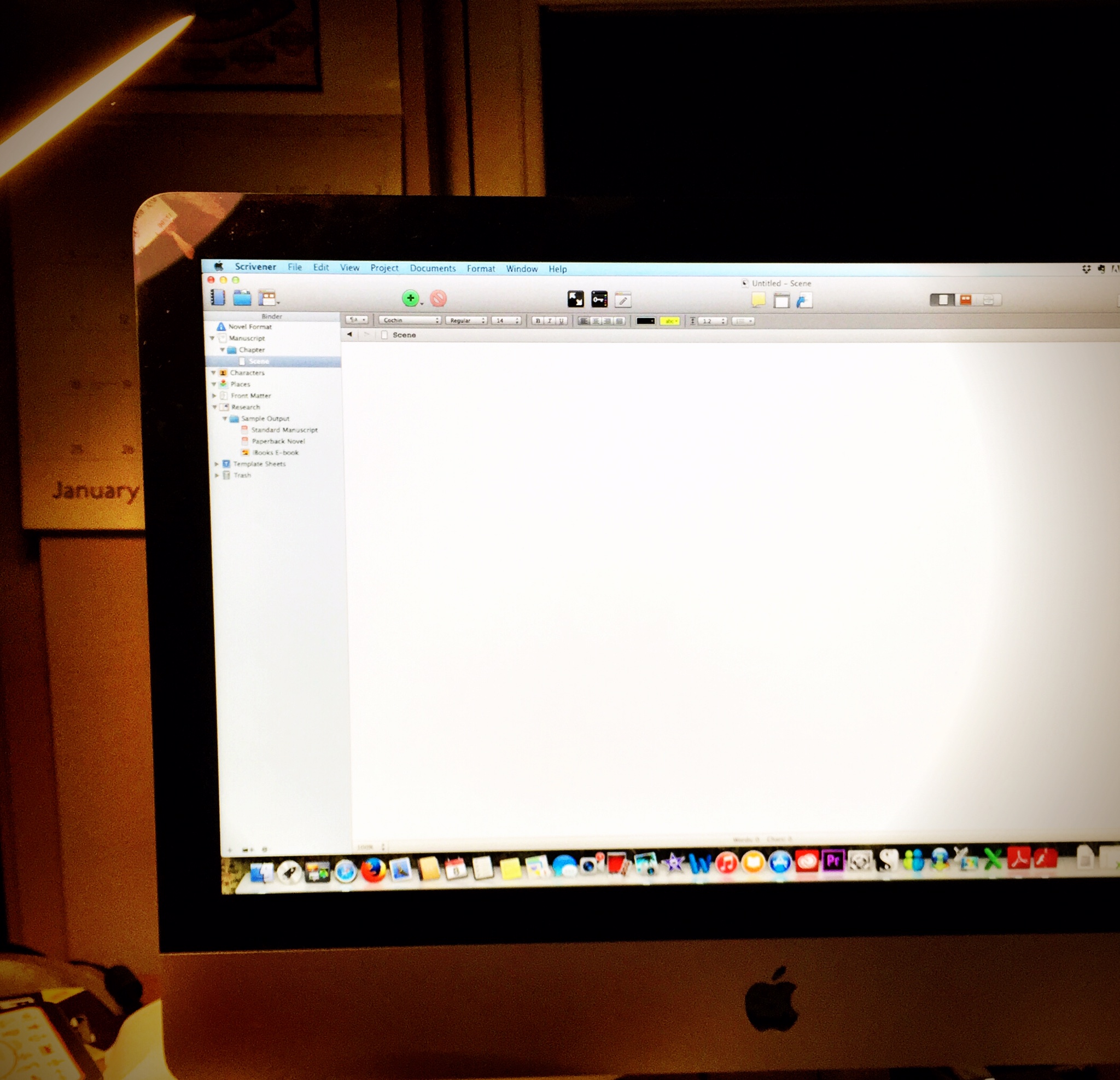
My discovery of this software has done wonders for my organisation. I found it great to write the first draft in, following my carefully planned structure and using the daily targets to keep me motivated, and now I’m deep into the edit it’s really coming into its own. I love how I can flit back and forth, move things around or cut them out completely safe in the knowledge that I can still get them back if I need them. I can keep an eye on my word count, and refer back to all the bank of research that I built up whilst I was writing the first draft. And all in one window.

Though when I’m tired of looking at that one, I can instantly refresh my soul by looking out of another at…

The view

I always dreamt of one day living by the sea, and more specifically having a place where I could write looking out over it. When that dream became a reality I was worried at first that the view might be a bit too beautiful and would distract me from getting anything done. As it happens though, that’s not a problem. I think my big computer screen helps – I have to consciously shift my gaze to get away from my manuscript. But there are times when I’m getting so frazzled that I really need something to give me a break from it all, and looking out at the big open sky and the ever-changing landscape of the sea is just the ticket.

IMG_0753

And that’s about it! Those five things have done a sterling job of keeping me on the straight and narrow so far, and I’m hoping I can continue to rely on them over the next few weeks as I bring this edit to a close.

How about you? What are the things that help you keep your focus when you’re writing (or editing)? I’d love to hear your thoughts in the comments.

Writing Bubble
Mama and More
Mums' Days

Don’t look down

IMG_1182

I feel like I’m walking a tightrope with this edit at the moment. I’ve mastered the juggling, just about, and am pleased with the pace of progress I’m maintaining. But as I get deep into the novel again I’m realising just how tricksy my main character is – and the considerable challenge I’ve set myself to take you, the reader, with me on her journey.

I’m finding myself wondering just how far I can go with Grace before I lose you… Her mental health is fragile from the start, although she’s becoming a little less insular – a little easier to relate to. Her disintegration, though, is crucial to the plot. It is linked to her own substance abuse, and the man who takes advantage of this and her, and his own narcissistic tendencies, and how that makes her question her perception of reality. And that’s just the start of it – but I don’t want to give too much away.

Not only do I want you to care about Grace, I want you to literally come with her on her journey – to question things as she does, and ultimately to question her. To doubt her, but without fearing that she (or I) have purposefully misled you in any way.

I’m focusing on the end goal, the solid ground of another completed edit, but each step I take towards it needs to be made carefully, gingerly – just one foot after the other. And I can’t look down, otherwise I might lose my nerve altogether.

In the earlier stages of working on this novel the worry was that Grace wasn’t likeable enough. I’m not so worried about that now, but I do want to make sure that you believe in her. And it’s that process I’m finding fascinating at the moment: how, as a writer, we carve out a version of reality that appears to be true.

It’s not as simple as just telling the truth. The truth is often dull, or off-putting, or just plain difficult to believe – particularly where depression and anxiety and psychosis are concerned. My job is to create something that is truer than true: that captures an essence of reality that many different readers will relate to whilst at the same time preserving Grace’s uniqueness and humanity.

And in doing this, I’m not just walking a tightrope – I’m dancing on it. Each word, each step, is part of a complex routine that feels clumsy at first but will appear increasingly seamless, even effortless, the more I immerse myself within it.

I’ve never thought of writing a novel in quite these terms before, but it makes a strange kind of sense. The end result needs to be a performance that will play out flawlessly in the reader’s mind. I am no stranger to performing – be it a sequence of moves on a trampoline or bringing a character to life on the stage, you may begin with a clear idea of what you want to achieve but it is only through practise, through gruelling rehearsals, that you begin to get close.

And that is where I’m at right now, twirling the words around on a tightrope in the sky, waiting for the moment when they are finally ready to present to the world. And whatever happens I won’t look down until I get there.


Muddled Manuscript


Cutting to the chase

IMG_0730

If there’s one thing I’ve become aware of as this second edit of my novel gets underway it’s that it really is more than a little inconsistent.

Overall I’d say my writing is pretty concise. I’m not very prone to waffle, and whilst I like to play with language to conjure up worlds and atmosphere I think I’m generally fairly skilled at selecting my words carefully so I don’t use one where ten will do.

But the more I re-examine my writing in this manuscript the more I realise that whilst it is on the whole pretty tight, there are still big swathes of text that really have no business being there at all. I thought they did, obviously, first time round – but looking at them now they add nothing, and if anything detract from the story I’m trying to tell.

On the flip-side of this there are other scenes that I’ve skipped over, related from a distance when really I needed to get stuck right in. Getting to those bits as I work my way through is actually the highlight of this whole process: realising that I can write more, can get lost inside my characters’ heads again even if only for a few minutes.

The cutting, though, is another matter altogether.

I almost entirely ignored it first time round. The process of editing my first draft was mainly one of tweaks and additions. I couldn’t quite bring myself to get rid of the dead wood – couldn’t even bring myself to notice it was there. But now, finally, I’m seeing things a bit more clearly.

It’s made me reflect a bit on my writing process actually. When I was creating that first draft I was working to a pretty detailed outline, one which I’d broken down into chapters, each with their own word-count target. I needed that structure at that stage – something that would make me get the words on the page, get the story out and give me something to work with. But of course the story itself didn’t fit those boxes I created quite as neatly – and it’s only through being more flexible that it’s beginning to fall into place.

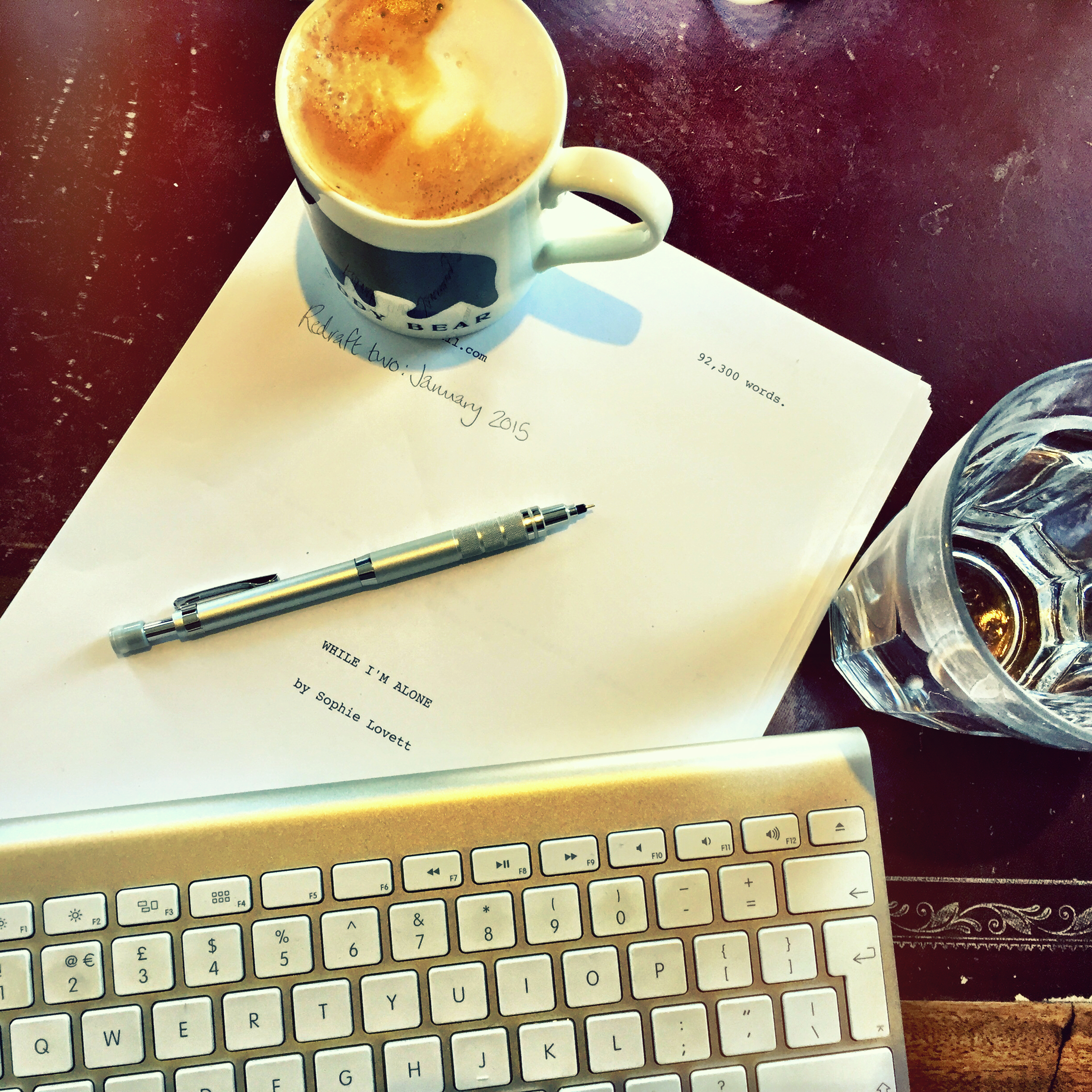
I’m almost halfway through the edit now – well, halfway through the manuscript at least. I’ve cut and combined some chapters, and even with a few necessary additions the overall word count has dropped from 92,300 to 88,313. It pains me slightly to think of the (over) 4,000 words that I laboured over as I crafted the initial story, rejected and consigned to the scrapheap.

Even as I write that I realise I’m living one of the age-old cliches of editing a novel – it might be relatively easy to get the words on the page but cutting the ones it turns out you don’t need is a whole other matter.

Now that they’ve started to go, though, I can feel new life being breathed into the story. There is a stronger sense of urgency, and neither the narrative nor my characters can be accused of dragging their heels.

I’m curious to see where things go from here. There’s more dead wood to cut, I know that for sure. And as it falls I can see new shoots growing in its place, scenes that will draw the reader into the story rather than make them switch off. It’s those scenes that are keeping me going, but it turns out the cutting isn’t too bad. Strangely liberating, in fact. And most definitely necessary.


Writing Bubble


Juggling

IMG_0728

This past week has been a week of two halves for me as far as writing is concerned.

Before the weekend, I was really finding myself struggling with the inevitable juggling that comes with being a stay-at-home mum to a toddler as well as an aspiring novelist. The edit itself was going brilliantly – I seem to have way more clarity this time round, noticing things that passed me by as I worked on the second draft and having no qualms about cutting things that I can now see are unnecessary. I’m also really enjoying elaborating where it’s needed, and I definitely feel as though the characters are springing into life much more convincingly as a result. In fact I’m enjoying it so much that actually I wanted nothing else but to hole up with my manuscript and my computer and just get on with it – let myself get lost in the words and the world I have created with them, just work and work until it’s done. And this is precisely where the problem lies.

Because I can only really work in chunks of a couple of hours at a time. If I’m lucky I’ll get two of those in a day, whilst Arthur’s napping in the sling and I can focus all my energies on the novel. More often it’s just one though – and sometimes not even that.

I know that I am incredibly lucky to be spending so much time with my little man. And I want to make sure that I make the most of it – that I’m truly present when we’re hanging out together. I worry sometimes that he’s missing out on the range of activities he’d get from being at nursery or with a childminder, so as well as the music and drama and gymnastics classes we go to I’m trying to find time to do arts and crafts together, to get outside as much as we can. And I think I’m getting there – but always swirling around with all of this is the desire to be writing, to be working on the edit. And the worry that maybe it just isn’t possible to juggle it all, that I’m going to have to admit defeat on one front or another. And that I really don’t want to do.

But then, just as my brain was about to explode, one of my oldest, bestest friends arrived for a visit with her family. Entertaining Arthur took care of itself – her older daughter is only a month younger than him, and it was lovely to watch them spend some quality time getting to know each other. She has a five-month-old too, who Arthur was completely rapt with, revealing a gentle, nurturing side to him that I haven’t really seen before. And us adults got to have lots of much-needed grown-up chats, about how hard it all was but how much we were loving it. And I remembered that it’s ok for the juggle to feel like a struggle sometimes and that I really should cut myself a bit of slack in my quest to be the perfect mum.

So whilst it’s now halfway through the week and the edit has remained untouched since Friday, I’m feeling pretty good about it all. My enthusiasm actually meant that I’d got through more than I’d thought I would before the enforced and much-appreciated break, and I reckon that if I can find a bit of extra time over the weekend I can make up for the time I’ve missed.

The chapter that’s currently staring at me from my desk, waiting for my scribbles before I rehash it in the electronic draft, is one of the most crucial overall. So I’m glad my head is a little less full as I turn my thoughts towards it.

And on that note, I had better stop my ruminations here and make the most of the rest of this nap. This edit won’t write itself after all.


Muddled Manuscript

An occupational hazard?

IMG_0727

So the edit’s progressing pretty well, which is good. I’m falling into a fairly productive rhythm, and whilst it’s not so easy to hold on to my clarity of thought now that I’m swimming in the words again I think things are heading in the right direction.

I’m definitely feeling like I’m getting deeper into my protagonist’s head, understanding more clearly why she’s acting the way she is (and actually sharing that with the reader rather than hoping they’ll work it out for themselves). I’m feeling the presence of my antagonist more keenly too, though he hasn’t explicitly made an appearance yet. And this is where the slight downside of all this comes in.

Having spent a week immersing myself in some incredibly tense and creepy thrillers, and now trying to layer that growing sense of dread into my own writing, I’m finding my relationship with the real world has gone a little bit off-kilter… I’m seeing things out of the corner of my eye, hearing noises that I’m pretty sure aren’t actually there, and at times feeling almost as on edge as poor Grace herself.

There was a particularly ridiculous night last week when Leigh was away in Exeter. I’d managed to get Arthur down to sleep reasonably early, and had stayed up a bit too late watching unnecessary TV. By the time I finally headed to bed, with revision ideas for the novel still whirring around my mind, I was overtired and a little too open to suggestion. It had just gone midnight, and Leigh’s bedside light was on when I got to our room. I’m still not entirely sure why (it hadn’t been when I’d gone upstairs earlier I swear), and at that moment in time I convinced myself it was because there was someone in the house. Heart racing, I cautiously checked the top floor was clear. I then crept downstairs and got Arthur from his room, waking him up in the process, and took him up with me to hide under the duvet. There was nothing rational about all this – and I knew that at the time, though it didn’t stop the creeping terror. I’m just glad I stopped short of calling Leigh and insisting he came home before I finally fell asleep!

It hasn’t got quite that bad since, but I’ve still been pretty jumpy. I’ve been prone to anxiety in the past, and it seems that letting my imagination wander into the recesses of a psychopath’s mind might just have awakened that… And I’m still only a few chapters in, so who knows what’s going to happen when things really start hotting up.

Ho hum… An occupational hazard I guess. Anyone else find their imaginary worlds seeping into reality, or is that just me?


Writing Bubble

Writing, and belief

image

By the time I hit publish on this post, I will have begun the process of reworking the second draft of my manuscript.

I’ve been laying the foundations for the redraft over the past couple of weeks: getting my head into gear, taking on board the feedback I’ve been given, reading some awesome novels for inspiration and filling my little grey notebook with strategies for moving forward.

The crux of the problem with the novel as it stands is that there’s still too much there which makes it not quite believable. The main characters don’t quite ring true. The plot is not quite watertight. My prose does not always fully command the reader’s attention, giving them small but vital opportunities to notice the edifice of my craft.

I’ve written a lot about confidence in recent months, but I think again it is my belief in myself that I must examine here.

There are a couple of key ways in which I think the lack of this might be holding my novel back. Firstly, I think I’ve become a bit too tied to my own experience – like a safety raft if you will. There is a lot of me in this novel, the mistakes and insecurities of my younger self. That gave me the confidence I needed to write the early drafts – I knew there was a truth underpinning my words that made getting them onto the page seem worthwhile, important even. There is plenty in the plot that is entirely fictional, but I think I got a bit trapped in my depiction of the emotional worlds of my characters. And now I think it’s time to branch out – to have the confidence to paint with broader brushstrokes, to allow my imagination a bit more freedom, to trust that I can create new emotional truths not just replicate the ones I know.

Secondly, I want to be a bit more daring with the details of the plot. To take more risks as I bring the story to life, to take conceits and events to their logical conclusions without worrying if the results of that appear at first to be far-fetched.

Thirdly, I want to loosen up when it comes to my actual prose. To let myself open up the inner workings of my main character rather than worrying about stating the obvious and hoping people will guess what’s going on in her head from the clues I’ve left them. To immerse myself more fully in scenes rather than telling them from the outside. To trust that what’s happening is interesting and worthy of deeper exposition, rather than just trying to brush past things to get to the main events.

There’s a lot of ‘more’ here I realise, and I’ll need to be ruthless in my cutting to create the space for it. But again this is an issue of trust – to believe that I can communicate the mood I want to in fewer words, that spelling out every descriptive detail doesn’t necessarily make a world more believable.

I think, if I pull all this off, then I will have a manuscript which is much tighter, much more engaging, much harder for my readers to put down. And if I don’t – well, it’s just another redraft isn’t it? I will get there in the end.


Muddled Manuscript

The gift of feedback

IMG_3164

I have realised this week how much I absolutely love getting feedback on my writing. Compliments are nice of course, especially useful for storing up and peeking at when confidence is low, but ideas, advice, opinions – they’re like gold-dust.

I’ve had some incredibly useful feedback this week. Some interesting thoughts about the opening of my novel (if you haven’t seen it then I would love it if you’d take a look), and also a long and detailed email from a novelist friend of my agent who was kind enough to read my second draft.

There’s a sense of pride that bubbles up as I read what people have to say about my writing. It comes from the fact they’ve read it, for a start, which is pretty awesome in itself. But then they’ve thought about it, and applied a critical eye that’s so, so hard to do to something I’ve written myself, and offered up their own ideas about what could make it better.

Even if I don’t agree with everything they say the feedback is still invaluable. It starts a chain reaction in my mind, a network of ‘what ifs’ that cuts through the editor’s block that I find so much more insidious than its first draft counterpart.

I have to admit that after the cautious optimism I felt this time last week I’d actually hit a bit of a wall. I felt overwhelmed by the task of once again picking my manuscript apart, and began to doubt whether I was capable of it.

But then the new wave of feedback came in, and alongside that I was asked to write a post for Faber Academy about why I write, and I remembered that it is all about pushing my comfort zone, about confronting my fears and daring to do it anyway.

And so I will.


Writing Bubble


Where to start

IMG_0694

As regular readers will know, I’m currently embarking on another major edit of my second novel.

I’m cool with this – I really am. Although I was happy with most of the revisions I’d made in the last draft, something about it just isn’t sitting comfortably with me. One of the things I’m mulling over is just where the story should start. I have a few different options to play with, and one of them is below.

I would really appreciate some honest feedback on whether this, as the first few pages of a novel, would draw you in and make you want to read more. I’m particularly interested in the impression you get of the main character, Grace. Do you like her? Is she someone you could come to care about? Do you want to know what happens next?

Questions or suggestions or criticisms or ideas are all very welcome! I look forward to hearing your thoughts…

***

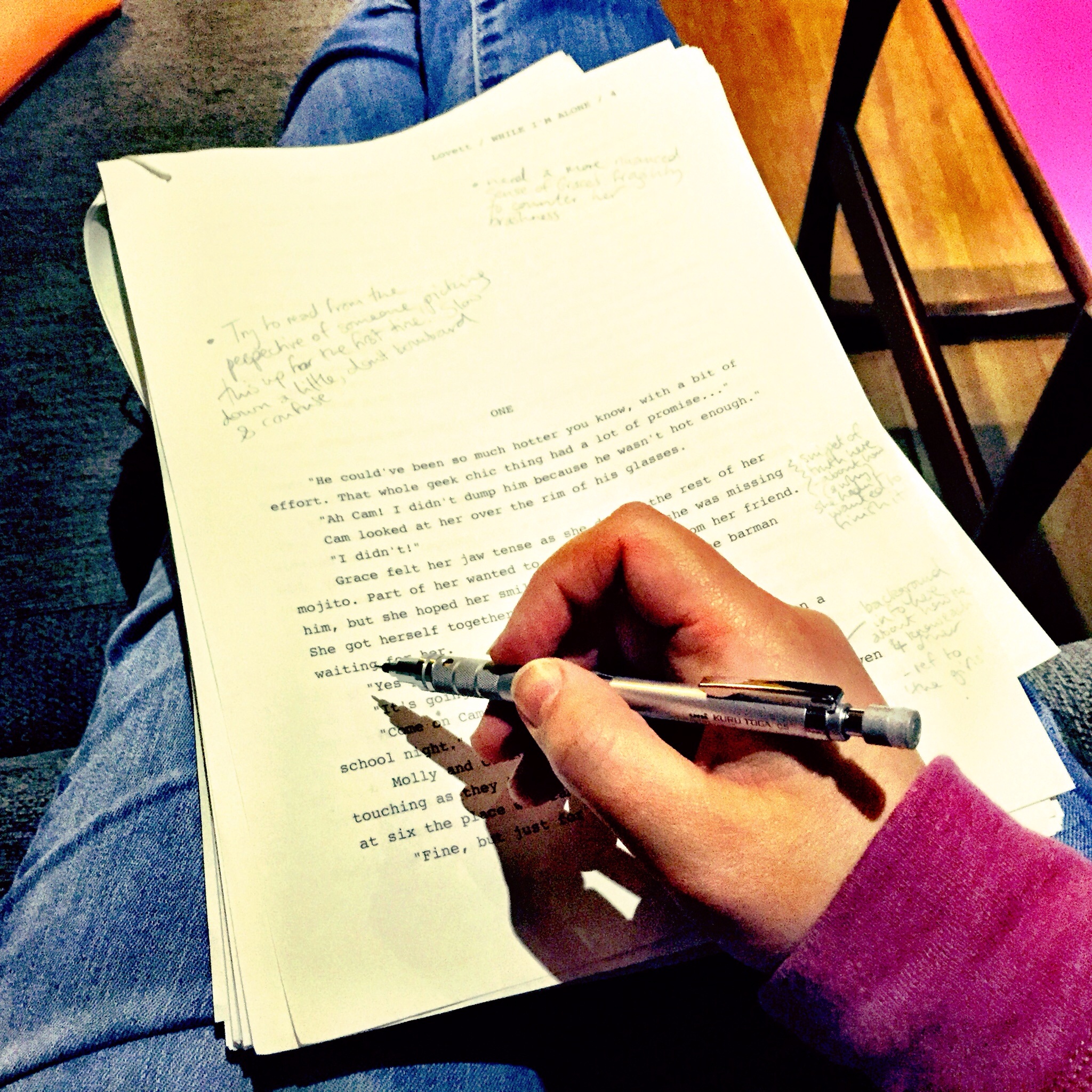
“He could’ve been so much hotter you know, with a bit of effort. That whole geek chic thing had a lot of promise…”

“Ah Cam! I didn’t dump him because he wasn’t hot enough.”

Cam looked at her over the rim of his glasses.

“I didn’t!”

Grace felt her jaw tense as she downed the rest of her mojito. Part of her wanted to admit how much she was missing him, but she hoped her smile would mask that from her friend. She got herself together and looked up to find the barman waiting for her.

“Yes please!” she said, “Cam?”

“It’s going to be one of those then huh?”

“Come on Cam. They’ll never keep me company, not on a school night.”

Molly and George were guarding a table, heads almost touching as they tried to hear each other above the din. Even at six the place was rammed, but then it was a Thursday.

“Fine, but just for you petal.”

“Love you,” Grace leant across to give him a hug as she motioned to the barman to bring another daiquiri, “you’ll grab our drinks yeah?”

Slipping off the stool in her high-waisted jeans, a glass in each hand balancing what remained of her mojito between them, Grace wove her way to her friends.

“One white wine spritzer with soda for the bride to be and one… ginger beer. What’s that about Moll?”

“I’ve got to swing by Mum’s later. Cheers!”

They clinked their glasses, and Grace tried to ignore the sadness hanging heavy in Molly’s face. It didn’t suit her. She knew she should talk to her about it all, but not tonight.

“So only a few weeks to go hey George? Best make the most of it.”

George smiled knowingly as she sipped her spritzer, “I guess.”

Her short dark hair framed her brown eyes perfectly, and that combined with the tailored jumpsuit gave her an air of eternal youth whilst at the same time she exuded a maturity beyond her years. At least Grace hoped it was beyond her years. At twenty-six, George was a year younger than her but seemed to have everything worked out. The job at the trendy gallery, the capacious flat in Farringdon, and of course the man. Barney was a few years older, devastatingly handsome if you liked that sort of thing, and on his way to becoming a Consultant at University College Hospital.

“So tell me again about the flowers,” intercepted Molly, leaving Grace once again standing on the sidelines.

Grace prodded at the mint leaves in the bottom of her glass with her straw, letting the excited chatter about peonies and petunias blend into the hubbub of the bar. She’d tried to be interested when talk had turned to bouquets before but failed miserably – it just wasn’t knowledge she wanted filling up her brain.

There was a time when George wouldn’t have know the difference between a daisy and a dahlia either. Grace remembered one Sunday at Columbia Road. It was early – they’d come straight from a club – and the stallholders were just setting up. It did look beautiful: colours bright against the grey of the tarmac, the freshness of the blooms contrasting with the weathered faces of those who sold them. Arm in arm, Grace and George had walked straight past the stalls and into The Royal Oak. Grace’s hair had been short then too, though she’d let it grow since. Two cropped heads bowed together, one black one red. They were still talking about Barney: George had turned up in tears the night before, worried he was having an affair with a nurse at the hospital. Grace knew they were destined to be together though; deep down she mourned for her comrade in arms but she couldn’t let that cloud her advice. When George eventually wove her way home a couple of hours later it was with a smile on her face, and a fortnight later Barney proposed.

Sucking the last of the rum out from the melting ice, Grace saw Cam looking apologetically at her from the other side of the room. His face was almost rubbery, and if you didn’t know better you’d think he was taking the piss. It was one of the things Grace loved about him though, how his expression transformed so completely with the slightest trigger.

A Latin looking guy had his hand on the pale skin of Cam’s arm, and now he was laughing at whatever it was Cam had just said. Grace almost didn’t want to interrupt – but she could seriously do with that drink. With a glance at the girls to confirm they wouldn’t miss her, she sidled over to Cam, plucking her drink out of his hand before he had time to notice she was there.

“Sorry darling!” he said effusively, “Do you remember Pedro? We met in Heaven back in January. He’s been away.”

The man leant and took her hand before kissing her on both cheeks. He was more than a little bit cute as it happened, but she was pretty sure she wasn’t his type.

“Please come and save me Cam. They’re talking about flowers again and I just don’t know how much more I can take.”

Cam turned to Pedro, “Our friend’s getting married.”

“Oh, amazing!” Pedro actually clapped his hands before turning to Grace, “You will make a beautiful bridesmaid.”

“I’m not… We’re just friends from work. Well college. I’m not really bridesmaid material.”

She’d been gutted when George had asked Molly to be a bridesmaid and not her. She’d asked her to do a reading, but it wasn’t the same.

“Shame. I think you’d look so pretty in a dress, with those flowers. You have the most incredible eyes. Like emeralds.”

He reached out and touched her cheek and Grace squirmed a little, fiddling with her fringe before stroking her auburn ponytail awkwardly. She really needed to meet someone: three months on her own and she’d fall for anything.

•••

Thank you to Sara at Mum Turned Mom for inspiring me to share this opening in response to her prompt, ‘Beginnings’. I am also joining in with Nikki Young‘s Friday Fiction.