Tag Archives: education

The most important meal of the day

When I was a teacher, I was always more than slightly alarmed to see teenagers clutching litre bottles of cut price energy drinks as they arrived at school in the morning. Sometimes this was supplemented with a packet of crisps, but either way I doubted it was going to do much to set them up for a day of learning.

Just by talking to kids about their breakfast habits, it was clear that there was a strong correlation between a healthy and nutritious morning meal and the ability to focus, study and learn – something that has been confirmed by numerous studies over the years.

It is a sad fact that one in seven British schoolchildren go to school without having eaten breakfast at all, but when you look at Africa the figures are even more stark. Research has highlighted that about a third of people in Uganda and Rwanda are gravely undernourished – an estimated fifteen million people. For children, this becomes yet another factor which holds them back from reaching their full potential.

It is for this reason that Send A Cow has launched the Break… Fast Appeal which aims to raise £500,000 to give children in Africa a better start to their days and to their lives. And as part of this appeal they have launched a fantastic free recipe book, ‘The Most Important Meals of Their Lives’, which is available online here and captures in stunning images the food that fuelled the achievements of some of the greatest people in the history of humankind.

From Winston Churchill to Rosa Parks, from Florence Nightingale to Nelson Mandela, this intriguing and inspiring book offers an insight into the meals that created history. And not only that, the clear and straightforward recipes offer you the chance to recreate the meals for yourself.

I rather like the look of Cleopatra’s Ancient Egyptian bread sweetened with honey and dried fruits.

image

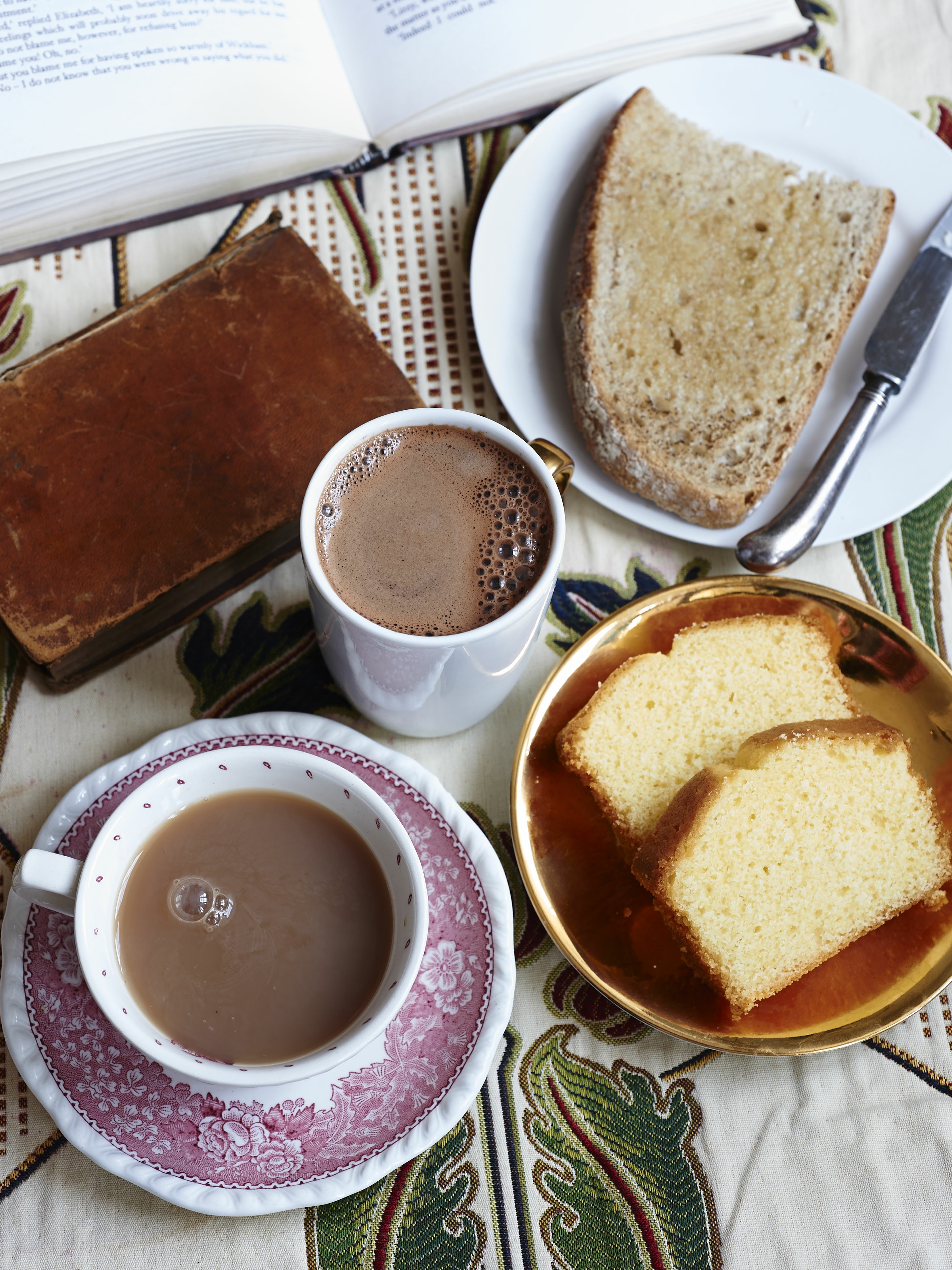
Someone else who was keen on a starchy start to the day was Jane Austen, with her breakfast of bread and cake accompanied by tea and cocoa.

image

Or perhaps you’d rather go for something a little more savoury, like Charles Darwin’s feast of game and eggs?

image

Whatever your tastebuds crave in the morning you’re bound to find something in this book to tickle your fancy. I’m certainly looking forward to trying out some of the recipes as an alternative to our breakfast staple of porridge and fruit.

But this is more than just a recipe book. It is a fantastic educational resource that could be used at home or in school not only to raise awareness of the importance of breakfast for children in Africa, but also to spark off conversations with young people about how they start their day. Perhaps by exploring the meals that their heroes enjoyed, teenagers might be encouraged to rediscover this essential meal for themselves – who knows, it might just be enough to release the potential of the people who will shape our future just its subjects have shaped our past.

You can find out more about the appeal and download your copy of the book at www.sendacow.org.uk/breakfast. Whilst the book is free, there is a suggested contribution of £2.50 to the appeal. The UK government are doubling all donations made until the end of June 2014, meaning that your £2.50 would provide enough to support an African child for a month. For £30, you could support a child for an entire year! Now that’s a lot of breakfasts…


image


Post Comment Love


Resisting the ‘inevitable’

Browsing through the education news this week, I came across this article. It reports on a study which seems to show that young people in the UK are being held back because their parents believe that their failure is inevitable – if they are not ‘born bright’, then no amount of hard work is going to change their futures.

This study has strong echoes of the beliefs of Dominic Cummings, a former special adviser to Gove who sparked outrage when he claimed that the fate of young people is determined by their genes, with neither them nor anyone else having the power to change that.

As a teacher, this notion certainly does not ring true for me – though there is no denying it permeates the attitudes of a good proportion of young people, parents and teachers alike. It was not uncommon to hear a year seven student declare they would never be any good at English for example, or a parent to respond to concerns about underachievement with the explanation that their child just wasn’t academic. Teachers too would sometimes fall into the trap of judging a new student by the prior performance of their siblings, or dismiss entire groups as unteachable. The practice of setting by ability, which in some schools begins when children are just five years old, is essentially dictating who will pass or fail – ask a pupil in a bottom set and they will rarely have much faith in their potential to succeed.

But for every young person who followed the seemingly inevitable path, leaving school at sixteen with minimal qualifications, there were others who were transformed by their time in education. The boy who at twelve was thrown out of most of his classes because of his inability to concentrate and went on to combine sixth form study with mentoring younger students who were struggling to focus. The girl who at fourteen believed she could aspire no further than vocational qualifications in childcare despite her dreams of university yet went on to complete the International Baccalaureate diploma and win a place on a degree course.

I am not saying here that academic success at school is the be all and end all – we all know stories of people who have broken the cycle of inevitability themselves, going on to build exciting careers in their adult lives despite the odds being stacked against them. But there is no denying that successfully jumping through the hoops of academic qualifications opens doors, giving people more choice over what to do with their lives rather than having their path dictated for them.

IMG_2277

As a parent, my interest in resisting the inevitable has been revived with new vigour. I want my son to be able to be whoever and whatever he wants to be, to be happy in his choices and not to be held back by other people’s beliefs about what he is capable of. I’m sure that is the dream of all new parents – looking at that helpless bundle of newborn joy in their arms and imagining a future which is boundless and free.

And yet before long something begins to change. A girl who does not seem to take much interest in books at the age of one is destined never to be a reader. A boy of three who runs around like a whirlwind is declared unlikely to ever really be able to focus – but it’s ok because he’s a boy and that’s what boys do. As children grow up even seemingly positive statements can begin to close doors – in my family my brothers and I were labelled encouragingly as ‘the sporty one’, ‘the creative one’, ‘the academic one’ and ‘the musical one’. Actually my youngest brother chose that label for himself, not wanting to compete with what he perceived as our territories. It has served him well, though the rest of us took many years to realise that maybe we could be more than just one thing, that in fact we were all creative, sporty, musical and academic in our own ways and the choices we made in our lives could reflect that.

Of course it’s almost impossible to resist labelling to some degree, but young people are so impressionable that I think it’s vital that anyone with a stake in their upbringing empowers them to believe that their future is not inevitable. The more I watch my baby finding his place in the world the more I believe that his potential is unlimited – and the more I hope he can hold on to that belief as he follows his dreams.

Thank you to Sara at ‘Mum Turned Mom’ for inspiring this post with her prompt: ‘It was inevitable…’

mumturnedmom


Why we need to lay off the tests and give our children space to learn

image

If this article had been published today, I would have had it pegged as an April fool. Testing and academic rigour for two year olds? Surely a predictably unfunny joke dreamt up by someone at the DfE to keep us on our toes. Sadly of course that is not the case. The letter that Wilshaw sent to Early Years inspectors was published on Friday, and it appears that he is deadly serious.

It comes as part of the latest onslaught on childhood and a meaningful education system which, if Gove et al get their way, will result in formal testing from age four, the reinstatement of national tests at seven, and the raising of the bar for schools as well as individual children in the year 6 SATs.

I am not an Early Years specialist: my expertise comes from ten years working in Secondary, and more recently as the mother of a fifteen month old. I do not intend to comment on Early Years provision, either current or proposed. What I do have an opinion on – and a strong one at that – is the damage that this regime of testing will cause.

Firstly, there is the stress and psychological pressure that comes with any test, however much its proponents try to play it down. Even if we are to consider the reception ‘check’ as a baseline assessment, nervous parents will no doubt want their offspring to do the best they can – and despair if they are found to be wanting. This nervousness and sense of expectation will naturally be passed on to the kids themselves. To be honest I’m having trouble marrying the idea of this as a baseline with the testing that will already have been going on for the previous two years: these tests will generate data, the data will have to be kept and compared, and suddenly the reception ‘check’ becomes a summative assessment of progress – at least for those children unlucky enough to have been in the system from the start.

Then of course there’s the question of what will be done with the data, how it will be applied to the provision of education for children in their primary years – a period when there will of course be regular high-stakes testing on the cards. The first and most obvious answer is that pupils will be set or streamed by ability. In fact in much of the comment I’ve read on this issue grouping by ability seems to be a given. And yet the research shows that this is damaging to pupil progress – particularly for the ‘less able’ pupils who this regime of testing is ostensibly meant to protect.

Children will be labelled, told what they are good at (perhaps) and where they are failing, and thus will begin the cycle of diminishing self-esteem that will serve to crush their potential.

There is also the question of what happens to the curriculum. With all the will in the world, when the stakes are high schools will teach to the test. Succeeding in the narrow framework the test defines is vital for the pupils and the teachers – far more immediately valuable than the pesky business of creating a lifelong love of learning. And what can be tested is necessarily narrow – it needs to be objective and quantifiable when so much of learning (especially for very young children) quite simply isn’t.

What happens to the space for children to play and explore and discover? What happens to the opportunities for them to surprise and delight with a fresh solution to a problem? What happens to the freedom for them to follow a spark of interest and have the satisfaction of finding something new? It strikes me as so spectacularly arrogant that this government can believe they know what is best for our children. My son amazes me every day: if I was focused on teaching him my truths there is so much I would miss, and so much of his potential that would go unrealised.

The irony of this all is that Wilshaw claims his goal is to prepare children for the demands of their education further down the line, and yet my experience of dealing with shell-shocked eleven year olds as they transitioned to secondary school taught me that testing does anything but. Though each cohort would come in with increasingly impressive KS2 scores, they would be broadly the same in terms of their actual ability. As an English teacher, much of year 7 was spent freeing them up to be creative again, to have their own thoughts, to realise that there was more to a good story than a range of connectives and lots of semi-colons. Some students were afraid to write anything at all for fear of not being able to spell correctly – and when they did they restricted their vocabulary in order to play it safe. Even by Wilshaw’s narrow view of the world, in order for students to have a hope of reaching the higher grades at GCSE they would need to be able to be perceptive, to offer original ideas and read between the lines, to take risks in their interpretations and in their own writing. And even to get that far they would need to have a sense of why they were doing it – the lure of yet another high-stakes test just isn’t going to cut it for most kids.

It is ultimately this goal of his that is the most telling thing of all. Education at any stage should be about preparing young people for the rest of their lives, not just the next phase of education.

In the early years it is not so much what children are learning that is the key, but who they are becoming: each experience lays down the very foundations of their personalities, shapes the people who they are going to be. By reducing this process to easily measurable goals that can be tested we will be doing our children a great disservice, and very possibly causing irrevocable damage that society will be left to fix for years to come.

Brilliant blog posts on HonestMum.com


Comprehensive, creative and democratic: my three wishes for education

With another national teacher’s strike looming next week, I’ve been pondering a lot about just what is wrong with our education system at the moment. As a former teacher, a governor and a parent, I fully support the difficult decision NUT members have made to strike. Of course a strike will cause disruption, but with the rhetoric often levelled against teachers in the press it’s easy to forget that ultimately the people who will suffer in a dysfunctional system are our children. Teachers who are overworked, undervalued and disillusioned will not be able to provide the education our children need and deserve. As the professionals at the frontline of Gove’s misguided reforms, society needs to trust teachers when they say that things are not OK in our nation’s schools – and to support them in the face of the bullies who are powering on regardless.

However as well as thinking about everything that is going wrong with the education system under the Tories’ guard, we mustn’t forget to hold on to our core beliefs about how our education system should be. It’s all too easy to get caught up in the minutae, particularly when any time to think is being eroded at an ever-increasing rate. Every teacher I know entered the profession with a philosophy that guides the choices they make in and beyond the classroom and keeps them focused on what’s really important. It would be a sad day indeed if, when teachers finally feel able to raise their heads above the parapet, they realise that the barrage Gove has unleashed upon the profession has eroded those core beliefs that led them into the classroom in the first place.

With this in mind, I’ve revisited my own philosophy of teaching and condensed it into three wishes for education: three core things which I believe if we could find a way to encompass would create a system fit for our young people and the futures they will carve for themselves and for society.

I wish our education system could be:

1) Comprehensive

I am a staunch supporter of comprehensive education: a system which rises above the divisions and inequalities in our society. As a teacher (and now as a governor), I gravitated towards schools that were called comprehensive, but the problem with our current system is that no school can truly call itself that.

Whilst we have a system that includes private schools and grammar schools – and increasingly a confusing patchwork of options which chip away at the comprehensive ideal in different ways – then the schools that are left are missing vital sectors of society. In order to have a system that everyone – particularly the most powerful and influential – is invested in, we need everyone to be a part of it.

I have made no secret of the fact that I went to private school – and have written about why I wish I hadn’t. Many people I speak to dismiss the idea that we could get rid of private schools in this country as naive. Perhaps it is, but it isn’t without precedent. The much-revered education system in Finland has no private schools – they were abolished in the 1970s – and its achievements come from a focus on equity rather than excellence. Public figures from Warren Buffett to Alan Bennett have called for the abolition of private schools to promote social justice. If Gove was really serious about the gap between rich and poor in this country being “morally indefensible”, then I would have thought private schools should be the first thing to go.

Personally I wouldn’t stop there though – in order for our system to be truly comprehensive I’d get rid of grammar schools too. There are only 164 of them anyway, against over 3000 secondary schools in total, and they are concentrated in particular geographic areas where they undermine the comprehensive system: heaping pressure on parents to try to do the right thing by their children and skewing the intake and results of schools that do not select by ability.

And whilst on the subject of ability, I’d actually go one step further in my quest for a truly comprehensive system and, as Finland has done, outlaw setting by ability even within schools. The damage it causes to the aspirations and self-esteem of children consigned to bottom sets is indefensible, and evidence collected over thirty years indicates that, counter to popular opinion, it actually damages pupils’ achievement.

Our schools should obviously be places of academic learning, but they are about so much more than that too: by making them truly comprehensive we could begin to build a better society from the outset.

2) Creative

The second foundation of my ideal education system would be creativity: not just in the curriculum, but underpinning the system as a whole.

Particularly at the moment, with the sidelining of arts subjects in the secondary curriculum as a result of the now-defunct EBacc, school seems to be a journey away from creativity for young people. As pre-school children their minds are open and alert to a multitude of ways of seeing and interacting with the world, but for many as they move through the exam factory their minds are narrowed. This is of concern not only for the creative industries: as the human race faces increasingly complex challenges, creative thinking is key to find solutions to the new problems we face.

So much of what Gove seems to want to do to the curriculum is backward looking: a return to a 1950s education stuffed with facts at the expense of learning. We need to encourage our young people to think, not just to regurgitate, if they are ever going to be well equipped for their futures: futures which in reality we know close to nothing about.

This space to think is a privilege that should be extended to our teachers and school leaders, too. No-one is saying that our schools were perfect before Gove came along, but education professionals need to be give the time and professional autonomy to creatively develop a system that really works. There is a wealth of research that can be drawn on to encourage this, and teachers should be encouraged to do their own research too to find out what helps their students in their classrooms. I was lucky enough to engage in such research whilst completing my Master of Teaching qualification, and it was incredibly powerful for my motivation and sense of pride in my work – something which all our teachers deserve.

Teachers don’t need to be told how to do their jobs by the government any more than young people need to be told what to think by their teachers. A system built on creativity would allow all stakeholders space to grow.

3) Democratic

The third thing that I believe should be at the heart of education is democracy – again both within and beyond the classroom, for pupils and teachers alike.

I believe in child-centred learning. Not in the unfocused, wishy washy way that has recently been denigrated in the media, but in a way that puts the child at the centre of their learning experience and structures an appropriate learning journey around them. There are a myriad of ways that this approach can manifest itself in schools: from getting students’ input into policies and procedures, from enlisting their help in planning schemes of learning, or simply by providing them with projects where the outcomes are not set in stone but can be crafted by their interests. Even better are approaches where young people’s learning can be rooted in projects whose impact is felt beyond the school gates, helping them see that their efforts really can bring about change in their communities.

For so many young people, there is so little about their lives they can control. In our schools we should teach them that what they do does matter, that they can have a positive impact on themselves and society by the choices they make.

Teachers and school leaders too need to feel that they are part of a democracy. There is not much worse for morale than feeling like your voice doesn’t count, and yet this is the reality for the majority of professionals in education under Gove’s regime.

Of course in all of this someone is going to have the final say: but everyone benefits from listening to the people who are really affected by what happens in our education system, and very few do if they are silenced.

So there you have it: I wish for an education system that is comprehensive, creative and democratic because I believe that is what is best for our young people and for our society. When you think about the teachers striking on Wednesday, remember that they too will have strongly held beliefs that are at the core of what they do, however much the government and the media may try to represent their actions as selfish and narrow minded. And if you are a teacher, or a parent, or in fact anyone with an interest in education, I’d love to hear your ideas too. What are your three wishes for education? How can we create a system that will work – now and for the future?

Thank you to Sara at ‘Mum turned Mom’ who inspired this post with her prompt: ‘If I had three wishes…”


mumturnedmom

Brilliant blog posts on HonestMum.com

Post Comment Love

Why ‘passivity’ in our learners is most definitely something to be criticised

Some weeks ago now, Michael Wilshaw sent a letter to OFSTED inspectors impressing on them the need to leave out of their reports any comments on how teachers teach, focusing only on the outcomes of said teaching.

This missive has been lauded as a breath of fresh air by teachers, school leaders and unions – a sign that perhaps this Michael at least has some respect left for the professional autonomy of teachers. It has also been welcomed by those who believe that today’s teachers are wedded to ‘trendy Left-wing ideology’, and that it is this that holds our students back from excelling in global league tables.

In this letter, Wilshaw said that ‘on occasions… pupils are rightly passive rather than active recipients of learning’ and that inspectors should not ‘criticise passivity’. This struck me as a little odd when I read it, and I touched on my concerns last week in the context of calls for schools to build character and resilience. But his choice of words has been playing on my mind since then, and I just couldn’t let it go without examining the implications of this statement further.

There are several definitions of passive, none of which sit terribly comfortably with me as descriptions of a child in a learning environment. We surely wouldn’t want them to be ‘not active or not participating’ and certainly ‘not working’ would be the opposite of our aims for a school pupil in lesson time. Perhaps there are those who would like young people to be ‘unresisting and receptive to external forces’, but it is my experience that other humans, even little ones, don’t tend to be that malleable without actively engaging in a process themselves.

Looking at synonyms for passive is even more worrying. Do we really want our young people sitting in classrooms to be described as ‘apathetic’, ‘indifferent’ or ‘uninvolved’?

In trying to gauge opinion on this amongst other education professionals, the general consensus seems to be that Wilshaw probably didn’t really mean ‘passive’, at least not in the way that I’ve defined it above. But if that were really the case then why not choose another word? Why pick a word – and then repeat it – which has so many connotations that are the antithesis of what we would like to see going on in our classrooms?

I fear that teachers have been so quick to welcome Wilshaw’s statement because they are desperate for someone in a position of power in education to throw them a lifeline – to tell them it’s ok, I trust you to teach however you like as long as you get the results. I would argue that if that’s the case why are inspectors bothering to go into lessons at all? Why not just look at the results if they don’t care about what’s happening in the classroom? Actually reading further into Wilshaw’s letter there are plenty of pedagogical preferences evident, from what resources teachers are choosing to use in the classroom to how they choose to set homework, but apparently questioning these choices does not ‘infring[e] the professional judgement of teachers’.

To be honest, though, it’s not really the teachers I’m worried about. Ok – there are probably a few who will use Wilshaw’s words as an excuse to make their workload lighter, will stop worrying so much about whether pupils are engaged or not because hey – even the HMCI says it’s ok for them to be passive. But in reality the vast majority of teachers want their students to be engaged and to learn, and they have the skills and professionalism to help them achieve that in a myriad of different ways.

What concerns me is what this acceptance of passivity – or in fact its promotion above more active learning methods if you look at the right wing interpretation – says about this governments aspirations for its young people.

Does it want to nurture a generation who can think for themselves, who can question the status quo, who can come up with new ways to face the world’s problems? Or does it want to create a society who will be easily controlled, accept authority without question, carry forward a canon of knowledge whilst quietly going about their business and being exploited by those in positions of power?

Certainly the tactics used by the Tories so far, from their denigration of the right to strike to their desire to curb peaceful political protests, from Gove’s attempts to falsify information and then rewrite history to hide his tracks to their incredible attempts today to rebrand themselves as the worker’s party, would indicate the latter. As Tony Benn articulates so clearly, ‘a healthy, educated and confident nation is harder to govern‘.

Casual references to passivity being an acceptable mode for the classroom effectively discard decades of educational research aimed at creating empowered and effective citizens to return us to a model of learning whereby the child is an empty vessel waiting to be filled with the superior knowledge of the teacher and of wider society. This is not how I want our world to view young people, either as a teacher or as a parent, and I think we should be very wary of anyone who has such low expectations of our future generations.

Why more time at school is not the answer

The proposal that educational achievement should be improved by increasing the amount of time young people spend in school is not a new one, and is by no means restricted to the UK. It’s been on Gove’s agenda since he came to power, and has recently raised its head again after Paul Kirby decided it would be the perfect promise to get the Tories re-elected. I’m not sure how, since I have yet to come across anyone who thinks it’s a good idea. Apart from Gove of course, who in ‘that‘ speech last week confirmed that ‘a future Conservative Government would help state schools … to offer a school day 9 or 10 hours long’. So much about his reasoning indicates a complete lack of understanding of what is currently going on in schools and the fundamental business of how children learn that I just couldn’t leave this one alone.

A review of the evidence indicates that extending the school day might just help to increase educational achievement. But not by much, not if the changes are unsupported by parents and staff and not if school time increases significantly – i.e. above nine hours a day. The financial cost is considerable, and the other potential costs to the wellbeing of all involved form a veritable minefield.

The initial reaction of most parents and teachers to the idea that school days should be longer and holidays should be shorter seems to be how on earth children are going to cope. Learning is an exhausting business, particularly when that learning is spread across a wealth of different subject areas and is continuously monitored and assessed. By the end of the school day, and as each holiday approaches, young people are genuinely in need of a break. Kirby’s argument is that the longer school day would allow for a slower pace, for a greater range of activities to balance out the school experience. I’ll come to my scepticism about that in a moment.

But first we cannot forget the teachers. They, too, would struggle to cope with a school day which saw them have any increased contact time with young people. When I was teaching my average working day was already at least ten hours – more often closer to twelve once work at home was factored in. Add in a few hours work on at least one day at the weekend and my working week was over 60 hours – despite a payslip which listed my hours as 32.5. I’m not detailing all this for your sympathy, but rather to point out one of the many ways in which Gove’s proposal is unworkable. My experience was by no means unusual – if fact I think in my ten years as a teacher I learnt every trick in the book as to how to cut the amount of hours I spent on the job. As a profession I loved it, but it consumed me. I needed every day of the holidays to keep on top of the workload and to rebuild relationships with friends and family that had to be put on hold during term time. And whilst I have total respect for those who manage to juggle teaching with having children of their own it is not something I can see myself doing until my son is considerably older – if at all.

Mr Kirby says that his ideas would actually improve the teacher’s lot rather than making things more difficult by providing time in the school day for all the additional work that fills the gap between the 20-odd hours of teaching time and the 60 hours spent working each week but I can’t quite see how he’d make that add up. He talks of all the non-academic activities that could be provided to enrich students’ experiences of school, but this is where my aforementioned scepticism comes in.

I mean, this is the Tories we’re talking about. What in anything Gove has done so far could make us believe that he would not slowly chip away at any ‘enrichment’ time in order to cram as many facts and exams and world-beating literacy and numeracy skills into an extended day as he possibly could? You only have to look at everything he believes to be important to know that the range of arts and sports activities he alludes to would never really be very high up his list of priorities.

Though ironically of course all of the enrichment activities he and Kirby purport to praise are very high up the list of priorities for most of the teachers I know. And this is one of the things that frustrates me most about the proposals: as with so much Gove says it indicates totally misplaced assumptions about what already goes on in schools. At the two schools I worked in for the majority of my teaching career – one in East London, one in Plymouth, both with ‘challenging’ intakes and neither ‘Outstanding’ as far as the government’s concerned – young people were already in school from 8am with breakfast clubs and study groups in place before the official start of the school day, and there were a wealth of activities on offer after school which would see kids in the corridors until 4, 5 even 6pm. I spent hours working with young people on a school newspaper – which they devised, secured funding for and ran in their own time – and a range of film projects, both as part of exam subjects and as extra-curricular projects. The schools ran mentoring schemes, drama groups, debating clubs and a full range of sporting activities – I know I’m only scratching the surface here but you get my point. And whilst most of these groups were voluntary, there were also compulsory study sessions for students to catch up on coursework or prepare for exams, or just to bring students in lower years up to their target levels. Other students might indeed head home at 3.15pm, but would be involved in all sorts of activities in the community, or they might just like to read, or, god forbid, hang out with their friends or family.

There are of course a minority of students who would use the time to make trouble, who would never do anything constructive with the hours that weren’t specifically mapped out for them, whose parents were unsupportive of their learning and who might just benefit from a heavy handed approach which would see ten hours of their day committed to whatever their school saw fit. But all of the work I have done over the years on raising expectations and achievement has taught me that very rarely can you do it by focusing on the lowest common denominator – and that if you do you very often lose the attention and the enthusiasm of the people you think are doing ok. More often than not there are pretty significant reasons why the minority are not able to focus on activities that will benefit them, are forever making the ‘wrong’ choices, will find themselves in trouble at school and in their community. Longer hours at school would not make their problems go away, and it would take a complete shift in focus on how those hours were spent to be able to begin to address the multitude of issues they face.

Time and time again the issues of troubled young people I worked with were found to be rooted in dysfunctional family units – I’m not talking about bad parenting, but a whole range of difficulties families were facing as they tried to bring up their children in a world often hostile to their needs. And one of the biggest things that worries me about these proposals for longer school days and shorter holidays is that they effectively normalise not spending time as a family. Kirby has a go at some sums in his piece, but he’s missing some figures. Even if we take the lower end of Gove’s intention, for nine hour school days, by the time you factor in getting to and from school you’re looking at more like ten. Add to that the actual recommended amounts of sleep for school age children rather than Kirby’s skimpy eight hours, and again you’re looking at an average of ten. Which leaves only four hours a day for everything else – not very much I think you’ll agree. Particularly if you combine this with proposals for children to start school from the age of two you’re looking at a population who become almost entirely institutionalised, have no idea how to fill their time for themselves, and have no time to even begin to work out who they might be.

Rather than focusing on ways of getting those pesky children out from under the feet of their parents so they can focus on the far more important business of work, we should instead be looking at ways to increase the amount of time families can spend together. When I was discussing all this with my Dad, a recently retired business leader, he found it bizarre that Gove’s emphasis should be on increasing the amount of hours parents can work when the business community is looking at ways to decrease everyone’s working hours. Even the Daily Mail acknowledges that spending too much time at work away from young children is the thing parents regret most, and studies show that the mutual benefit of spending time together as a family continues well into the teenage years. This definitely seems to be born out by the experience of most parents I know – opportunities for flexible hours, working from home and job shares are few and far between and mean that many people see much less of their children than they would like. The scary thing about Gove’s proposals is that by making these extended school hours a legal requirement then even the people who had managed to find a balance would suffer – short of home educating their kids, something which is not a realistic or desirable proposition for everyone, parents would be restricted to only those four hours a day that they could spend with their children as they pleased.

I am not disagreeing with the fact that a range of enrichment activities can be extremely beneficial for young people, helping them to find their passions and learn all sorts of skills that there is limited space for within the curriculum. But I strongly believe that enrichment opportunities for young people should be provided by the community, not just by schools in isolation. Looking at Gove’s preferred list of extra-curricular pursuits it seems strikingly narrow in comparison to all that is on offer from youth clubs and arts organisations and sports centres all over the UK. Or at least what used to be on offer before so many of these fantastic groups had their funding cut. By focusing on community provision young people would be able to mix with a range of people of all ages and backgrounds, and specialist centres could offer equipment and expertise that most schools could only dream of. Families could participate in activities together, and young people would have the satisfaction of seeking out the things that they want to fill their time with rather than just being told what to do.

Of course all of this still hasn’t addressed the very real need for individual time, for boredom, for unstructured play which would be the first casualty of longer school days and shorter holidays. So much research has shown that so much learning happens where it was least intended. Children need time and space for learning begun in school to embed itself, and if they are going to become genuine life-long learners then young people need space to develop their own passions and interests rather than the ones that others, however well-meaning, choose for them.

That brings me to my final point, the reason why these proposals are so insidious. Both Kirby and Gove and others who have spoken out in favour of extending the time that young people spend in school justify their ideas with a raft of rhetoric which makes it seem like they’re acting in the best interests of society. And so many of the people making the decisions about what happens to our communities are so detached from reality that they may be taken in by their promises of raised achievement, lower crime and a flourishing economy, and even be able to convince themselves that they really are acting in peoples’ best interests. That is why, though these proposals are not new, I think we should continue to beware them – and continue to listen to the very real concerns of the people they would really affect.

mumturnedmom

http://bit.ly/1khvxJm

Why private school’s not all it’s cracked up to be

Every time I think I’ve drifted far away enough from teaching that Gove’s latest directives won’t have quite such a visceral effect on me he comes up with something else to punch me in the stomach. Today’s blow was this article in The Telegraph, its impact not lessened now I’ve read the actual text of the speech Gove made this morning.

There’s lots in what he says that I could pick apart, but the thing that really winds me up – that’s been winding me up for a while actually – is his misplaced assertion that private schools are categorically better than state schools.

Some of the things Gove aspires to in this speech are downright nonsense. The statement that stands out for me is the desire to see a society ‘where a state pupil being accepted to Oxbridge is not a cause for celebration, but a matter of course’. There were more than half a million applicants to university last year in the UK, and there are up to 7,000 places available to undergraduates each year in Oxford and Cambridge universities combined. That makes, approximately, 1% of all applicants that will be able to be accepted by Oxbridge unless Gove’s planning on a mass expansion: hardly a ‘matter of course’ by any stretch. Fortunately there are plenty of other great universities to take them on, but whilst Gove’s cavalier approach to figures – such as his assertion that he wants all schools to be above average, a clear mathematical impossibility – might make for good soundbites it indicates an unwillingness or inability to engage with the real issues at hand.

Private schools, like Oxford and Cambridge, are by their very nature elite organisations. 7% of British children are currently educated in the private system, and these are children whose parents are, on the whole, very well off and highly committed to their education as well as having a host of contacts in the world of work and beyond. Spending per pupil in the private sector is almost double that in state schools – as has been highlighted in the ongoing debate on twitter today:

So it’s hardly surprising that for that small, wealthy group of people facilities and opportunities are better than for the rest of the population. What I would argue is that this doesn’t always make for a better education.

The majority of my education was in the private sector. It didn’t start like that – my first schools were small village primaries in Wales, the second one being particularly amazing. I remember genuinely interested teachers and a personalised approach to how I spent my days at school – from taking some lessons with older children to being allowed to spend a week writing and illustrating a sequel to The Iron Man after I’d been inspired by reading Ted Hughes’ book in class.

And then, when I was seven, we moved from the Welsh countryside to the city of Birmingham, and I joined a well-respected all-girls private school. I found it all a bit odd – the size of it, the old-fashioned uniform, the competitive nature of the girls even in the prep school, the fact that there were no boys and generally such a narrow mix of people. And so despite not entirely disliking the experience I asked my parents if I could move to a local state school as the transition to secondary approached. For reasons we’ve thrashed out many times over the years but which were grounded entirely in what they believed were my best interests, they refused.

Over the next few years I went from being a happy, creative, sociable girl to suffering from various forms of depression and a fairly significant eating disorder – something which was far from uncommon amongst my peers. I was academically able, but to use a well-worn cliche felt like a square peg being tapped persistently into an unwaveringly round hole. I didn’t respond well to the pressure, and there was little support available to help me. By the time I left at fifteen I had no sense of direction and no real enthusiasm for learning.

We moved to London then, and I went to a sixth form in a local school which was part of the same private girls school trust. The damage had very much already begun by this point, and I was far from a model student – I spent my weekends clubbing, was late to school pretty much every day, bunked off lessons I didn’t like to go and smoke in the local cafe and regularly fell asleep in class. And the school did nothing to stop it. I guess because my grades didn’t suffer.

I credit my early years education with giving me the resilience and ability to learn that got me through all those exams – that amazing village primary, a mum who filled every waking hour with exciting, creative projects and a dad who’d read book after book to me when he got home from work in the evening. And the education I got in those two private schools was… fine. It clearly covered what I needed to get the grades, but I can’t imagine I met my potential – in fact I had no idea what my potential might be. I knew I didn’t fancy the narrow future the school had in mind for me, but I had no idea what else might be out there.

And I’m not alone in this. I have plenty of friends who have certainly not got value for money from their expensive private schools – friends whose parents spent yet more money putting them through crammer colleges to get the grades out of them that their private schools could not; friends who are still deciding now, in their thirties, what they want to do with their lives. Friends whose mental health, like mine, did not survive the pressures of the private system. There is a strong body of thought that sees the championing of public boarding schools in the UK as a state sanctioned form of child abuse – and in many ways I am inclined to agree.

It took me a long time to rediscover myself and my love of learning after I left private school. In fact it took me training to be a teacher. I went into teaching after a randomly chosen degree and several years of drifting between various low paid jobs and half-hearted attempts to do something creative. I was drawn to it in the end by an unashamed desire to make a difference, to make up in some way for all the privilege I felt I’d wasted.

And in ten years working in the state education system I found so much more than that. Personally, I found something that stimulated me creatively and academically. I found teams of colleagues who were committed and hardworking, always willing to go the extra mile for their pupils. I found incredible young people overcoming unbelievable personal challenges every day in their pursuit of an education. And I found amazing opportunities that I could channel their energies into, building up CVs to help them achieve their goals – the goals we sat down and worked out together. Lateness, truancy, falling asleep in class – none of these things were tolerated. Pupils who were achieving the grades but still had energy to spare? New challenges were found for them, within and beyond the classroom. And mental health issues were identified and guarded against as best we could with our limited resources – but never ignored.

So with all this incredible work going on in the state sector, what is it that holds it back from the private school elite? Well, all the things that make the private schools elite – the money for starters, but also the contacts, the lack of equal opportunities in the wider world for people from different social backgrounds. The facilities, not just within the schools but in the wider community – all of those fantastic arts organisations that have had their funding slashed since the Tories came into power. And the sense of entitlement that makes it a given that your average private school pupil will go on to a top university and into a high-flying career whilst many state school pupils are fighting against the expectations and ambitions of their community.

I know that the majority of private school alumni are unlikely to have such bleak memories as mine – and the disproportionate percentages who end up in top universities and influential careers does indicate a certain type of success. But quite frankly with all of the advantages the private school sector has then that success should be a given. And in contrast to the beliefs of Gove and his cronies I think it is those who work in our state schools, with all the additional challenges they overcome on a daily basis, that have much to teach their private colleagues.

If we really want to remove the barriers between them, to create a system of excellence for all, then it is the private schools that have to go. The state system is achieving so much already: just imagine what it could do for those who are less fortunate with the backing of the wealthiest and most influential citizens. And imagine what it in turn could do for their children to create a new generation of empathetic, balanced, open-minded and happy individuals at all levels of society.