Tag Archives: learning

19/52

IMG_1433.jpg

“A portrait of my child, once a week, every week, in 2016.”

I love watching Arthur play, especially outdoors.

He is becoming so imaginative and agile and brave: balancing and climbing and reaching and exploring. Even when he is playing on his own – in fact especially when he is playing on his own – he buzzes with the energy of all that he is discovering about the world.

He fell not long after I took this picture, balancing on the beams that spanned the brook, reaching down for his bucket that had tumbled into the water. He managed to catch the beam before he got too wet, and though he needed help to right himself he never lost his calm. Once he was freed from his precarious position he quickly re-found his focus, and carried on as if nothing had happened.

I’m not sure you can teach skills like that.


Linking up with Jodi at Practising Simplicity for The 52 Project. 

“What shall we make with this?”

The unschooling diaries: week sixteen

I think those six little words might be the ones that have made me the proudest yet in this motherhood journey.

It started just over a week ago, when we came downstairs one morning to a couple of empty cardboard boxes waiting to be flattened down for recycling. Arthur looked at me, gasped with delight, and said:

“What shall we make with this, mummy?”

We have had an awful lot of fun making things out of cardboard boxes over the past couple of years, but generally it’s been me or Leigh who’s initiated it. Arthur has happily chipped in as the creation develops, offering direction and issuing demands. But this latest development, where it is him looking at a piece of trash and using it to kickstart his imagination, is just awesome.

On that morning, I bounced the question back at him and he decided we were going to try to build a spaceship. It was a little ambitious, but we worked together and came up with something he was pretty happy with – it had controls and a light and everything.

A couple of days later, Arthur’s new blackout blinds arrived, in THE BEST cardboard tube ever. Again Arthur took one look at it and asked the question:

“What shall we make with this?”

We spent a while exploring ideas – he used it as a channel for balls, experimenting with different sizes, and then as a tunnel for his cars, raising one end up on our mini trampoline.

But then he decided it would make an even better train tunnel, and together we incorporated it into a super duper train set, with the track running up and over another box then all the way down the tube. It took a few goes to get it right – some trains ran better than others – but we got there.

IMG_1428

His other idea was on a smaller scale, but no less fun. He’d been picking up smaller boxes for a couple of days and insisting that we could turn them into a camera. He always managed to catch me at inopportune moment, and I couldn’t quite see how we were going to pull it off, but in the end we succeeded, and he took great pleasure in running around the house taking photos.

IMG_1427

It’s not just cardboard boxes either: as we explore this whole act of making together he is beginning to see potential in all sorts of other things around the house. He picked up a ribbon yesterday and asked his same question:

“What shall we make with this, mummy?”

I was initially stumped, but he jumped in with “A twirly thing! Let’s make a twirly thing!” whilst spinning the ribbon in circles around his head. I had actually been planning for a while to make him a twirly thing out of ribbons (not sure what the technical term for it would be) so dashed upstairs to find an old bangle and my ribbon stash, and together we picked out a selection of ribbons to add to the one we’d started with and tied them on.

IMG_1429

I love the extra injection of creativity it’s given to our everyday routine, and the sense of limitless possibility that Arthur exudes at the moment. He takes inspiration from everywhere – he declared on another morning that he would like to make a scarecrow, and it turned out that he had been fascinated by one in Curious George.

It sounded like a bit of a mission, but I didn’t want to let him down – and actually making a scarecrow wasn’t nearly as hard as I thought it was going to be – and we now have him ready for when we finally get round to planting up our veg patch!

It’s not just pride at Arthur’s enthusiasm that I’m loving about this particular phase. It is also, as so many things about parenting are, incredibly liberating: to look at trash and see potential, to have an idea and to keep going until you achieve it.

Lessons for life from a three year old.


This is literacy

There were all sorts of things that wound me up about the government’s response to yesterday’s kids’ strike, but by the end of the day the number one accusation I was reeling about was that the tens of thousands of parents and teachers who supported the strike did so because they do not have high enough expectations of children’s literacy.

There are many things I may have fallen short of as a teacher and a parent, but having high expectations most definitely isn’t one of them. It is just that, like many others, I seriously doubt the validity of the narrow interpretation of literacy that success in the SATs exams hinges upon – and fear for our children’s sanity when they are expected to be able to absorb and regurgitate complex grammar knowledge that stumps everyone from masters graduates to the very Schools minister who champions this rigorous approach to assessment.

I am not convinced, actually, that Nick Gibb knows much about the content of the tests he reveres. In press statements yesterday he talked about the importance of basic comprehension and the use of capital letters. It made the people opposing the tests look pretty stupid – and fuelled the hundred of trolls who engulfed social media to pour scorn on the intentions of parents who pulled their children out of school. The fact is, though, that we’re not just talking about learning basic literacy here: we’re talking about learning (by rote) huge swathes of linguistic terminology. There are many people who have written about this more expertly than I have – I especially like Michael Rosen’s blog for no nonsense critique of literacy in schools. What I want to highlight here though is not only that what primary school children are being expected to learn (and be summatively tested on) is excessive and in many case irrelevant, it is on the most basic level the opposite of what literacy really is.

IMG_1420 (1).jpg

The simplest definition of literacy is being able to read and write. As an English teacher, and then a parent, and now a writer, these are both skills that I believe of course to be essential: being a confident reader and writer opens a door to a whole other world of learning and communication. But is being able to confidently label fronted adverbials and subordinating conjunctions really a central part of literacy, or even any part of it, for ten year old children? I think not.

Nicky Morgan says that the new tough regime of SATs exams will help increase the numbers of young people achieving the top grades at GCSE, but if it extinguishes the curiosity that drives the desire to learn then there’s no way it will do that. She insists that the knowledge that the SATs examines will, once children have mastered it, allow them to be more creative. But in saying this she is completely ignoring the much-researched developmental window before the age of seven which has inspired play-based curricula worldwide – and leads to many successful education systems holding off from any formal education for children before that age.

The government accuses us of dumbing down, but I would argue that what they are doing is dumbing down our children: producing a factory line of automatons who have missed out on the opportunity to fully develop their own personalities or a sense of who they are as members of our society.

My concept of literacy is considerably more ambitious. My desire to truly understand how children become confident readers and writers has been rekindled by watching my three year old son learn and grow, and that is what is at the root of my fear of what the SATs, and the pedagogy that is seeping out from them, is doing to our children.

My son is a reader. He tells me the story of pictures in the books we share, interpreting the images themselves and augmenting that with his imagination and his memory of the words being read aloud. He seeks out letters in the world around us – not yet being able to differentiate between more than a handful, but knowing that letters make words and that words label things and concepts. I am confident that, as we continue to make books and stories an integral part of our lives, he will make the transition to reading independently. He will begin to use the multitude of cues available to us as readers to make his own sense of the written word – and he will want to, because he already knows what treasures there are to be found within the pages of his books.

As an aside, I have to admit I really don’t understand the government’s obsession with synthetic phonics when it comes to teaching children to read. Some degree of phonics, sure. But to strip back the process of reading to solely decoding? To insult children’s intelligence by making them read ‘nonsense’ words just for the sake of catching them out? That doesn’t make sense to me . But I guess it’s easier to test than a system that recognises the real nuances that underpin the process of becoming a confident reader.

My son is also a writer. Don’t get me wrong – he can’t actually form letters yet. In fact he shows very little interest in concentrating on the fine motor skills that will eventually lead to him writing down the thoughts that are in his head. But what thoughts he has! He picks up new vocabulary like a sponge, knows exactly how to use words to achieve particular effects, mirrors the complex sentences he hears and reshuffles them for himself to suit his purpose. He tells stories to his teddies and his trains, comes up with brilliant if unlikely explanations for particular juxtapositions of objects in his play, and is developing a very strong line in persuasive reasoning. When he is ready to put pen to paper I have no doubt that these skills and knowledge will underpin his actual writing, but he already demonstrates the aptitude that I admire in any writer who has mastered their craft.

I know my son is not unique. He is doing exactly what every three year old instinctively does – experimenting with language and relating it to the world around him. But I worry about what will happen if he is asked to put all of those thoughts and ideas into nice tidy boxes for the sake of standardised assessment.

I worry for him, and I worry for all of our children.

This worry has not come about because my expectations are low. I have the highest expectation of young people, one that will empower them and motivate them whilst they are at school and throughout their lives: I expect them to want to learn. If they want to learn, if they want to achieve, if they are inspired, they will use that as a drive to overcome whatever obstacles are in their way – including those basic reading and writing skills. Hell, one day they might even be driven by the desire to be able to confidently identify those subordinating conjunctions and fronted adverbials. But if they aren’t? I think they’ll be ok.

I am not sure though that our kids will be ok if this government is allowed to plough on unchecked with its imposition of an increasingly restrictive straightjacket on literacy and learning. And it is our responsibility to stand up for them.

May 3rd 2016 was a momentous day, and it was incredible to see the impact that parents can have on the dialogue surrounding education in this country. We cannot stop now though: parents and teachers need to draw strength from this groundswell of passion and purpose. There is still so much work to be done.


Writing Bubble

Today is the day

Today is the day: the day that thousands of parents up and down the country refuse to accept for a moment longer that what the government is doing to our education system is ok.

I am so impressed and inspired by how the Let Our Kids Be Kids campaign has grown, in little over a month, from five parents concerned about the impact the SATs are having on their own children to a national movement. It has been covered by all major news outlets in the UK, with public debates raging about the damaging nature of the SATs and the extent to which taking kids out on strike will have an impact.

To that I would say: it has already had an impact. Teachers and school leaders across the country have come out and expressed their thanks and support for the campaign, the NAHT has passed a motion calling for a complete review of primary assessment, and the DfE has shown its disquiet in public statements from Nicky Morgan and the release of pro-SATs propaganda which, as all of us would expect, shows a complete misunderstanding of what constitutes meaningful learning for our children.

If you are taking part in the strikes, awesome. If you can’t – whether because it’s not right for you and your kids, or you don’t have kids of the relevant age, or you don’t have kids – then that does not mean you do not have a part to play.

If you are keeping your kids off school today, then please include the hashtag ‪#‎THISislearning‬ in your social media posts about whatever wonderful activities you get up to.

If you will not be taking part in the strike for whatever reason, then please use the hashtag to add your voice to the debate – share with us images, experiences, quotes, links, or anything else that will help this government understand what learning really looks like.

So many people I know are despairing about the state of our education system at the moment, but too many of them believe that there is nothing they as individuals can do to make a difference.

But we are not just individuals any more, and now is the time for our voices to be heard.

Together we are stronger.


18/52

IMG_1418.jpg

“A portrait of my child, once a week, every week, in 2016.”

Those of you who follow me on Instagram may have noticed that WE HAVE TADPOLES!

I am very excited about this. Possibly even more excited than Arthur. There has been something really quite astounding about watching them grow and change every day, and the whole process with it has brought with it so many opportunities for learning.

More on that later…

For now, though, I just love this image from the other morning. I’m not sure quite what our emerging froglets made of this giant towering over them, but it most definitely made me smile.

Linking up with Jodi at Practising Simplicity for The 52 Project. 

Animal magic

The unschooling diaries: week fifteen

Sometimes you plan for learning: gather resources, anticipate interests, provide inspiration. And sometimes, when you’re least expecting it, it just happens. I guess, fundamentally, that’s the beauty of unschooling – especially because going on adventures (small or large) is a particularly good way of throwing up those unexpected learning opportunities.

I like adventures.

We went on one last weekend, to the countryside near London where some friends are about to embark on the ginormous adventure of building a house. I love living by the sea, but there is something quite wonderful about being somewhere properly rural too: seeing bunnies hop across the fields and horses trotting along the lanes.

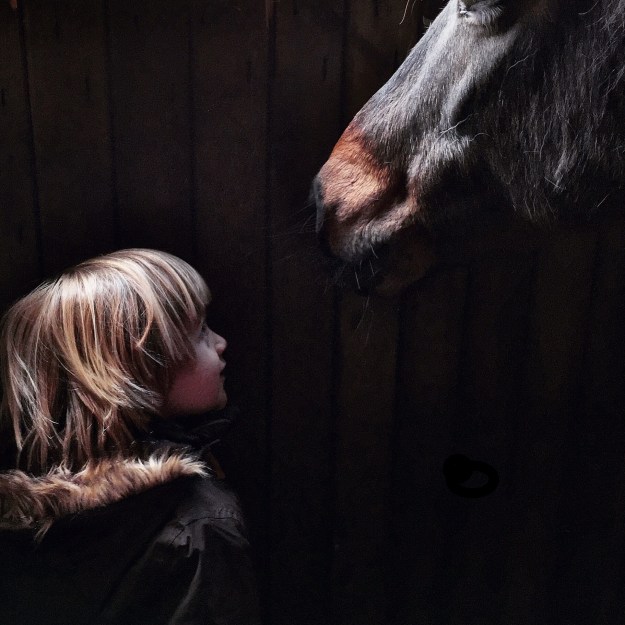
There were horses living in the field next door to our friends and one of them, Tommy, was particularly friendly himself. Arthur was transfixed.

IMG_1417.jpg

He’s not really met horses before, not close up. Tommy is a very small horse – a pony really – but to Arthur I imagine he seemed huge. We went to see him first in his stable, just to say hello, and he was incredibly tolerant of all of these people invading his space – especially the curious little ones.

IMG_1413.jpg

Arthur just loved being next to him, and giggled when he nibbled at his hair. It does, admittedly, look an awful lot like straw.

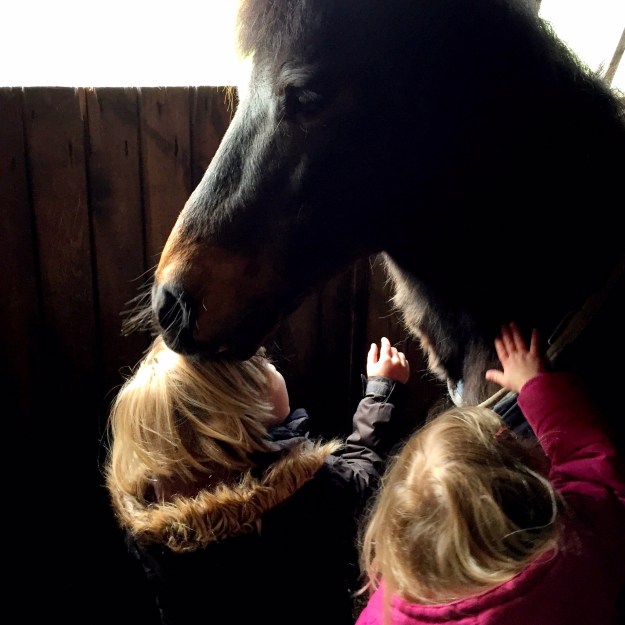
The next day Tommy came out of his stable, and again Arthur delighted in having him close. He rested his hand against his flank and then, getting braver, rested the other hand on him too and went in for a kiss.

IMG_1415.jpg

IMG_1414.jpg

He took the opportunity to get involved in grooming very seriously, gently brushing Tommy’s coat. Arthur has a tendency to get a bit overexcited around animals, but he visibly calmed in the presence of the horse. I was so lovely to watch – a glimpse of a more centred place for my little man.

IMG_1416.jpg

It didn’t entirely last: the offer of a ride on Tommy’s back seemed to freak him out completely. He swung between wanting to and not wanting to at all, and in the end we just followed down the road on foot as his friend enjoyed a ride herself.

I’m not really surprised he was overwhelmed. The proximity to this animal was already an awful lot for him to digest, and the experience was clearly an important one for him. It’s hard to put a finger on exactly what he learnt – there were practical things, like the way his behaviour shifted and an awareness of the dangers of standing behind a horse – but the deeper learning is less tangible. He was absorbing so much from just being there, making whole his perception of an animal he had only previously seen from a distance or in books.

It was a reminder of the magic animals hold for children, and how important it is to include them in their experience of the world. I don’t think we’ll be getting a pet just yet (the tadpoles are plenty for the moment), but I am looking forward to seeking out opportunities over the months to come for Arthur to feel that magic again.


17/52

IMG_1411.jpg

“A portrait of my child, once a week, every week, in 2016.”

It’s hard, learning to make friends.

We spent the weekend with one of my oldest and bestest and her two kids, the elder of whom is weeks younger than Arthur. He was so excited to see her.

Things weren’t always entirely smooth. There were moments when Arthur’s experimental interactions crossed the boundaries, moments when I wanted just to sweep him up and replace him with a child who was perfectly socialised and knew not ever to push or hit or kick.

Looking at this image – of all the images I have as memories of the weekend – it would be easy to forget that it had not all been smiles. But it is important to remember, I think, what a huge amount of subconscious negotiating is going on when our little people are learning to share their world with others.

Ultimately, though, they were learning to be friends, these two. By the end of the weekend Arthur cared enough for her opinion not to want to make her sad or cross. When they went to say goodbye, he gave her a little kiss.

And when she kissed him back he visibly melted.

Linking up with Jodi at Practising Simplicity for The 52 Project. 

#THISislearning update

It has been a week and a day since Maddy and I launched the #THISislearning campaign, and already it is beginning to gather momentum.

THISislearning badge final

We have 272 members of our Facebook group – parents and teachers, from up and down the country, united in their belief that there is something seriously wrong with the lack of understanding and respect our government shows towards the art of learning.

There has been lots of interest in the campaign on Twitter, with some of my favourite educationalists (including Michael Rosen and Sue Cowley) showing their support. The links that people have shared using the hashtag #THISislearning have led me to some fantastic posts, including one which sums up perfectly why it is time for parents and teachers to unite and fight the decimation of our education system.

And support from parents is certainly strong.


I love that not only are people beginning to share their own images and stories that promote a positive and passionate vision of learning, but also that the stories that are being shared are actually beginning to inspire people to think more deeply about learning – something which has been an unexpected side effect of the campaign for me as well.

The blogging community is beginning to come together, sharing their posts about learning and the activities which inspire it. I particularly like this story-inspired rainbow activity, and the hands-on learning about the butterfly life cycle using the ever-versatile tuff spot.

Of course this is all leading up to the 3rd May, when children across the country will be kept out of school and will have the chance to engage in exciting learning opportunities in their communities. I am particularly excited about what is going to be happening in my little town: a Celebrating Children’s Creativity day organised by the fantastic Flossy and Jim.

But perhaps most of all, I am excited by the general tide of enthusiasm in the world of education. The sense that, whilst things might be pretty rubbish right now, there IS another way – and that by standing together we really do have the chance to create a better future for our children. There are all sorts of campaigns kicking off, with people making the most of their expertise and interests to galvanise support from far and wide. And the wider campaign now has a soundtrack, in the form of this protest song which is in the process of being created by a group of teachers in London.

So what can you do – what can we all do – to take things further?

As far as #THISislearning is concerned, we would love it if you could do the following:

  • Join our Facebook group if you haven’t already, and share it with your friends
  • Use the #THISislearning hashtag to share your experiences of (or thoughts about) learning on Facebook, Instagram and Twitter
  • Link up your blog posts to inspire others with your experiences, ideas or activities
  • Share our badge (link in sidebar) to raise awareness of the campaign

Thank you for your support: together we are stronger.


A space to learn

The unschooling diaries: week fourteen

It may be taking up rather a lot of time and headspace, but one major benefit of the #THISislearning campaign for me has been the renewed focus I have found on the way Arthur learns, and how I can best facilitate it. I’ve been reading lots of articles about what does – and doesn’t – inspire effective learning and I in turn am feeling very much inspired.

One of the key concerns parents and teachers have about the SATs is the space they take up – both in terms of time and the room they occupy in peoples’ heads – meaning that other learning, proper learning, is squeezed out as a result. With Arthur learning at home (and out and about) with me, I don’t need to worry about his learning time (and quality) being reduced by assessment or administration. I do, however, want to make sure that his learning does not get lost in the focus on the everyday.

This is a bit of an oxymoron when it comes to unschooling. After all, everyday life IS learning – everything we do, enhanced by talk and questions, is teaching Arthur about a different aspect of the way the world works. But all of that is fairly ordinary, and I want to make sure he is inspired by the extraordinary too – that he has the chance to explore familiar (and less familiar) objects and materials in his own way, and in doing so learn things that might challenge his perceptions and everyday experiences.

Part of that means making sure he has the time in the day to play, and to immerse himself in that extra-ordinary learning. And part of it means dedicating physical space for him to do it – space that inspires curiosity and exploration, space that is his.

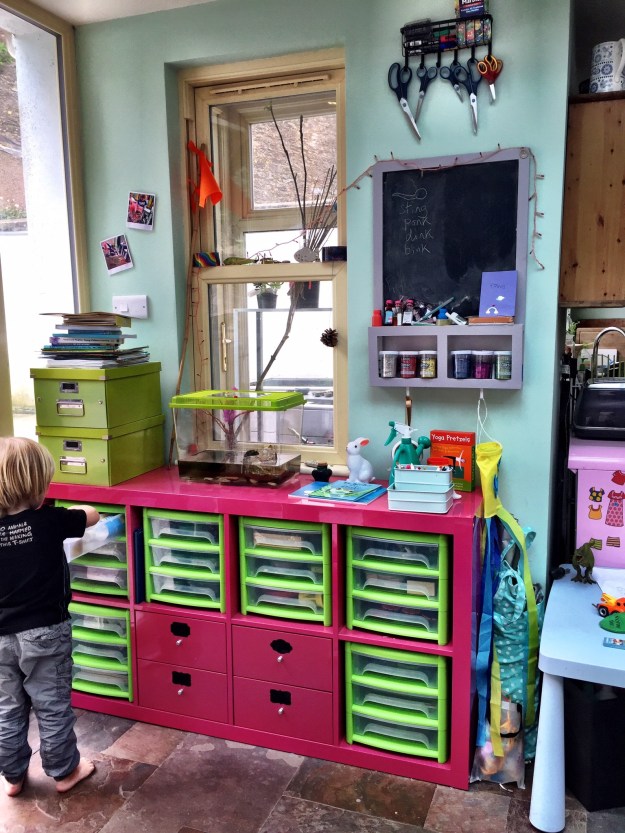
He actually has various little places around the house for this – his room, obviously, and a corner of my study. The area we’ve been working on this week, though, is in the kitchen. It started off just over a year ago as Arthur’s art corner, but as the months have passed it has evolved: he has acquired an increasing amount of resources for building and creating and experimenting, and the more things we’ve had to try to cram in to his corner the harder it’s been to actually access them.

I dream of Montessori-style open shelves, with carefully curated learning materials rotated on a regular basis. But then I have to get realistic, and remember just how quickly the space around me can descend into chaos if I’m not careful. So we’ve gone for clear drawers instead – I trawled the internet to find ones which would fit on our Ikea unit and finally found the perfect ones. I’m still waiting for another column of shelving to arrive which should (hopefully) fit perfectly into the corner by the window, and then there will be space for books and boxes of miscellaneous bits and pieces.

IMG_1408.jpg

The idea with the drawers is that each of them has one type of resource. The way I’ve grouped them has varied, but there is a logic to it all. I’m hoping each one contains something that will inspire Arthur towards creative play: very few of the resources have a ‘right’ application, so it’s going to be interesting to see how he interprets their potential.

My favourite at the moment is definitely the seaside drawer, with shells and stones and sand collected from local beaches and our travels all over the world. I have so many ideas of what we might be able to do with them, but I’m trying to hold back at the moment to see what Arthur comes up with first.

IMG_1403.jpg

As for Arthur, he seems especially intrigued by the ‘small worlds’ drawer, and I can’t blame him. We have yet to collect all of the weird and wonderful creatures he has secreted around the house and introduce them to their new home, but the ones that are there are already inspiring some interesting play – I particularly liked this morning’s conversation between the bear and the octopus.

IMG_1404

On the subject of creatures, this learning space is also home to Arthur’s first pets – four tadpoles collected from the pond at my parents’ place. We are both fascinated by their habits and their creeping metamorphosis – in the last forty eight hours they have just begun to grow legs. They have inspired so many fascinating conversations already – I can’t wait to see Arthur’s wonder when their transformation is complete!

IMG_1410

There is generally something incredibly powerful about focusing Arthur’s creative and conceptual energies around this space. He tends to oscillate round it as we go through our day, picking up new things to explore or pausing to investigate something further. It has certainly become the place he gravitates towards first thing in the morning. With things being accessible and clearly laid out he has proved more likely to just leap straight in – like yesterday, when I came downstairs to find him drawing on his easel (welly boots on of course ready to escape into the garden the second I opened the door).

IMG_6195.jpg

The more I learn about learning the more I realise I have yet to learn – which is exactly as it should be. I am just very grateful to be spending my days with such a good little teacher, and will continue to do all I can to make the adventures we have together as inspiring and enlightening as possible.


This is what learning looks like

On Tuesday 3rd May, thousands of parents are planning to take a stand against a school system which is more interested in testing our children than it is in nurturing in them a love of learning. They will be adding their voices to the growing unrest that already permeates the teaching profession, and joining the call from the National Union of Teachers to cancel the SATs for 2016. By keeping their children home from school on that day, they want to send a clear message to the government that enough is enough, and that their children – all children – deserve more.

We want to take things one step further.

THISislearning badge final

As well as fully supporting the kids’ strike on 3rd May, we want to use that day and the run up to it to flood the internet with inspirational learning moments: images, stories and activities that show just how much more there is to learning than the narrow focus of the SATs allows. Whatever the age of your child, whether they are at school or nursery or educated at home, we would like you to help us show the government what learning really looks like using the hashtag #THISislearning.

If you’re a teacher, we would love to hear your thoughts too: this government has marginalised the expertise of education professionals for far too long.

If you have a blog, you can link up your posts below to create a hub of inspiration in the run up to 3rd May and share what you and your child(ren) get up to on the day itself. If you are not a blogger then don’t worry – you can share your ideas and activities on your social media accounts, using the hashtag #THISislearning on Facebook, Twitter and Instagram.

You can find out more about why we’re taking this action by reading Maddy’s post No, Mr Cameron, No, which inspired us with the fantastic response it received from parents and teachers alike, and the follow up, This is learning, Mr Cameron, as well as my post Why SATs are Bad for our Children, reflecting on the current situation from the perspective of ten years of teaching as well as life with a three year old.

You can also join our Facebook group to keep up to date with latest developments, and please comment below or contact either of us directly if there is anything else you want to know.

Sophie: Sophie is…

Maddy: Writing Bubble

#THISislearning


We would love as many bloggers as possible to join in! Here are just a few suggestions for taking part:

  • Link up any post (old or new) about inspiring children to learn, including fun activities people might like to try on May 3rd.
  • Please grab the #THISislearning badge for your post to spread awareness of the campaign (copy and paste the HTML code to add it to your site). We will share your posts on Twitter in return.
  • If you share your post on social media, please the hashtag #THISislearning. If you tweet us a link to your post @writingbubble and @sophieblovett then we will RT.
  • Link up your post below – just click on the blue button that says ‘add your link’ and follow the instructions. We look forward to reading your posts!


grab button for Sophie is

<div class=”sophie-is-button” style=”width: 200px; margin: 0 auto;”>
<a href=”http://www.sophieis.com&#8221; rel=”nofollow”>
<img src=”https://sophieis.com/wp-content/uploads/2016/04/thisislearning-little-badge.jpg&#8221; alt=”Sophie is” width=”200″ height=”200″ />
</a>
</div>