Tag Archives: #THISislearning

#THISislearning update

It has been a week and a day since Maddy and I launched the #THISislearning campaign, and already it is beginning to gather momentum.

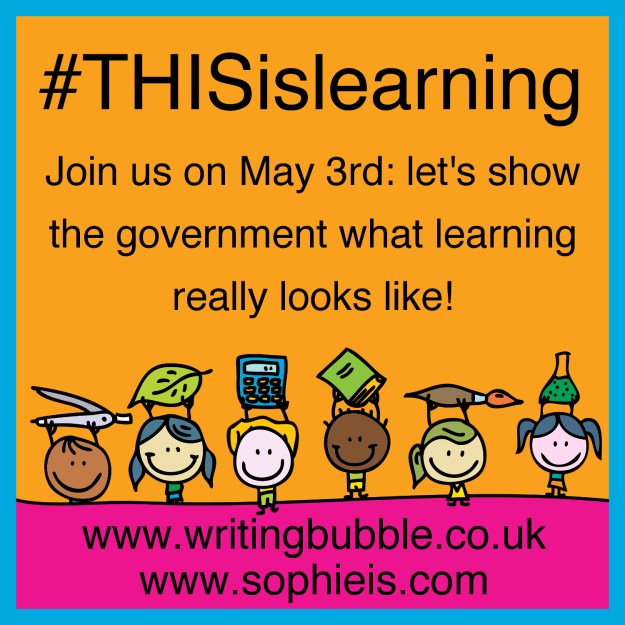
THISislearning badge final

We have 272 members of our Facebook group – parents and teachers, from up and down the country, united in their belief that there is something seriously wrong with the lack of understanding and respect our government shows towards the art of learning.

There has been lots of interest in the campaign on Twitter, with some of my favourite educationalists (including Michael Rosen and Sue Cowley) showing their support. The links that people have shared using the hashtag #THISislearning have led me to some fantastic posts, including one which sums up perfectly why it is time for parents and teachers to unite and fight the decimation of our education system.

And support from parents is certainly strong.


I love that not only are people beginning to share their own images and stories that promote a positive and passionate vision of learning, but also that the stories that are being shared are actually beginning to inspire people to think more deeply about learning – something which has been an unexpected side effect of the campaign for me as well.

The blogging community is beginning to come together, sharing their posts about learning and the activities which inspire it. I particularly like this story-inspired rainbow activity, and the hands-on learning about the butterfly life cycle using the ever-versatile tuff spot.

Of course this is all leading up to the 3rd May, when children across the country will be kept out of school and will have the chance to engage in exciting learning opportunities in their communities. I am particularly excited about what is going to be happening in my little town: a Celebrating Children’s Creativity day organised by the fantastic Flossy and Jim.

But perhaps most of all, I am excited by the general tide of enthusiasm in the world of education. The sense that, whilst things might be pretty rubbish right now, there IS another way – and that by standing together we really do have the chance to create a better future for our children. There are all sorts of campaigns kicking off, with people making the most of their expertise and interests to galvanise support from far and wide. And the wider campaign now has a soundtrack, in the form of this protest song which is in the process of being created by a group of teachers in London.

So what can you do – what can we all do – to take things further?

As far as #THISislearning is concerned, we would love it if you could do the following:

  • Join our Facebook group if you haven’t already, and share it with your friends
  • Use the #THISislearning hashtag to share your experiences of (or thoughts about) learning on Facebook, Instagram and Twitter
  • Link up your blog posts to inspire others with your experiences, ideas or activities
  • Share our badge (link in sidebar) to raise awareness of the campaign

Thank you for your support: together we are stronger.


A space to learn

The unschooling diaries: week fourteen

It may be taking up rather a lot of time and headspace, but one major benefit of the #THISislearning campaign for me has been the renewed focus I have found on the way Arthur learns, and how I can best facilitate it. I’ve been reading lots of articles about what does – and doesn’t – inspire effective learning and I in turn am feeling very much inspired.

One of the key concerns parents and teachers have about the SATs is the space they take up – both in terms of time and the room they occupy in peoples’ heads – meaning that other learning, proper learning, is squeezed out as a result. With Arthur learning at home (and out and about) with me, I don’t need to worry about his learning time (and quality) being reduced by assessment or administration. I do, however, want to make sure that his learning does not get lost in the focus on the everyday.

This is a bit of an oxymoron when it comes to unschooling. After all, everyday life IS learning – everything we do, enhanced by talk and questions, is teaching Arthur about a different aspect of the way the world works. But all of that is fairly ordinary, and I want to make sure he is inspired by the extraordinary too – that he has the chance to explore familiar (and less familiar) objects and materials in his own way, and in doing so learn things that might challenge his perceptions and everyday experiences.

Part of that means making sure he has the time in the day to play, and to immerse himself in that extra-ordinary learning. And part of it means dedicating physical space for him to do it – space that inspires curiosity and exploration, space that is his.

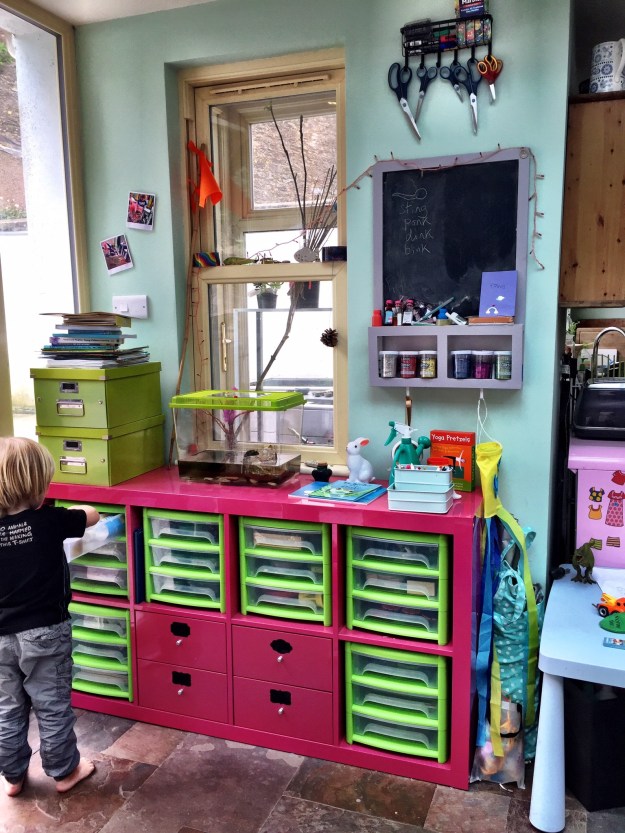
He actually has various little places around the house for this – his room, obviously, and a corner of my study. The area we’ve been working on this week, though, is in the kitchen. It started off just over a year ago as Arthur’s art corner, but as the months have passed it has evolved: he has acquired an increasing amount of resources for building and creating and experimenting, and the more things we’ve had to try to cram in to his corner the harder it’s been to actually access them.

I dream of Montessori-style open shelves, with carefully curated learning materials rotated on a regular basis. But then I have to get realistic, and remember just how quickly the space around me can descend into chaos if I’m not careful. So we’ve gone for clear drawers instead – I trawled the internet to find ones which would fit on our Ikea unit and finally found the perfect ones. I’m still waiting for another column of shelving to arrive which should (hopefully) fit perfectly into the corner by the window, and then there will be space for books and boxes of miscellaneous bits and pieces.

IMG_1408.jpg

The idea with the drawers is that each of them has one type of resource. The way I’ve grouped them has varied, but there is a logic to it all. I’m hoping each one contains something that will inspire Arthur towards creative play: very few of the resources have a ‘right’ application, so it’s going to be interesting to see how he interprets their potential.

My favourite at the moment is definitely the seaside drawer, with shells and stones and sand collected from local beaches and our travels all over the world. I have so many ideas of what we might be able to do with them, but I’m trying to hold back at the moment to see what Arthur comes up with first.

IMG_1403.jpg

As for Arthur, he seems especially intrigued by the ‘small worlds’ drawer, and I can’t blame him. We have yet to collect all of the weird and wonderful creatures he has secreted around the house and introduce them to their new home, but the ones that are there are already inspiring some interesting play – I particularly liked this morning’s conversation between the bear and the octopus.

IMG_1404

On the subject of creatures, this learning space is also home to Arthur’s first pets – four tadpoles collected from the pond at my parents’ place. We are both fascinated by their habits and their creeping metamorphosis – in the last forty eight hours they have just begun to grow legs. They have inspired so many fascinating conversations already – I can’t wait to see Arthur’s wonder when their transformation is complete!

IMG_1410

There is generally something incredibly powerful about focusing Arthur’s creative and conceptual energies around this space. He tends to oscillate round it as we go through our day, picking up new things to explore or pausing to investigate something further. It has certainly become the place he gravitates towards first thing in the morning. With things being accessible and clearly laid out he has proved more likely to just leap straight in – like yesterday, when I came downstairs to find him drawing on his easel (welly boots on of course ready to escape into the garden the second I opened the door).

IMG_6195.jpg

The more I learn about learning the more I realise I have yet to learn – which is exactly as it should be. I am just very grateful to be spending my days with such a good little teacher, and will continue to do all I can to make the adventures we have together as inspiring and enlightening as possible.


This is what learning looks like

On Tuesday 3rd May, thousands of parents are planning to take a stand against a school system which is more interested in testing our children than it is in nurturing in them a love of learning. They will be adding their voices to the growing unrest that already permeates the teaching profession, and joining the call from the National Union of Teachers to cancel the SATs for 2016. By keeping their children home from school on that day, they want to send a clear message to the government that enough is enough, and that their children – all children – deserve more.

We want to take things one step further.

THISislearning badge final

As well as fully supporting the kids’ strike on 3rd May, we want to use that day and the run up to it to flood the internet with inspirational learning moments: images, stories and activities that show just how much more there is to learning than the narrow focus of the SATs allows. Whatever the age of your child, whether they are at school or nursery or educated at home, we would like you to help us show the government what learning really looks like using the hashtag #THISislearning.

If you’re a teacher, we would love to hear your thoughts too: this government has marginalised the expertise of education professionals for far too long.

If you have a blog, you can link up your posts below to create a hub of inspiration in the run up to 3rd May and share what you and your child(ren) get up to on the day itself. If you are not a blogger then don’t worry – you can share your ideas and activities on your social media accounts, using the hashtag #THISislearning on Facebook, Twitter and Instagram.

You can find out more about why we’re taking this action by reading Maddy’s post No, Mr Cameron, No, which inspired us with the fantastic response it received from parents and teachers alike, and the follow up, This is learning, Mr Cameron, as well as my post Why SATs are Bad for our Children, reflecting on the current situation from the perspective of ten years of teaching as well as life with a three year old.

You can also join our Facebook group to keep up to date with latest developments, and please comment below or contact either of us directly if there is anything else you want to know.

Sophie: Sophie is…

Maddy: Writing Bubble

#THISislearning


We would love as many bloggers as possible to join in! Here are just a few suggestions for taking part:

  • Link up any post (old or new) about inspiring children to learn, including fun activities people might like to try on May 3rd.
  • Please grab the #THISislearning badge for your post to spread awareness of the campaign (copy and paste the HTML code to add it to your site). We will share your posts on Twitter in return.
  • If you share your post on social media, please the hashtag #THISislearning. If you tweet us a link to your post @writingbubble and @sophieblovett then we will RT.
  • Link up your post below – just click on the blue button that says ‘add your link’ and follow the instructions. We look forward to reading your posts!


grab button for Sophie is

<div class=”sophie-is-button” style=”width: 200px; margin: 0 auto;”>
<a href=”http://www.sophieis.com&#8221; rel=”nofollow”>
<img src=”https://sophieis.com/wp-content/uploads/2016/04/thisislearning-little-badge.jpg&#8221; alt=”Sophie is” width=”200″ height=”200″ />
</a>
</div>


Mud glorious mud

The unschooling diaries: week thirteen

This week, we have finally managed to start sorting the garden out for summer.

It’s not an especially big space, and because our house is essentially built into the cliff face it’s on three different levels – and has no grass. So over the wet, windy Devon winter it really does start to look quite sorry for itself, and I start yearning for a house with a proper garden with room to run and explore.

I’ve realised, though, that there is actually an awful lot we can do with the space we have. Rather than bemoan the lack of lawn, I’ve decided instead to focus on what an interesting space it is, and its huge potential as an outdoor classroom. So, with Arthur taking the lead of course, we’ve been exploring exactly what that might look like – and having lots of messy fun in the process.

We started with some digging and pulling up of weeds in our raised beds. Arthur was very keen to get involved, and was fascinated by the bugs we came across along the way. We found snails, slugs, earthworms, a centipede, woodlice and a caterpillar – and had a good chat about each of them before getting on with our work.

IMG_1397.jpg

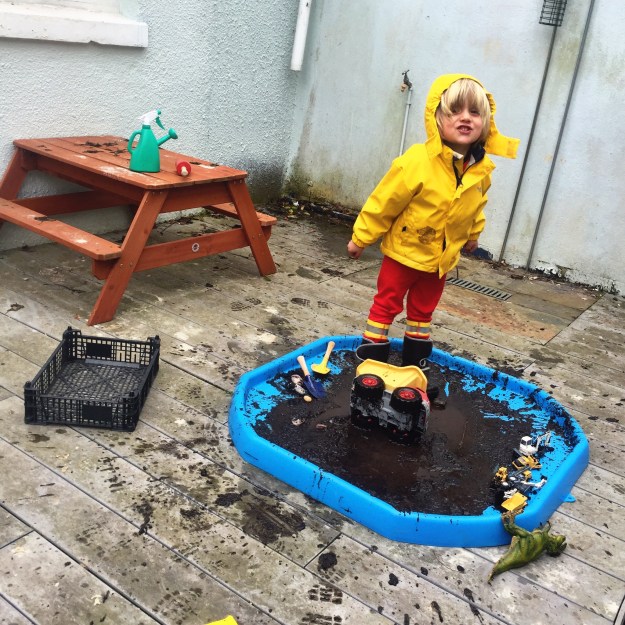
We also got the tuff spot out into the garden, creating a mud-filled paradise for Arthur’s beloved diggers, made even more fun when we added water to the equation.

IMG_1396.jpg

IMG_1395.jpg

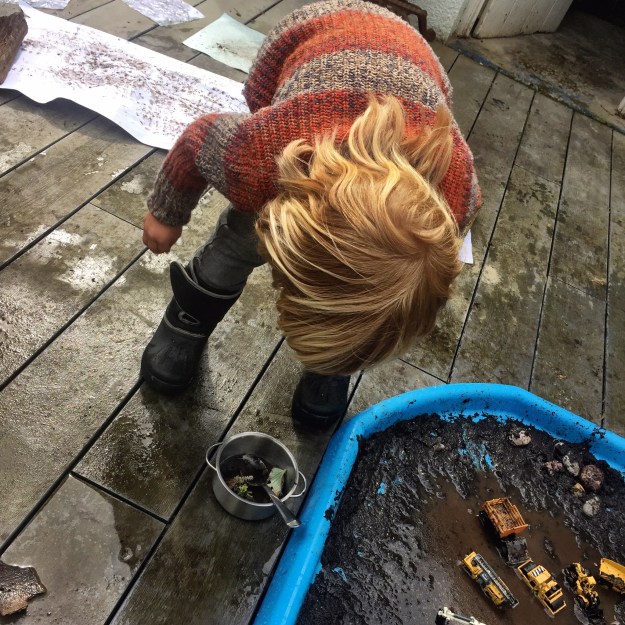
We managed to work some arts and crafts in there too. When we were in Lanzarote we’d talked about how Cesar Manrique had used volcanic ash in his paintings – Arthur had been quite intrigued by the unusual textures it created. So, inspired by the puddle that formed after some overnight rainfall, we decided to try some mud art.

We started with some puddle painting, using oil and food colouring to create colourful swirls on the water. This didn’t work brilliantly as Arthur got a bit over excited with the amount of oil he added, but it was still lots of fun!

IMG_1394.jpg

Especially fun was, of course, stamping in the oily puddle – and seeing how much Arthur was enjoying making footsteps on the deck I decided to give him a bit of a canvas.

IMG_1385.jpg

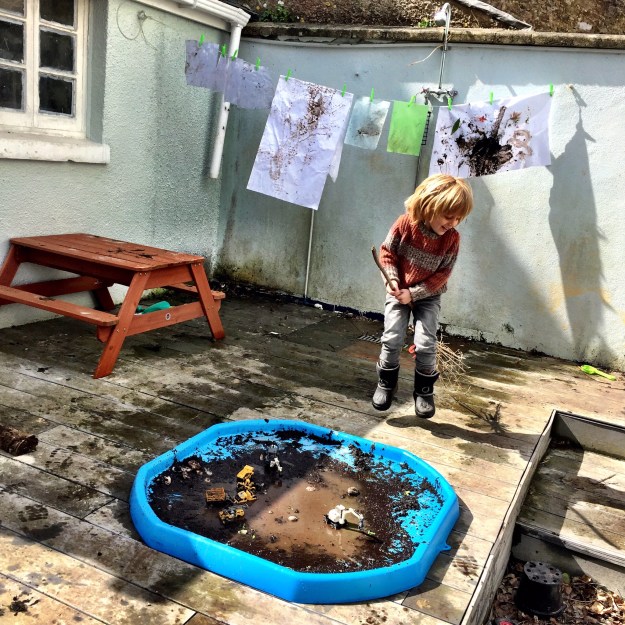
Then, after a slight diversion to make a magic potion, we got properly stuck in and covered a large sheet of paper with pva glue before pouring on the muddy concoction and mixing it up with anything else that took our fancy…

IMG_1393.jpg

There was more focused preparation too, with Arthur climbing inside the raised beds to get the earth ready for planting (and make some mud castles).

IMG_1388.jpg

It was all so much fun! And tidying up was even more so: Arthur was super keen to use the hosepipe, and I in my infinite wisdom let him. It was going great until he accidentally splashed me whilst I was holding the tuff spot, and I yelped, and he laughed, and… well, let’s just say we both got very wet!

IMG_1387.jpg

IMG_1386.jpg

All in all it’s made me very excited about our little garden, and the fun and learning that is going to happen there in the weeks and months to come. There is something about being outdoors that just can’t be beat.


Why SATs are bad for our children

There are many moments that have stayed with me from my ten years of teaching. The overwhelming majority of them are positive, but there is one in particular that has been circling around my head the past few days that makes me feel so sad about what current government policy is doing to our children’s experience of learning.

Early on in the first term of Year Seven, I often broached the question to my English class “What makes good writing?”. It’s a big question, and not one I ever expected to hear answered in its entirety, but still the responses that I got were pretty telling. The particular set of responses I remember was from Autumn 2012, just before I disappeared on maternity leave. Fresh from SATs preparation, hands shot up as I wrote the question on the board, and the answers spilled out proudly into the classroom: “varied sentence starters”, “correct use of conjunctions”, “fronted adverbial clauses”, “using semi-colons”.

Now none of this is strictly wrong, of course – and I dutifully noted each response on the whiteboard before mooting my own ideas. But it was still incredibly deflating to hear it from a room full of eleven year olds. Where was the talk of imagination? Of storytelling? Of creativity? Where was the space for them to fly?
IMG_1384

It is this reduction of learning to rote mechanics that worries me most about the SATs, because the world doesn’t work like that – and yet in order for children to be able to succeed in these exams they have to be trained as if it does. When Key Stage 3 SATs were still around, I remember as an English department poring over questions trying to work out what it was they were actually getting at, and then teaching our students which right answers to put down for which type of question to make sure they got the marks they deserved. It was a preposterous waste of time and energy at a delicate stage in young people’s lives when the cocktail of hormones they were dealing with made the conventions of school pretty challenging anyway.

Still, I can get the argument that (at least within the limitations of our current system) being able to ‘do’ exams is kind of necessary. And I can just about stomach the concept of putting thirteen year olds through that process – at least we could explain to them the whole idea of the hoops they had to jump through, and begin to separate out different types of learning so that the experience didn’t completely extinguish the fire within.

I find it harder to justify for ten year olds, and I think it is such a crushing shame that children’s final year in primary school, a period in education which for many has been characterised by creativity and imagination, is reduced to drills and mock exams and learning ‘right’ answers to the most complex of questions making reopening the door to the potential for real learning a dauntingly challenging task in the years that follow.

Except of course primary school isn’t really like that any more. Not since the reintroduction of KS1 SATs, where children as young as six are now expected to sit formal tests in spelling, punctuation, grammar, reading, arithmetic and reasoning. SIX! The notion of what constitutes correct answers is, from what I have seen, just as convoluted as it was in KS3 – and so drilling is, if teachers are not going to sacrifice the children in their charge (and themselves) on the pyre of government assessment, inevitable.

And then of course there is the question of what all of this drilling occurs at the expense of. Play, for example, and creativity. Various other government initiatives are squeezing out the arts as children move up through the school system, but it is beyond belief that they should be marginalised at this crucial early stage. It goes against all of the research, the experience and the professional instinct that should guide our education system. When I admit that as a result of the regressive nature of government reforms I am reluctant to enrol my child in nursery, friends are quick to defend the relative freedoms that are still enjoyed in the early years. They go quiet when we get on to what starts to happen in year one.

All of this is part of why I am no longer teaching, and is a major driver in my decision to home-educate my son – for the first few years at least. My approach as a teacher always meant that there was a degree of rallying against the system – I wanted to see my students grow as individuals, to try to find creative ways of managing assessment that did not compromise their own personal development. During the bulk of my career, it felt at least as if I was moving with the tide – that what I innovated with one year I could integrate the next as Labour education policy responded to the needs of teachers and schools. And then the Tories came to power.

I could still be fighting the battle from the inside – I have untold respect and admiration for my former colleagues that are – but it is just so exhausting to have to make your classroom a fortress against the outside world, and I have a family to think about now.

My son is three: he is curious, brave, funny, unique and creative. He has many subjects he is passionate about, and is developing his own clear preferences for how he likes to learn about them. I want to nurture those in him, to enable him to find his way through the world in a way that it keeps its wonder, and where he gets to cherish his uniqueness, not play it down to fit in within the system and win validation for himself, his teachers and his school.

These KS1 SATs don’t give children levels; they don’t take a formative approach to identifying their strengths and areas for development; they don’t recognise that each and every child will progress in different areas at a different pace: they just indicate whether they have reached the required standard, whether they have passed or failed, whether or not they are ‘good enough’ at this stage in their lives.

I cannot imagine putting my little boy through that in three years time.

And it looks like I am not alone.

A campaign is gathering pace to undermine the KS1 SATs with a children’s strike on the 3rd of May. Yet more parents are calling for a boycott of the KS2 SATs, where the expected standards have risen so sharply that children are being set up to fail more than ever before. Parents up and down the country are uniting to say that this dismantling of their children’s childhood is simply not OK, that to stop their kid’s learning in its tracks by subjecting it to meaningless assessment is not something they want to be a part of.

My son is too young for me to be able to make a stand in this way, but I will be taking the opportunity on that day to demonstrate just what learning can look like when we set it free: to tell the story of our learning journey on this blog and on social media, to show how much fits into a day when it is not constrained by the need to learn to jump through hoops.

If you too are angry about what current government policy is doing to our schools, teachers and most importantly our children, then I hope that you will join me.


Edited 16th April 2016:

In response to our general disbelief at the way the government are decimating our education system, myself and Maddy from Writing Bubble have started a campaign to show them what learning really looks like. 

To find out more, check out our launch post and join our Facebook group. It would be awesome to have you on board.
 

Writing Bubble