Monthly Archives: June 2014

F is for folk

IMG_8043

During my formative years, I generally listened to trance and trip hop. It was a bit of a revelation to be (re)introduced to folk music in my mid-twenties.There’s something about the rawness and purity of the sound and the lyrics that I love.

This picture was taken at the Cadgwith Cove Inn during our recent trip to Cornwall for my cousin’s wedding. The pub holds a lot of history for my family: my mum’s parents used to run it, and it’s been the heart of the community for as long as I can remember. This was the first time we’d actually made it down for their famous folk night though. It was rammed with locals and tourists, and at its core was a group of people making music together, laughing and loving life. Arthur was in the sling, nodding his head and tapping his feet. It was way past his bedtime but it was definitely worth it.

Because there’s something very special about watching and listening to people making music for music’s sake, connecting with a community of listeners who in that moment are all there for the same reason, tapping into a sense of satisfaction and pleasure that is as old as time. F is for folk.

Joining in with The Alphabet Photography Project over at PODcast.

Why schools fining ‘bad parents’ is a really, really bad idea

Another day, another ludicrous idea from one of the Michaels. This time it’s Michael Wilshaw, chief of Ofsted, saying that parents should be fined if they don’t, amongst other things, make children do their homework.

This story made my blood boil when I read it this morning, and I can feel the fury rising inside me reading it again now. I mean, who does this man think he is? To make sweeping statements about the causes of underachievement amongst children growing up in poverty, to drive a wedge between parents and schools in the communities where close collaboration is perhaps most important, to blithely dictate what it is that makes a good parent in such a patronising and unpleasant manner. There are so many things wrong with his proposals that I almost don’t know where to start, but I will try.

Let’s just begin with what he expects of good parents. I agree that communicating with the school is pretty important, though I also know there are a multitude of reason why someone may not be able to attend a designated parents’ evening – and the realities of those evenings (or afternoons, or days) is that there is little scope for in depth discussion about young people’s progress, especially if they’re struggling.

I agree, of course, that reading is something to be encouraged – urgently so given the impact it can have on children’s lives. But you can’t force someone to read for pleasure – adult or child – and the real focus should surely be on expanding local libraries rather than closing them, or maybe reinstating the funding that would bring inspirational authors into schools on a regular basis.

And then we come to the tricky subject of homework. I never much liked homework, neither as a child nor as a teacher. And with educational research throwing up little to support its position as a tool to improve learning, and officials in countries from China to France and Sweden seeking to reduce it or ban it altogether, it seems a funny time for Wilshaw to be insisting on its importance. I’m not saying that there aren’t times when it is appropriate for students to work on something at home, but teachers setting tasks for the sake of it then parents battling with demotivated kids to complete homework that’s only going to increase teachers’ workloads when they have to mark it just makes no sense at all to me.

But to be honest it’s not the nitty gritty of Wilshaw’s proposals that I find so offensive, even if they are typically narrow-minded and outdated in their origins. What I find really unbelievable is that he can think that pitching schools and parents against each other is really the best way to get them to work together to support the young people in their care. The bullying tactics he used against the parents at his old school in Hackney are really not going to work for anyone – and I can’t imagine that many head teachers would want to take the approach he describes.

The issues that lead to underachievement in impoverished communities are complex and far-reaching. Many of them have their roots in low self-esteem perpetuated by generations of un- or under-employment – in a lack of trust in the system, and schools in particular. The only way to truly overcome this is to help communities believe in themselves again, to show what they can achieve for themselves and for their children when they work hard, to celebrate successes and find the things that motivate them to change.

Treating parents as naughty school kids themselves would have the opposite effect – sure people might purport to play the game, might jump through the hoops they need to to escape the fines, but that is a long way from nurturing the impetus for learning that will truly help young people escape the cycle of poverty.

And what if parents don’t play the game? To be honest the ones that are hardest to reach, that aren’t already responding to schools’ attempts to engage them, are highly unlikely to give two hoots about the prospect of a fine. And what then? Protracted and costly legal proceedings, culminating in poor families being poorer still and so condemning the young people who most need our help to an even harder struggle?

I don’t know whether Wilshaw intended to be taken seriously, or whether he was just firing off another simplistic idea for the sake of it. But I do know that his way of thinking is incredibly damaging to our society – and it is time that parents stood together with schools to tell him that enough is enough.


Beautiful Bombay Duck

IMG_1505.JPG

Father’s day this year coincided with another rather special occasion: the relaunch of my parents’ boat, Bombay Duck, after six months of painstaking work to restore her to her former glory.

The actual launch happened on Saturday, but yesterday we made our way over to meet them at the Salcombe estuary for the inaugural trip to celebrate her restoration.

Arthur was a little bit sceptical at first: he’s been on bigger boats before, but this was his first boat trip where I think he was really aware of what was going on and he found it all a bit peculiar.

IMG_1506

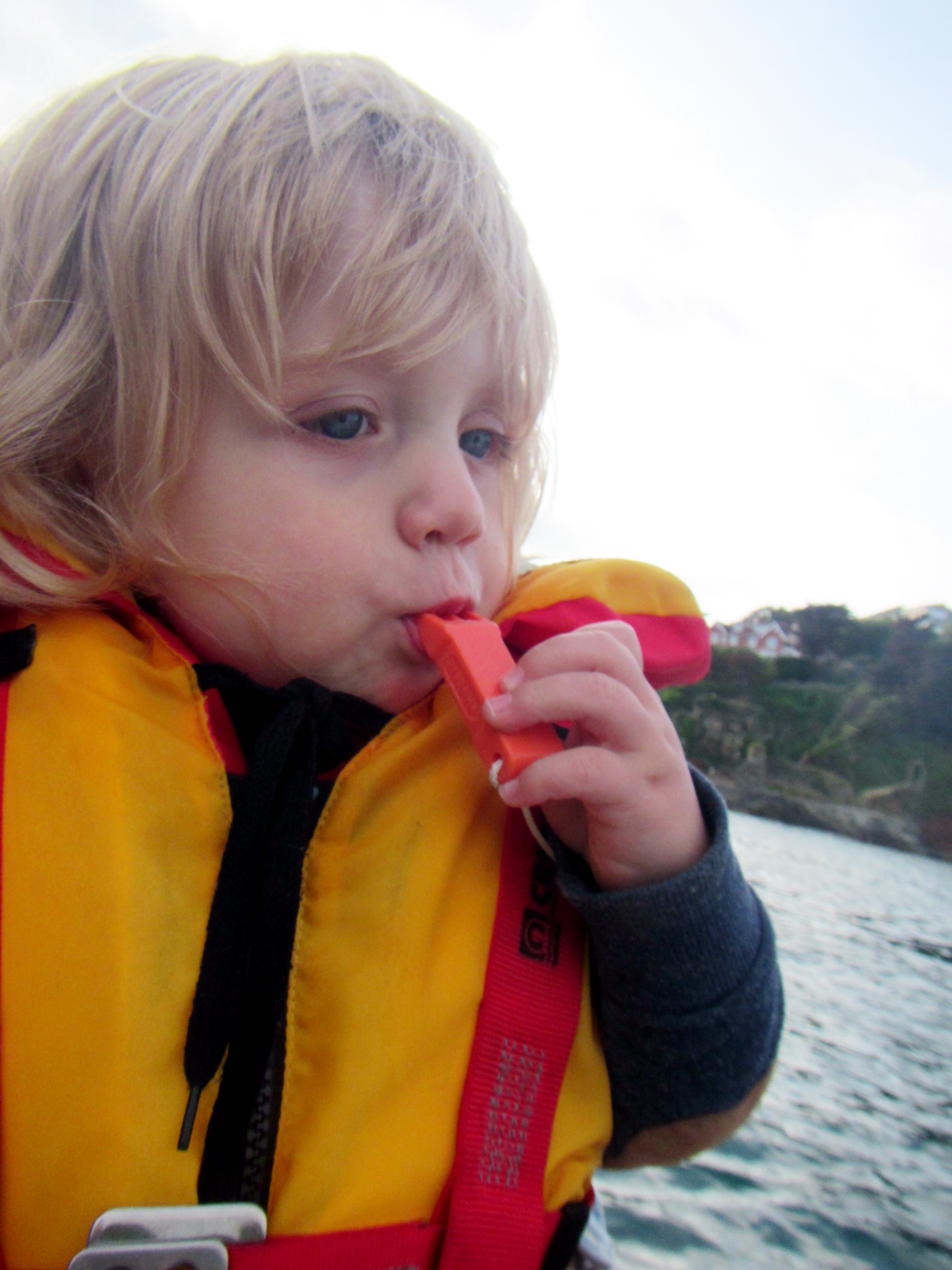
He soon got into the swing of things though: testing out the whistle on his life jacket, finding out what all the wheels and buttons did, and generally having a pretty awesome time.

IMG_1504    IMG_1507.JPG

IMG_1500.JPG    IMG_1503.JPG

We’d brought Leigh’s fishing kit with us – last year’s birthday present that with everything else that’s been going on hadn’t yet made it out of the house! We didn’t actually catch any fish, but it was good to finally get it out and in the water – and Arthur certainly seemed interested in what daddy was up to…

IMG_1501.JPG

IMG_1502.JPG

It was lovely to get to hang out on the water – such a gorgeous afternoon, perfect to fill with family, fun and fresh air. The fresh air did eventually take its toll though, and as we began to head back Arthur started to get very sleepy and just a little bit fractious. Nothing that the sling couldn’t solve of course!

IMG_0237    IMG_1510

Once the boat was all moored up we made our way back through the woodland, Arthur dozing and the rest of us full of excitement about the watery adventures the summer will hold aboard beautiful Bombay Duck.

IMG_1508


 photo 93142f35-6d39-479f-b3de-d94dbca68162_zps58499252.jpg


Hello summer!

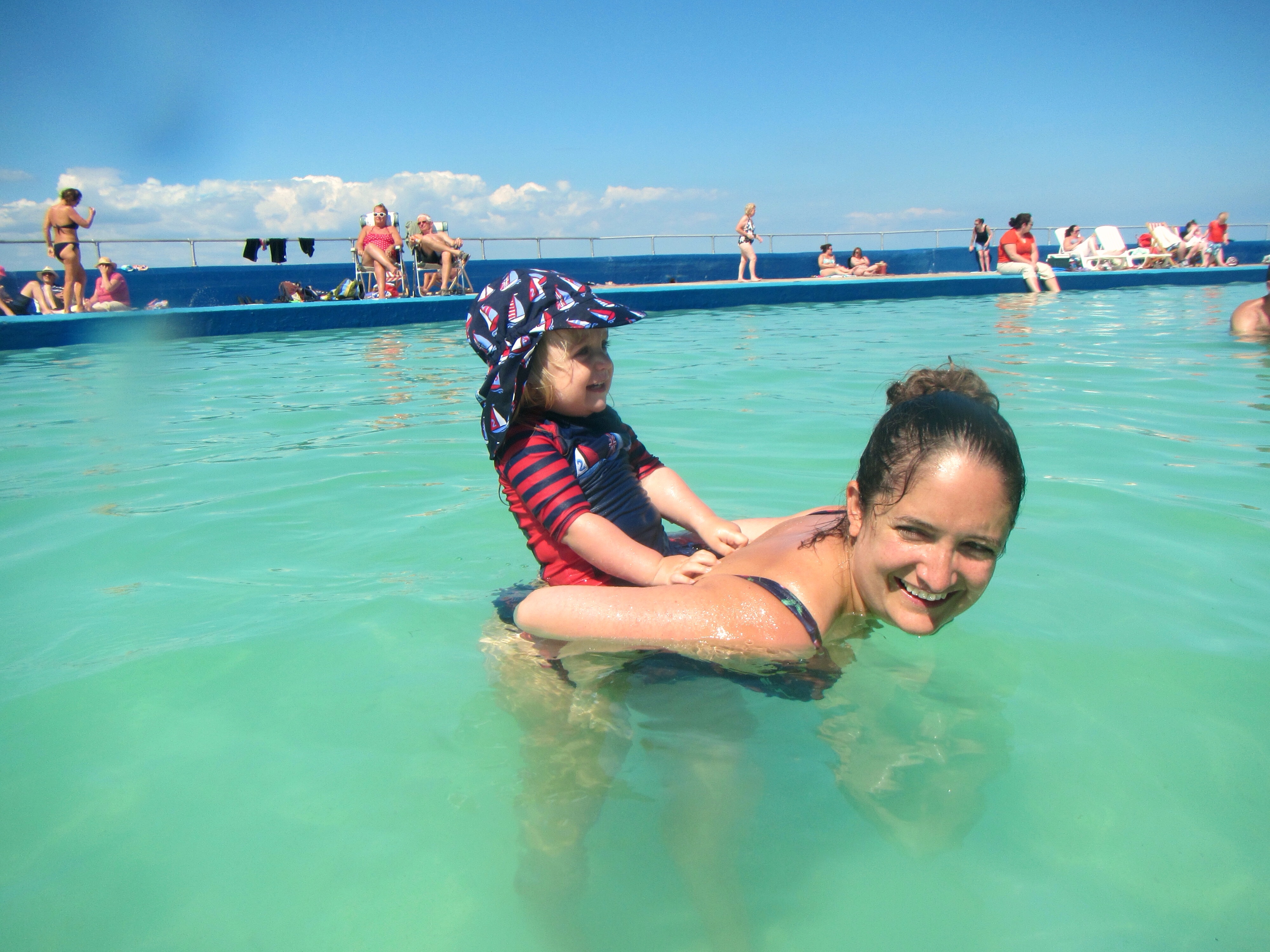
It’s been coming for a while, in the gloriously light evenings and the no need to take a jacket when we leave the house, but today summer finally arrived. In scorching sunshine we finally made our way to Shoalstone Pool for the first dip of the season.

Arthur was so excited: we barely had time to get him into his swimmers before he was running towards the water. He definitely found it cold at first, but each time we lifted him out he was desperate to get back in again.

image

Before long we had both got used to the cold – after the initial shock it really wasn’t that bad, and now that I’ve broken the ice (so to speak) I’m determined to fit some regular swims into our routine.

image

image

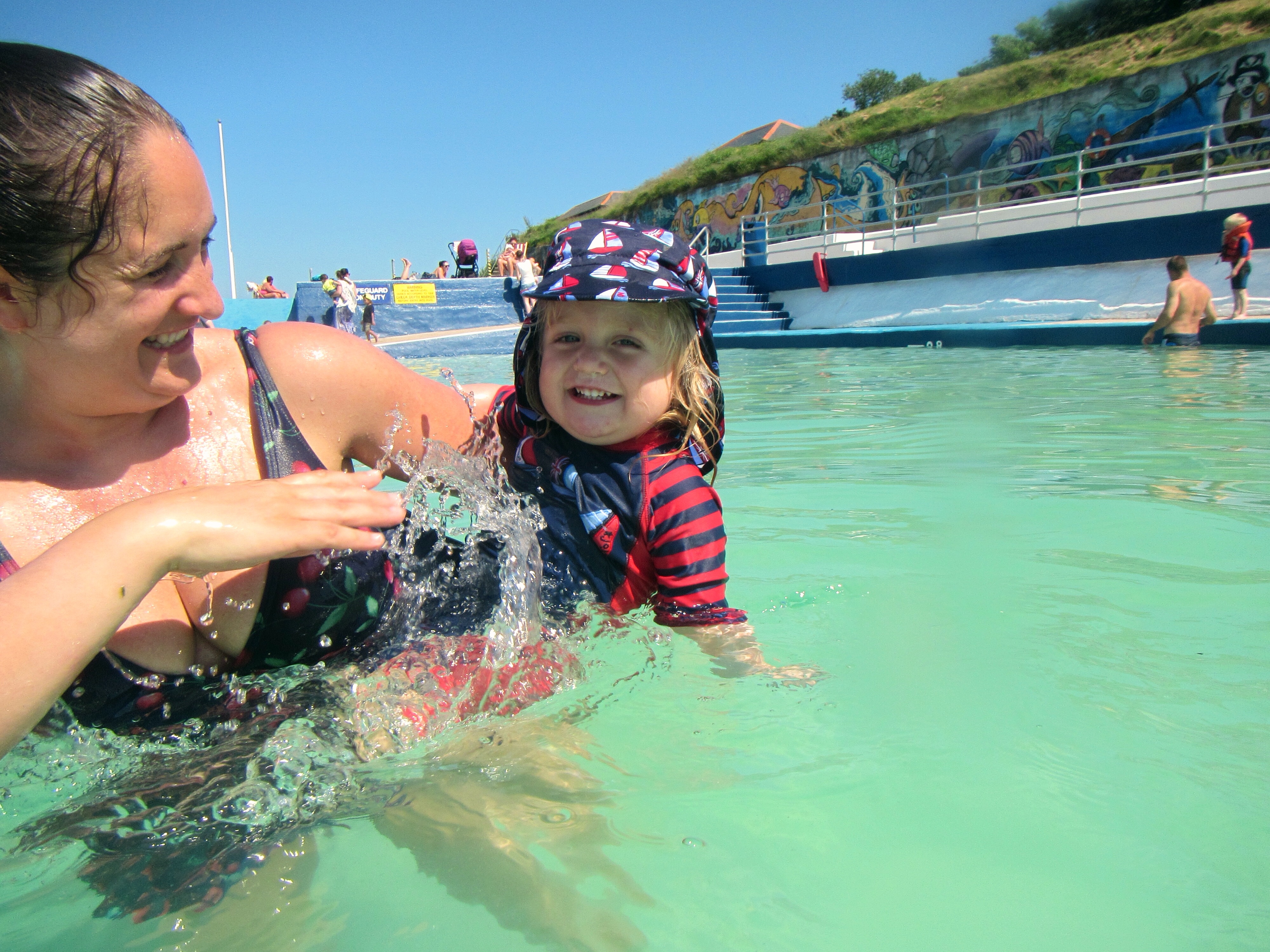
Arthur being Arthur there was quite a lot of splashing – hence the somewhat blurry photos where I forgot to wipe the lens… But it was brilliant to see him having so much fun!

image

I think he would happily have stayed in the water for hours, but we figured we’d better not let him get too cold. He protested a bit at first but then was happy to entertain himself with my hat for a while.

image

We went for a wander to get some ice-creams (it’s summer right?) which gave us a chance to look back at the pool in all it’s glory. It was so great to see so many people enjoying the water and the spectacular setting – unbelievable to think it almost didn’t open at all this year!

image

It wasn’t long before Arthur was desperate to get back in again, this time splashing around in the shallow end with the kids who’d started piling in at the end of their day at school.

image

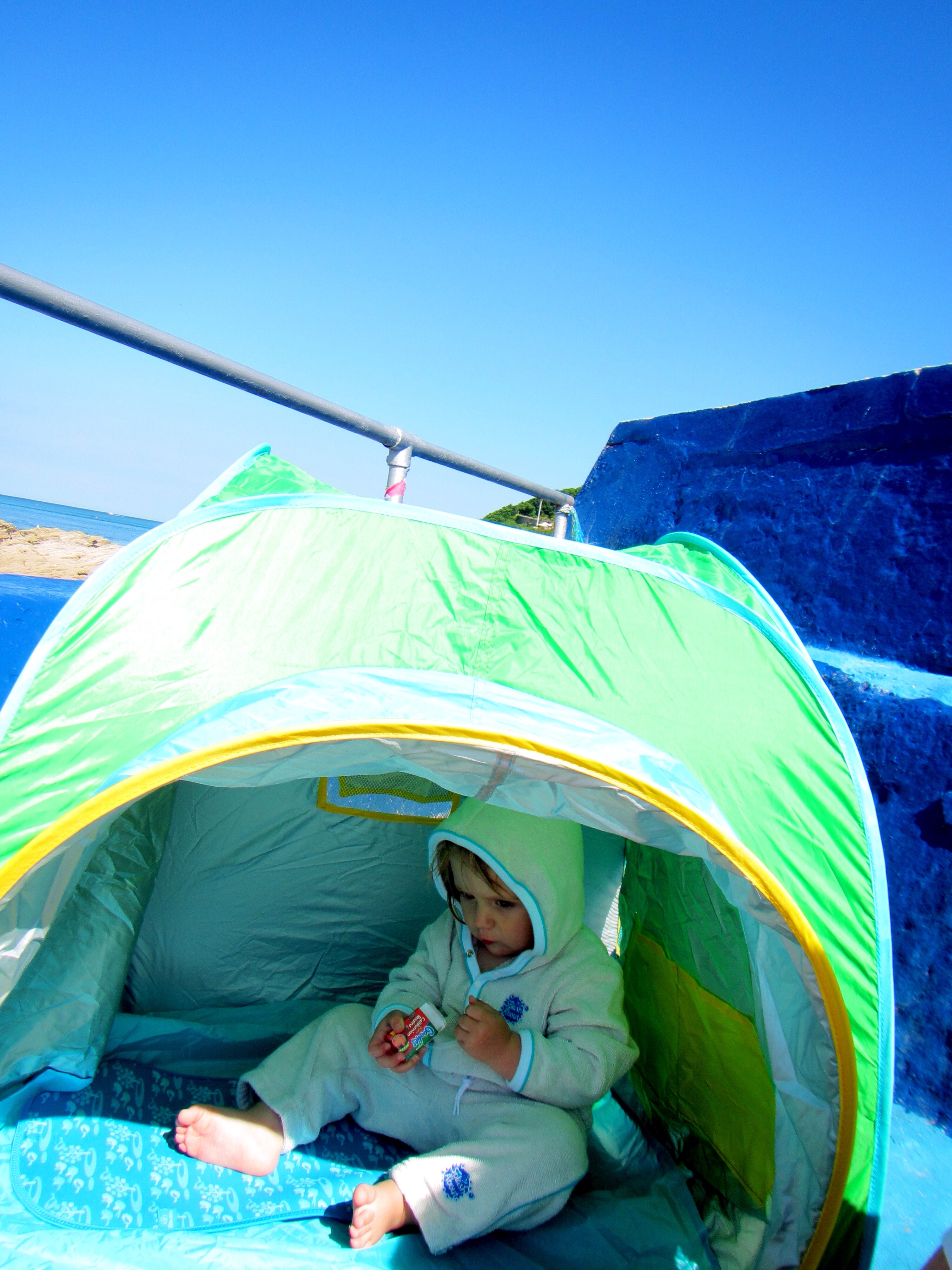
Eventually though he did begin to shiver, and was grateful to be wrapped up warm with raisins and take a moment to relax out of the sun in his little ‘house’.

image

Which gave Leigh and I a chance to look out over the bay and take in the view. And what a view it was.

image

It’s lovely to see you summer! Very much looking forward to getting acquainted again over the next couple of months.


Country Kids from Coombe Mill Family Farm Holidays Cornwall

Word of the Week: Building

Today the word that sums up the week that was is:

image

It’s been Arthur’s other new enterprise, alongside hanging things everywhere: instead of just knocking things down he wants to build them up.

After I wrote about the activity board I made to encourage Arthur’s hanging skills, a friend sent me an interesting link about schemas in children’s play. It made me wonder whether these two interests are in fact connected: they both involve construction, are both about how things in the world go together.

He started with his gorgeous Djeco stacking blocks, carefully placing the cubes on top of each other and delicately attempting to reach inside to put the animals in their homes. His first few attempts ended with the blocks losing their balance though, or him losing his focus and deciding to knock them down.

image    image

He’s enjoyed trying to build up his little Haba mirror blocks too, though he has at times been distracted by his reflection!

image    image

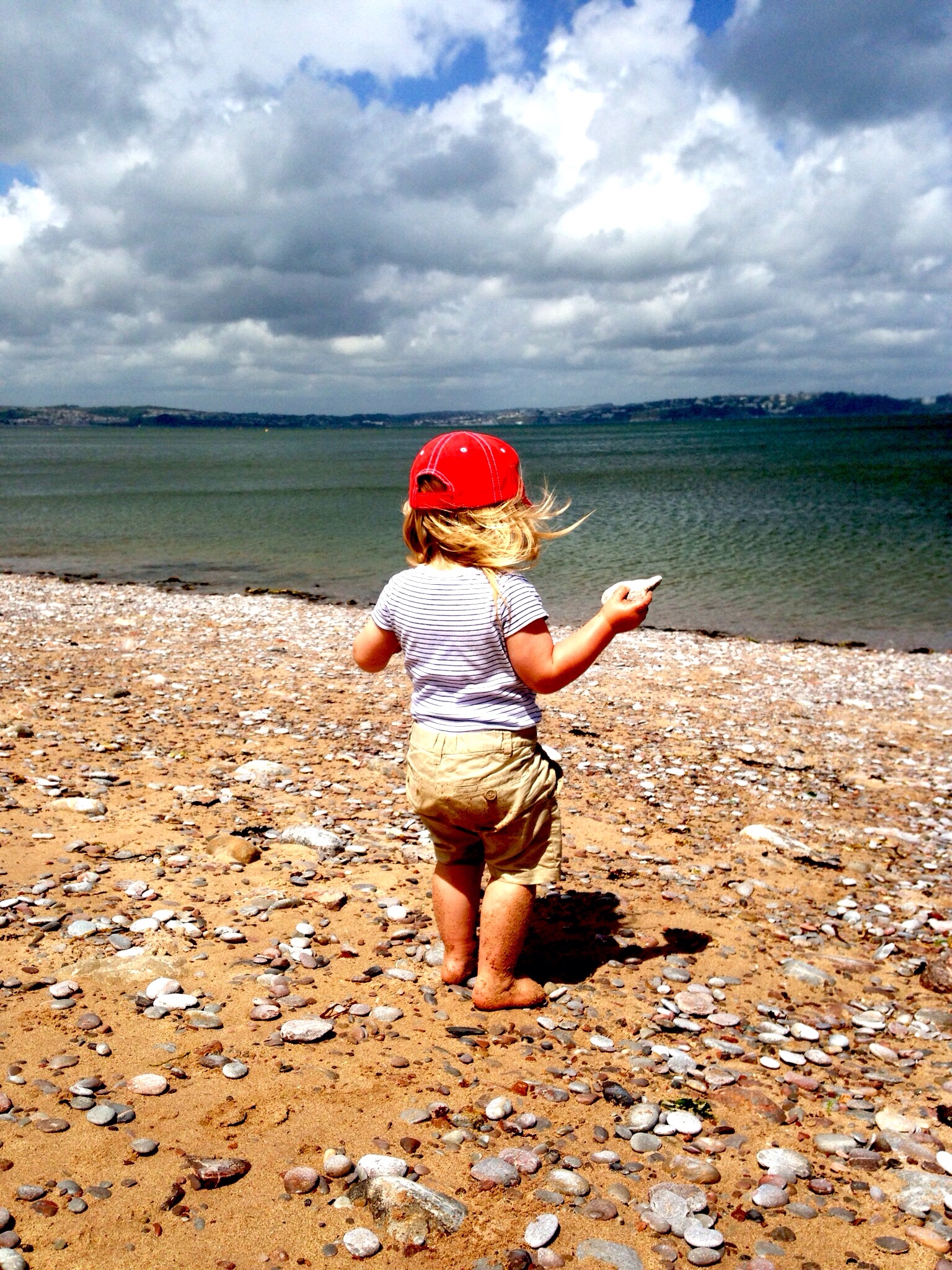
We continued the theme when we stopped off at the beach the other day, taking advantage of the flat pebbles to see how many we could stack. It wasn’t all that easy though, and turned out to be not quite as much fun as throwing the pebbles in the sea…

image    image

image    image

But then yesterday he finally cracked it: we’d been sat out in the sunshine, idly playing with the blocks, then daddy came home and with very little prompting Arthur had all of a sudden built a tower!

image

I think I was probably the most excited out of all of us about this, though Arthur was pretty pleased with himself too. The whole building thing just opens up a whole new world of play, and I’m finding myself getting increasingly fascinated with how his play is helping him learn – and what I can do to help him enjoy it even more.


The Reading Residence

Why schools need to do what they know is right (just don’t tell Gove)

So after many, many months of reasoning, protesting and pleading from teachers and parents alike, Gove is still ploughing on with his ill-guided reforms of the education system. With Tristram Hunt pledging to undo little of this government’s bad work it looks like we’re in this for the long haul: a system devoid of creativity, culturally narrow and reducing the next generation to empty vessels to be filled to the brim with facts, neither questioning nor challenging the status quo and most definitely not thinking for themselves.

But it doesn’t need to be like this.

Some big hitters in the world of education finally appear to have given up hope in the state system altogether. Sir Alasdair MacDonald, one time head of Morpeth Secondary School in Tower Hamlets and now the Welsh Assembly’s ‘Raising Attainment’ tsar, has claimed that the only chance British pupils have of a rounded education now is to go to a private school. Michael Rosen has just finished a book written for parents to help them fill the gaps in their child’s education left by the direction that schools are being forced to take.

But it doesn’t need to be like this.

There are three secondary schools in the UK that I can currently claim to know well, and I know that all of them are full of teachers doing their best to provide the education that they know their young people need. They will jump through the ever-changing hoops presented to them by the government, play by the rules as much as they need to to be left alone, but they will keep on doing what they know is right. The leaders in those schools will seek out frameworks to support a more holistic education: Building Learning Power for example, or the International Baccalaureate. They may no longer be required to filter personal, learning and thinking skills through the curriculum – but they will, because they know it’s right. Speaking and Listening may no longer be assessed, Music and Drama may have fallen down the pecking order – but these aspects of their students’ learning will not be ignored because they are vital to their all-round education. Multicultural texts may no longer appear on GCSE syllabi, but these schools will find a way to fit them into their curriculum because to do otherwise would be to do the young people in their care a disservice.

And yet there are other schools who are, if media reports and TES forums are to be believed, collapsing under Gove’s reforms and following his rules unwaveringly. They are narrowing the curriculum in order to teach directly to the tests that he says matter, they are closing Music and Drama departments because those subjects are invisible in league tables.

And on one level I don’t entirely blame them. Because it’s hard, jumping through all those hoops. When teachers and school leaders are worked almost to breaking point it’s easy for them to forget what brought them to their classrooms in the first place. It’s easy to think that all that matters is being judged good by whatever the latest criteria happens to be, to climb up that league table and away from the reaches of those who would remove you from post if they deemed you to be failing.

But it doesn’t need to be like this.

In the arts, tight constraints – whether externally enforced or self imposed – have generated some of the most innovative and creative results. The Iranian film industry always comes to mind when I think of this: so many rules and restrictions and yet a body of work that almost any country would find it hard to rival.

The constraints facing our teachers operate on a different level, but they are still numerous and growing: restricted finances, an archaic new curriculum, seemingly endless bureaucracy, narrowly focused and high stakes tests. Rather than being defeated by these, schools need to see them as a challenge to be overcome. School leaders and teachers need to remember why they are doing what they do and find the confidence and strength to trust their professional judgement.

Because the pleading and the protesting and the reasoning is getting us nowhere, and if we’re not careful a whole generation of young people is going to be trampled underneath Gove’s stampede for standards. We owe it to them – and to our own sanity – to do what we know is right.


Thanks to Sara at Mum Turned Mom for inspiring this post with her prompt ‘rules are meant to be broken’.

mumturnedmom

Making a toddler activity board

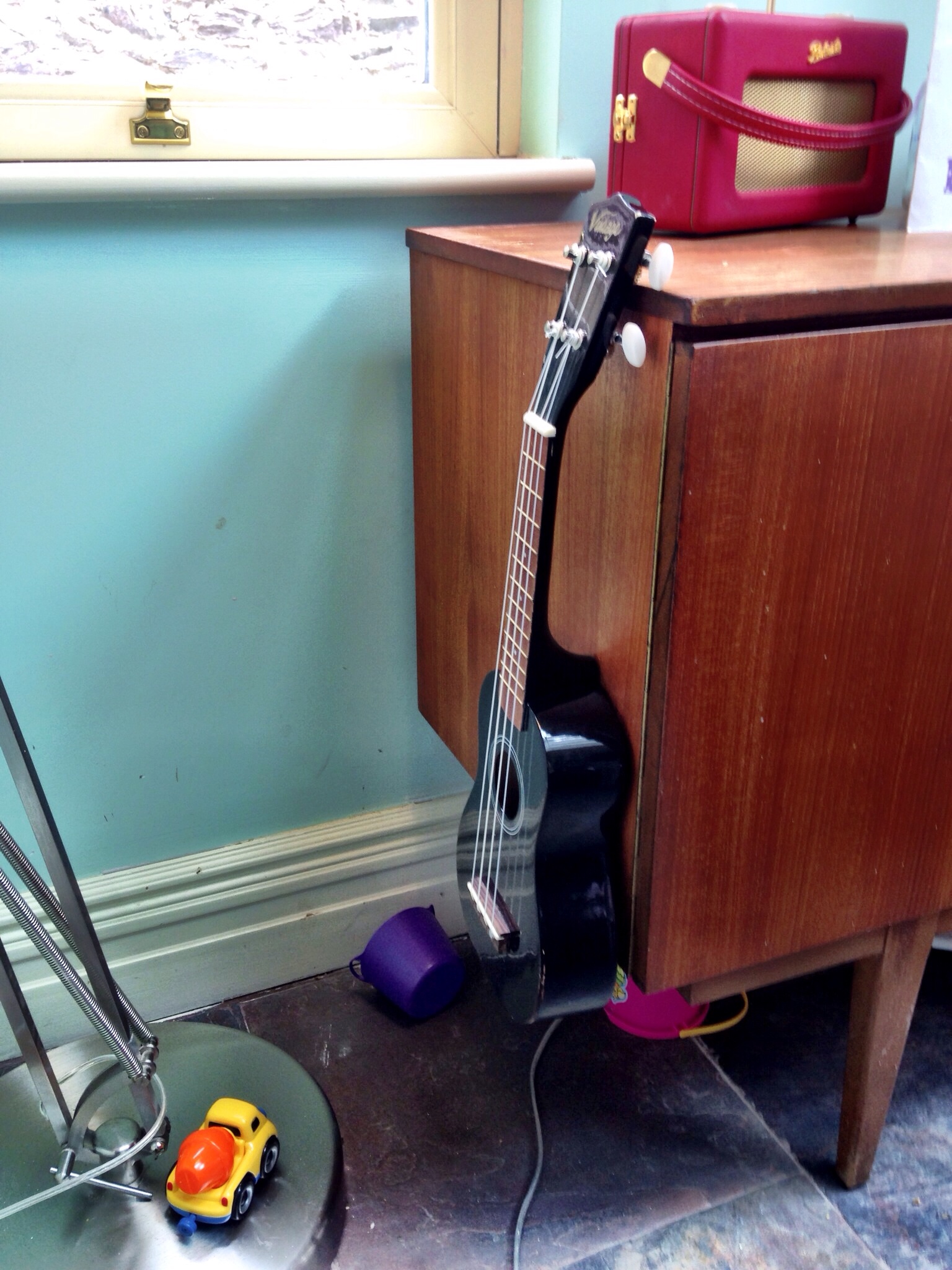
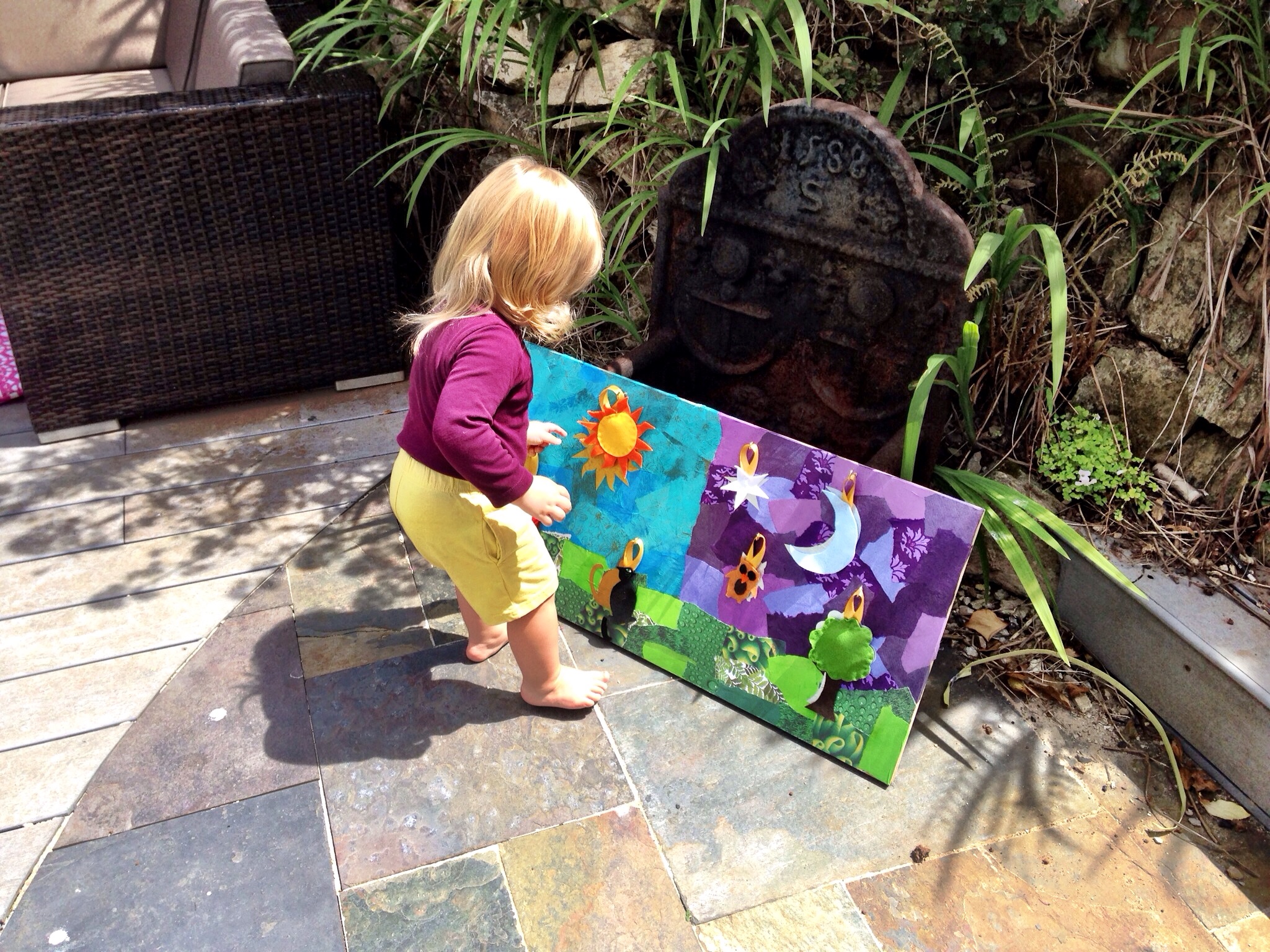
Over the past couple of weeks, Arthur has become obsessed with hanging things wherever he can manage to get them to stick. It started with his beloved Ukulele – balanced on the edge of a sideboard or hanging from the lamp in the kitchen. The other morning he was very pleased with himself when he hung a bag of nappies on the doorknob, though adding the hat was a little trickier. Now wherever I go around the house there is evidence of this new game he’s invented for himself.

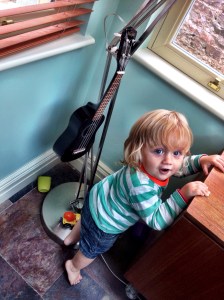
image    image

image    image

It got me thinking: was there something I could make that would help him practise this new skill, and maybe discover some new ones whilst he was having fun with that? Then I remembered we had some cup hooks kicking around somewhere, and an idea was born.

Toddler Activity Board

image

You will need:

  • A rectangular piece of wooden board: ours was 80 x 40 x 2cm
  • Colourful paper for the background
  • PVA glue
  • Metallic or grey paper for the ‘shadows’
  • Card for templates
  • Cup hooks
  • A selection of different coloured felt
  • Ribbon for hanging

As well as the usual paint brush/sewing kit/basic tools!

Step One

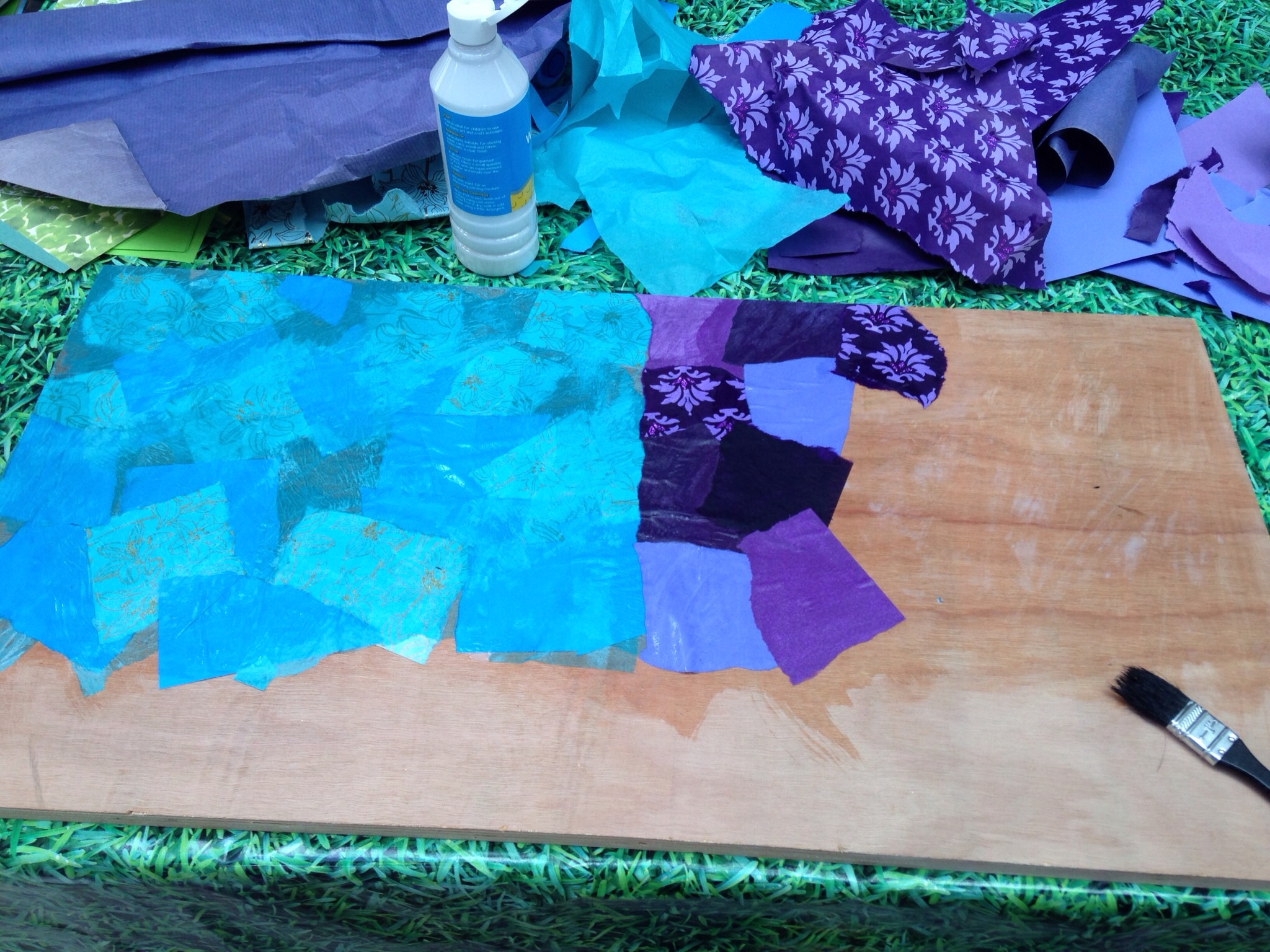
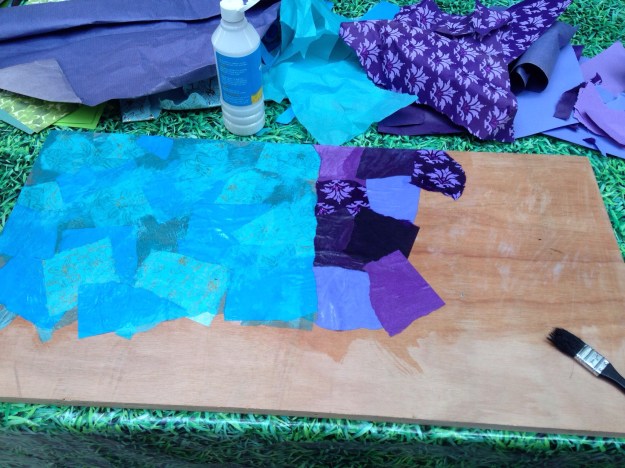
I decided I wanted the background of Arthur’s board to be night and day: we’re still having issues with frequent night waking so this is something we need to discuss with him! Once I’d gathered my range of papers in three colours (blue for day, purple for night and green for the grass), I began by creating this background.

image

I used standard PVA glue – full strength as a base for sticking then diluted 50-50 with water as a glaze for over the top.
image

I was pretty pleased with the finished effect – it looked even better when it had dried!

image

Step Two

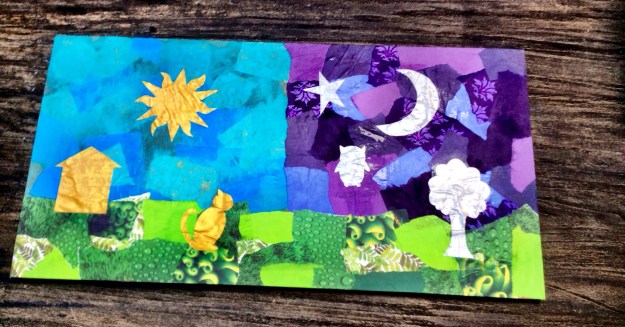
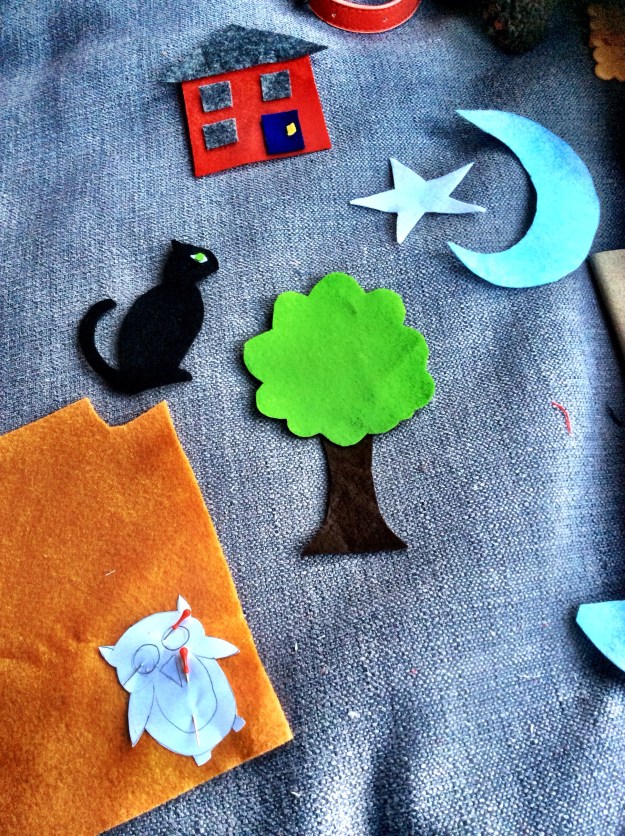
Using this background I wanted to create a simple scene using things that are just beginning to be in Arthur’s vocabulary. I decided on a house, the sun, a cat, a tree, an owl, a star and the moon. I drew the shapes on to card, then cut them out to use as templates.

image

Step Three

I wanted to create ‘shadows’ on the board so that part of the activity became matching shapes. I decided to use gold paper on the ‘day’ side, and silver for ‘night’. Once I’d used the templates to cut out the shapes I used the PVA to fix them in place, remembering to leave space for the cup hooks and hanging shapes.
image

Step Four

Next came the cup hooks for the key hanging part of the activity. I used a mix of sizes just because that’s what we had – but actually it works quite well to add different levels of difficulty into the activity. I used a hammer and nail to make an initial hole which made screwing in the hooks easy peasy.

image

Step Five

Once the board itself was completed it was time to make the shapes for hanging. I used the templates to cut these out of felt, embellishing them a little and sewing on a loop of ribbon to each. You could go as far as you like with these, maybe even creating little stuffed shapes if you wanted something more substantial!
image

Step Six

After checking all the shapes fitted where they were supposed to, it was time to lay them out in front of the board and see what Arthur made of it!

image

He was definitely quite intrigued, though at the moment he finds hanging the shapes a bit challenging – which is a good thing as it means there’s room to grow!

image

We also found that the portability of this activity was very handy when the sun came out this afternoon…

image

So all in all a success I reckon! These are the skills I think this activity board will help Arthur develop:

  • Fine motor skills (hanging the shapes)
  • Matching shapes
  • Naming and developing vocabulary
  • Understanding night and day

It only took a few hours to make, and that was whilst keeping Arthur entertained too. I’m already thinking about the next one which might end up being a little bit more complicated!



Post Comment Love

E is for evening

IMG_9652

I absolutely love this time of year. In the midst of winter I forget, I think, just how long and light the evenings are in June: the contrast with the dark and the cold of only a couple of months ago, especially down here, is hard to fathom. A couple of evenings ago we went for a walk after dinner. Just the usual round-the-block stroll, past the pool as the sun was lowering itself down towards the horizon, the streaks of clouds providing the perfect canvas for its rays. The sea was calm, gently lapping against the rocks as the scent of seaweed wafted up through the warm air, and the pool itself was like a mirror. We were the only ones there, apart from a man walking his dog and humming to himself. It felt more than a little bit like heaven.

Joining in with The Alphabet Photography Project over at PODcast. 

The sweet smells of motherhood

image

Now that I stop to think about it, it was my enhanced sense of smell that first gave me a hint of the superpowers that were to come as I made my journey into motherhood. Right from those very early days of pregnancy, before my body had visibly begun to reveal the new life growing inside it, I could feel myself changing. Some days the superpower was decidedly unwanted: the nausea rising up from dog poo on the pavement at twenty paces, my stomach churning as meat began to brown in the oven, closing doors and opening windows to get as far as possible from the source of the discomfort. Mainly though it made me feel strong, powerful. As if I was more in tune with the world as my body underwent this most primal of transformations before unleashing its creation on the world.

Once my baby was born, smell as superpower began to abate. In its place came new strengths, all rooted in the overwhelming desire to protect this little creature against all odds, to nurture him and help him flourish.

Perhaps as part of this, though, my sense of smell has never quite been the same as it was before I began this journey. There are the smells that I would never have believed that I would find so sweet: the scent of my sleeping companion’s milk-tinged breath as he snuggles up to me in the morning; the cheesy whiff of his toes released from tiny shoes after a day spent toddling; even the nappies, the smell of which I will pretend to merely tolerate as I inhale deeply to check if he needs a change, secretly hoping for that silage aroma that shows that everything is working as it should.

There are smells too that once I might not have noticed, or found inoffensive if I did, that now set alarm bells ringing and change my demeanour to one of defence. The curling odour of cigarette smoke that I am ashamed to admit I might have sought out in the past, a faint memory of an old addiction still wanting to be sated: its poisonous charms no longer lure me in but rather repel me as I cross the road in search of cleaner air. Those roads, too: years lived in London had inoculated me against their toxic fumes, or so I thought. Now though I am painfully aware of the fog the traffic emits. I would rather not tread pavements next to busy roads at all if I can help it, and if I do console myself that at least my baby’s sling lifts him up above the line of the exhausts.

Finally there are the smells that I have always loved that I am lucky enough to enjoy more frequently through this new way of life that motherhood has ushered in. The salty spray of the sea that seeps through the air into my nostrils on our walks around the neighbourhood, the delicious freshness of grass after the rain as I crouch down to his level to search for daisies, the heady perfume of the organic coconut oil I use to soothe his skin.

There are many changes I have undergone as I’ve become this creature called a mum, but there’s one thing that’s for sure: never in my life has life smelt quite as sweet.

Thanks to Sara at Mum Turned Mom for inspiring this post with her prompt: ‘My favourite smell’.

mumturnedmom

Brilliant blog posts on HonestMum.com