Tag Archives: play

19/52

IMG_1433.jpg

“A portrait of my child, once a week, every week, in 2016.”

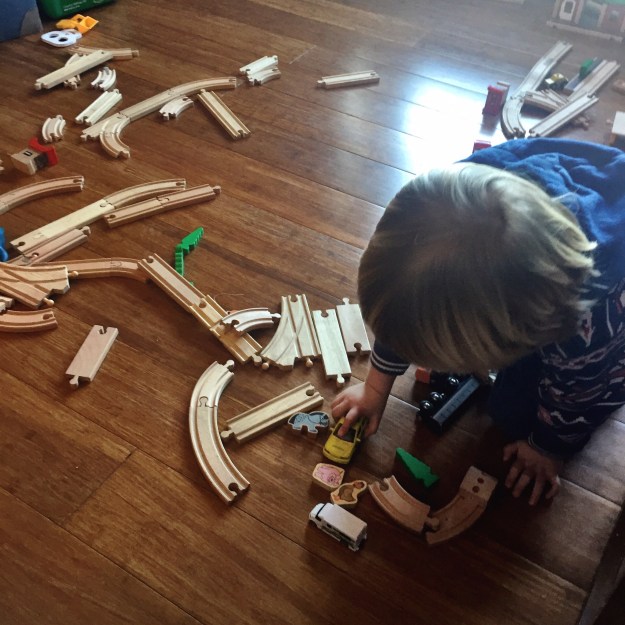
I love watching Arthur play, especially outdoors.

He is becoming so imaginative and agile and brave: balancing and climbing and reaching and exploring. Even when he is playing on his own – in fact especially when he is playing on his own – he buzzes with the energy of all that he is discovering about the world.

He fell not long after I took this picture, balancing on the beams that spanned the brook, reaching down for his bucket that had tumbled into the water. He managed to catch the beam before he got too wet, and though he needed help to right himself he never lost his calm. Once he was freed from his precarious position he quickly re-found his focus, and carried on as if nothing had happened.

I’m not sure you can teach skills like that.


Linking up with Jodi at Practising Simplicity for The 52 Project. 

“What shall we make with this?”

The unschooling diaries: week sixteen

I think those six little words might be the ones that have made me the proudest yet in this motherhood journey.

It started just over a week ago, when we came downstairs one morning to a couple of empty cardboard boxes waiting to be flattened down for recycling. Arthur looked at me, gasped with delight, and said:

“What shall we make with this, mummy?”

We have had an awful lot of fun making things out of cardboard boxes over the past couple of years, but generally it’s been me or Leigh who’s initiated it. Arthur has happily chipped in as the creation develops, offering direction and issuing demands. But this latest development, where it is him looking at a piece of trash and using it to kickstart his imagination, is just awesome.

On that morning, I bounced the question back at him and he decided we were going to try to build a spaceship. It was a little ambitious, but we worked together and came up with something he was pretty happy with – it had controls and a light and everything.

A couple of days later, Arthur’s new blackout blinds arrived, in THE BEST cardboard tube ever. Again Arthur took one look at it and asked the question:

“What shall we make with this?”

We spent a while exploring ideas – he used it as a channel for balls, experimenting with different sizes, and then as a tunnel for his cars, raising one end up on our mini trampoline.

But then he decided it would make an even better train tunnel, and together we incorporated it into a super duper train set, with the track running up and over another box then all the way down the tube. It took a few goes to get it right – some trains ran better than others – but we got there.

IMG_1428

His other idea was on a smaller scale, but no less fun. He’d been picking up smaller boxes for a couple of days and insisting that we could turn them into a camera. He always managed to catch me at inopportune moment, and I couldn’t quite see how we were going to pull it off, but in the end we succeeded, and he took great pleasure in running around the house taking photos.

IMG_1427

It’s not just cardboard boxes either: as we explore this whole act of making together he is beginning to see potential in all sorts of other things around the house. He picked up a ribbon yesterday and asked his same question:

“What shall we make with this, mummy?”

I was initially stumped, but he jumped in with “A twirly thing! Let’s make a twirly thing!” whilst spinning the ribbon in circles around his head. I had actually been planning for a while to make him a twirly thing out of ribbons (not sure what the technical term for it would be) so dashed upstairs to find an old bangle and my ribbon stash, and together we picked out a selection of ribbons to add to the one we’d started with and tied them on.

IMG_1429

I love the extra injection of creativity it’s given to our everyday routine, and the sense of limitless possibility that Arthur exudes at the moment. He takes inspiration from everywhere – he declared on another morning that he would like to make a scarecrow, and it turned out that he had been fascinated by one in Curious George.

It sounded like a bit of a mission, but I didn’t want to let him down – and actually making a scarecrow wasn’t nearly as hard as I thought it was going to be – and we now have him ready for when we finally get round to planting up our veg patch!

It’s not just pride at Arthur’s enthusiasm that I’m loving about this particular phase. It is also, as so many things about parenting are, incredibly liberating: to look at trash and see potential, to have an idea and to keep going until you achieve it.

Lessons for life from a three year old.


How to grow a writer

It is easy to be negative at the moment when thinking about education. In fact it’s easy to be negative about most things to be honest – I’ve spent most of this week dwelling on the seemingly inevitable fate of the NHS, while intermittently wondering whether there is anything we can do to bring our schools back from the brink.

But of course there is.

Beneath all the doomsaying around the utterly depressing state of assessment – the unbelievably detrimental SATs exams, and ill-thought-out reforms to GCSEs – there are teachers just getting on with doing their jobs. Jobs which, incidentally, align the vast majority of them much more closely with the interests of the young people in their care than with the government and its dictats.

Much of what we have shared through the #THISislearning campaign so far has been rooted in the Early Years. And it is a relief to know that here the notion of play as a vehicle of learning still predominates; that our children, at least when they are very young, can follow their own path to creativity and fun.

But of course play does not become defunct as children grow older. In fact I would argue that its magic becomes all the more important.

IMG_1412.jpg

It was always one of my key goals as a secondary school teacher, to harness the power of play.

There is a tightrope of engagement when you are working with teenagers, hung tentatively between the towers of curriculum and assessment. My job, the way I saw it, was to enable my students to balance on that high wire – to give them the skills they needed to succeed whilst simultaneously not losing sight of the love of learning that motivated them all, once upon a time.

Of course inherent in this is the notion of success, and this is where my views diverge most from those of our our current government. For me, success (from an English teacher’s perspective) is a young person who can think, read, write and speak with confidence. I imagine what that looks like for me is very different to Nicky Morgan’s idea of a perfectly educated child. To be honest I seriously doubt whether confidence, and all of the dangerous individuality that goes with it, factors anywhere at all in this government’s vision for our children. But that’s a story for another post.

So back to my job, as a teacher.

I established very early on in my career that I was not a ‘filling empty pails’ kind of educator, but rather one more interested in kindling fires. I have never had much time for bare facts – knowledge without context leaves me cold, and I admit to finding myself so completely disengaged with the approach to learning about grammar intrinsic to the new KS2 SATs papers that I can hardly read to the end of a sample question without switching off.

That’s not to say grammar is not important, or fascinating – of course it is, given the right situation. It’s just that there are so many more interesting ways to understand it than by methodical categorisation and endless rules – especially given that our language is often not very interested in following the rules itself.

My goal in the classroom was to get my students interested in things. To get them asking questions, being genuinely curious – to get them to a place where the answers (where they existed) might just stick.

I remember sitting down with a colleague (and friend) to plan a scheme of learning for Year Eight which needed to get down to the nitty gritty of word and sentence level analysis, as well as improving students’ use of grammar and punctuation in their own writing. We wanted to use a multimodal approach to engage students in a dialogue about how texts were constructed, the similarities and differences in the way meaning is conveyed through images, film and the written word. It ended up being based around a range of texts including ‘Where the Wild Things Are’, ‘Persepolis’ and ‘Stand By Me’, weaving back and forward through the narratives in their different forms and inviting an intelligent discussion which did – inevitably – lead us to the technicalities of how language was being used, and how the students could manipulate it to their own ends. I can tell you now that at the end of it none of those kids would have been any closer to passing the exams that, according to our current government, they should have been sitting two years earlier. But they were more confident readers and writers, and could explain why they (and others) used words the way they did.

All of that aside, it was fun. Not easy – in fact arguably harder than going through the motions of learning by rote because of the degree of thinking involved. But it was interesting: informed by the personalities of myself and my friend, and inviting our students to engage with it on a personal level.

There are a couple of other schemes of learning that stand out to me from Year Nine – a notoriously tricky year where the emotions of puberty are in danger of taking over completely, but an exciting one too when the new level of maturity students are beginning to exhibit can take everything up to another level. One was inspired by a brilliant set of resources from BT, using an exploration of all forms of spoken language as the hook into learning more about how words work. Another took its starting point from an excellent study guide produced by the English and Media Centre to explore the Sherlock Holmes stories, and detective fiction in general. We encouraged students to go into role as detectives as they read and studied the texts, to look out for clues in the language to the meaning that was being created and then be able to apply the techniques themselves as they grew into more confident writers. My kids produced some fantastic stories as a result of what they learnt, with some exhibiting incredibly sophisticated and effective manipulation of language. Could they have told me exactly what grammatical devices they were using and why? I doubt it. Did they need to? No! Not back then anyway…

I could go on, but I imagine you get my point. The nurturing of a writer has very little to do with teaching them to identify fronted adverbials and subordinate clauses, to carefully construct expanded noun phrases and employ the correct balance of semi-colons and exclamation marks. It has everything to do with introducing them to a wide range of texts, with letting them discover for themselves the thrill that comes from reading words that truly speak to you, with giving them the tools and the confidence to be able to construct their own sentences and paragraphs and weave them into whole texts that they are proud of and that mean something.

I know that, in English classrooms up and down the country, that is exactly what is happening. But I fear that it is happening less and less. Because, in our overloaded education system, this sort of learning seems to no longer be valued. And I don’t mean by the teachers – they know what learning looks like, and how to inspire.

But they also have an obligation to get the children in their charge to pass the tests. And if this government remains insistent on testing the wrong things (and testing them way too often) then there will be no space for real learning left at all.


Writing Bubble


17/52

IMG_1411.jpg

“A portrait of my child, once a week, every week, in 2016.”

It’s hard, learning to make friends.

We spent the weekend with one of my oldest and bestest and her two kids, the elder of whom is weeks younger than Arthur. He was so excited to see her.

Things weren’t always entirely smooth. There were moments when Arthur’s experimental interactions crossed the boundaries, moments when I wanted just to sweep him up and replace him with a child who was perfectly socialised and knew not ever to push or hit or kick.

Looking at this image – of all the images I have as memories of the weekend – it would be easy to forget that it had not all been smiles. But it is important to remember, I think, what a huge amount of subconscious negotiating is going on when our little people are learning to share their world with others.

Ultimately, though, they were learning to be friends, these two. By the end of the weekend Arthur cared enough for her opinion not to want to make her sad or cross. When they went to say goodbye, he gave her a little kiss.

And when she kissed him back he visibly melted.

Linking up with Jodi at Practising Simplicity for The 52 Project. 

Going with the flow

The unschooling diaries: week nine

I’ve been mulling over various different options for this post today – Arthur’s delight in playing with sand at Paignton sea front, his growing interest in helping in the kitchen, the hours of roleplay that followed when we found a Buzz Lightyear costume in the charity shop – but it’s actually an almost inconsequential moment that I keep coming back to.

Leigh was late home on Friday, but with it being the weekend I figured we’d wait for him before pushing on to bed after Arthur had finished his dinner. That’s daddy time, generally – the chats about the day and the washing things and the stories – and both of them miss it on the odd occasions when he can’t be around.

I didn’t really have a plan – which could, at the end of a long day, have ended in disaster – but as it was distraction came in the most unexpected form. I’d been unpacking a delivery whilst Arthur ate his dinner, and it had arrived in a box filled with little polystyrene pellets. I normally whip them away from Arthur whenever I order from this company, but on Friday I guess I was feeling a bit more relaxed and so I let him explore. And the resulting play was, I think, the best fun he’d had all week.

IMG_1343.jpg

Things started pretty simply: having watched me unpack my order from the box, he proceeded to fill it with all of his precious things and offer it to me as a present.

Then once I’d gone through and admired each of his ‘gifts’, he decided that he wanted to see what it was like in there himself.

IMG_1339.jpg

Then of course came the tipping out, and the moment when on another day I might have put a halt to all of it. The tuff spot comes in handy for that – even if it didn’t contain the pellets for long…

IMG_1342.jpg

He piled them up and drove his diggers into them, threw them in the air to see how they fell, smooshed them and squeezed them and generally just experimented with this new material that had previously been off limits.

And whilst he played I sat and watched and laughed, until his daddy arrived at the door and came in to find us giggling in the midst of a pile of mess. Fortunately he got it too.

IMG_1340.jpg

I couldn’t tell you exactly what Arthur learnt from this little bit of unplanned and unstructured play, but still it felt important: to give him permission to go a little bit wild at the end of the day, to go with the flow even if a part of me was raising some serious eyebrows, to let him lead and explore and make us both laugh.

As much as it’s great to have some carefully thought out activities on hand too I think it is moments like this that remind me why I am leaning towards unschooling, and the freedom it gives my son to be who he wants to be.


10/52

IMG_1325.jpg

“A portrait of my child, once a week, every week, in 2016.”

These diggers have come everywhere with us since we bought them last week.

I really try not to just randomly buy stuff for Arthur, but he is so completely fascinated by anything to do with construction that when I saw them online I couldn’t resist. They are the first things he wants when he wakes up: he came out of his room a few mornings ago, earlier than usual, and headed straight towards the stairs instead of into me for cuddles. When I asked what he was doing he said that his diggers needed him because they had been having bad dreams.

At home he plays with them with kinetic sand, or on his road mat, or with his trains. Sometimes he just lines them up carefully in front of him so he can look at them more closely: he knows the names of almost every part of them, and will happily relay them to anyone who will listen.

He’s been having some trouble with the tracked excavator, because the rubber tracks keep coming off when he drives it on the floor or in the tuff spot. We worked out, though, when we took them to the beach, that it just needs rough ground beneath it and it works just fine.

The things you learn when you spend your days with a three year old…

Linking up with Jodi at Practising Simplicity for The 52 Project. 

Creative construction

The unschooling diaries: week seven

The fascination with all things construction (and demolition) that last week led us to the library has directed lots of Arthur’s play over the past few days. He has gathered his motley collection of construction vehicles with the kinetic sand in the tuff spot, brrrrming them round his little building site which I sense still has further to evolve.

IMG_1323.jpg

Whenever we’ve been out and about he’s been drawn to diggers and steam rollers and cranes. There seem to be plenty around – way more than I’ve ever noticed before. But maybe that’s just because I wasn’t looking properly.

Back at home, he has taken tremendous delight in directing me to build increasingly complex creations using duplo and his train track only to smash them to smithereens, scattering pieces across the lounge and declaring an emergency as he brings in the nee naws to sort it all out. I’ve had to resist the primal urge in me to get irritated at this wave of destruction – I know it’s important that he explores how things break as well as how they come together.

IMG_1322.jpg

His impulse to understand how things work has been focused on the vehicles themselves. We’ve found a great selection of YouTube videos that he watches with studied concentration as they break down the complex operation of an excavator, for example, into language that a preschooler can understand. The vocabulary is precise and the mechanics stretches even my understanding.

IMG_1317

The most fascinating aspect of this play for me, though, has been how he has taken it into his whole body – a kinaesthetic exploration of the engineering concepts underlying the things he observes. He stretches his arm out like a crane, his movements slow and robotic as he fashions his hand into a scoop, all the time replicating the mechanical noises he has heard with his voice. He loves it if I join in too, both of us together forming a human construction site.

IMG_1321.jpg

If I were taking the lead on his learning, I’m not sure I ever would have thought to take this topic in all these different directions. Even with my background in physical theatre I don’t think I’ve ever stood and worked out how to move my body like a crane. He is literally consumed by learning – and the power of that is more than a little awesome to behold.


8/52

IMG_1312.jpg

“A portrait of my child, once a week, every week, in 2016.”

Another day, another box.

This time, just such complete and utter delight at being able to get inside and close the lid. He played for ages with it yesterday, climbing in and folding down the cardboard flaps, giggling until we ‘found’ him.

We discussed our ideas about what we might be able to make with it today. He decided he would like to make a flying train. After breakfast though he turned it upside down and it became a house, complete with doorbell and chimney and window and carpet.

It didn’t last long before the ‘wrecking ball’ demolished it, but it was fun whilst it did.

Linking up with Jodi at Practising Simplicity for The 52 Project. 

7/52

IMG_1304.jpg

“A portrait of my child, once a week, every week, in 2016.”

We don’t get much snow down here in Devon, so when I woke up on Sunday morning to pictures of Dartmoor blanketed in white on my Facebook feed I knew we were going to have to go on a bit of a mission.

It takes about an hour to drive there from where we are on the South coast, but every time we do we tell ourselves we really should do it more often. And this time was no different.

We were not the only people whose minds had been captivated by the romance of some Valentine’s day snow: in fact we were beginning to think, as we wove our way up onto the moors behind lines of traffic through decidedly unsnowy scenery, that maybe it wasn’t such a great plan after all.

But then we turned a corner and up ahead of us we saw higher ground. Higher ground with an unmistakeable icing sugar coating, which became more convincingly wintery the further up we ventured.

Ok so it wasn’t Iceland. The ground was wet and muddy in between the patches of snow. And there were an awful lot of other cars. But this being the moors we found our own expanse of ground within minutes of parking up, and Arthur couldn’t care less that it was less than perfect. It was snow!

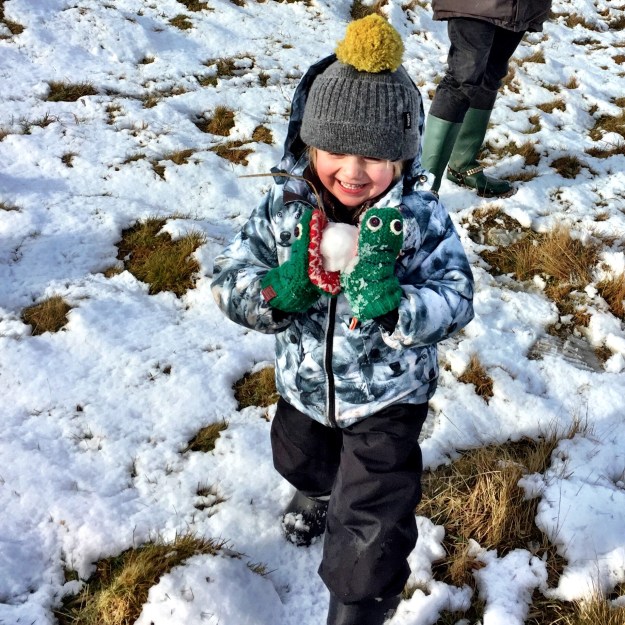
I got pelted with this snowball seconds after this photo was taken, but it was most definitely worth it.

Linking up with Jodi at Practising Simplicity for The 52 Project. 

Give a boy a box…

The unschooling diaries: week four

I ordered a new pillow for Arthur this week, and predictably it came in a box that was far bigger than it needed to be. Predictably also the box caused considerably more excitement than its contents.

The delivery arrived on recycling day, but just as we were about to dismantle it accordingly Arthur leapt in protesting “No! My train!”

Cue distraction as Leigh grabbed a crayon and began drawing on a control panel whilst Arthur watched with glee, before picking up a rectangle of cardboard that had fallen onto the floor and trying unsuccessfully to attach it to the side: “The wheels! The wheels!”. We delved into his craft corner and found a roll of masking tape I’d bought him specially – he went through a phase of wanting to tape up everything a little while ago, and now it was just what he needed to complete this job.

Once it was stuck we had to draw on the wheels themselves, and on the other side too of course. He’d also noticed, whilst delving in said craft corner, some leftover halloween decorations that he had interpreted as characters from Hotel Transylvania, his then-favourite film. He insisted they had to come on the train too, and we used the masking tape to attach them to the sides. A blue flashing light toy made the perfect lever for operating his train, and he was done.

He sat happily in his box by the front door for a while, shouting “choo choo” and “all aboard”. Then before bed he asked for a ride down the hallway, me pushing his train along the wooden floor.

The next day he was playing in the lounge, his box-train looking on whilst he built a wooden track, when he suddenly leapt up proclaiming “The carriages! I need to get the carriages!” I presumed he meant the little carriages for his brio train which have a tendency to get scattered to the four corners of the house, but when he came came back downstairs he was dragging another box behind him.

This one had started life as a robot, then turned into a spaceship, and now was being refashioned as a carriage for his train. A “sleeping carriage” to be precise.

Dolly was his first passenger, and he looked very comfortable.

IMG_1289.jpg

I love love love watching this imaginative play unfold, hovering nearby to facilitate its development. The whole joy to be had from a cardboard box thing is such a cliche, but so gloriously true!

The train (and its carriage) are starting to look a little battered around the edges now after some very serious playing, so they may make it into the recycling this week. But I’m sure it won’t be long until we have another creation. I can’t wait to see what it might be!