Category Archives: Sophie is pondering

The Q&A meme

IMG_1801

Just as I was thinking I was ahead of the game with my blogging this week Renee over at Mummy Tries goes and tags me in a meme… That’s ok though – have you seen the weather out there?!

Here are my answers to Renee’s questions whilst I try to work out what information I’m going to wheedle out of my chosen targets:

Where was your first holiday sans parents?

I went to Malaga in Spain when I was about twelve I think to stay with one of my school friends who’d moved out there. I remember being given special treatment on the plane as an ‘unaccompanied minor’, and being ridiculously jealous when I got there that Sarah had a pool. We lost touch not long after that. I often wonder what she’s up to now.

How old were you when you had your first kiss?

I would have been about the same age I think. I went to the cinema with a boy whose name completely escapes me, but who looked a lot like Chesney Hawkes. He was shorter than me too, so it didn’t last long.

What are your all-time favourite starter, main and dessert?

This is a tricky one, as my favourite food is Vietnamese or sushi and that all kind of comes together. But if I’m at a starter-main-desert kind of restaurant then… Maybe scallops? Followed by a really nice rare steak? Then tiramisu. Or maybe eton mess. Though with my nut allergy there are very few places I trust to serve me dessert.

What are your thoughts on climate change?

I think it’s a bit of a no-brainer that we’ve been mistreating our planet terribly over the past couple of centuries. I get that the world’s climate goes in cycles, so not every shift in temperature is necessarily to do with us, but with the amount of rubbish we’ve been pumping into the atmosphere I think we’d be terribly naive to think we weren’t having an impact. What to do about it is a whole other issue. I think the Western world has a huge responsibility to clean up its act, but when there are other huge nations at a different stage in their development it doesn’t exactly seem fair to say they’re not allowed to follow a similar trajectory to us. It’s all very complex and I could go on, but I think I’ll leave it at that.

Do you self-reflect?

Yes. Probably too much to be honest. I think self-refelction is absolutely vital and can be an incredibly powerful tool – I used to drive kids mad with it when I was teaching. But if it’s allowed to go unchecked then I think it can become unconstructive – my mind just doesn’t stop sometimes and I’m not sure that’s entirely healthy!

Adrian Mole, love or loathe?

I have to admit an ignorant indifference. I was too busy reading Stephen King and John Grisham when I was a teenager and have never actually picked up an Adrian Mole book…

Tell us three things about yourself you usually do not share!

There’s actually not all that much I don’t share, especially since starting this blog! Though whilst it was one of the first things I blogged about, I’m often reluctant to admit I went to private school when I meet people, as I feel like they’ll judge me because of it – especially since it’s so contrary to my politics. I have a guilty addiction to Casualty and Holby City that I very rarely talk about. And increasingly, depending on who I’m talking to, I’m becoming nervous to admit that I’m still breastfeeding my almost two year old. Which is bonkers really because it’s a personal decision that I’m very happy and proud about!

So there you go. Thank you, Renee, for the tag – it’s always actually quite fun doing these things, and your questions have definitely got things out of me I haven’t written about elsewhere…

I would like to invite the following lovely bloggers to answer my seven questions which are listed below:

Jocelyn at The Reading Residence

Iona at Redpeffer

Hannah at Make, Do and Push!

Merlinda at Pixiedusk

Dean at Little Steps

Louise at Little Hearts, Big Love

And those questions are:

Where in the world would you most like to be right now?

What do you love most about having your blog?

Who is the person that you most admire?

What keeps you awake at night?

What is your all-time favourite breakfast?

Which song makes you smile every time you hear it?

If you could go back and give one piece of advice to your fifteen year old self, what would it be?

And now it’s over to you!

 

Why teaching is actually pretty awesome

image

I’ve spent a lot of time on here pondering on what’s wrong with education. And for good reason – there’s much about the system that frustrates me enormously, especially under the current government. But actually I truly loved the time I spent as a teacher, and I hope to go back to it one day. When I was teaching, I threw myself into it wholeheartedly. Great when I had no ties but not so great with a young family.

There’s a lot of work to be done on ensuring teaching remains a good career choice for people once their own children become part of the equation. But I’m still pretty convinced that for enthusiastic and ambitious graduates there are not many career paths that are as fulfilling.

So when I was asked by The Guardian to write an article encouraging sixth-form students to consider training as a teacher when they leave school, I jumped at the chance.

You can read that article here.

And if you want to read some of my other (slightly more cynical) articles on the world of education you’ll find them here.

Because teaching as a career isn’t perfect – but it’s still pretty awesome.

Mama and More

Why it’s time for all of us to insist on gender equality

image

The notion of women or men being inherently better at some things rather than others purely because of their gender is not something that’s ever sat comfortably with me. The idea that men are more powerful, or women more nurturing; that men are better leaders whilst women are more compliant; that a man should be out earning money whilst a woman should focus on bringing up the babies.

When I was growing up, I was surrounded by boys most of the time. I have three (very different) brothers who were my constant childhood playmates, and during my teenage years I often found myself feeling intimidated by female company – the vast majority of my friends were male.

As I got older I became increasingly aware of the stereotypes concerning gender, both latent and overt, but I could never take them seriously because I knew too many people who didn’t fit them. I didn’t feel that there was anything I could not do just because I was a girl, and whilst I was aware of the history of the fight for women’s rights for me it had already achieved what it needed to. I heard the voices of feminists, but I did not understand why they were still complaining: surely women had the choice, now, of what they wanted to do with their lives? And besides, in every feminist argument I heard a message that I just could not tally with the reality of my life and the people in it: that it was men that were in fact inferior, and that it was only by hating them that women could promote their cause.

Fast-forward more than a decade later and I know I was wrong. Not just about the message underpinning feminism, but about how far from gender equality we as a society are.

The stereotypes I rejected in my youth are more pervasive than ever, with campaigns like Let Toys Be Toys highlighting the part the toy industry is playing in limiting children’s aspirations with products and marketing now that is more gender specific than it was in the 1970s.  I’ve watched as this gender bias has invaded my classroom: teenage girls playing down their intellect to fit the ideal of being beautiful and submissive or attacking each other in fits of bitchiness as they struggled to reconcile the roles they felt they were destined for with their ambitions; teenage boys playing the joker to avoid being seen to show an interest in studying or exploding in aggression because they couldn’t see any other avenue open to them to express their feelings. And these anecdotes of course barely scratch the surface of the injustices faced by women in our world today – and the damage that outdated and inaccurate notions of masculinity do to men.

Now that I have a child the challenges facing us in our quest for gender equality have become even more clear. I have watched friends, old and new, battling with the expectations society puts on them as parents – and the gulf that still exists in the expectations we have of women and men. Of course on one level the reason for this gulf is obvious: the physical impact that motherhood has on women, from pregnancy to childbirth to breastfeeding cannot be underestimated. But women do not become weaker when they bring a new life into the world: if anything they become more powerful, more capable. So why is it that their value diminishes? Is it because we put so little importance on growing our future generations that we still champion a model of work and careers that refuses to make significant concessions to the vital role parents play?

I have, on the surface at least, fallen into this trap myself. Unable to see a way of being the mother I want to be whilst remaining in teaching, I have left the career I dedicated myself to for over ten years to bring up my child. With every spare second that I have, I am attempting to forge a new career, something that will allow me to work more flexibly, to acknowledge my role as a parent rather than handing it over to someone else. I know that I’m in the minority in that I have a myriad of options: an education and career path to fall back on, the financial security to be able to take time out to try something new, a husband who wants to take an active role in parenting our son whenever he can.

But like many, many other women in the world – and men too, though they are less visible and less vocal – I can’t imagine a much more important job than raising a human being, than helping to build the next generation. One of the most vital aspects of this for me is to nurture a child who believes in equality, who does not feel constrained by his gender – nor expect undue privilege merely for the fact that he is a boy.

I only hope that he can grow up in a world where this might begin to be true. And this is why I believe the HeForShe movement is so important: why feminism needs to be embraced by everybody, not just the women who have historically fought its corner, and why we need to accept that men are held back by the myths and stereotypes that will continue to be perpetuated if we do not all insist on gender equality.

Emma Watson put this far better than me in her speech to the United Nations this weekend. She has inspired me to finally shake off any residual antagonism I might have felt towards the feminist movement, and to encourage the men I am lucky to count amongst my family and friends to stand up and do the same.

http://www.youtube.com/watch?v=pTG1zcEJmxY


Linking up with Sara at Mum Turned Mom for The Prompt: Are women better parents than men? 

mumturnedmom

Why setting children by ability does more harm than good

Yesterday afternoon I was rudely awakened from my post-Gove reverie by the announcement that Nicky Morgan plans to effectively force schools into setting pupils by ability. Twitter was aflame with indignation, tempered only by those who were sure the papers were over-reacting. Morgan herself was quick to refute the claims soon after, but I cannot help but wonder whether that was prompted more by the backlash the news received than the lack of truth at its core. And exaggeration or not, I’m not prepared to leave this one alone – particularly when Cameron is so clear on his own views about the issue: “I want to see setting in every single school. Parents know it works. Teachers know it works… But it still hasn’t happened. We will keep up the pressure till it does.”

When you put it like that it appears there’s not much to argue against. If everyone knows setting works so well, then why indeed are all our children not taught in ability groupings? The thing is of course that, like most things in education, it’s not actually that simple. It may seem obvious – separate the brighter kids from the ones who are struggling so that teachers can pitch their lessons more effectively – but in reality it doesn’t quite work that that. I’ve got plenty of anecdotal evidence to draw on here, but first let’s look at the research.

The Educational Endowment Foundation, in its analysis of setting or streaming as a potential intervention to raise achievement, concludes that overall it has a slightly detrimental effect. On average pupils taught in ability groups will be one month behind similar pupils elsewhere at the end of a year, with the only positive impact (equivalent to one or two additional months progress) being seen in higher attaining pupils. Significantly negative impact on achievement is seen in pupils who are mid-range or lower attainers, summer born or from ethnic minorities.

And it’s not just the detrimental impact on achievement that we should be concerned about. This might fly directly in the face of Cameron’s claims, but even more worrying are the myriad of other impacts setting by ability has on our children.

In her 2002 book ‘Ability Grouping in Schools’, Susan Hallam delves deeper into this, analysing research carried out over almost a century to conclude that:

‘concerns about underachievement, lack of pro-school attitudes and exclusion have tended to be approached by calls for more differentiation by ability or attainment. Such moves are not supported in the research literature. Indeed differentiation by ability/ attainment has been associated with limited access to knowledge by some pupils, domination of pedagogic practices by teachers, preferred teachers for ‘elite’ pupils and enforcement of social divisions among pupils’

Students put in lower ability groups struggle with their self-esteem, which then impacts on their motivation and performance – a situation only made worse by the allocation of less experienced or less effective teachers to their classes. Every teacher I know has tales of bottom sets made up of mostly boys, with a disproportionate number of pupils of lower socio-economic status and a high incidence or special educational needs and challenging behaviour – and these experiences are fully supported by the research that has been carried out.

But what of the higher attainers? The ones who would otherwise be held back by those badly behaving boys, have their thirst for knowledge hampered by the need for teachers to attend to all those individual needs? Well I would argue that they, too, are ill done by to be grouped with others of supposedly similar ability. My experience of teaching top sets has shown me that pupils can become arrogant, ultimately underachieving against their individual potential because they feel that the label they have been given shows they don’t need to work as hard as everyone else. At the other end of the scale it has also shown me bright students lacking in confidence who feel that they don’t belong in the top set, who will happily take their place at the bottom of that particular ladder when if they were taught in a system which valued the individual they may have been more keen to play to their strengths.

The thing with mixed ability teaching is that you can’t do it unless you recognise that all the students in front of you are individuals. Of course that is true in any classroom, but teachers can be lulled into a false sense of security if they are told that the students in their charge fall into a set – that there is parity in how they will perform as learners.

One of my favourite ever classes was a mixed ability group who were studying for GCSEs in English and Media. The target grades in that class ranged from G to B, and the personalities ranged from introverted high achievers to poor attenders with challenging behaviour. I had to design my lessons around each of their needs – to pitch each different task at the level that was going to best help each individual in that class achieve their potential. That process was illuminating in itself, because there was not one child in that room who was universally high or low ability. Some were better at analysing literature, others at creative writing; some excelled in creative thinking, others in their artistic ability; some listened perceptively, others spoke engagingly and eruditely on a range of topics.

I am confident that each pupil in that class left with a strong sense of what they were good at, and also the areas in which they needed to improve. They learnt not to judge others on face value, that they had much to gain from listening to their peers as well as much to offer in supporting them. And the actual grades they achieved ranged from E to A*, with a good proportion going on to study English or Media in sixth form.

In a literature review carried out in 2005, Kutnick et al express their concern about the narrow scope of the educational outcomes that are considered, saying that ‘in general a narrow range of learning outcomes has been researched with little concern for critical thinking, creativity and meta-cognitive and transferable skills’. 

I would add to this concerns about equality, about social mobility, and about mental health. Ultimately I believe in the importance of each pupil being able to genuinely discover their potential through learning, not through a label imposed on them at the start of their educational journey.

But even if we put all this to one side, even if we focus purely on academic achievement, then the fact remains that setting children by ability does more harm than good.

In contrast, research shows that mixed ability teaching can:

  • provide a means of offering equal opportunities
  • address the negative social consequences of structured ability grouping by encouraging co-operative behaviour and social integration
  • provide positive role-models for less able pupils
  • promote good relations between pupils
  • enhance pupil/ teacher interactions
  • reduce some of the competition engendered by structured grouping
  • enable pupils to work at their own pace
  • provide a sense of continuity and security for primary pupils when they transfer to secondary school
  • encourage teachers to acknowledge that the pupils in their class are not a homogenous group
  • encourage teachers to identify pupil needs and match learning tasks to them 

(S.Hallam, 2002)

Or to put it another way:

‘I love group discussions and I admit I get really excited and a surge of energy to participate. In GCSE English we had mixed ability students in class and I enjoyed it. Helping and telling others what I know about the task or stimulus helped me to remember as I was going over it out loud. I learn the best in discussions or debates as I hear what other people are thinking and it gives me a different or an altered view and the ideas just seem to flow one after another in my head.’

(A* GCSE English student, 2009)

For me this sums up the key benefits of mixed ability classrooms – where students become collaborators in each others’ learning and teachers adapt their pedagogy to include, challenge and engage all learners.

Of course not all schools or classrooms or situations are the same, and where mixed ability works for one teacher and one group of pupils another may thrive on setting by ability. But to claim that setting should be happening across the board? I am afraid, Mr Cameron, that I do not see the logic in that.

Why anyone has to be better than Gove

gove tombstone

When I heard the news on the radio this morning I felt my spirit lighten: after all of the heartbreak he has caused as he dismantled our education system brick by brick, Gove was being removed as education secretary. Finally it appeared that teachers, parents, children and educationalists up and down the country were being listened to: we had roared ‘Gove must go’ until we were hoarse, and now our pleas had been answered.

Of course I am not naive enough to think that placating the victims of Gove’s reforms was Cameron’s motivation. I cannot allow myself to hope that now that he has been replaced the misguided direction of the Tory education policy will change significantly. I’m trying to avoid finding out too much about his successor, Nicky Morgan: I’d rather spend just one day in blissful ignorance. From what has seeped into my twitter feed I gather that her politics are at least as unsavoury as Gove’s, but then given her political allegiance that’s not entirely surprising.

The thing is it was not just his politics that made me so angry whenever Gove opened his mouth to say something about education. In fact the political stance he was taking was generally the least of my worries – after all, there were so many other things to be angry about.

There was the way he completely disregarded the professional opinion of people who had devoted their lives to education, presuming that his own experience of school could over-ride decades of evidence-based research.

Worse, there was his coining of the term ‘the blob’ for those who disagreed with his reforms – the sneering condescension with which he dismissed their concerns about the impact those reforms might have on young people.

There was the exploitation of those young people for photo opportunities to try to disguise the archaic nature of his mission with a vulgar attempt to get down with the kids.

The total failure to acknowledge the impact his race to lead the world might have on the mental health of young people and their teachers – along with his buddy Wilshaw he seemed determined to wear down all of the stakeholders in the education system, deciding that misery was a mark of success.

Another thing that made me furious was the way new policies appeared to have been scribbled on the back of a cigar box after one too many glasses of claret at a dinner party. Dropped on to breakfast tables with the Sunday papers they often bore more than a whiff of the public school education of his peers, and very rarely stood up to tight scrutiny in the cold light of day.

There was also, of course, the way he held up the private sector as the pinnacle of education, blithely ignoring all of the other factors that influenced the success of its alumni to wrongly presume that these fee-paying schools were fundamentally doing everything better than their state-funded equivalents, that within their ivy-clad walls and manicured lawns was the cure for all the maladies of the education system.

At the core of all this was the way Gove completely ignored the truth wherever it got in the way of his vision. He took this to ridiculous lengths – if rumours are to be believed he rewrote syllabi for English and History GCSEs, an absurd arrogance and grossly overstepping his role as education secretary.

There is so much more I could add to this list, but I can feel my blood beginning to boil just remembering all of the injustices served to our nation’s young people by that man. I am however finding great solace in the repetition of the phrase ‘there was’. He is now in the past, at least as far as our education system is concerned, and hopefully schools and teachers and students and everyone with their best interests at heart can begin the slow process of recovery from the damage he has done to their sense of worth.

There is much for Nicky Morgan to consider as she steps into this role, but there is one key thing I would ask of her: to listen. To recognise how much people care, and how much they know. To rebuild the bridges between the policy makers and the professionals, so that together we can work to carve out a better future for our children.


Why schools fining ‘bad parents’ is a really, really bad idea

Another day, another ludicrous idea from one of the Michaels. This time it’s Michael Wilshaw, chief of Ofsted, saying that parents should be fined if they don’t, amongst other things, make children do their homework.

This story made my blood boil when I read it this morning, and I can feel the fury rising inside me reading it again now. I mean, who does this man think he is? To make sweeping statements about the causes of underachievement amongst children growing up in poverty, to drive a wedge between parents and schools in the communities where close collaboration is perhaps most important, to blithely dictate what it is that makes a good parent in such a patronising and unpleasant manner. There are so many things wrong with his proposals that I almost don’t know where to start, but I will try.

Let’s just begin with what he expects of good parents. I agree that communicating with the school is pretty important, though I also know there are a multitude of reason why someone may not be able to attend a designated parents’ evening – and the realities of those evenings (or afternoons, or days) is that there is little scope for in depth discussion about young people’s progress, especially if they’re struggling.

I agree, of course, that reading is something to be encouraged – urgently so given the impact it can have on children’s lives. But you can’t force someone to read for pleasure – adult or child – and the real focus should surely be on expanding local libraries rather than closing them, or maybe reinstating the funding that would bring inspirational authors into schools on a regular basis.

And then we come to the tricky subject of homework. I never much liked homework, neither as a child nor as a teacher. And with educational research throwing up little to support its position as a tool to improve learning, and officials in countries from China to France and Sweden seeking to reduce it or ban it altogether, it seems a funny time for Wilshaw to be insisting on its importance. I’m not saying that there aren’t times when it is appropriate for students to work on something at home, but teachers setting tasks for the sake of it then parents battling with demotivated kids to complete homework that’s only going to increase teachers’ workloads when they have to mark it just makes no sense at all to me.

But to be honest it’s not the nitty gritty of Wilshaw’s proposals that I find so offensive, even if they are typically narrow-minded and outdated in their origins. What I find really unbelievable is that he can think that pitching schools and parents against each other is really the best way to get them to work together to support the young people in their care. The bullying tactics he used against the parents at his old school in Hackney are really not going to work for anyone – and I can’t imagine that many head teachers would want to take the approach he describes.

The issues that lead to underachievement in impoverished communities are complex and far-reaching. Many of them have their roots in low self-esteem perpetuated by generations of un- or under-employment – in a lack of trust in the system, and schools in particular. The only way to truly overcome this is to help communities believe in themselves again, to show what they can achieve for themselves and for their children when they work hard, to celebrate successes and find the things that motivate them to change.

Treating parents as naughty school kids themselves would have the opposite effect – sure people might purport to play the game, might jump through the hoops they need to to escape the fines, but that is a long way from nurturing the impetus for learning that will truly help young people escape the cycle of poverty.

And what if parents don’t play the game? To be honest the ones that are hardest to reach, that aren’t already responding to schools’ attempts to engage them, are highly unlikely to give two hoots about the prospect of a fine. And what then? Protracted and costly legal proceedings, culminating in poor families being poorer still and so condemning the young people who most need our help to an even harder struggle?

I don’t know whether Wilshaw intended to be taken seriously, or whether he was just firing off another simplistic idea for the sake of it. But I do know that his way of thinking is incredibly damaging to our society – and it is time that parents stood together with schools to tell him that enough is enough.


Why schools need to do what they know is right (just don’t tell Gove)

So after many, many months of reasoning, protesting and pleading from teachers and parents alike, Gove is still ploughing on with his ill-guided reforms of the education system. With Tristram Hunt pledging to undo little of this government’s bad work it looks like we’re in this for the long haul: a system devoid of creativity, culturally narrow and reducing the next generation to empty vessels to be filled to the brim with facts, neither questioning nor challenging the status quo and most definitely not thinking for themselves.

But it doesn’t need to be like this.

Some big hitters in the world of education finally appear to have given up hope in the state system altogether. Sir Alasdair MacDonald, one time head of Morpeth Secondary School in Tower Hamlets and now the Welsh Assembly’s ‘Raising Attainment’ tsar, has claimed that the only chance British pupils have of a rounded education now is to go to a private school. Michael Rosen has just finished a book written for parents to help them fill the gaps in their child’s education left by the direction that schools are being forced to take.

But it doesn’t need to be like this.

There are three secondary schools in the UK that I can currently claim to know well, and I know that all of them are full of teachers doing their best to provide the education that they know their young people need. They will jump through the ever-changing hoops presented to them by the government, play by the rules as much as they need to to be left alone, but they will keep on doing what they know is right. The leaders in those schools will seek out frameworks to support a more holistic education: Building Learning Power for example, or the International Baccalaureate. They may no longer be required to filter personal, learning and thinking skills through the curriculum – but they will, because they know it’s right. Speaking and Listening may no longer be assessed, Music and Drama may have fallen down the pecking order – but these aspects of their students’ learning will not be ignored because they are vital to their all-round education. Multicultural texts may no longer appear on GCSE syllabi, but these schools will find a way to fit them into their curriculum because to do otherwise would be to do the young people in their care a disservice.

And yet there are other schools who are, if media reports and TES forums are to be believed, collapsing under Gove’s reforms and following his rules unwaveringly. They are narrowing the curriculum in order to teach directly to the tests that he says matter, they are closing Music and Drama departments because those subjects are invisible in league tables.

And on one level I don’t entirely blame them. Because it’s hard, jumping through all those hoops. When teachers and school leaders are worked almost to breaking point it’s easy for them to forget what brought them to their classrooms in the first place. It’s easy to think that all that matters is being judged good by whatever the latest criteria happens to be, to climb up that league table and away from the reaches of those who would remove you from post if they deemed you to be failing.

But it doesn’t need to be like this.

In the arts, tight constraints – whether externally enforced or self imposed – have generated some of the most innovative and creative results. The Iranian film industry always comes to mind when I think of this: so many rules and restrictions and yet a body of work that almost any country would find it hard to rival.

The constraints facing our teachers operate on a different level, but they are still numerous and growing: restricted finances, an archaic new curriculum, seemingly endless bureaucracy, narrowly focused and high stakes tests. Rather than being defeated by these, schools need to see them as a challenge to be overcome. School leaders and teachers need to remember why they are doing what they do and find the confidence and strength to trust their professional judgement.

Because the pleading and the protesting and the reasoning is getting us nowhere, and if we’re not careful a whole generation of young people is going to be trampled underneath Gove’s stampede for standards. We owe it to them – and to our own sanity – to do what we know is right.


Thanks to Sara at Mum Turned Mom for inspiring this post with her prompt ‘rules are meant to be broken’.

mumturnedmom

Just a matter of time

image

Time is a weird thing. On one level it should be pretty straightforward: seconds and minutes and hours and days that are clearly defined, easily comparable and impossible to argue with. Except it never quite works like that.

There are days when time seems to stretch out endlessly before me. When it seems to bend to my will, allowing me to squeeze out extra drops of possibility long after the well should have run dry. Those days were especially frequent when I was teaching. I’d look at my to do list in the morning, scrunching up my nose with the conviction that this would be the day that had me beat. And yet I’d find myself in the evening, exhausted with a glass of wine in hand, marvelling at all I’d managed to achieve. And I’d get up the next morning and do it again, continuing on repeat until the end of term finally appeared. Those days still happen now that I’m a work at home mum, though they’re coloured by the knowledge that not for a long time will I have a real holiday to collapse into. I’m wary when I feel myself straining against my limits as I know I cannot afford to break.

There are other days when time seems to eat me up. When everything seems to take forever, and the simplest tasks balloon out of my control. There have been more of those since I’ve been a mum: having a baby in hand makes rushing almost impossible, and the fog of sleep deprivation has much to answer for in its ability to mess with the very fabric of the universe.

My least favourite days are when time scares me. When it looms up out of nowhere and laughs at my dreams. In many ways I think I’m still extremely sheltered and naive: I haven’t yet had to cope with loss on any grand scale, and I’m only just surfacing out of that teenage belief in invincibility to realise that my time on this planet is not in fact infinite. I look at my son, think of all the things I want to show him, to experience with him, and sometimes I am filled with a sense of dread. What if there just isn’t enough time?

I chastise myself for the hours and days and weeks I wasted when I was younger – time spent on trying to make time go faster, to get to a place where I would be happy, where I didn’t have to try so hard any more.

Because now I’m here, and I want to savour every moment. I know that I can’t really change the amount of time I have left, but I also know that if there are days when ten minutes can feel like forever then I want to strive for that rather than let them pass in a flash. Everyone says that time speeds up when you have kids, but I’m not sure I’m willing to accept that.

So I will continue on my mission to bend time to my will, to see it less as a set of shackles I must comply with and more as a challenge to be overcome. The Doctor put it well when he spoke of ‘wibbley wobbley timey wimey’: certainly nothing to be taken too seriously, not when there’s just so much to do.

Thank you to Sara at Mum Turned Mom for inspiring this post with her prompt: ‘I wish I had more time…’

mumturnedmom


The most important meal of the day

When I was a teacher, I was always more than slightly alarmed to see teenagers clutching litre bottles of cut price energy drinks as they arrived at school in the morning. Sometimes this was supplemented with a packet of crisps, but either way I doubted it was going to do much to set them up for a day of learning.

Just by talking to kids about their breakfast habits, it was clear that there was a strong correlation between a healthy and nutritious morning meal and the ability to focus, study and learn – something that has been confirmed by numerous studies over the years.

It is a sad fact that one in seven British schoolchildren go to school without having eaten breakfast at all, but when you look at Africa the figures are even more stark. Research has highlighted that about a third of people in Uganda and Rwanda are gravely undernourished – an estimated fifteen million people. For children, this becomes yet another factor which holds them back from reaching their full potential.

It is for this reason that Send A Cow has launched the Break… Fast Appeal which aims to raise £500,000 to give children in Africa a better start to their days and to their lives. And as part of this appeal they have launched a fantastic free recipe book, ‘The Most Important Meals of Their Lives’, which is available online here and captures in stunning images the food that fuelled the achievements of some of the greatest people in the history of humankind.

From Winston Churchill to Rosa Parks, from Florence Nightingale to Nelson Mandela, this intriguing and inspiring book offers an insight into the meals that created history. And not only that, the clear and straightforward recipes offer you the chance to recreate the meals for yourself.

I rather like the look of Cleopatra’s Ancient Egyptian bread sweetened with honey and dried fruits.

image

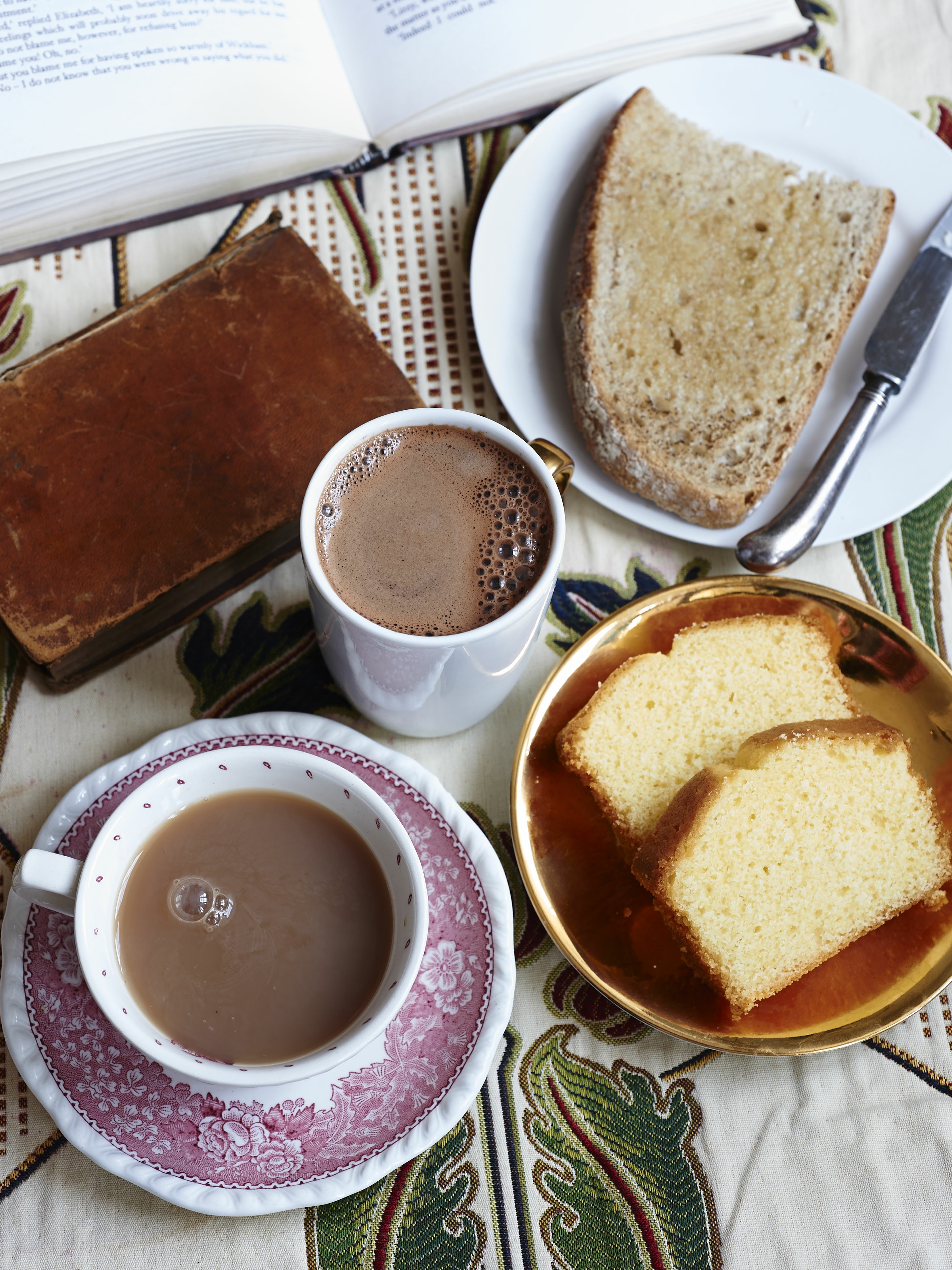
Someone else who was keen on a starchy start to the day was Jane Austen, with her breakfast of bread and cake accompanied by tea and cocoa.

image

Or perhaps you’d rather go for something a little more savoury, like Charles Darwin’s feast of game and eggs?

image

Whatever your tastebuds crave in the morning you’re bound to find something in this book to tickle your fancy. I’m certainly looking forward to trying out some of the recipes as an alternative to our breakfast staple of porridge and fruit.

But this is more than just a recipe book. It is a fantastic educational resource that could be used at home or in school not only to raise awareness of the importance of breakfast for children in Africa, but also to spark off conversations with young people about how they start their day. Perhaps by exploring the meals that their heroes enjoyed, teenagers might be encouraged to rediscover this essential meal for themselves – who knows, it might just be enough to release the potential of the people who will shape our future just its subjects have shaped our past.

You can find out more about the appeal and download your copy of the book at www.sendacow.org.uk/breakfast. Whilst the book is free, there is a suggested contribution of £2.50 to the appeal. The UK government are doubling all donations made until the end of June 2014, meaning that your £2.50 would provide enough to support an African child for a month. For £30, you could support a child for an entire year! Now that’s a lot of breakfasts…


image


Post Comment Love


Resisting the ‘inevitable’

Browsing through the education news this week, I came across this article. It reports on a study which seems to show that young people in the UK are being held back because their parents believe that their failure is inevitable – if they are not ‘born bright’, then no amount of hard work is going to change their futures.

This study has strong echoes of the beliefs of Dominic Cummings, a former special adviser to Gove who sparked outrage when he claimed that the fate of young people is determined by their genes, with neither them nor anyone else having the power to change that.

As a teacher, this notion certainly does not ring true for me – though there is no denying it permeates the attitudes of a good proportion of young people, parents and teachers alike. It was not uncommon to hear a year seven student declare they would never be any good at English for example, or a parent to respond to concerns about underachievement with the explanation that their child just wasn’t academic. Teachers too would sometimes fall into the trap of judging a new student by the prior performance of their siblings, or dismiss entire groups as unteachable. The practice of setting by ability, which in some schools begins when children are just five years old, is essentially dictating who will pass or fail – ask a pupil in a bottom set and they will rarely have much faith in their potential to succeed.

But for every young person who followed the seemingly inevitable path, leaving school at sixteen with minimal qualifications, there were others who were transformed by their time in education. The boy who at twelve was thrown out of most of his classes because of his inability to concentrate and went on to combine sixth form study with mentoring younger students who were struggling to focus. The girl who at fourteen believed she could aspire no further than vocational qualifications in childcare despite her dreams of university yet went on to complete the International Baccalaureate diploma and win a place on a degree course.

I am not saying here that academic success at school is the be all and end all – we all know stories of people who have broken the cycle of inevitability themselves, going on to build exciting careers in their adult lives despite the odds being stacked against them. But there is no denying that successfully jumping through the hoops of academic qualifications opens doors, giving people more choice over what to do with their lives rather than having their path dictated for them.

IMG_2277

As a parent, my interest in resisting the inevitable has been revived with new vigour. I want my son to be able to be whoever and whatever he wants to be, to be happy in his choices and not to be held back by other people’s beliefs about what he is capable of. I’m sure that is the dream of all new parents – looking at that helpless bundle of newborn joy in their arms and imagining a future which is boundless and free.

And yet before long something begins to change. A girl who does not seem to take much interest in books at the age of one is destined never to be a reader. A boy of three who runs around like a whirlwind is declared unlikely to ever really be able to focus – but it’s ok because he’s a boy and that’s what boys do. As children grow up even seemingly positive statements can begin to close doors – in my family my brothers and I were labelled encouragingly as ‘the sporty one’, ‘the creative one’, ‘the academic one’ and ‘the musical one’. Actually my youngest brother chose that label for himself, not wanting to compete with what he perceived as our territories. It has served him well, though the rest of us took many years to realise that maybe we could be more than just one thing, that in fact we were all creative, sporty, musical and academic in our own ways and the choices we made in our lives could reflect that.

Of course it’s almost impossible to resist labelling to some degree, but young people are so impressionable that I think it’s vital that anyone with a stake in their upbringing empowers them to believe that their future is not inevitable. The more I watch my baby finding his place in the world the more I believe that his potential is unlimited – and the more I hope he can hold on to that belief as he follows his dreams.

Thank you to Sara at ‘Mum Turned Mom’ for inspiring this post with her prompt: ‘It was inevitable…’

mumturnedmom