Tag Archives: parenting

Dear daddy

It’s so good to have you to myself again. I know you’ve been busy, making people’s ouchies better in the hospital. I know you’ve been working hard.

But I’ve missed you.

image

Life is so much more fun when you’re around.

I love going on adventures with you and mummy – I asked her where you were, every time, when we set out on our own. We had lots of good times together just the two of us, but it’s even better when you can come too.

Your shoulders are broader, and your hair doesn’t tickle so much.

I always got so excited when I saw your car pull into the drive: clamouring against the window, nose pressed to the glass as it misted up with my giggles. You would come right up and put your nose against mine and draw love in the cloud of our breath. When you disappeared again I would worry for a moment, but then I would hear your key in the lock and run as fast as I could for cuddles in the kitchen.

Thank you for always having time for me, even when you had been up since before dawn and had been ground down by mean consultants and endless traffic. Thank you for not even waiting to take off your coat before kneeling down to play train tracks, for finding the patience to do washing things before bed even when you would rather be having a glass of wine and collapsing on the sofa. Thank you for making me laugh and reading me stories until we both fell asleep in the chair.

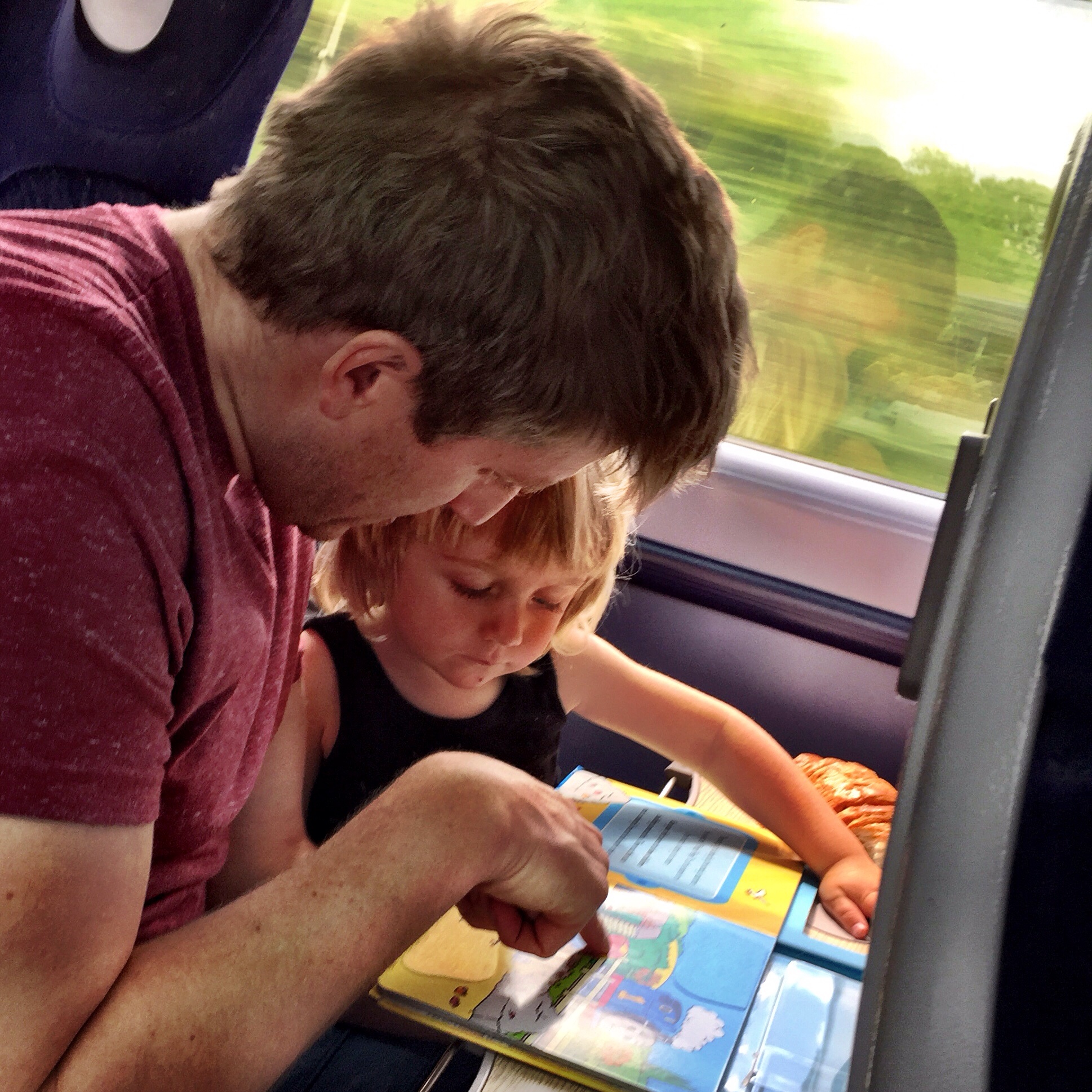
I love it when you read with me.

image

Thank you for the tickles and the Gruffalo cuddles and the prickle kisses.

Thank you for making mummy smile.

I know that sometimes I am hard work with my throwing and my hitting and my frustration at the world. But every time you listen to me it helps me begin to work it out, and every time you hold me it helps me remember how much I am loved.

I love you too, daddy.

Thank you for being.

Just need to stay focused…

image

I started this year with such grand plans. Not resolutions, exactly – I only really made one of those. But so many different things I wanted to do. I was raring to go, in fact – after two weeks of not doing anything particularly constructive over Christmas I couldn’t wait to start ticking some tasks off my mental to do list.

As well as my goals around my novel and blogging, I really need to find some time to get our increasingly messy house in order. And then there’s Arthur – as he gets older I’m starting to feel like I want to structure our days together a little bit more closely. He’s with me pretty much all the time, and whilst we do get out to a few excellent groups over the course of the week I want to ensure I’m giving him the opportunities for a whole range of different types of play, not just the ones that are easiest for me to facilitate. I’ve got lots of ideas for all of this – I know pretty much exactly what I want to do in fact, at least in my head.

But actually, in reality, it’s felt a bit like the universe has been conspiring against me getting very much done.

Arthur’s sleep is still all over the place since he’s moved out of his cot, and this has coincided with a particularly busy period for my husband (he has his finals at medical school this year, so the academic pressure is being ramped up alongside an increasingly challenging schedule of hospital shifts). I am, to put it plainly, knackered. And that does not do much for my productivity.

There also seems to be lots going on in Arthur’s ever-growing social life. I’d sort of forgotten that following him turning two at the end of December we would have a very busy few weeks of birthdays with NCT and baby group friends. This is all great fun of course – but does add in a whole other layer of things to organise!

I’ve found myself collapsing on the sofa after seemingly endless days barely able to recall what I’d managed to achieve since I’d got up that morning whilst listening to the whirr of things I still needed to do and wondering when my mind would ever be still enough to focus on them – let alone make a proper start on editing that novel…

And then it struck me. I didn’t need to keep all this stuff trapped inside my head. I needed in fact to write it down, to make some lists, to see it all there plain and simple so I could begin to tackle it. I needed to get a diary.

I’m not entirely sure why I stopped using a diary – a paper one at least. In the ten years I was teaching I would never go anywhere without my planner. Every thought and task relating to my professional life would be documented in there somewhere – and it was an important ritual at the beginning of each week to go through and get my goals clear in my head. I kept a separate diary for my personal tasks – a pocket moleskine one for years, with space for notes. This gradually transitioned onto my phone, and once I was on maternity leave that electronic method became the only one I used.

That seemed ok, for a while. Especially once Arthur arrived so much of what I had to do was so ‘in the moment’ that it seemed a waste of any precious spare seconds to write it down. Things have got increasingly complicated since those early days, but I’ve generally managed to muddle through, hanging the thoughts and tasks in my head onto our simple routines and frantically making the occasional list when it all got too much.

But I’ve realised that the time has come when I need more structure. There are so many balls I’m trying to juggle now that if I try to do it by the power of my mind alone then I’m going to start dropping them. So last weekend I ordered a diary. A moleskine, for old-time’s sake, but one which encapsulates what I loved about my teacher planner alongside the conventional day by day approach. It’s called a ‘professional taskmaster’ (even the name makes me feel more organised), and it’s pretty awesome.

When it arrived on Tuesday I sat down and filled in our plans for the week ahead, spread clearly over two A4 pages. Then on the next two, in the bullet pointed spaces for ‘actions and projects’, I decided on my non-negotiables for the week. There were quite a lot of them, but seeing them there in black and white made it all seem possible.

And as the week’s gone on I’ve been taking great pleasure in ticking off the things I have achieved. I’d forgotten quite how satisfying simple,everyday lists are. I’m still playing catch-up a little, and I’m still exhausted, but I’m getting there. I’m looking forward to reflecting back on my week on Sunday, celebrating what I’ve done and setting out what needs to happen next.

None of this is rocket science I realise, but they are things that somehow I had forgotten in all the changes I have lived through in the past couple of years. And I’m hoping, as I fall back into the routines left over from a very different life, they might just help me to keep the one I’m living now more focused.


mumturnedmom


Why it’s time for all of us to insist on gender equality

image

The notion of women or men being inherently better at some things rather than others purely because of their gender is not something that’s ever sat comfortably with me. The idea that men are more powerful, or women more nurturing; that men are better leaders whilst women are more compliant; that a man should be out earning money whilst a woman should focus on bringing up the babies.

When I was growing up, I was surrounded by boys most of the time. I have three (very different) brothers who were my constant childhood playmates, and during my teenage years I often found myself feeling intimidated by female company – the vast majority of my friends were male.

As I got older I became increasingly aware of the stereotypes concerning gender, both latent and overt, but I could never take them seriously because I knew too many people who didn’t fit them. I didn’t feel that there was anything I could not do just because I was a girl, and whilst I was aware of the history of the fight for women’s rights for me it had already achieved what it needed to. I heard the voices of feminists, but I did not understand why they were still complaining: surely women had the choice, now, of what they wanted to do with their lives? And besides, in every feminist argument I heard a message that I just could not tally with the reality of my life and the people in it: that it was men that were in fact inferior, and that it was only by hating them that women could promote their cause.

Fast-forward more than a decade later and I know I was wrong. Not just about the message underpinning feminism, but about how far from gender equality we as a society are.

The stereotypes I rejected in my youth are more pervasive than ever, with campaigns like Let Toys Be Toys highlighting the part the toy industry is playing in limiting children’s aspirations with products and marketing now that is more gender specific than it was in the 1970s.  I’ve watched as this gender bias has invaded my classroom: teenage girls playing down their intellect to fit the ideal of being beautiful and submissive or attacking each other in fits of bitchiness as they struggled to reconcile the roles they felt they were destined for with their ambitions; teenage boys playing the joker to avoid being seen to show an interest in studying or exploding in aggression because they couldn’t see any other avenue open to them to express their feelings. And these anecdotes of course barely scratch the surface of the injustices faced by women in our world today – and the damage that outdated and inaccurate notions of masculinity do to men.

Now that I have a child the challenges facing us in our quest for gender equality have become even more clear. I have watched friends, old and new, battling with the expectations society puts on them as parents – and the gulf that still exists in the expectations we have of women and men. Of course on one level the reason for this gulf is obvious: the physical impact that motherhood has on women, from pregnancy to childbirth to breastfeeding cannot be underestimated. But women do not become weaker when they bring a new life into the world: if anything they become more powerful, more capable. So why is it that their value diminishes? Is it because we put so little importance on growing our future generations that we still champion a model of work and careers that refuses to make significant concessions to the vital role parents play?

I have, on the surface at least, fallen into this trap myself. Unable to see a way of being the mother I want to be whilst remaining in teaching, I have left the career I dedicated myself to for over ten years to bring up my child. With every spare second that I have, I am attempting to forge a new career, something that will allow me to work more flexibly, to acknowledge my role as a parent rather than handing it over to someone else. I know that I’m in the minority in that I have a myriad of options: an education and career path to fall back on, the financial security to be able to take time out to try something new, a husband who wants to take an active role in parenting our son whenever he can.

But like many, many other women in the world – and men too, though they are less visible and less vocal – I can’t imagine a much more important job than raising a human being, than helping to build the next generation. One of the most vital aspects of this for me is to nurture a child who believes in equality, who does not feel constrained by his gender – nor expect undue privilege merely for the fact that he is a boy.

I only hope that he can grow up in a world where this might begin to be true. And this is why I believe the HeForShe movement is so important: why feminism needs to be embraced by everybody, not just the women who have historically fought its corner, and why we need to accept that men are held back by the myths and stereotypes that will continue to be perpetuated if we do not all insist on gender equality.

Emma Watson put this far better than me in her speech to the United Nations this weekend. She has inspired me to finally shake off any residual antagonism I might have felt towards the feminist movement, and to encourage the men I am lucky to count amongst my family and friends to stand up and do the same.


Linking up with Sara at Mum Turned Mom for The Prompt: Are women better parents than men? 

mumturnedmom

Word of the Week: Dada

Today the word that sums up the week that was is:

image

After the fantastic family wedding that drew us down to Cornwall, Leigh had to head home pretty promptly to keep up with his medical school commitments. Not having anything in particular to lure us back, Arthur and I stayed in Cadgwith with my parents.

From moments after Leigh drove away Arthur began to wonder where he was, and calls of ‘dada’ have punctuated the rest of our week. Whenever anyone came to the door Arthur’s eyes lit up, and the anticipation when anyone reached for the phone was almost too much to bear. It was dada who was on the other side of the door whenever Arthur heard the shower running, and dada who he cried out for in the middle of the night as I tried to hold him close.

There was a silver lining to all this: over the course of the week having only me as a familiar comforter Arthur has come to trust my parents more and more. From beach fun to sleepy stories it’s been lovely to watch them bond – and to watch Arthur realise that his safety net extends further than he perhaps initially thought.

image    image

image    image

Still, though, I think Arthur is going to be overjoyed to realise his dada still exists – and not just on Skype. And without a doubt I’m going to be very glad to have my co-parent back by my side.


The Reading Residence

The power of attachment

Before Arthur was born, I didn’t really have much of an idea about the kind of parent I wanted to be. I knew I wasn’t great at keeping to fixed routines, and my time as a teacher had taught me that nurturing young people generally works best when you take the cues from them. But it was one thing listening to teenagers communicate their needs and wants – how on earth was I supposed to do that with a tiny baby?

I knew I wanted to breastfeed, but I figured I’d want to express fairly regularly so that other people could feed the baby too and I could have a bit of freedom. It was losing my freedom, if I’m honest, that I was most nervous about. I was sure I’d want to make the most of my parents’ enthusiasm as new grandparents to get out for time alone with Leigh, to touch base with the me that I was before I became pregnant rather than letting this new little person take over everything.

We were given a pram by Leigh’s parents, having researched endlessly which one would be best for tackling the off-road paths and beaches near where we live. My mum helped me decorate the nursery, all decked out with the cot the baby would move into once he’d passed the six month stage and was ready to graduate to his own room. I knew there would be times when he would sleep with us, but I definitely didn’t want to encourage that on a regular basis.

And then when Arthur was born everything changed. He went from being an abstract baby to a real little human being – and I was surprised to find that I didn’t want to leave his side. I didn’t really get out of bed for the first two weeks after he was born. Partly because it was the middle of winter, and partly because it took all the focus and energy I could muster to overcome the problems we had getting breastfeeding established (you can read about that here). And during that time, when I wasn’t dozing, I read. I started by browsing internet forums looking for inspiration about how I was actually going to approach this business of parenting. I know people say that you should just trust your instincts, but I was terrified of getting it wrong – I did have an idea about how I wanted to do things, but it was so different to what I considered socially acceptable that I needed validation. And slowly I began to find it.

I realised that I identified with what people were calling attachment parenting – I’d never heard of it before, but keen to find out more I ordered several books – Dr Sears’ The Baby Book was great for day to day questions and concerns, but it was the work of Deborah Jackson that really inspired me. I read When Your Baby Cries and Three in a Bed, and as I journeyed with her through different times and cultures I realised that the status quo I had come to accept was far from the only option.

As Arthur and I began to face the world together, I began to put these ideas into practice. After nearly being put off by the first sling I tried I soon became a convert to babywearing – I wrote about the beginnings of that journey here. I found that I was so calm and focused when I was wearing my baby – I didn’t have to put him down alone to get things done, or worry about him as he napped elsewhere. Bizarrely by physically attaching Arthur to me I found I finally had the freedom to begin to live my life again, starting with beginning to write the novel that had been swimming around in my head for so long.

It was a long time before we asked my parents to babysit – they’ve still only done it a couple of times – because we decided we’d miss Arthur too much and would rather he just came with us. And so he did, to meals out, to parties, to gigs, to festivals. I was surprised again – though of course relieved – to find that Leigh shared my inclinations, and as a result the three of us have had so many fantastic adventures together.

IMG_7347

The thing that has most surprised both Leigh and I though has been I think our attitudes to sleep. The sixth month point came and went long ago and Arthur is still sleeping in our room. We’ve talked about it, and both agree that it’s going to be a little while before we’re ready to give up co-sleeping. Arthur loves being close to us, and there is something quite magical about sharing the moments just before he goes to sleep and when he has just woken up as well as the groundswell of love that I still feel when I watch his sleeping form in the middle of the night or he snuggles up to me for a feed.

I know that we’ve been lucky, that there are certain freedoms that we’ve had that have meant I have been able to let Arthur set the pace. I haven’t had to go back to my job as a teacher, and as I muddle through in my attempts to forge a new career at home I can adjust how and when and where I do things to suit his rhythms.

And bizarrely, with all this talk of attachment and the warnings I’ve ignored from well meaning advisors, Arthur’s actually becoming a very confident and easy going little boy. He rarely cries, and as much as I try to follow his cues whenever I can he is proving himself to be highly adaptable when he has to fall in step with me.

I am just so glad I took the time to explore the alternative approaches to parenting that were out there, to find a way to meet the needs of both my baby and myself. I’m glad too that I accepted the changes that becoming a parent wrought within me – however surprising they were at first. I suppose you’ll never know what sort of a parent you’ll be until you are one – I’m not for a second suggesting that the approach we’ve taken would work for everyone, but for the time being at least it definitely seems to be working for us.

Thank you to Sara at Mum Turned Mom for inspiring this post with her prompt of ‘surprise’.


mumturnedmom


Resisting the ‘inevitable’

Browsing through the education news this week, I came across this article. It reports on a study which seems to show that young people in the UK are being held back because their parents believe that their failure is inevitable – if they are not ‘born bright’, then no amount of hard work is going to change their futures.

This study has strong echoes of the beliefs of Dominic Cummings, a former special adviser to Gove who sparked outrage when he claimed that the fate of young people is determined by their genes, with neither them nor anyone else having the power to change that.

As a teacher, this notion certainly does not ring true for me – though there is no denying it permeates the attitudes of a good proportion of young people, parents and teachers alike. It was not uncommon to hear a year seven student declare they would never be any good at English for example, or a parent to respond to concerns about underachievement with the explanation that their child just wasn’t academic. Teachers too would sometimes fall into the trap of judging a new student by the prior performance of their siblings, or dismiss entire groups as unteachable. The practice of setting by ability, which in some schools begins when children are just five years old, is essentially dictating who will pass or fail – ask a pupil in a bottom set and they will rarely have much faith in their potential to succeed.

But for every young person who followed the seemingly inevitable path, leaving school at sixteen with minimal qualifications, there were others who were transformed by their time in education. The boy who at twelve was thrown out of most of his classes because of his inability to concentrate and went on to combine sixth form study with mentoring younger students who were struggling to focus. The girl who at fourteen believed she could aspire no further than vocational qualifications in childcare despite her dreams of university yet went on to complete the International Baccalaureate diploma and win a place on a degree course.

I am not saying here that academic success at school is the be all and end all – we all know stories of people who have broken the cycle of inevitability themselves, going on to build exciting careers in their adult lives despite the odds being stacked against them. But there is no denying that successfully jumping through the hoops of academic qualifications opens doors, giving people more choice over what to do with their lives rather than having their path dictated for them.

IMG_2277

As a parent, my interest in resisting the inevitable has been revived with new vigour. I want my son to be able to be whoever and whatever he wants to be, to be happy in his choices and not to be held back by other people’s beliefs about what he is capable of. I’m sure that is the dream of all new parents – looking at that helpless bundle of newborn joy in their arms and imagining a future which is boundless and free.

And yet before long something begins to change. A girl who does not seem to take much interest in books at the age of one is destined never to be a reader. A boy of three who runs around like a whirlwind is declared unlikely to ever really be able to focus – but it’s ok because he’s a boy and that’s what boys do. As children grow up even seemingly positive statements can begin to close doors – in my family my brothers and I were labelled encouragingly as ‘the sporty one’, ‘the creative one’, ‘the academic one’ and ‘the musical one’. Actually my youngest brother chose that label for himself, not wanting to compete with what he perceived as our territories. It has served him well, though the rest of us took many years to realise that maybe we could be more than just one thing, that in fact we were all creative, sporty, musical and academic in our own ways and the choices we made in our lives could reflect that.

Of course it’s almost impossible to resist labelling to some degree, but young people are so impressionable that I think it’s vital that anyone with a stake in their upbringing empowers them to believe that their future is not inevitable. The more I watch my baby finding his place in the world the more I believe that his potential is unlimited – and the more I hope he can hold on to that belief as he follows his dreams.

Thank you to Sara at ‘Mum Turned Mom’ for inspiring this post with her prompt: ‘It was inevitable…’

mumturnedmom


Word of the Week: Relief

Today the word that sums up the week that was is:

relief

Arthur had his final vaccinations in the seemingly never-ending first year cycle this week. Every time he’s had a jab, right from those very first ones when he was eight weeks old, he’s reacted badly. Not the extreme but very rare allergic reactions you read about thank goodness, but still enough to make all of our lives miserable in the aftermath.

miserable

These latest jabs seem to have had a particularly lengthy impact. He had his MMR at the beginning of January: after I voiced my concerns to the nurse about the reactions he’d had previously she suggested that I might like to ask for these ones to be split up, delaying the boosters until his system had a chance to recover from the live MMR vaccine.

I gratefully followed her advice – one of my main concerns has been about the effect of the combination of vaccines on his system  – and I’m glad I did. About a week after the MMR vaccine he developed a cold, which turned into croup (terrifying) for which he was prescribed a course of steroids, after which he developed vomiting and diarrhoea which resulted in him losing almost a kilo in weight. He had an on and off fever for about a month, and a niggling cough which still hasn’t quite gone away – and which has regularly made him retch and vomit over the past six weeks. On the basis that he had no actual fever we went back for the booster jabs this Monday (we’d already delayed them again once), and he then had 48 hours of feeling rotten with new cold symptoms and a fever. Through all of this he wouldn’t accept calpol – the smallest amount makes him vomit, something which is possibly our fault for trying to avoid it entirely in the early months – and was almost permanently attached to the boob.

I would still rather have all of these side effects than the potentially devastating effects of the illnesses he’s been vaccinated against – I am not for one second suggesting that I’d rather we’d skipped the vaccines. But I still can’t help feeling guilty for putting him through all of this – especially as with the most recent jabs he was fully aware of what was going on, pulling against me as we went into the nurses office.

I wish as well that I felt more able to speak openly about vaccination side effects without feeling like I’m promoting the anti-vaccination camp. Neither the nurse nor the doctor I saw whilst Arthur was suffering would really engage in conversation about his symptoms having anything to do with the jabs, even though the only times he’s been ill in his fourteen months have mysteriously coincided with vaccinations. I understand that they need to promote the vaccination programme, especially in the light of all of the damage done by Andrew Wakefield’s unfounded claims about the MMR vaccine. However I’m not sure a ‘one size fits all’ approach is appropriate – and as someone committed to vaccinating my child, I just wish I could have an intelligent conversation with a healthcare professional about my concerns.

Anyway. I’m not going to turn this into a rant. The whole vaccination trauma is over for us – at least for another couple of years – and what I’m left with now that Arthur seems to have recovered is an overwhelming sense of relief.

And on the plus side, this week’s feverish insomnia did bring with it some very cute middle of the night storytelling sessions. I’m strangely relieved to see that breastfeeding and books rather than calpol seem to be my baby’s medicine of choice!

fever stories

The Reading Residence

Reasons to be cheerful

So we’re starting the week in rather more of a tired and grumpy place than I’d like: Arthur-bear is still not well after a croup attack two weeks ago. He has a nasty cold which just won’t relinquish its grip on him – rivers of snot, a hacking cough, d & v, an infected tear duct – and if that wasn’t enough I’m pretty sure his molars are coming through too! The doctor’s confirmed it’s nothing serious, but it’s enough that no-one’s really sleeping much and I’m getting worried that he’s forgotten what it’s like to not feel a bit rubbish all of the time.

Fortunately we have something special in our anti-grumpiness arsenal since I brushed up my video editing skills in December: a 20 minute film celebrating Arthur’s first year which is so full of gorgeousness that none of us can watch it without feeling considerably better about the world. Arthur giggles and chats and points at himself whilst Leigh and I have a little cry about how much our baby has grown and we all end up with a warm and fuzzy glow and lots of reminders of why we should be smiling, however tough things might seem right now.

And whilst I’m not about to suggest you watch the whole film, there’s a little clip of Arthur attempting to drink from a sippy cup (before discovering that there are way more exciting things to do with the water than drink it) that I find curiously life-affirming.

Incidentally, if anyone’s got any tips about how to get Arthur to actually drink from a cup rather than conducting physics experiments with it then I’d be eternally grateful! Apart from of course to not encourage him by taking videos of his exploits and posting them on the internet…

spread a little happiness

Powered by Linky Tools

Click here to enter your link and view this Linky Tools list…


Holiday time

Last week, driven by the bleakness of January weather and the fog of sleep deprivation brought on by an attack of croup, we booked a week in Cyprus over Easter. We had to suck it up and book during the school holidays in order to fit in with Leigh’s term times. Not ideal, but I’m used to it.

You may have noticed that the issue of school holidays has been in the news a lot recently. More specifically, the issue of whether or not it’s reasonable for parents to take their children out of school for holidays in term time. The Sutherlands would argue that it absolutely is, and they have growing support from another one of those petitions that seem to be dominating popular involvement in politics nowadays.

There’s a part of me (the future parent of a school age child part of me) that has a lot of sympathy with them. Why shouldn’t I be able to take my son out of school for a couple of weeks if I so choose? He’s my son after all. And as a parent I know I’m going to provide all sorts of exciting learning experiences beyond the confines of the classroom – family holidays being a perfect springboard for these either by design or by happy accident. Holidays outside of term time are expensive (believe me, after ten years of teaching, I know), and who knows whether my future doctor husband will be able to take his leave when it suits the school anyway? Having had those ten years of being constrained by the school timetable – and particularly with Gove’s plans to cut holiday time for teachers and young people – I’m really not looking forward to the inflexibility of my son’s schooling dictating the experiences we can have as a family.

But then the pondering begins. Ignoring uncharitable thoughts about other parents not necessarily prioritising educational experiences when planning a holiday, I simply cannot let go of how important it is for schools and young people that we don’t sanction a free for all in families taking a holiday whenever it suits.

Thinking that two weeks out of the classroom won’t really have an impact on a child’s education essentially shows a total lack of understanding of what goes on in schools these days. Project work, inquiry based learning, development of thinking skills – hardly the sort of stuff that can be covered by a few hastily photocopied worksheets even if they ever were to make their way out of the bottom of the suitcase. Teachers spend hours planning schemes of work that will take their charges on a learning journey. Ten days of holiday is fifty hours of that journey spread across many different subjects – an awful lot to catch up on, and I’d argue pretty much impossible for even the most diligent of learners.

I’m not saying that fifty hours of learning in school is worth more than the two weeks of family time. In fact I’d agree that two weeks spent in Rome, say, with the right experiences offered and the right questions asked, could be infinitely more valuable in isolation. But the thing is that’s not really the point. Once you’ve decided to buy into the state education system, to take what a school has to offer and to trust them to educate your child, you kinda have to follow their rules.

Attendance is a key factor by which schools are judged – and rightly so when you consider the impact attendance has on young people’s achievement. I won’t go into the figures here, but they’re pretty stark. Schools and teachers are held to account for how well young people do in schools on a whole variety of measures, but they simply cannot do their job if pupils aren’t there.

And pupils do miss out too – whether it’s not being there to help their group complete a project, not getting to give a presentation they’ve been working towards for weeks, or just having less time to spend on a topic they’ve developed an interest in. I find it bizarre that parents can believe that nothing of value is missed in two whole weeks of lesson time. Doesn’t say much about their faith in the school – why bother to send their kids there at all?

Rather than expecting young people to cope with the disruption to their school experience, and teachers to juggle the knock on effects of pupils randomly missing a week or two here and there, I think we, as a society, have to look at the reasons why parents are looking beyond the thirteen weeks of school holiday time already provided. It’s pretty outrageous that those involved in the holiday industry think it’s ok to hike their prices up at the only time when families are able to travel. And it’s pretty unreasonable for employers not to demonstrate flexibility to enable their workers to spend time with their children. After all, it’s those children who are going to grow up to be the work force of the future, so they need their education!

Back to where I stand on this personally, as a parent, and one who loves travelling at that. To be honest, for a multitude of reasons I’m starting to think I might home school Arthur, for the first few years at least. I won’t go into the whys and wherefores right now – that’s the subject for another post. But if or when he joins a local school I hope it will be with my full support for the teachers and what they are striving to achieve. To expect a flexible two week window of your choice where you can remove your child from the school community – not just once, but every year of their education – is I think to miss the point of choosing to be part of that community in the first place. It’s just a shame that the wider society can’t put its money where its mouth is and demonstrate its support for education by removing the barriers that are driving parents to take such drastic measures in pursuit of a holiday they can enjoy with their family.

Adventures in train travel

photo(3)

One of the flip sides of escaping to live on the South Coast is that keeping in touch with friends and family involves a lot more travel. People come to see us too of course – and there’s something very special about getting to spend a whole weekend catching up with a backdrop of sea air and glorious views – but we need to do our bit too. So at least one weekend a month we seem to find ourselves juggling baby and travel cot and way too much luggage to head up to the big smoke.

We made sure we got Arthur in ‘train’ing early – when he was three months old we took a trip to Paris on the Eurostar, and over last summer we adventured further afield to visit friends and family in the US and Canada, travelling by rail from New York to Halifax via Toronto. All that was before he started crawling though, something which definitely adds another dimension to babies and trains.

I’d still way rather do a long journey by train than in the car. Quite aside from the slightly embarrassing fact that I have yet to learn to drive so Leigh has to be permanently on duty I like the fact that on the train we can move around and do cuddles: Arthur’s isolation in a car seat threshold is about two hours, and then he’s only really happy if he’s asleep.

Several hours sat mainly in one place definitely calls for a growing arsenal of equipment though, and that is the subject of this post. In no particular order, these are the things that no Arthur train journey can be without.

*Disclaimer: none of this is rocket science. It has, however, taken my baby-addled brain a good few months to work it all out, and I’d like to believe I’m not the only one who might benefit from a bit of stating the obvious from time to time.*

1) A Baby Carrier
Ok, so I lied when I said this was in no particular order. The rest might be, but anyone who knows me knows that a baby carrier is my number one piece of baby kit for pretty much any situation. On a train journey, it means no wrestling with a pram on top of all the other luggage; somewhere for the baby to sleep so that you don’t need to hold them and can have your hands free for other things (writing blog posts for example) or in fact catch up on some sleep yourself; and finally something to support them as you wander up and down the carriages to keep them entertained or sing and dance in the vestibule when things really get bad, all the while being able to hold on to the grab rails to stop yourself from going flying. My favourite baby carrier has to be the Connecta. Comfy enough to wear for long periods of time, yet small enough to throw into the change bag or easily slip on under a jacket. And gorgeous fabrics too, which is always nice.

2) An Upgrade
Now this is clearly a luxury rather than a necessity, but an upgrade to first class makes journeys with a baby so much smoother. We only do it on the weekends, when for our route from Totnes to London it costs £20, and offset it by booking as far in advance as we can for the cheapest ticket. When you bear in mind that the baby is otherwise travelling for free, and that the upgrade almost always guarantees you a couple of extra seats and a table, it really starts to make sense.
(For non-parent-first-class travellers reading this in uproar about a potential influx of babies to your sanctuary, we tend to choose the carriage with the fewest reservations, and never the quiet carriage so you can always escape there if you need to).

3) Food
Since Arthur’s been eating solids, food has always been a great way to pass the time. Not so useful at home when you want to have a quick snack before heading out the door but pretty handy when you’ve got a couple of hours to kill. The key thing to remember here is nothing too messy, something I learnt the hard way after a particularly spectacular houmous explosion at a motorway service station on one of our rare car journeys. I say learnt, but I still found myself mashing banana on rice cakes for an in-transit breakfast on the way to London last weekend before taking one look at them and eating them myself. But dry rice cakes, hard cheese, fruit and veg sticks, raisins – all these things make for pretty good snacks and pass a bit of time in the process.

4) Boobs
I might be cheating a bit with this one, as I know I’m very much in the minority to still be breastfeeding Arthur now he’s past a year, but a major reason for keeping going (there are lots, but that’s a different post) is how much easier it makes things on the move. If all else fails, stick him on the boob. He’s happy, and with any luck he’ll take the opportunity to have a nap.

5) Toys
Now this definitely falls into the stating the obvious territory, but it’s more the choice of toys that I feel is worth mentioning. Before I was a parent I always winced slightly when I saw children being kept ‘quiet’ by some device that was actually making more noise than they could’ve done if they tried. I may change my mind on this as Arthur gets older, but for now I’m definitely in the camp of not becoming massively anti-social in the pursuit of keeping my child entertained. See point 6 for reasons why this can definitely work to your advantage…
There are a few things that we’ve found particularly useful in keeping the journey fun for a wriggly baby:
– Small soft toys are great – initially I used to make them sing and dance for Arthur, and recently he’s started making them do that himself. His current favourite is a fox, but anything small enough to carry easily will do.
– Those toys with suction cups for sticking onto highchairs are also pretty handy. I bought this one to keep Arthur entertained on the flight to New York, and he’s still fascinated by it.
– And of course books – for reading, and in their board book format great for chewing, or stacking, or wearing. The potential’s endless.
I always have to remind myself to resist the temptation to get everything out the minute Arthur starts to get restless. One thing at a time, and then repeat until you arrive at your destination…

6) Other People
It can’t be denied that one or more travelling companions (besides the baby) is a pretty helpful addition to the journey. But if you play your cards right then other passengers can quickly become your best friends! I’m always extremely self-conscious about getting on a train with Arthur, inventing an internal monologue for everyone sat nearby which is chastising us for daring to leave the house with our baby, let alone bring him into the train carriage where they have to sit for the next few hours. It always gives me flashbacks of getting on packed tube trains for school trips, ready to defend the perfectly affable teenagers in my charge from accusations of loutishness levelled at them purely because of their age… But I digress.
When travelling on trains with Arthur, I have generally found him to be extremely good at making friends if I let him. On more than one occassion people who have raised their eyebrows when they first see us are proclaiming what a lovely baby he is by the end of the journey. And if people really don’t want to travel with a baby – well, they can always move to another carriage. Their loss I say.

With all of these things to support us, I have to say that travelling with Arthur is almost always a delight. Watching his excitement as the train begins to move, looking out of the window with him and pointing out all the things we see along the way, feeling him lean into me when we arrive at our destination and he gazes around taking in his new surroundings. It is these things and more that make me love travelling in general – not just to see friends and family, but to see the world – and I can’t wait for all the future adventures we have in store with our baby.

 

Mums' Days